• Quote of the Day: How Dare You Compare Horses to Cows


    From the LA Times:

    A number of horse owners at Thursday’s meeting took exception to comparing cows to horses and demanded a new study.

    This is part of the endless soap opera of California’s bullet train. Everyone thinks the train is a great idea as long as it comes nowhere near where they happen to live. Rich communities in the north have already filed environmental lawsuits. Poor communities in the south have demanded that the train tunnel through their neighborhoods. Others want the route changed to protect endangered species in the Angeles National Forest. And equestrians worry that the sound of the train will spook their horses. As the quote above suggests, they were not impressed by European studies suggesting that cows get accustomed to the noise.

    And this is all in addition to the endless stream of lawsuits emanating from farmers in the Central Valley who don’t want the train to bisect their property. And from residents of Bakersfield who don’t want the train anywhere near them.

    Labor unions, on the other hand, “praised the new plan, saying the project would create badly needed jobs.”

  • Note to Trump Foes: Not Too Much Coordination, Please


    From the Wall Street Journal:

    Pro-Democratic groups are launching an orchestrated bid to weaken GOP presidential front-runner Donald Trump ahead of a potential November showdown with Hillary Clinton, while her campaign readies a strategy of engaging the billionaire businessman on issues without trading insults.

    A coalition of 22 liberal groups—including some that have endorsed Mrs. Clinton and others that back her Democratic rival, Sen. Bernie Sanders—have united behind a campaign to stop Mr. Trump.

    Among their plans: anti-Trump demonstrations, possibly including protests at the Republican National Convention this summer in Cleveland, and marches in major cities.

    If I can play amateur strategist for a minute, I hope these groups aren’t coordinating too much. It’s nice to see everyone taking the Trump threat seriously, but my sense is that big, coordinated campaigns don’t work very well. They end up adopting strategies that everyone in the group can agree to, and those tend to be a little bland in a lowest-common-denominator sense. For the most part it’s best for everyone to do their own thing. Some of those things will work, some won’t. But at least you don’t have all your eggs in one basket.

  • Congress Proves Yet Again They’re Worse Than Useless

    Another day, another congressional hearing. Today it was all about the water in Flint, which produced “often-furious questioning” aimed at EPA chief Gina McCarthy and Michigan governor Rick Snyder:

    The long-anticipated hearing provided the highest-level jousting yet over a public health disaster that has revealed another partisan divide on Capitol Hill and the campaign trail.

    Democratic presidential candidates Bernie Sanders and Hillary Clinton have called on Snyder to resign, which some committee Democrats also urged Thursday. But Chairman Jason Chaffetz (R-Utah), a longtime critic of the EPA, joined other Republicans in targeting the federal agency during officials’ testimony in the two hearings this week.

    Have you ever watched one of these self-righteous displays of mock fury? Of course you have. Did you ever learn anything from them? Of course not. They’re the American version of old-time Soviet show trials, with the victims expected to sit stoically while members of Congress take turns competing to see who can berate them most theatrically for the TV cameras.

    But if they want something to be really outraged about, here’s a list of cities, counties, and entire states that have a higher percentage of kids with lead poisoning than Flint ever did after they switched their water supply. These are not crisis levels, either. These are normal, everyday, forever levels:

    • Allentown, PA: 23.11%
    • Atlantic City, NJ: 10.2%
    • Baltimore, MD: 6.7%
    • Cleveland, OH: 13.67%
    • Detroit, MI: 8.0%
    • Erie County, NY: 14.0%
    • Grand Rapids, MI: 9.2%
    • Illinois: 5.97%
    • Louisiana: 4.95%
    • Milwaukee County, WI: 10.7%
    • New Hampshire: 6.24%
    • New York (outside NYC): 6.67%
    • Ohio: 5.99%
    • Philadelphia, PA: 10.19%
    • Pittsburgh, PA: 8.32%
    • Richland County, WI: 12.4%
    • Salem County, NJ: 8.9%
    • Toledo, OH: 5.28%
    • West Virginia: 5.28%
    • Wisconsin: 5.57%

    This is by no means a complete list. I just got tired of typing. And if no place in your state shows up, don’t be too quick to feel smug. Most likely it’s just because your state doesn’t bother to do rigorous testing.

    When Gina McCarthy had the gall to explain that EPA has to follow the laws that Congress writes, Jason Chaffetz hammed it up predictably. “You failed!” he screamed at her. Of course, that’s the US Congress she was talking about, the body Chaffetz and the rest of the panel work for. If they actually give a damn about lead poisoning, maybe they should think of doing something about it instead of preening for CSPAN. They’re not in medically induced comas, after all.

  • A Few Wee Questions


    I’m a little confused:

    • I understand why Donald Trump pulled out of today’s scheduled debate. He figures there’s nothing in it for him. But why did John Kasich pull out? Does he figure he’s so well known by now that he no longer needs free publicity?
    • Why can’t Donald Trump find any foreign policy advisors? Sure, as best we can tell his foreign policy is juvenile and erratic, which probably puts off most competent foreign policy hands. But what about the less competent ones? Or the ambitious little gits who just want to hook up with a winner? Why can’t he lure any of those folks into his tent?
    • Why doesn’t Merrick Garland figure out a way to quietly leak the notion that he’s opposed to abortion and thinks Roe v. Wade is bad law? He has no track record on abortion, so it would seem perfectly plausible. That would really put Republicans in a tough spot, wouldn’t it?

    That’s all for now.

  • Quote of the Day: The Middle Class Doesn’t Care If We Cut Taxes on the Rich


    From House Speaker Paul Ryan, talking about his view of tax reform:

    I do not like the idea of buying into these distributional tables.

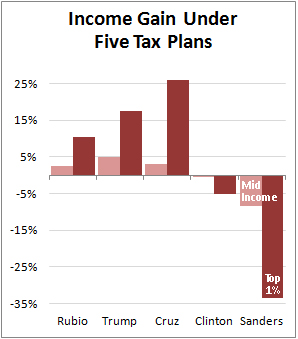
    “These distributional tables” are the ones that show Republican tax plans giving enormous cuts to the wealthy and nothing much at all to the middle class. Ryan calls them ridiculous because once you account for the economic boom of Republican tax cuts for the rich, everyone is going to be rolling in dough. Besides which, Ryan insists, “I think most people don’t think, ‘John’s success comes at my expense.'” Bottom line: distributional tables are for losers. “Bernie Sanders talks about that stuff. That’s not who we are.”

    On a more amusing note, Ryan says he’s not looking at how to fund a border wall. “Remember, we’re not going to pay for that, recall?” So true.

  • Trump Voters Are Not Angry About the Economy. Really.


    I’ve been periodically making the case that Americans aren’t really all that angry about the economy, which naturally implies that the economy isn’t the reason for Donald Trump’s success. This argument has taken several forms. First, in objective terms, the economy is in decent shape. Second, the number of people affected by globalization (lost jobs, reduced wages) isn’t that large in absolute terms. Third, polls indicate that concern about the economy isn’t especially high by historical standards. And fourth, polls also indicate that overall personal financial comfort is fairly strong.

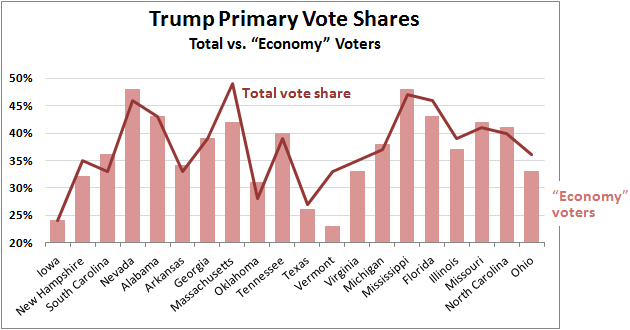
    Over at National Review, Scott Winship makes yet another argument: exit polls don’t suggest that Trump is winning an outsize share of voters who say the economy is their #1 issue:

    Trump performed no better in states where the economy was the biggest issue than in other states….His average margin of victory was 7.8 points in states where the economy ranked second but just 6.9 points in states where the economy was the top issue….Trump also did worse among voters for whom the economy was a top issue than among other voters. He won voters who chose the economy as their top issue in 10 of 15 states, worse than his showing among voters over all, which he carried in 12 of 15.

    Interesting! But there’s another way of looking at this: How did Trump do among “economy” voters compared to his overall performance in each state? If economic anxiety is really driving Trump’s ascent, you’d expect these voters to support him in large numbers. Here’s how that turned out:

    Trump actually does slightly worse with voters who are concerned with the economy than he does overall. This is yet more evidence that economic anxiety just isn’t a big factor driving Trump’s success. The bigger factor, by far, is immigration, and Winship argues persuasively that this is not primarily an economic concern. It’s a cultural concern:

    For many, it is about national security, as reflected in the draconian suggestion that Muslims be barred from coming to the United States. For others, immigration is simply about the rule of law….For a non-negligible subset of Trump voters, anti-immigration sentiment is about racism and nativism, plain and simple. Many more are uneasy about rapid cultural change….People value ways of life for understandable reasons; when their permanence is thrown in question, it is reasonable for them to be anxious about change.

    The rest of Winship’s piece is an argument about cultural traditionalists vs. “cultural cosmopolitans,” and your mileage may vary. I don’t really buy it, myself: culture-war issues have been front and center for a long time, and it’s not clear to me that cultural anxieties among conservatives are any more pronounced this year than in the past.

    Generally speaking, I don’t think any of the issues that pundits talk about are any more pronounced this year than in any other. People aren’t more angry, or more bigoted, or more scared than usual. It’s just that we didn’t have a guy like Trump fanning these flames quite so crudely in past elections. This year we do.

  • Obama’s Foreign Policy Explained: “Multilateralism Regulates Hubris”


    Here’s one last excerpt from Jeffrey Goldberg’s essay on President Obama’s foreign policy worldview. Today’s subject is free riders:

    If Obama ever questioned whether America really is the world’s one indispensable nation, he no longer does so. But he is the rare president who seems at times to resent indispensability, rather than embrace it. “Free riders aggravate me,” he told me. Recently, Obama warned that Great Britain would no longer be able to claim a “special relationship” with the United States if it did not commit to spending at least 2 percent of its GDP on defense. “You have to pay your fair share,” Obama told David Cameron, who subsequently met the 2 percent threshold.

    Part of his mission as president, Obama explained, is to spur other countries to take action for themselves, rather than wait for the U.S. to lead….“We don’t have to always be the ones who are up front,” he told me. “Sometimes we’re going to get what we want precisely because we are sharing in the agenda.”

    ….The president also seems to believe that sharing leadership with other countries is a way to check America’s more unruly impulses. “One of the reasons I am so focused on taking action multilaterally where our direct interests are not at stake is that multilateralism regulates hubris,” he explained. He consistently invokes what he understands to be America’s past failures overseas as a means of checking American self-righteousness. “We have history,” he said. “We have history in Iran, we have history in Indonesia and Central America. So we have to be mindful of our history when we start talking about intervening, and understand the source of other people’s suspicions.”

    ….Why, given what seems to be the president’s natural reticence toward getting militarily ensnarled where American national security is not directly at stake, did he accept the recommendation of his more activist advisers to intervene [in Libya]?

    “The social order in Libya has broken down,” Obama said, explaining his thinking at the time….“At that point, you’ve got Europe and a number of Gulf countries who despise Qaddafi, or are concerned on a humanitarian basis, who are calling for action. But what has been a habit over the last several decades in these circumstances is people pushing us to act but then showing an unwillingness to put any skin in the game.

    “Free riders?,” I interjected.

    “Free riders,” he said, and continued. “So what I said at that point was, we should act as part of an international coalition. But because this is not at the core of our interests, we need to get a UN mandate; we need Europeans and Gulf countries to be actively involved in the coalition; we will apply the military capabilities that are unique to us, but we expect others to carry their weight.”

    The interesting part of this is not just that I agree with it—though that’s interesting to me!—but the fact that it confirms what both Obama’s admirers and his detractors think of him. Admirers appreciate the fact that he understands America’s limits and is focused on committing American power only when our national interests are powerfully at stake. Detractors will take one look at “Multilateralism regulates hubris” and fall off their chairs. It’s strong evidence that Obama really does believe that America is something of a bull in a china shop and needs to allow itself to be reined in by others.

    “Multilateralism regulates hubris” might be the ultimate Rorschach test of Obama’s foreign policy. Given our recent (and not-so-recent) history, it seems to me like a no-brainer. America really does make better decisions when it listens to its allies. To Obama’s critics, it’s an admission that he really is trying very deliberately to diminish American freedom of action and military superiority. As Marco Rubio kept saying, he knows exactly what he’s doing.

  • Health Update


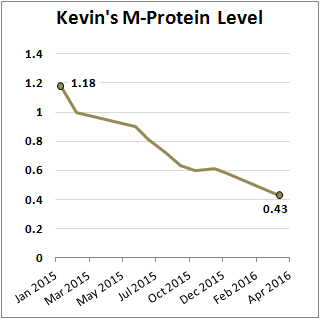
    Not much to report this month. My M-protein level—a proxy for the level of cancerous plasma cells in my bone marrow—is down from 0.48 in February to 0.43 in March. That’s not a big drop, but it’s a drop, and anything moving in the right direction is good news. Apparently the evil dex is reluctantly doing its job.

    FWIW, there are other markers besides M-protein that I haven’t been sharing because they’re all basically OK and haven’t changed much. For example, we routinely measure something call Kappa light chains, and it’s been at a nice low level ever since the first round of chemotherapy. Ditto for my IgG immunoglobulin levels. (There are three types of immunoglobulins corresponding to three different types of multiple myeloma. I have the G version.) This is all good news. If we can just get the basic level of cancerous cells down close to zero, I’ll be in pretty good shape. In fact, it’s even possible that the slow response of the M-protein level is a positive thing, since it would be expected if I have a very slow-moving version of multiple myeloma. That’s just speculation at this point since there’s no way of knowing, but it fits the evidence so far.

  • When Factories Shut Down, Why Don’t Workers Move?


    What’s been the impact of Chinese manufacturing on US employment? A recent paper by David Autor, David Dorn, and Gordon Hanson adds it up like this:

    Had import penetration from China not grown after 1999, there would have been 560 thousand fewer manufacturing jobs lost through the year 2011….Direct plus the indirect input-output measure of exposure increases estimates of trade-induced job losses for 1999 to 2011 to 985 thousand workers in manufacturing, and to 2.0 million workers in the entire economy….Net impact of aggregate demand and reallocation effects imply that import growth from China between 1999 and 2011 led to an employment reduction of 2.4 million workers.

    This amounts to direct effects of about half a million jobs, and total effects of 1 million manufacturing jobs and 2.4 million total jobs since 1999—a little less than 2 percent of all US jobs. This is a substantial number, but keep in mind that it was the result of a truly unprecedented explosion of Chinese activity: their share of global manufacturing activity skyrocketed from 5 percent to 25 percent in only 20 years. In the past half-century, no other change in bilateral trade has been even a fraction as significant.

    The authors suggest that there were two main causes of China’s manufacturing success. The first, of course, is that China had a large pool of low-cost workers. The second was the accession of China to the WTO in 2001, which had forced the Chinese government over the previous decade to enact changes that made their economy considerably more efficient. So “free trade” gets the blame in one sense, but not in the sense of a direct deal between the US and China. Basically, China had to adapt to the modern global trade regime, and this compelled a wide range of economic reforms that were, in the end, good for them.

    But there’s more to the story. The US labor market adjusted poorly to this competitive sea change, primarily for two reasons. The first was our decision to accommodate the Chinese manufacturing boom not with increased exports in other sectors, but with a growing trade deficit. The second was the apparent unwillingness of US workers to move when they lost their jobs:
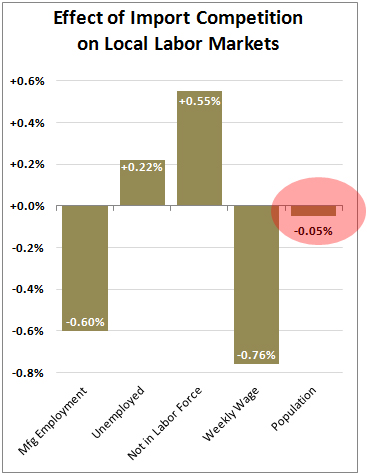
    Contrary to the canonical understanding of U.S. lab or markets as fluid and flexible, trade-induced manufacturing declines in [commuting zones] are not, over the course of a decade, largely offset by sectoral reallocation or labor mobility. Instead, overall CZ employment-to-population rates fall at least one-for-one with the decline in manufacturing employment, and generally by slightly more.

    The chart on the right tells the story. The effects of import competition are frequently local rather than national, and on average produce lower manufacturing employment and lower wages, along with higher unemployment. But out-migration from affected areas is nearly zero. Workers who are affected by an import shock stay where they are instead of moving to greener pastures.

    Why? It’s hard to know how to allocate blame here. On the one hand, you have the big macroeconomic effect of a growing trade deficit, which is outside the control of individual workers. On the other hand, you have an unwillingness to move when the local economy tanks, which is very much within the control of individual workers. Taken together, it’s almost a conspiracy to give up. At a national level, we shrug and simply accept a trade deficit. At an individual level, we shrug and accept that no jobs are available anywhere.

    It’s mostly a moot point now. The huge Chinese growth boom is largely over, and it’s unlikely anything similar is going to come along soon. New trade deals—regardless of whether you like them or hate them—simply don’t have a very big impact on anything. Their effects can be measured in tenths of a percentage point 20 years down the road. Still, it’s hard not to wonder why we collectively decided to do next to nothing to respond to the Chinese boom during the 90s and aughts.


  • Quote of the Day: “You Have to Admit That It Worked”

    Here is Ben Carson defending his endorsement of Donald Trump:

    Q: If someone like Mr. Trump can call you, an acclaimed and noted neurosurgeon, as someone who lacks intellect or is a child molester, doesn’t that alarm you as to how he can portray other people in this country as well, and use the same rhetoric?

    A: Well, you know, he said it was political, he was concerned about the fact that he couldn’t shake me. Look, I understand politics, particularly the politics of personal destruction. And you have to admit to some degree, that it did work. A lot of people believed him.

    First Christie, now Carson. What does Trump have on these people?