• Here’s the Latest on Flint’s Water


    How is Flint doing these days? Here’s the most recent report from Michigan’s Department of Health and Human Services:
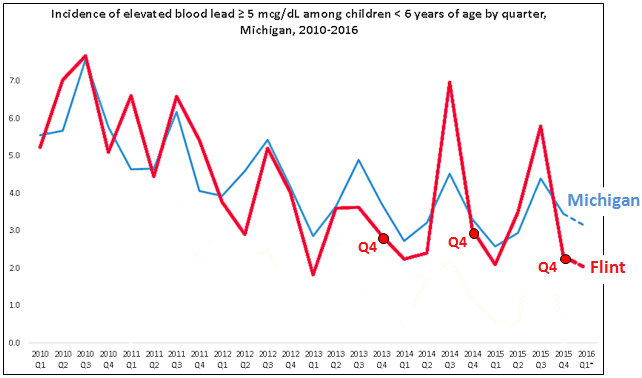
    Blood lead levels tend to be seasonal, going up in the summer thanks to old lead in the soil getting kicked up during dry weather. As you can see, those summer peaks have been higher than normal since 2014 thanks to the ongoing contamination of Flint’s water supply. However, the 2015 summer peak was below the 2014 peak, and the Q4 level for 2015 is below the Q4 level for 2014. This suggests pretty strongly that Flint’s water pipes are returning to their pre-crisis state.

    And how many houses still have lead concentrations above the EPA’s “action level” of 15 parts per billion? According to the residential testing report through Sunday, 786 out of 11,785 homes tested had levels above 15 ppb. That’s 6.7 percent. About 140 homes had levels above 100 ppb and 19 were above 1,000 ppb.

    This is….sort of normal, actually. The number of homes with very high lead levels is unusual and needs to addressed immediately, but the overall number of 6.7 percent above the action level is well within the federal limit of 10 percent. Flint’s water appears to be in fairly good shape, and I wouldn’t be surprised if the 2016 summer spike is no higher than it was before 2014.

    But nobody trusts the EPA or the Michigan DEQ, so probably none of this matters. If I lived in one of the 11,000 houses in Flint that tested below 15 ppb, I’d drink the water. But it’s hard to blame the residents for feeling otherwise.
  • Being Leader of the Free World Is Now “The Presidential Thing”


    Whatever else you can say about Donald Trump, you have to give him credit for not avoiding the press. Take today’s mythbusting story in the New York Times, for example:

    While Trump remains a visible brand name around the city’s five boroughs, it is much harder to discern his imprint as a classic power broker, someone who is feared and can make things happen with a phone call or a quiet aside with the right person at the right time.

    His real estate holdings in New York are modest….He rarely interacts with top politicians or government officials, or contributes to campaigns….Though he portrays himself as a major developer, his companies’ highest profile ownership stakes in real estate in New York include an office building on Wall Street; part of another on Avenue of the Americas; commercial space at Trump Tower on Fifth Avenue, where he lives; and parking below the Trump Plaza on East 61st Street.

    ….The major banks, for their part, say they are leery of lending to him after having lost millions of dollars on past deals. Lawyers and contractors he has hired in the past say he is slow to pay his bills, and often shortchanges them. Even the few Wall Street executives who say privately that he is a friend are loath to speak publicly about him.

    If you called the Rubio or Cruz press shops for reaction to a story like this, they’d probably decline comment. They certainly wouldn’t put the candidate himself on the line. But Trump? No problem. He was happy to respond:

    On the parking below Trump Plaza: “It’s a very successful garage.”

    On his low New York profile: “I’m less focused on New York now. I started going international and national, which is what we are doing now, and then I did the presidential thing, so that to me is cooler than all of it.”

    On not paying his contractors promptly: “If they do a bad job, they have to suffer.”

    On the reluctance of banks to extend loans to him: “I don’t use Wall Street much because I don’t need money.”

    This is all BS, of course, just like his “Cash is king” nonsense in the early 90s when he was liquidating everything he could lay his hands on—not because cash was king, but because his businesses were all failing. As for going international, he didn’t have much choice. No one would loan him money that would just get flushed down the toilet on failed development projects, so instead he licensed his name to rubes from the Middle East. And since he was still desperate for money, he cranked up every penny-ante, late-night shill he could think of to bring in a few bucks: Trump water, Trump vodka, Trump magazines, Trump steaks, Trump mortgages, Trump university, Trump energy drinks. As near as I can tell, they were basically all failures. If they weren’t, surely Trump would be trumpeting how much money he made from them.

    Anyway, none of that matters anymore. He’s now doing the “presidential thing,” which is “cooler” than any of his other hustles. And the rubes are still buying it.

  • Would You Buy a New Car If Your Neighbor Won the Lottery?


    A new study of Canadian lottery winners concludes that winning a big prize increases the likelihood of subsequent bankruptcies. But not for the prize winners themselves. Just for the folks who live next door: “We find that a C$1,000 increase in the lottery prize causes a 2.4% rise in subsequent bankruptcies among the winners’ close neighbors.”

    OK. That’s interesting. The problem is what comes next when the researchers try to explain why the neighbors of lottery winners go bust. Here is Tim Lee’s nickel summary:

    The clever study is one of the first to provide statistically rigorous evidence for a claim that seems plausible but is hard to prove: that rising inequality causes people to spend beyond their means in an effort to “keep up with the Joneses.”…And while big lottery winnings are rare, the study could have much broader implications. Critics of income inequality have long argued that large income disparities make people unhappy. The Philly Fed study provides further evidence for this point of view. While it focuses on lottery winners, the same basic problem is likely to arise anytime some people enjoy rapid income growth at the same time that others’ incomes are not rising.

    I’m not so sure about that. The researchers actually found two things:

    • Bankruptcies increased among the winners’ near neighbors.
    • Bankruptcies didn’t increase among neighbors who were slightly farther away.

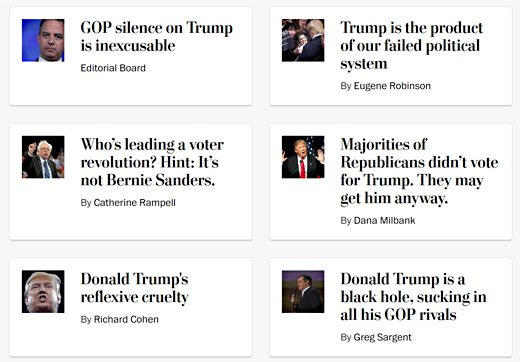
    And when I say “slightly,” I mean slightly. The map on the right shows the difference. A typical lottery winner is shown by the star. “Inner ring neighbors” are ones with the same postal code, in purple. “Outer ring neighbors” are the rest of them. In other words, a separation of literally 50-100 feet is enough to wipe out the entire effect. If large income disparities really do make people unhappy, it only seems to do so if they live within a few doors of some conspicuously consuming rich person. Needless to say, this is fairly rare given the fact that rich people tend to live in entirely different neighborhoods than poor people.

    Now, I suppose you can argue that being exposed to conspicuous consumption on TV produces the same feelings of envy as living next door to a friend who just won the lottery and bought a shiny new car. But you’d have to produce some evidence for that, since they’re very different things. For the time being, count me as skeptical.

  • The Latest Cruz-Rubio Spat Is Very Strange

    Ted Cruz has fired his communications director, Rick Tyler, for spreading a lie about Marco Rubio. Jeff Stein suggests this means there might be hope for us after all:

    For months, the top Republican candidates have been engaged in a brutal knockout battle of negativity. Personal insults, lies about each other’s records, schoolyard taunts — nothing has been deemed out of bounds. The good news is that, so far as we can tell, this attack really has backfired….It may be comforting to know that even in this Lord of the Flies–style campaign cycle, some of the basic conventions just might retain a bit of power.

    Anything is possible, but I’ll stick with the cynicism my hard-earned age allows me on this score. Still, there really are a couple of odd things about this episode:

    • The whole thing started when the Daily Pennsylvanian got hold of a video that shows Rubio walking by a Bible-reading Cruz staffer and allegedly remarking, “Got a good book there….Not many answers in it.” But this makes no sense. Did Tyler seriously believe that Rubio walked up to a Cruz staffer and casually denigrated the Bible? Even in the Donald Trump era, no one would believe that. It’s insane. Tyler is an experienced guy, and it’s inexplicable that he’d fall for this.
    • Tyler took down the video and apologized after he learned Rubio’s remarks had been transcribed incorrectly. Rubio actually said “all the answers are in there.” Normally that’s the end of things. But this time Cruz decided to fire him. What’s that all about?

    It sure seems like there’s something goofy going on here. I’m just not sure what.

  • Quote of the Day: “Nothing Too Hard, Mika”


    Do you ever wonder what Joe and Mika and Donald Trump talk about during commercial breaks on Morning Joe? Me neither. But we’re finding out anyway. Here’s a snippet of hot mic action from their prime-time town hall with Trump last week:

    Trump: I watched your show this morning. You had me almost as a legendary figure. I like that.

    [More good-natured chatting and joshing until the 30-second on-air warning.]

    Mika: Do you want me to do the one on deportation?

    Joe: We really have to go to some questions.

    Trump: That’s right. Nothing too hard, Mika.

    The audio comes from Harry Shearer, who jokes, “You can cut the adversarial tension there with a knife—a butter knife.” Unfortunately, the joke is on all of us.

  • Sorry, George: The Republican Party Is Wrecking the Republican Party


    From George Will, bemoaning the fate of a Republican Party in thrall to Donald Trump:

    It is time to talk about his tax records.

    OK, let’s talk! Unfortunately, this is not the first line of Will’s column, it’s the last. Is it a two-part column, and this is just the cliffhanger? I don’t know. I was reading the column for a different reason, when it suddenly stopped dead on this sentence.

    So why was I reading the column? Because I was intrigued by the headline: “Donald Trump relishes wrecking the GOP.” You see, a few days ago President Obama claimed that Trump merely “says in more interesting ways” what every other Republican says too. Will isn’t buying:

    Certainly not last week when Trump said, “I like the [Obamacare] mandate.”…Trump was not saying “what the other candidates are saying” when last week he said: “Every single other [Republican] candidate is going to cut the hell out of your Social Security.”… Embraces torture and promises to kill terrorists’ families.
    Trump quickly backed away from his mandate mistake, and other Republican candidates endorse torture as well—as have large majorities of Republican voters since long before Trump burst on the scene. They just don’t say so in quite such interesting ways as Trump.

    So, once again, we’re left with Trump’s heresy on Social Security. That’s about it. With fairly trivial exceptions, Trump is quite mainstream on all the other big conservative hot buttons: taxes, health care, abortion, guns, military spending, regulations, climate change, crime, deficits, and smashing ISIS to bits. Given all this, he sure is getting a lot of mileage out of his slight nonconformities on issues like eminent domain and Planned Parenthood funding.

    So is Trump really wrecking the GOP? I don’t see it. The GOP wrecked the GOP. They’re the ones who have spent the last 30 years building the kind of party that Trump appeals to. If Michael Moore entered the Democratic race, do you think he’d have the same effect? After all, he’s loud, he’s funny, and he’s unapologetically liberal.

    But he wouldn’t have any serious impact. He’d build a small movement and get some good press, and that would be that. There just aren’t enough Democrats around who’d find his brand of rabble-rousing convincing presidential material. The Democratic establishment hasn’t spent the last 30 years building that kind of party.

    So let’s knock off the crocodile tears about Trump wrecking the Republican Party. This is the party the Republican establishment built. They found it convenient, and they were pretty sure they could keep it under control. But they couldn’t. They started a bonfire to keep the rubes good and fired up, and now they’re getting upset because someone else is throwing in a few logs and taking ownership of it. Boo hoo.

  • Donald Trump Has a 40-Word Plan to Make Health Care Great Again


    Jordan Weissmann points out that we now have a health care plan from Donald Trump. For starters, Trump has now made clear that he doesn’t like the individual mandate after all—he just misspoke when he said that to Anderson Cooper a few days ago. What’s left are the three mighty pillars of Trump’s plan. First, he’s going to take care of the poor “through maybe concepts of Medicare.” Second, the Trump campaign has previously indicated that it will “provide individual tax relief for health insurance.” Third, after the scourge of Obamacare has finally been eradicated, the rest of us get this:

    Amazingly, this is going to produce health care nirvana. “The plans will be much less expensive than Obamacare…you’ll get your doctor, you get everything you want to get, it’ll be unbelievable.”

    As Weissmann points out, this is just your bog-standard Republican health care plan with an extra dash of Trumpian crowing. It won’t just work better than Obamacare, it will be unbelievable. In fact, “you get everything you want to get.” How much more can you ask for?

    To the extent that it makes any sense to discuss Trump’s policy proposals, there are a couple of takeaways from this:

    • Far from being a populist, Trump is just an ordinary Republican. He sometimes tosses out heterodox ideas in one of his rambling speeches, but they never last. With only a few exceptions, his advisers eventually talk him into adopting Republican orthodoxy in his usual amped-up, dumbed-down way. And the Republican orthodoxy on health care is almost literally a straitjacket: High-risk pools, HSAs, competition across state lines, tort reform, and tax credits for individual insurance. If we assume that “concepts of Medicare” includes high-risk pools, Trump has four of these—and he’s undoubtedly in favor of tort reform too.
    • Trump, like most Republicans, is apparently under the impression that the big problem with American health care is the evil, monopolistic insurance companies. “The insurance companies are making a fortune because they have control of the politicians,” he said in one of the first debates. Liberals sometimes make this mistake as well, and it’s ridiculous. If I had my druthers, I’d get rid of the insurance companies too, but it wouldn’t do much to reduce the cost of health care. The fundamental cause of high health care costs in America is the high cost of health care itself. Compared to other countries, we pay our doctors more; we pay our nurses more; we pay more for drugs; we pay more for devices; and we pay more for hospitalization. If you don’t tackle that, you’ll never even make a dent.

    So that’s that. As usual, Trump is just a standard-issue Republican once the dust has settled, and he has no more idea about how to fix health care than any of the rest of them. He’s just more willing than most to brag about how great his plan will be.

  • Raw Data: Projected Poverty Among the Elderly


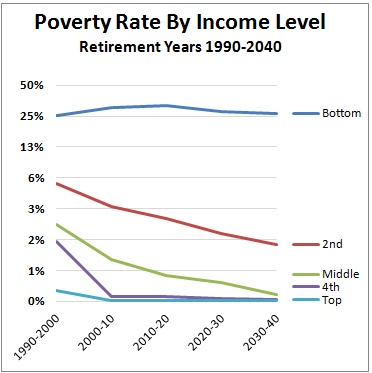
    The current rate of poverty among the elderly is 9.8 percent, compared to 15.7 percent for those under age 65. But what about the future? The Social Security Administration projects that poverty rates will continue to decline for the elderly. About 7 percent of depression babies, who started retiring in 1990, currently live in poverty, compared to a forecast of 5.7 percent for Gen Xers, who will begin retiring in 2030. However, these averages hide some stark differences:

    Not all groups are expected to do so well. Among high school dropouts, poverty rates are projected to increase from 13.5 percent to 24.9 percent…before declining to 18 percent for [GenXers]….Given the projected increase in minorities and immigrants, as well as the historic increase in women’s labor force participation, retirees with low labor force attachment are increasingly low-educated, low-skilled, and disabled. Not surprisingly, those retirees are projected to have very high poverty rates.

    By 2030, SSA forecasts that poverty will be all but eradicated for every income group except one: the very poorest. This is unsurprising but nonetheless far-reaching in its policy implications: If you are poor during your working career you will continue to be poor when you retire. If not, then not. Our retirement programs should be set accordingly.