• Friday Cat Blogging – 19 February 2016


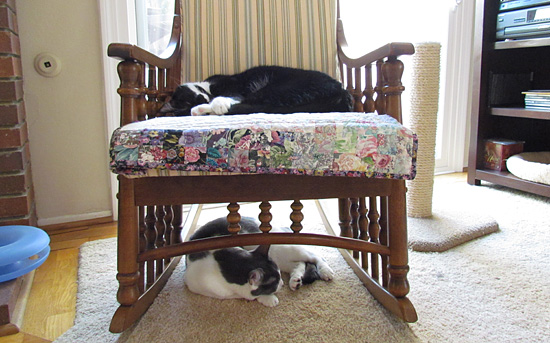
    Today we have bunk bed kitties. Among felines, I’m not sure whether the alpha gets the top bunk or the bottom bunk. Since they usually like hiding in nooks and crannies, I’m guessing bottom bunk. Other evidence corroborates this. Hopper used to let Hilbert bully her, but lately she barely even opens an eyelid when he tries to push her around. And sure enough, he just sadly backs away. Poor thing. He used to think he was the toughest mammal in the house, but time has taught him otherwise.

    Also, Hopper bit his ear a few days ago. If that doesn’t get the message across, I don’t know what will.

  • Ted Cruz Wins the Family Values Endorsement


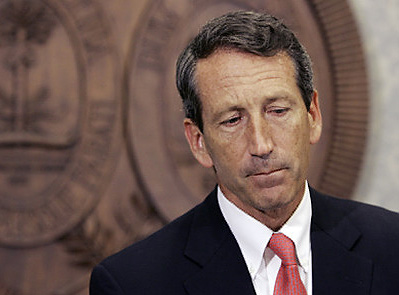
    Exciting news! Former South Carolina governor Mark “Appalachian Trail” Sanford has endorsed….

    Ted Cruz! This is quite a coup. As you no doubt remember, Sanford demonstrated his commitment to traditional Republican values by starting up an extramarital affair; disappearing to Buenos Aires for a six-day vacation with his beloved; telling his spokesman to claim that he was gone because he was “hiking the Appalachian Trail”; and then tearfully admitting his affair and claiming that he had found his “soul mate.” He subsequently got divorced, and later on broke up with his soul mate.

    In fairness, the generous folks of South Carolina decided to elect him to Congress in 2013. So I guess all is forgiven. Certainly Ted Cruz has forgiven him.

  • Obama Kept His Immigration Reform Promise to Latinos in the Only Way That Actually Matters in Politics


    Dara Lind reports that young Latinos are torn between Bernie Sanders and Hillary Clinton. But not because of anything either candidate has said:

    Instead, the president on their mind is Obama. They’re still wrestling with his failure to keep his campaign promise to pass immigration reform, and the record deportations of his first term.

    ….”My biggest fear,” says Jocelyn Sida of the civic engagement group Mi Familia Vota, “is that the mentality of Latinos is going to be all about broken promises, don’t trust any candidate or campaign.”…Sida’s reference to “broken promises” is right on. For many — especially for young Latinos, many of whom came of political age during the Obama administration — the outgoing president is associated with the promise he made, then broke, on immigration reform, as well as the deportations that took place in its stead.

    There are lots of obvious things to say before I comment about this. I’m not young. I’m not Latino. I’m not idealistic. And I’m a pretty big fan of Obama. So I have my own biases.

    And yet…there’s still something dispiriting about this. Did Obama break his promise to introduce comprehensive immigration reform in his first year? Yes indeed. He says it was because the economy had collapsed and he had to spend all his time dealing with that. But no one really buys that. The stimulus bill passed pretty quickly, and during the rest of his first year Obama found time to deal with health care, Afghanistan, General Motors, climate change, touring the Middle East, and plenty of other things. Was he really so busy that he couldn’t spend some time on immigration reform?

    The answer is that Obama is skirting the truth here—but, oddly for a politician, not in a way designed to make him look better. The real truth is that during an epic unemployment crisis he had no chance of getting the votes to pass immigration reform. So like any president, he triaged. He spent his time on other things in hopes that he could make a successful run at immigration reform a little later. Was this the right call? We’ll never know, but it sure strikes me as correct.
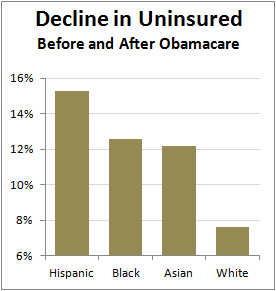
    In the end, of course, disaster struck: Democrats lost their House majority in 2010, and even with a strong enforcement record (all those deportations) and Republican support, immigration reform could no longer pass. But this is hardly the end of the story. Obama signed the mini-DREAM executive order in 2012. He worked hard to pass comprehensive reform in 2013. He signed another historic executive order in 2014 aimed at immigrant adults. And although this is seldom given much attention, the biggest beneficiaries of Obamacare have been Hispanics.

    So did Obama break his promise? Yes. Should young Latinos be demanding that the next president make immigration reform a priority? Yes. That’s how you get things done.

    But should they feel betrayed by Obama? I don’t think so. The nutshell version is this: Every president has to decide which of his priorities can pass Congress. If Obama had tried to push immigration reform in 2009, it almost certainly wouldn’t have passed, no matter how hard he had pushed. That’s the fault of reality, not presidential willpower. So, as Obama so often does, he waited. He waited for the economy to improve, and in the meantime he tried to set the stage for success with a strong enforcement record—even at the expense of losing political support from an important voting bloc. When the time came, he worked with Republicans and came close to passing something. But the House balked and it failed.

    None of this would have changed if Obama had barreled ahead in his first year. He would have lost just as badly, but two other things would also have happened. First, some of his other first-year initiatives would likely have fallen by the wayside. Second, he would have had a big, symbolic losing fight to his name. That would have done him a world of good in the Hispanic community, but he wasn’t willing to go down that cynical path.

    I’m not young. I’m not Latino. I’m not idealistic. But I don’t consider it a betrayal to have a president who shows me the respect of foregoing the cheap and cynical political stunt in favor of a longer, tougher, but more realistic chance of getting something actually done.

  • Quote of the Day: Donald Trump Was Against the Iraq War No Matter What He Actually Said at the Time


    From Donald Trump, asked on September 11, 2002, if he was in favor of invading Iraq:

    Yeah…I guess so. I wish the first time it was done correctly.

    That’s Donald being “loud and strong” against the Iraq War. For the record, his explanation is, yeah, he said it, but it was probably the first time anyone had asked him. But for sure he was against it a little later. Seriously. He was.

    As you might expect, being confronted with this didn’t even cause him to break stride. He immediately segued into a lengthy rant about how he was totally opposed to the war and everyone knew it, there were all sorts of headlines, and it destabilized the whole Middle East, it was responsible for ISIS and Libya and, um, Syria, the biggest mistake ever in American history, and it was Obama’s fault too, just a disaster, and Saddam didn’t bring down the towers, it was probably the Saudis, and did I mention that it was a complete and total disaster? And I was against it. Totally.

  • Sadly, Rubio-Obama Left-Handed Handshake Is Just Design Laziness, Not Latest Terrorist Fist Jab


    Today’s idiotic campaign tiff involves Marco Rubio pretending to be outraged about an image from the Ted Cruz campaign that illustrates their supposed outrage over the fact that “Rubio cast the deciding vote to fast-track three highly secretive trade deals negotiated by Obama and encouraging corrupt, backroom deals.” It shows a photoshopped Rubio shaking hands with a photoshopped Obama.

    Yawn. What I want to know is why this illustration shows Rubio and Obama shaking hands left-handed. Weird, no? But it turns out the answer is simple: the campaign used a stock photo for the bodies, but the black guy in the photo was on the left and they wanted Obama to be on the right. So they inverted the image, which made it look like a left-handed handshake.

    I’m disappointed. I thought maybe conservatives were under the impression that a left-handed shake was the latest black thing, like a terrorist fist jab or something. Oh well.

  • Pope Francis Relaxes Catholic Prohibition Against Contraception


    This is interesting:

    With the mosquito-borne Zika virus continuing to spread through Central and South America, Pope Francis said today that contraception could be seen as “the lesser of two evils” if women are concerned about having children with the birth defect microcephaly….“Avoiding pregnancy is not an absolute evil,” Francis said. “In certain cases, as in this one, such as the one I mentioned of Blessed Paul VI, it was clear. I would also ask doctors to do their utmost to find vaccines against these mosquitoes that carry this disease. This needs to be worked on.”

    The Vatican’s shameful history of fighting condom use in sub-Saharan Africa as the AIDS epidemic raged has long been one of my strongest grievances against the Catholic Church. Thousands of people likely died because the church considered its sexual teachings more important than saving lives:

    The Catholic Church’s official approach to AIDS in Africa can be summed up in the speech repeatedly given by the late Pope John Paul II as he toured the continent in 1990. In his addresses to desperate communities, who often did not understand why so many people were dying, he preached that condoms were a sin in all situations….As AIDS activists watched his speech erode more than a decade of campaigning, the Pope declared, “The Church is convinced that without a resurgence of moral responsibility and a reaffirmation of fundamental moral values any programme of prevention based on information alone will be ineffective and even counterproductive.”

    Pope Benedict XVI made a very tentative move toward relaxing the church’s view on condoms a few years ago, and now Francis has gone further. That’s good news. More please.

  • Lead and Crime: It Happened in Australia Too


    Let’s turn now to a less contentious topic: gasoline lead and violent crime. As you know by now (yes, there will be a quiz), there are three fundamental types of evidence in favor of the lead-crime hypothesis:

    • Retrospective statistical studies. These are called “ecological studies,” and they rely on comparing past rates of lead poisoning in children to rates of violent crime two decades later. The more of these studies the better, but by themselves they’re rarely convincing because it’s very hard to disentangle all the possible causes of crime in an entire population based only on past statistics.
    • Prospective studies. These are studies that pick a sample of babies and then follow them in real-time for 20 or 30 years. The researchers can measure blood lead levels every few months and then compare that to behavior later in life.
    • Brain scan studies. This is just what it sounds like. You put people who have suffered from lead poisoning into an MRI machine and take a look at how lead affects specific parts of the brain.
    All three of these suggest that lead poisoning in kids leads to more violent crime later in life. Today brings yet another bit of evidence. It’s an ecological study done at Macquarie University in Australia, which makes it especially interesting. Here’s the problem: As long as you do studies only of American crime, you can never know for sure if there’s some hidden variable that affected all American kids and just happened to spread at about the same rate as lead poisoning. Maybe eating lots of McDonalds hamburgers causes crime rates to soar for some reason. But you’ll never know because kids everywhere in the country ate more and more Mickey D’s during the 50s and 60s and there’s no data to tell you precisely who ate the most.

    But if you study other countries, a lot of these confounding variables go away. Not all of them, perhaps, but most. If you think the problem is poverty or social welfare programs or policing styles or the unique American history of racism, then take a look at Canada. Or Italy. Or Australia. They have very different histories of all these things. If violent crime rates still match up with lead poisoning, that’s good evidence that lead poisoning is truly the causal agent.

    Rick Nevin has already done some of this work, comparing crime rates to lead poisoning in a number of other countries. But it’s always better to get a detailed study from a local research team with access to more data. Interestingly, the Macquarie team didn’t look at blood lead levels in children. They had direct access to atmospheric levels of lead, which Australia has tracked for decades, and this allowed them to look specifically at the effect of just gasoline lead. They were also able to make comparisons at the neighborhood, state, and national levels. Here are their conclusions:

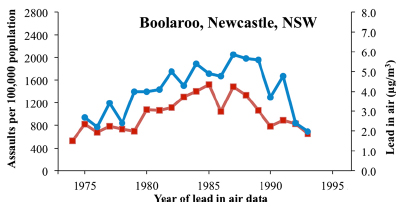
    Direct effects between air lead and assault rates across all suburbs were examined….For every additional μg/m3 of lead in air, assault rates 21 years later increased by 163 per 100,000 population. Lead in air was the strongest predictor in the model, accounting for 29.8 % of the variance in assault rates 21 years later.

    ….At the state level, strong positive correlations between petrol lead emissions and death by assault rates were found only for the states with the largest populations, highest population densities and greatest petrol lead emissions, namely, [New South Wales] and Victoria….Lead emissions in NSW accounted for 34.6 % of the variance in death by assault rates 18 years later….In Victoria…lead emissions accounted for 32.6 % of the variance in death by assault rates 18 years later.

    ….At a national level, the data also demonstrated a positive correlation between lead emissions and death by assault rates, but the association was weak. National lead emissions accounted for only 7 % of the variance in national death by assault rates 18 years later, as the health and behavioral effects of lead emissions are dissipated at larger geographic scales.
    The chart on the right is typical of the suburban neighborhood-level data. Boolaroo is about an hour north of Sydney and has a history of high lead levels thanks to a local smelter that operated for decades. As you can see, the correlation between atmospheric lead and violent crime (lagged by 21 years) is very strong. In other suburbs, where lead was produced by gasoline and overall levels were lower, the correlation isn’t quite as visually convincing, but it’s still quite strong.

    Australia banned leaded gasoline in 1985, and crime rates began dropping in the mid-2000s. That’s quite different from the US, where leaded gasoline was phased out starting in the mid-70s and crime rates started dropping in the early 90s. This suggests that it’s not just something about the specific time period from 1991-2010 that’s responsible for our crime decline. Australia also has a very different racial history, a very different policing culture, a very different drug/gang culture, and a very different social welfare state. None of these are likely to be hidden variables that are coincidentally identical in both countries.

    So we have a different country; a different time frame; and a different criminal justice culture. Yet crime still follows the trajectory of lead emissions, which appears to explain about a third of the change in assault rates. That’s a lot. It’s one more bit of data to add to the already persuasive pile of evidence in favor of the lead-crime theory.

  • Is Bernie Sanders Responsible For Gerald Friedman’s Economic Analysis?


    I’ve gotten enough tweets like this that I suppose I should probably respond:

    The topic is Gerald Friedman’s paper suggesting that Sanders’ domestic spending program will supercharge the economy in wildly unlikely ways. And it’s true that Friedman isn’t officially part of the Sanders campaign team. But they’ve previously relied on his analysis of their universal health care plan, and the campaign’s policy director has repeatedly praised Friedman’s paper:

    CNN: “Sanders’ policy director, Warren Gunnels, also defended the estimates, noting the candidate is thinking big. ‘We haven’t had such an ambitious agenda to rebuild the middle class since Presidents Roosevelt, Truman and Johnson,’ he said.”

    Pittsburgh Post-Gazette: Warren Gunnels, policy director for the Sanders campaign, hailed the report’s finding that the proposals are feasible…’It’s gotten a little bit of attention, but not nearly as much as we would like,’ Mr. Gunnels said….’It’s a very bold plan, and we want to get this out there.'”

    NPR: “As for whether he was worried about these sorts of criticisms hurting the campaign in the future, he said no. ‘That does not bother us at all,’ he said. ‘What bothers us is the fact that the U.S. has more kids living in poverty than nearly any major country on Earth.'”

    Come on, folks. If your policy director is out in the media promoting Friedman’s paper, then it means the campaign is standing behind it. There’s no two ways about this.

    The second line of defense for Sanders’ supporters is that no one has proven that Friedman is wrong. In fact, the critics are “the establishment of the establishment”: just a bunch of Wall Street shills on Hillary’s payroll who have it in for Bernie. I’m at a loss about how to respond to this. Obviously you can’t prove that a forecast of the future is wrong. But you can say that Friedman is forecasting a sustained level of economic growth that’s literally never happened before in history. Not here, not in Denmark, not anywhere. Mature economies simply don’t grow 5 percent a year for a decade. Labor productivity doesn’t double just because you create a bunch of social welfare programs. The number of people in the labor force doesn’t skyrocket to new records even in the face of increasing rates of boomer retirement.

    The discouraging thing here is that Friedman’s critics aren’t saying that Sanders’ proposals are bad. You can support every single element of his plan with a clear conscience. Their criticism is solely about forecasting how his plan will affect economic growth. And on that score, it’s not even remotely realistic. It’s about like saying his Medicare-for-all plan will increase life expectancy ten years. It’s beyond belief. No matter who you support, you shouldn’t do it based on fantasies like this.

  • In Shocker, Americans Divided by Party on Scalia Replacement


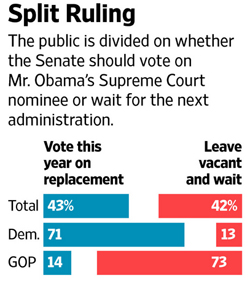
    A new poll says Americans are evenly divided about whether the vacant Supreme Court seat should be filled this year. Can you guess why they’re so evenly divided? Huh? Can you?

    The survey found voters were split deeply along party lines, with 71% of the Democrats favoring Senate consideration of an Obama nominee and 73% of Republicans supporting no action until the next president assumes office.

    Yeah, that’s a shocker, all right. By an amazing coincidence, partisans on both sides have accepted the rigorous and principled arguments set forth by their fellow partisans. However, the fight for the independents continues. They’re split 43-42 percent, just like the country as a whole.