
• Tea Party Republican Decides to Wreck Klamath River Agreement Just For the Hell of It


    Here’s a depressing story for you. After years of acrimony and negotiations, the various factions who get water from the Klamath River basin finally hammered out a water-sharing agreement in 2008 that was lavishly praised by Rep. Greg Walden, who represents the area. In 2014, the last of the holdouts signed on and it looked like a war that had lasted over a decade might finally be over. But the Republican Party has gone nuts since 2008, and Greg Walden apparently went nuts right along with them:

    As it turns out, Walden, a tea party favorite, is now chairman of the National Republican Congressional Committee, which makes him the House’s third-most powerful member. Given Republicans’ views on federal power, you’d think he’d continue to support a bottom-up agreement like this, particularly since the majority of his constituents decided they needed it. But conservative orthodoxy holds that dam removal is never good — apparently even when, as in this case, the dams are antiquated, environmentally disastrous and privately owned, and when nearly every constituency in the community would benefit.

    So here is what the basin got for doing everything right. After five years of struggle for congressional approval of the Klamath agreement, the four Democratic senators of California and Oregon introduced authorizing legislation in January. But this month, just ahead of a Dec. 31 deadline dissolving the agreement if it hasn’t gained Congress’ approval by then, Walden unveiled a draft House bill that will almost surely kill the deal. It omits dam removal — the agreement’s centerpiece — and includes an unrelated provision to turn over 200,000 acres of federal timberland to two counties on the California-Oregon border. Given the new provision’s controversial content and the timing of the House bill, Walden must have known it had no chance of passage. In essence, his move consigned the Klamath’s “best and longest-lasting solution” to Washington’s black hole.

    It’s just obstruction for the sake of obstruction. Or because Walden hates the Obama administration, which OKed the deal. Or, perhaps he did it for the sake of some particular interest group that’s donated money to him. Who knows? It’s insanity.
  • It’s Official: Donald Trump Can Say Anything


    Apparently Donald Trump can literally say anything now and get away with it. Here he is on Vladimir Putin’s comments from this morning:

    It is always a great honor to be so nicely complimented by a man so highly respected within his own country and beyond,” Trump said in a statement. “I have always felt that Russia and the United States should be able to work well with each other towards defeating terrorism and restoring world peace, not to mention trade and all of the other benefits derived from mutual respect.”

    No doubt—though this “highly respected” man is now directly threatening American military forces in a crucial area of Syria: “Earlier this month, Moscow deployed an SA-17 advanced air defense system near the area and began ‘painting’ U.S. planes, targeting them with radar in what U.S. officials said was a direct and dangerous provocation.” No worries, though. Trump apparently thinks Putin is a great guy who’s eager to restore world peace.

    By the way, I notice that most news stories about Putin have started to distance themselves from suggesting that he called Trump “brilliant” or “outstanding.” They’re now more correctly translating Putin’s description as “lively” or “colorful.” Nonetheless, the media still seems to be on the “budding bromance” bandwagon, even though Putin didn’t really say anything complimentary about Trump. I wonder if Trump will change his tune once he finds out?

  • Suddenly, Deficits Don’t Matter Anymore


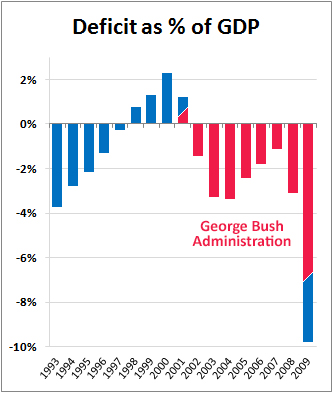
    Republicans and Democrats have agreed on a year-end budget package that will increase the deficit by around $500 billion or so. There’s been a bit of grumbling about the bill from the Republican side, but mostly it’s not about the spending. It’s about the lack of shutdown bait like defunding Planned Parenthood and banning Syrian refugees. Paul Waldman comments:

    Let’s be honest: despite all their talk about what we’re handing to the next generation and how government should balance its books just like a family does, when it comes down to actually making choices, Republicans are no more concerned about deficits than Democrats are. Crying about the deficit is a tool they use to constrain policies they don’t like. When it comes to the policies they do like, how much the government will have to borrow to fund them is barely an afterthought. So can we stop pretending they actually care about deficits?

    I doubt it. Loads of people have been making this very simple point for years and years, but it’s done no good despite the plain evidence of the past few decades. Reaganomics was explicitly built on the idea that Republicans had paid far too much attention to deficits in the past. George Bush the Elder passed a budget bill that actually did reduce the deficit, and was pilloried for it. George Bush Jr. blew up the deficit with tax cuts and Republicans thought it was great. Over the past 35 years, the only time Republicans have seriously tried to rein in the deficit was during the Clinton and Obama administrations.
    Republicans routinely insist that they care deeply about balanced budgets, and just as routinely this claim gets reported at face value. All the evidence in the world points in exactly the opposite direction, but it doesn’t matter: the conventions of journalism require reporters to pass along what politicians say, not what they mean. Overall, this is probably a good thing. But it sure does make it hard for the average Joe to understand what’s really going on.

  • Here’s What Vladimir Putin Really Said About Donald Trump Today


    LA Times reporter Michael Hiltzik has spent time reporting from Russia and speaks the language well. Via email, he offers this explanation of what Vladimir Putin really said about Donald Trump today:
    From what I can hear from the video you posted, he calls Trump a “yarkom chelovekom.” In my dictionary, “yarkii” can be “clear, bright, dazzling.” You sometimes hear Russians using the term to denote the bright sky of a bracing, clear morning.

    Brilliant I think would be wrong to the extent it connotes intelligence—that’s not what Putin’s driving at. Outstanding is a pretty lazy translation. Bright personality captures the meaning, but not the idiomatic tone, of the word. Very colorful is downplaying the real meaning.

    I’d go with something like vivid. The word also could mean garish, but I think Putin was trying to be complimentary, and garish would be criticism.

    I’d guess that the reason all the translations agree on “talented” is that —though I can’t hear it in the clip—Putin probably used “talantlivii,” which is a common Russian adjective, stolen from the French.

    So Putin was probably just trying to say that Trump is a big personality. Hiltzik says—and I agree—that Putin wasn’t especially trying to say anything either good or bad about Trump—though knowing Putin, it’s a good guess that he approves of big personalities. Basically, he was just trying to state the obvious about Trump. In any case, there you have it.

  • Why Is WhatsApp Refusing to Comply With a Valid Warrant?


    On Wednesday, a judge in Brazil ordered the temporary suspension of WhatsApp, a popular Facebook messaging app. Everyone went nuts. Mark Zuckerberg said he was “stunned.” The CEO of WhatsApp said it was “sad to see Brazil isolate itself from the rest of the world.” Users moved in droves to another messaging app.

    Today, another judge lifted the ban because “it does not seem reasonable that millions of users are affected” over a tiff between WhatsApp and a judge.

    Fair enough. The first judge pretty clearly overreacted. But apparently this whole thing started because the judge wanted access to messages from a suspect in a drug trafficking trial. The judge issued legal warrants several months ago, but What’sApp refused to comply.

    Does WhatsApp have a response to this? Do they think the warrant is invalid? Do they think they don’t have to respond to warrants? Or what? I’m generally opposed to governments hoovering up messages and phone calls without a warrant, but if there’s a warrant in a legitimate criminal case, then you have to turn things over. What am I missing?

  • How Old Should Kids Be Before They’re Allowed to Play in the Front Yard on Their Own?


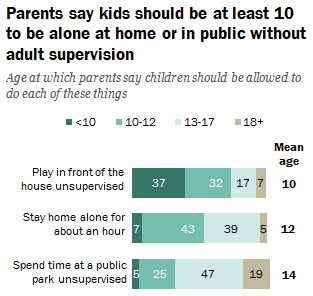
    Pew Research routinely comes out with long, detailed surveys of interesting things, and I usually thumb through them looking for intriguing tidbits. Today it’s “Parenting in America,” and you’ll be unsurprised to learn that middle-class parents generally have a more positive view of things than poor parents. I may have more to say about this later, but in the meantime here’s a tidbit that answers a question I’ve pondered more than once: how old should kids be before they’re allowed to do stuff on their own?
    I don’t know how this has changed over time, but these figures sure seem strange. I played on my own in front of my house when I was five,1 but today’s parents think you need to be 10—and a substantial fraction think you need to be over 12 to play in front of the house unsupervised.

    Ditto for the others. I suppose 12 isn’t unreasonable for staying home alone, but again, a substantial fraction think you need to be 14 or 15 or even 18.

    As for public parks, holy cow. The average age for allowing kids to play in a park without adult supervision is 14, and there’s a substantial fraction who think you literally have to be an adult yourself before you should be allowed to go to a park on your own.

    Unsurprisingly, Pew says that the answers are correlated with income, which is correlated with the kind of neighborhood you live in. If you live in a safe neighborhood, the average age for playing in front of the house is 9. If you live in a poor neighborhood, it’s 11. This makes sense.

    Still, the overall numbers sure strike me as high. Of course, I’ve led a sheltered existence, so maybe I just don’t get it. But the world is a safer place than it was 30 years ago. Do kids really need to be ten just to play in the front yard these days?

    1I called my mother to confirm this. She did.

  • Vladimir Putin Calls Donald Trump Brilliant, Flamboyant, Lively, Colorful, Outstanding….Um, What?

    The opening line of Fyodor Dostoyevsky’s Notes from the Underground is “I am a sick man…a spiteful man.” Or is it? I once read a fascinating introduction to Dostoyevsky’s famous novella that began by collecting a dozen different translations of that line, all of them suggesting a slightly different meaning. So what did Dostoyevsky really mean? It may be impossible to say for sure in English.

    That’s how I feel today, reading the news that Vladimir Putin praised Donald Trump at a news conference. Here are eight different translations of Putin’s remarks:

    He is a brilliant and talented person without a doubt…

    He is a very outstanding person, talented, without any doubt…

    He is a very bright person, talented without any doubt…

    He’s a very colorful person. Talented, without any doubt…

    He is a standout, talented person, without any doubt

    He is a bright personality, a talented person, no doubt about it…

    He is a very flamboyant man, very talented, no doubt about that…

    He’s a very lively man, talented without doubt…

    Needless to say, these are very different things. “Outstanding” suggests that Putin thinks well of Trump. “Bright” suggests a more neutral assessment. And “flamboyant” and “lively” suggest that he thinks Trump is a blowhard.

    So what did Putin really say? Beats me. But video of his remarks is above for anyone who wants to provide a deeper analysis of Putin’s word choice and what it really means in Russian.

  • Has Ted Cruz Always Opposed Legalization of Undocumented Immigrants?


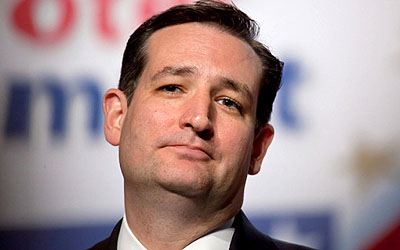
    In conservative circles, it turns out that one of the hottest debate topics from Tuesday night was the fight between Ted Cruz and Marco Rubio over immigration. Rubio, of course, is famous for championing a comprehensive immigration bill in 2013 that included a path to citizenship for undocumented immigrants. Cruz voted against it. But he also said this:
    CRUZ: You know, there was a time for choosing, as Reagan put it. Where there was a battle over amnesty and some chose, like Senator Rubio to stand with Barack Obama and Chuck Schumer and support a massive amnesty plan. Others chose to stand with Jeff Sessions and Steve King and the American people and secure the border.

    ….RUBIO: As far as Ted’s record, I’m always puzzled by his attack on this issue. Ted, you support legalizing people who are in this country illegally.

    ….CRUZ: Look, I understand Marco wants to raise confusion, it is not accurate what he just said that I supported legalization. Indeed, I led the fight against his legalization and amnesty.

    ….RUBIO: Did Ted Cruz fight to support legalizing people that are in this country illegally?

    ….BASH: Senator Cruz, can you answer that question please?

    ….CRUZ : I have never supported legalization, and I do not intend to support legalization. Let me tell you how you do this, what you do is you enforce the law.

    But this isn’t true. Cruz did support legalization. As Jim Geraghty points out, Cruz offered an amendment to Rubio’s legislation that would have legalized millions of immigrants. Here is Cruz explaining it at Princeton in 2013:

    It’s worth thinking for a moment about how that would operate. That’s an amendment to the underlying bill. The underlying bill from the Gang of Eight provides for legal status for those who are here illegally. It provides for them getting a temporary visa initially, and ultimately being able to get a green card, as a legal permanent resident. The amendment I introduced would not change any of that, which would mean the 11 million who are here illegally would all come out of the shadows and be legalized under the Gang of Eight’s bill. It would simply provide that there are consequences for having come illegally, for not having followed the legal rules, for not having waited in line, and those consequences are that those individuals are not eligible for citizenship.

    Cruz would have denied citizenship to anyone here illegally, but he explicitly supported a path to legal residence. Cruz now likes to pretend that he merely meant his amendment as a poison pill, something that would make the entire bill unacceptable to Democrats. But that’s not what he said at the time. Here’s Geraghty:

    Asked directly, Cruz had every opportunity to state that he didn’t intend for his amendment to be adopted or for the Gang of Eight bill to pass at all and in fact replied the opposite. At no point did he describe his amendment as a poison bill or procedural maneuver to derail the bill. He had every chance to say he opposed a legal status for illegal immigrants and didn’t do so. At this point, there is no reason to believe that in 2013, Ted Cruz opposed a path to legalization (not citizenship) for illegal immigrants.

    Byron York confirms that Cruz told him the same thing during an interview in May of 2013. In other words, Cruz may have gotten the better of Rubio during the debate by lying with a straight face on national TV, but he also may have set himself up for trouble down the line since his record on this point is pretty clear. Liberals haven’t paid a lot of attention to this bit of byplay, but conservatives have. And it’s not likely to end here.

  • Strike Two for Pair of New York Times Reporters


    Today, FBI director James Comey said the San Bernardino shooters never talked openly about violent jihadism on social media: “So far, in this investigation we have found no evidence of posting on social media by either of them at that period in time and thereafter reflecting their commitment to jihad or to martyrdom. I’ve seen some reporting on that, and that’s a garble.”
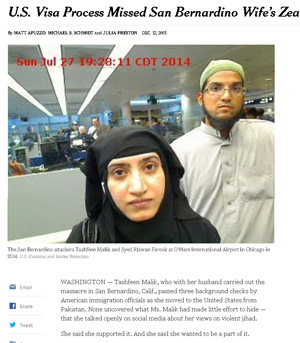
    So where did this notion come from, anyway? The answer is a New York Times story on Sunday headlined “U.S. Visa Process Missed San Bernardino Wife’s Zealotry on Social Media.” It told us that Tashfeen Malik “talked openly” on social media about jihad and that, “Had the authorities found the posts years ago, they might have kept her out of the country.” The story was written by Matt Apuzzo, Michael Schmidt, and Julia Preston.

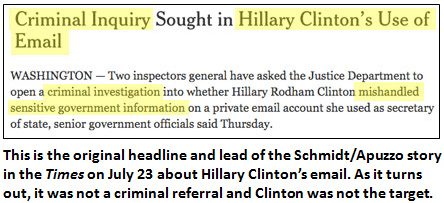
    Do those names sound familiar? They should. The first two were also the authors of July’s epic fail claiming that Hillary Clinton was the target of a criminal referral over the mishandling of classified information in her private email system. In the end, virtually everything about the story turned out to be wrong. Clinton was not a target. The referral was not criminal. And as the story itself noted, the emails in question had most likely not been classified at the time Clinton saw them.

    Assuming Comey is telling the truth, that’s two strikes. Schmidt and Apuzzo either have some bad sources somewhere, or else they have one really bad source somewhere. And coincidentally or not, their source(s) have provided them with two dramatic but untrue scoops that make prominent Democrats look either corrupt or incompetent. For the time being, Schmidt and Apuzzo should be considered on probation. That’s at least one big mistake too many.

    UPDATE: The New York Times has asked for a correction to my characterization of the July 23 Schmidt/Apuzzo piece about Hillary Clinton’s email. “Our story never said that a probe or investigation had been opened,” their representative writes. That is correct. It said there had been a request for a criminal investigation.

    Also: “The story does not say that the emails had been classified at the time Clinton saw them.” True enough. My apologies for implying otherwise. I have corrected the text of the post.

