
• Big Recessions Are Good For Right-Wing Politics


    I guess today is David Dayen day. Over at the New Republic, he points me to an interesting new historical study of systemic banking crises. Here’s what happens when the financial system implodes:
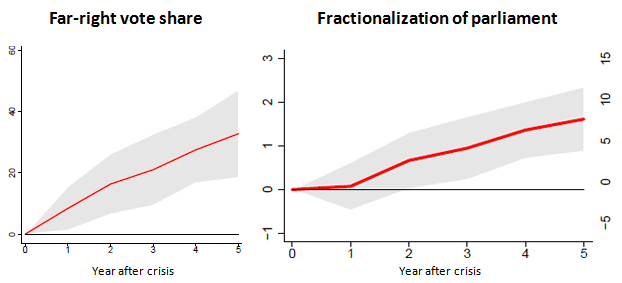
    Both before and after WWII, the authors find the same dynamic: the voting share of far-right parties increases by about a third and national legislatures become more fractured and dysfunctional. This doesn’t happen after normal recessions. Only after major recessions caused by a banking crisis.

    Why? The authors are unsure. One possible explanation, they say, is that financial crises “may have social repercussions that are not observable after non-financial recessions. For example, it is possible that the disputes between creditors and debtors are uglier or that inequality rises more strongly….Financial crises typically involve bailouts for the financial sector and these are highly unpopular, which may result in greater political dissatisfaction.” Or maybe this: “After a crisis, voters seem to be particularly attracted to the political rhetoric of the extreme right, which often attributes blame to minorities or foreigners.”

    Since we’re guessing here, I’ll add my two cents. People are, in general, more generous when times are good. Policywise, they’re more likely to approve of safety net programs that help the poor, which are generally associated with the left. But when times turn bad, people get scared and mean—and the longer the bad times last, the meaner they get. When people have lost their jobs, or had their hours cut, or seen the value of their home crash, they’re just not as sympathetic to helping out the poor. They’re looking out for their own families instead.

    Politically, the result of this is pretty obvious. Liberal parties think that bad times are precisely when the poor need the most help, so they propose more social spending. Right-wing parties, by contrast, oppose increased spending.

    In public, this usually isn’t framed as support or opposition to doling out money to the poor. Liberals talk about stimulus and countercyclical spending. Conservatives talk about massive budget deficits and skyrocketing government outlays. But it doesn’t really matter. What people hear is that liberals want to spend more on the poor and conservatives don’t. When people are feeling vulnerable and mean, the conservative message resonates with them.

    From a practical policy standpoint, this makes little sense. Liberals are right that recessions are the best time to spend more on safety-net programs, both because the poor need the help and because it acts as useful stimulus. But human nature doesn’t work that way, and conservatives have the better read on that.

    So what’s the answer? Dayen suggests that banks and bank bailouts are central to this dynamic, so we need to take a meat axe to the political power of the financial sector. I’m all for that. But my guess is that this isn’t really key. I think people just get scared when times are bad, and hate the idea of their tax dollars going to other people. This means the answer is to assuage both their financial anxiety and their perception that their money is being spent on the poor. So how about something that dramatically makes this point? Say, a one-year income tax holiday for everyone making less than $70,000 coupled with explicit promises to increase the deficit and help the poor. The tax holiday could be extended year by year as necessary, or phased out gradually.

    Why something like this? Because it puts more money in everyone’s pocket and reduces their angst over money matters. It also makes it crystal clear that their money isn’t being spent on the poor. They aren’t paying any taxes, after all. Under those circumstances, helping out the poor would probably strike most people as a lovely idea.

    Obviously conservatives would still oppose this, and the tax holiday wouldn’t last forever. Still, it’s worth a thought. You need something dramatic to cut through people’s fears, and this might do it.
  • Big Banks Lose a Battle


    In order to close a $70 billion gap in highway funding, Congress plans to raid the Federal Reserve and sell some oil from the Strategic Petroleum Reserve. Yesterday I called these moves “ill considered,” but David Dayen writes that there’s at least one pay-for in the transportation bill that’s also pretty good public policy.

    Ever since its founding, the Fed has paid banks a 6 percent annual dividend on the stock they buy to become members of the Federal Reserve system. In 1913 this was designed to entice banks to join the newfangled scheme. Today, it’s just an annual gift. So Senate drafters decided to cut the dividend to 1.5 percent and use the rest of the money for the transportation bill. Banks went ballistic, but in the end they were unable to keep their full handout:

    When the final bill was released Tuesday, the dividend reduction remained in there, albeit with some modifications.

    The reduction now applies only to banks with over $10 billion in assets, compared to the $1 billion threshold in the original bill. Instead of cutting the dividend to 1.5 percent, the rate will now match the interest rate of the highest-yield 10-year Treasury note at the point that the dividend is due. For context, the high yield at the last Treasury auction was 2.304 percent.

    It’s a small thing, but it’s always nice to see big banks lose a battle now and again. It keeps us all on our toes.

  • Ted Cruz Is Counting On Republican Voters To Be Less Bloodthirsty Than Most People Think

    Richard Ellis/Zuma


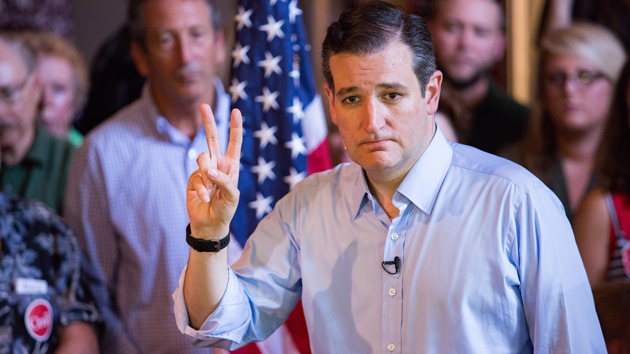
    One of the interesting things about the GOP primary race is that uber-conservative Ted Cruz is a bit of a dove when it comes to foreign policy. It’s not always easy to see this behind the bellicose rhetoric favored by Republicans, but even at the very beginning of Cruz’s campaign he said things like, “It’s worth noting, in eight years, the largest country Ronald Reagan ever invaded was Grenada.” In the four debates so far, Cruz has adopted less hawkish positions than most of the other candidates, and today he spelled out his national security stance in an AP interview:

    While promising to destroy the Islamic State, beat back aggression from Russia, China and Iran, and ensure extremists don’t infiltrate the U.S. homeland, Cruz also places notable limits on his approach to national security. While Syrian president Bashar Assad is undoubtedly a “bad man,” removing him from power would be “materially worse for U.S. national security interests.” He is unwilling to send more U.S. ground forces into the Middle East and rejects the idea that torture can serve as an appropriate interrogation tool.

    “We can defend our nation and be strong and uphold our values,” he says. “There is a reason the bad guys engage in torture. ISIS engages in torture. Iran engages in torture. America does not need to torture to protect ourselves.

    But if Cruz is generally trying to position himself as the most conservative candidate running, why the restraint on foreign policy? Brian Beutler argues that it’s because Cruz understands the conservative base better than Marco Rubio and some of the other candidates:

    Cruz is highly attuned to the views and grievances that animate Republican voters, even when they are out of step with the right-intellectual consensus. One of these arenas, where the right-wing position on a left-right axis fails to neatly line up with Republican voter sentiment, is foreign policy.

    Though they share a desire to be tough on terrorism, grassroots conservatives, unlike many Washington hardliners, don’t want the U.S. mired in unbounded entanglements. Here, the rightmost position—Rubio-esque neoconservatism—is identified with the dreaded Washington establishment, while organic conservative preferences are reflected in broad support for less militarily adventurous candidates. Republican voters trust Donald Trump to fight terrorism more than any other candidate by a wide margin….These voters consider anti-terrorism a priority but are uninterested in a return to the George W. Bush doctrine. It’s why Trump’s line about “bomb[ing] the shit/hell” out of ISIS is such a hit with his supporters—but those supporters would also rather Russia get bogged down in an ugly war than us.

    It’s also why Cruz isn’t crouching against Rubio’s foreign-policy attacks, but counter-striking with a ferocity, and an approach, that will surprise the shapers of conventional wisdom.

    This difference is likely to become sharper over the next month or two. Both Rubio and Cruz probably think it’s helpful to carve out some concrete differences with the other, and both probably think their version of foreign policy is better attuned to the current Republican id.

    So who’s right? I wouldn’t presume to guess at the details of the Republican id at the moment. But I will say that both Iowa and New Hampshire probably still bear traces of traditional conservative isolationism, and Cruz’s approach might go down pretty well there. Once the primary moves to other states, who knows? But wins in the first two states sure wouldn’t hurt Cruz’s chances.

  • Congress Has Agreed On a Highway Bill!


    Maybe Paul Ryan really is getting a handle on this whole governing thing:

    Congressional negotiators have agreed to a $305 billion measure to fund highways and mass-transit projects for five years, the longest in almost two decades—and an unexpected show of agreement after years of clamoring by state transportation officials for money for infrastructure projects.

    ….The agreement was made possible when lawmakers identified a collection of strategies to offset the costs. Among other things, the measure would raise revenue by selling oil from the nation’s emergency stockpile and taking money from a Federal Reserve surplus account that works as a sort of cushion to help the bank pay for potential losses.
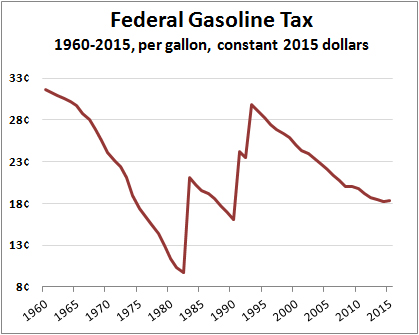
    The “strategies” here are necessary because the gas tax has declined over the past two decades, and unlike in past eras, inflationary erosion is no longer being offset by a rapid increase in miles driven. As a result, the highway trust fund doesn’t have enough money to pay for all the stuff Congress wants to do. This is being fixed by funding highways partly by gas taxes and partly by other revenue sources, which destroys the principle that “people who use federal transportation systems should pay for the projects.”

    Of course, this is a dumb principle anyway. Lots of people benefit from transportation infrastructure who don’t pay gas taxes. We should just ditch this principle for good and instead fund the government like this:

    1. Collect tax money from various sources.
    2. Put it all in the general fund.
    3. Spend the money as Congress directs.

    See? Easy peasy. We still have the problem of matching revenue and spending, of course, but at least we get rid of all the nonsense about funding specific programs from specific sources and worrying about trust funds “going broke.” Nothing is going broke. We’re just raising money and spending money. If we’re worried about a balanced budget, then we have to raise taxes or reduce spending, and it doesn’t really matter which taxes or which spending we target. It’s all just money.

    So I’m perfectly happy that Congress is ignoring the “principle” of funding transportation projects only via gas tax money. On the other hand, the revenue sources they’re tapping in order to pass this bill are probably pretty ill considered. Both are in the nature of emergency funds, and both are one-time deals that can’t be repeated. But in a world in which taxes not only can’t be raised, but can’t even be kept the same, I guess there’s little choice.

  • The Great Donald Trump Polling Gap, Not Explained


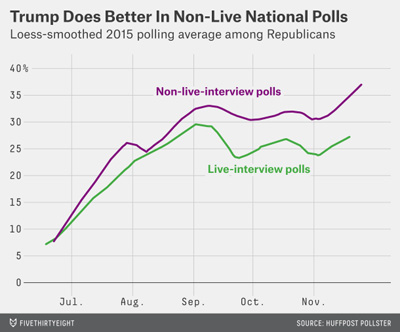
    Here’s something pretty interesting: It turns out that Donald Trump does significantly better in robocall and online polls than he does in traditional live-interview polls. Harry Enten shows the difference on the right. As Trump might say, it’s yuuuge: a full 10-point difference in the latest polling.
    This is peculiar for several reasons. First, this gap didn’t really open up until September. Second, we never saw a gap of this size in 2012. Third, since Enten doesn’t mention this, I assume other 2016 candidates don’t show gaps anywhere near this big.

    So what’s going on? Enten suggests a few reasons why non-live polls might be a bit less accurate, but in the end he doesn’t really know. And whatever the reason, why does it affect only Trump in a substantial way? This is very mysterious. And until people start voting, we don’t even know for sure which type of poll is more predictive. It’s just another way in which this year’s Republican primary is winning awards for all-time weirdness.

  • It’s Not Just Middle-Aged Whites Who Are Killing Themselves These Days


    I’m not sure why Josh Marshall decided to write about the Case/Deaton mortality study today, but he did. Here’s what he says:

    They made a startling discovery. As you would expect, every age and ethnic/racial grouping has continued to see a steady reduction of morbidity (disease) and increase in lifespans for decades. But there’s one major exception: middle aged (45-54) white people. Since roughly 1998, disease and death rates for middle aged white men and women has begun to rise.

    ….We might assume that a middle aged population group, under some mix of economic and societal stress, would be hit by the classic diseases of life stress: heart disease, cancer, diabetes, etc. But that’s not it. These people are quite simply killing themselves — either directly or indirectly. According to Case and Deaton’s study, the reversal in the overall mortality trend is driven by three causes: drug and alcohol poisonings, suicide and chronic liver disease. In other words, either literal suicide or the slow motion suicide of chronic substance abuse.

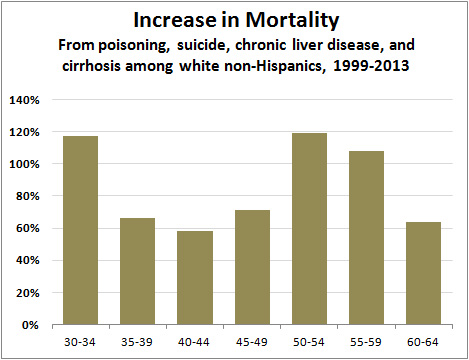
    I don’t really blame Marshall for saying this, since Case and Deaton go to considerable lengths to focus on this age group. But it’s just not true. Their own data shows that every white age group has seen a big increase in mortality from suicide/alcohol/drugs. I’ve tried to make this clear before, but I’ll try again today with a brand new chart. This is based on Figure 4 from the Case/Deaton paper and it shows the increase in mortality for all age groups.

    The biggest increase isn’t from 45-54. It’s from 30-34 and 50-54. In fact, 45-49 saw one of the lower increases.

    So why did Case and Deaton focus on the 45-54 age group? They explain it themselves:

    The focus of this paper is on changes in mortality and morbidity
    for those aged 45–54. However, as Fig. 4 makes clear, all 5-y age
    groups between 30–34 and 60–64 have witnessed marked and similar increases in mortality from the sum of drug and alcohol poisoning, suicide, and chronic liver disease and cirrhosis over the period 1999–2013; the midlife group is different only in that the sum of these deaths is large enough that the common growth rate changes the direction of all-cause mortality.

    That’s it. The 45-54 group doesn’t have the largest increase in death from suicide/alcohol/drugs. The only thing that makes them different is that the increase in these deaths “changes the direction of all-case mortality.” In other words, their line on the chart went from sloping up to sloping down. That’s the only reason to focus on them: because they crossed the zero line.

    But that’s purely esthetic. If, say, the mortality rate of one group goes from -3 percent to -1 percent, and the other goes from -1 percent to +1 percent, they’ve both changed by two percentage points. The latter one, however, goes from negative to positive, and that makes for a dramatic chart. But that’s all it does.

    I wouldn’t care so much about this except that people are drawing a lot of conclusions about “what’s wrong with middle-aged whites?” without noticing that the answer might very well be “nothing.” A better question is, “what’s wrong with America?” As Case and Deaton show, the mortality of middle-aged US whites did indeed start increasing around 1999, while the mortality rate in other advanced countries continued to decline steadily. I’d like to see that chart for all age groups before I tried to draw any conclusions, but it sure seems like we should be focusing on this, not on middle age. It’s not clear that middle age really has much to do with any of this.

  • Syrian Refugee Camps: “Really Quite Nice” or Brutal Hellhole? Ben Carson Explains.


    I don’t think I’d bother with this if I had something better to write about, but when life hands you lemons, you write a blog post with them anyway. Here is Ben Carson this morning:
    Carson last week visited Jordan to tour Syrian refugee camps in an effort to bolster his foreign affairs credentials, something he has been criticized for lacking. Carson called the camps “really quite nice” and suggested they should serve as a long-term solution. On TODAY, he called the Jordanians “very generous people” who have set up camps and hospitals “that work very well” but just lack to the resources to support the efforts.

    And here is Carson writing about Syrian refugees on the same day:

    Many are now housed in refugee camps, such as the one I visited, the Azraq refugee camp. The Azraq camp is located in a bleak and deserted stretch of desert that was built to house Iraqis and Kuwaiti Gulf war refugees.

    ….Here is a picture of life in Azraq: The camp is a bleak expanse of row after row of white sheet metal shelters. There is no electricity or air conditioning or heat against the scalding desert summer temperatures or cold winds of winter. Lack of electricity adds further hardship, as people are forced to choose between having light to see their way to the bathroom at night (six shelters share one bathroom) and charging their cellphones, which connects them to family and the outside world.

    Seriously, WTF? There was never any question that Carson’s photo-op trip to Jordan might provide him with some actual insight that would change his perspective. He’s obviously a guy who doesn’t do that once he’s made up his mind. But can he really not get his story any straighter than this? Which is it, Ben? Are these camps really quite nice or are they a bleak hellhole of freezing desert? Inquiring minds want to know.

  • No, Marco Rubio Has Not “Killed” Obamacare


    From “Team Marco” on Twitter:

    Q: Did Marco Kill Obamacare?

    A: You bet he did.

    Congratulations, senator! I hadn’t heard this, and of course I’m devastated. But this should certainly lock up the Republican nomination for—

    Hmmm? What’s that? This is a wee bit exaggerated? Here’s the story: Obamacare includes a program called “risk corridors” that’s designed to smooth out insurance company profits during the first few years of the program, when everyone is still trying to figure how to price their plans. The key element is that companies that make less than a certain amount will be compensated. Nicholas Bagley picks up the story from there:
    The Obama administration soon came to recognize that the risk corridor program contained a serious flaw: the ACA didn’t appropriate any money to fund it….At Rubio’s insistence, Congress in 2014 passed a budget bill prohibiting the administration from using other funding streams—the budgetary equivalent of looking under the couch cushions for change—to make up for any shortfall.

    Rubio’s bill has now come back to bite the administration. On October 1, HHS announced that, for 2014, health plans were owed substantially more under the risk corridor program than they paid in. Unprofitable plans will thus receive just 12.6% of what they were supposed to.

    The administration hopes to make it up to these health plans…But there’s another option, one that hasn’t received much attention. When Congress creates an entitlement directly in legislation, the person who’s supposed to get the entitlement can file a lawsuit in the Court of Federal Claims to recover what she’s owed….The same principle holds (1) where Congress vests a federal agency with the power to obligate the United States to make certain payments and (2) the agency welches on those obligations. Here, the ACA instructs HHS to create a risk corridor program requiring the government to pay health plans a given amount of money. If the past is any guide, plans should be able to sue if HHS doesn’t pay them in accordance with the program. That’s so whether or not Congress has appropriated money to fund the program.

    ….That’s small consolation to the co-ops that needed risk corridor payments now to stay afloat. But the question for health plans isn’t whether they’ll get paid. It’s when. Marco Rubio hasn’t killed Obamacare and he hasn’t saved taxpayers any money. All he’s done is throw a wrench in the works.

    A wrench is a wrench, I suppose. Republicans are fanatically opposed to poor and working-class folks getting decent health care, so anything that helps the cause should be welcome on the campaign trail—especially among the GOP’s elderly supporters, who already get government health care.

    Elsewhere, Mitch McConnell is going after the really poor by promising to use reconciliation to repeal Obamacare’s Medicaid expansion. Apparently this is making some Republicans nervous, since it means taking away a benefit from their own constituents, but Ol’ Mitch says they shouldn’t worry: Obama will just veto the bill anyway. You’d almost think Congress didn’t have anything useful to do judging by the GOP’s attachment to an endless stream of symbolic legislation. Do these guys really believe that extracting a presidential veto is some kind of historic victory or something?

  • Quote of the Day: Ted Cruz Angling For Some of That Trump Magic


    From Ted Cruz, apparently feeling gloomy today over Donald Trump’s ability to get attention with outrageous statements:

    The overwhelming majority of violent criminals are Democrats. The media doesn’t report that.

    Huh. Could be, I suppose. Most convicted felons are pretty poor, and poor people tend not to vote for Republicans. Why would they? Of course, they tend not to vote for Democrats, either. They just don’t vote.

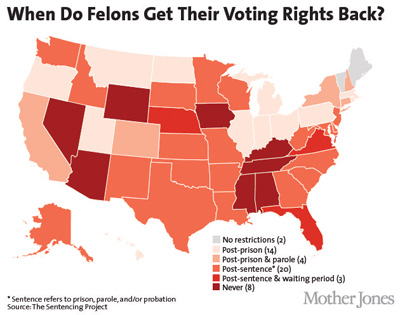
    Presumably, Cruz got his data from this study, which estimates that 73 percent of “hypothetical felon voters” would vote for Democrats. However, a more recent study that looks at how many actual felons register as Democrats puts the number at 62 percent for New York, 52 percent for New Mexico, and 55 percent for North Carolina. That’s still not bad, Democrats! You have the felon vote cornered. Except for one thing: only about a third of them registered at all, only about a fifth have active registration records, and only about 10 percent or so actually voted for president recently. Liberals may generally be in favor of allowing released felons to vote, but it sure isn’t because they think it will help them at the polls. Working for felon voting rights is about the most inefficient and futile way imaginable of getting out the vote.

    In any case, anyone can play this game. Just find some demographic group that tends to vote for Party X, and then find some bad thing also associated with that group. In this case, poor people tend to vote for Democrats, and felons tend to be poor. Bingo. Most felons are Democrats.

    Or this: rich people tend to vote for Republicans, and income-tax cheats tend to be rich. So most income-tax cheats are Republicans.

    Or this: Middle-aged men tend to vote for Republicans, and embezzlers tend to be middle-aged men. So most embezzlers are Republicans.

    We could do this all day long, but what’s the point? The whole exercise is kind of silly. If Ted Cruz wants some attention, he’s going to have to do better than this.

  • Like a Zombie, You Just Can’t Kill Countrywide Financial


    Back at the height of the housing bubble, Countrywide Financial was responsible for about 15 percent of all the mortgage loans in America. This turned out to be disastrous because the people who ran Countrywide showed no interest at all in the quality of the loans they originated. Thanks to this, their business eventually imploded and in 2008 they were acquired by Bank of America.

    But fear not. The executives behind Countrywide are still around, and they’re still shoveling out the loans:

    PennyMac, AmeriHome Mortgage and Stearns Lending have several things in common.

    All are among the nation’s largest mortgage lenders — and none of them is a bank. They’re part of a growing class of alternative lenders that now extend more than 4 in 10 home loans.

    All are headquartered in Southern California, the epicenter of the last decade’s subprime lending industry. And all are run by former executives of Countrywide Financial, the once-giant mortgage lender that made tens of billions of dollars in risky loans that contributed to the 2008 financial crisis.

    This time, the executives say, will be different.

    You betcha! I’m sure these folks have all learned their lessons and will never push the mortgage envelope again. We can all breathe easy.

