• White Americans Without a College Degree Are Seriously Depressed These Days


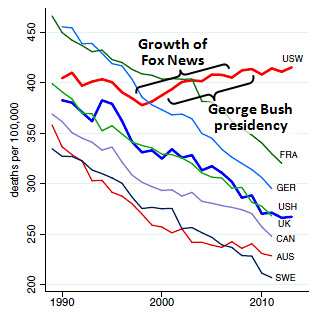
    A new paper by Angus Deaton and Anne Case has gotten a lot of attention for showing that mortality among middle-aged whites has increased over the past two decades in the United States, driven primarily by an increase in suicides, alcohol abuse, and drug overdoses. Everywhere else it’s continued to go down. The chart on the right tells the story. I’ve helpfully annotated it to suggest that perhaps the crisis is over for the time being.

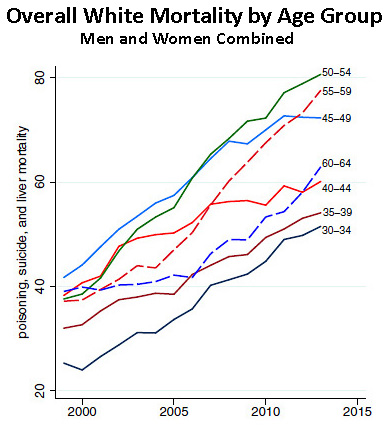
    But the paper is being misreported. It’s not just middle-aged whites. It’s all whites. The chart below tells the real story: every age group from 30 to 65 has shown a steep increase in mortality. So why focus just on middle-aged whites? “The midlife group is different only in that the sum of these deaths is large enough that the common growth rate changes the direction of all-cause mortality.” In other words, the midlife group makes for a more dramatic chart. But every age group has shown a similar trend.

    The increase is dominated by whites with a high-school education or less. They’re reporting more pain, taking more opioid painkillers, abusing alcohol more, and killing themselves more. Why? So far, we don’t really know.

    UPDATE: The chart below was originally titled “White Male Mortality by Age Group.” In fact, it applies to all whites, both men and women. I’ve corrected the title.
  • California Bullet Train Cost Goes Up Yet Again


    Here’s the latest HSR news from California:

    The California high-speed rail authority bowed to pressure from California legislators and members of Congress late Tuesday and released a copy of a 2013 report showing a large estimated increase in the cost of building the initial segment of the bullet train project.

    The report, disclosed by the Times in a story Oct. 25, said Parsons Brinckerhoff had briefed state officials in October 2013 that the projected cost of the first phase of the bullet train system had risen 31%. The state did not use the increase, however, in its 2014 business plan four months later.

    So that’s a 31 percent increase over the course of about two years. But no worries. This new estimate is “preliminary, still in development and subject to review clarification and refinement.” In other words, it might go up even more.

  • Obamacare Co-Op Closures: A Headache, Not a Catastrophe


    Six years ago the Obama administration backed away from offering a public option in Obamacare. In its place, we got nonprofit co-ops. Paul Krugman was not impressed:

    Let’s be clear: the supposed alternative, nonprofit co-ops, is a sham. That’s not just my opinion; it’s what the market says: stocks of health insurance companies soared on news that the Gang of Six senators trying to negotiate a bipartisan approach to health reform were dropping the public plan. Clearly, investors believe that co-ops would offer little real competition to private insurers.

    Well, both Krugman and the market were right: co-ops never signed up all that many patients, and now they’re failing. By next year there could well be none left.

    This has led to a round of breathless news reports. The failures have “handed Republicans a new weapon in their campaign against the health law.” Patients are “scrambling” to find new coverage. The closures have left behind a trail of “human wreckage.”

    Fair enough, I suppose. Co-ops probably were never a good idea, and their bankruptcies really are causing a lot of grief for the people who had signed up with them. Still, in the midst of all this, it’s worth pointing out what we’re talking about:

    • Roughly 500,000 co-op customers will have to switch insurance plans.
    • That’s out of 30 million people who already switch insurance plans each year.1
    • And because of Obamacare, co-op customers can shop for a new plan pretty easily.

    It’s not unfair to make political hay out of this, especially if you thought co-ops were a bad idea to begin with. But the bottom line is that instead of 30 million people switching plans, about 30.5 million will switch plans next year—and they’ll be able to do it more easily than they could in the past. It’s a headache, but hardly a catastrophe.

    1Mostly against their will. About 68 percent are forced to switch because they changed jobs or their employer decided to change carriers. Another 16 percent switched because their plan was too expensive. Less than 10 percent switched because their new plan offered better service.

  • Sarcasm Turns Out to Be Great Creativity Tool. You’re Welcome.


    A new paper suggests that sarcasm is underrated:

    Studies 1 and 2 found that both sarcasm expressers and recipients reported more conflict but also demonstrated enhanced creativity following a simulated sarcastic conversation or after recalling a sarcastic exchange.

    Um, yeah. I remember that part. It’s why my boss once told me I had to give her a dollar every time I said something sarcastic. It was the best she could do since HR told her shock collars violated OSHA regulations. Anyway, onward:

    Study 3 demonstrated that sarcasm’s effect on creativity for both parties was mediated by abstract thinking and generalizes across different forms of sarcasm. Finally, Study 4 found when participants expressed sarcasm toward or received sarcasm from a trusted other, creativity increased but conflict did not. We discuss sarcasm as a double-edged sword: despite its role in instigating conflict, it can also be a catalyst for creativity.

    I would tell you more, but the abstract is all I have access to. Besides, I have a funny feeling that if I read the actual paper I’d find myself underwhelmed by the methodology. If you’re looking for a justification for your witty repartee—and aren’t we all?—maybe it’s best just to let things stand where they are.

  • Trump’s Insults Are Weak, Lack Energy


    Me, yesterday, on how Donald Trump is likely to attack rising star Marco Rubio: “The obvious route for Trump is to mock Rubio’s inability to balance his own checkbook, but I’m hoping for something more original.”

    Trump, today: “He is a disaster with credit cards. All you have to do is look.” And: “He certainly lives above his means — there is no question about that.”

    That’s really disappointing. Trump also went after Rubio on immigration and for not showing up to vote in the Senate. Bo-o-o-o-ring.

    There’s just no creativity here anymore. Remember when he called Jeb Bush “low energy”? That was great. Or that he couldn’t imagine anyone voting for Carly Fiorina’s ugly mug? Good times. It makes me wonder if Trump is really giving his all for America these days. Even the cover of his new book looks phoned in. I mean, is that supposed to be Blue Steel or Le Tigre? I can’t tell.

  • Do Anti-Poverty Programs Work Better Than We Think?


    Poverty data generally comes from the Census Bureau, which bases its analysis on the Current Population Survey. But do poor people under-report or underestimate the value of the programs they participate in? They might, and it seems to me it’s pretty easy to figure this out. Add up the value of, say, all SNAP reports from the CPS, and then compare it to the actual amount of SNAP money the government sends out. If it doesn’t match pretty closely, then the survey is off.

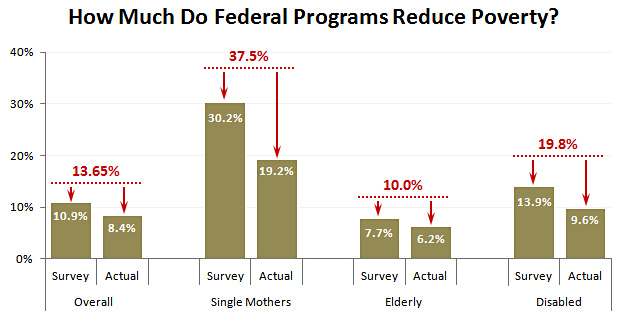
    A pair of researchers recently took a look at how effective anti-poverty programs are, but they never mention this. I guess it must be harder than I think. Instead, they compare CPS data to detailed administrative data from the state of New York that’s known to be highly accurate. They did this for four programs: TANF (basic welfare), SNAP (food stamps), subsidized housing, and general assistance. It turns out that poor people underestimate their annual benefits by about $1,500. This produces two conclusions. First, the authors believe that survey data in general is becoming less reliable over time. Second, they believe that anti-poverty programs lift a lot more people out of poverty than we think.

    The chart below shows their basic conclusion. The overall poverty rate, for example, is 13.65 percent. Using conventional CPS data, that goes down to 10.9 percent after benefits. Using the higher-quality data, however, it appears that anti-poverty programs actually reduce the poverty rate to 8.4 percent. The effect is even more dramatic in households headed by single mothers. Apparently the war on poverty is going better than we thought.

  • Marco Rubio Needs to Come Clean on His Tax Plan


    This is ridiculous. Marco Rubio says that percentage-wise his tax plan is more favorable to the poor than the rich, and both left and right-leaning tax groups agree. But—this is only because Rubio’s plan includes a new $2,000 fully refundable personal tax credit. For those of you not in the know, “refundable” means you get it even if you don’t owe any taxes. So if you’re poor, and your tax bill is already zero, you get a check for $2,000 from Uncle Sam. For someone making minimum wage, that’s a big chunk of money, and on a percentage basis it means that Rubio’s plan is pretty generous.

    But is this really Rubio’s plan? After last week’s debate, a Rubio spokesman told Vox, “Rules would be tailored to ensure that our reforms would not create payments for new, non-working filers.” So….maybe the credit isn’t fully refundable? Perhaps Rubio will update his plan to explain. Well, he did update his plan, and here’s what it now says:

    Creates a new $2,000 (individual) / $4,000 (married filing jointly) refundable personal tax credit in place of the standard deduction: Credit phases out beginning above $150,000 (individual) / $300,000 (married filing jointly) and would be unavailable to taxpayers with an annual income in excess of $200,000 (individual) / $400,000 (married filing jointly).

    So Rubio took the time to specifically say that his tax credit would phase out at high levels, which makes almost no difference to anyone. But his update continues to say, without qualification, that his tax credit is refundable. This means that everyone gets a $2,000 check regardless of their tax bill.
    Look: if you want to go the Ben Carson route and just vaguely say that you’re in favor of a 10 or 15 percent flat tax, and don’t worry your pretty heads about whether the math works, then fine. But if you offer up a very detailed plan, then you’re responsible for the details. Rubio’s plan says he’s going to offer a $2,000 refundable tax credit to everyone. He was challenged on this, and in an update he still says he’s going to offer a $2,000 refundable tax credit to everyone.

    It’s time for Rubio to knock off the games. If the refundable credit is really available to everyone, he needs to say so. If it’s not, then his plan isn’t very generous to the poor, and he needs to stop quoting analyses that assume the credit exists. He can’t have it both ways. Which is it, Marco?

  • Justice Takes a Biblical Turn


    I feel guilty. The New York Times is running a marathon look at arbitration and other forms of private justice, and I haven’t highlighted any of it even though it’s long been one of my pet issues. Big corporations increasingly insist on private arbitration if customers have complaints, and this is happening at the same time the Supreme Court is making it harder and harder to file class-action suits. The upshot is that big corporations can still sue each other (you can bet they don’t accept arbitration clauses when they sign deals) and ordinary people can sue other ordinary people. But when it comes to ordinary people suing big corporations, good luck. Increasingly, you can’t sue them yourself, and law firms can’t initiate class actions. Your only option is to go before an arbitrator who depends for her living on getting lots of corporate business. Good luck getting a fair hearing.
    Today brings Part 3 of the series, and it’s all about the creeping imposition of sharia law in arbitration hearings. No, wait. That’s not it:

    For generations, religious tribunals have been used in the United States to settle family disputes and spiritual debates. But through arbitration, religion is being used to sort out secular problems like claims of financial fraud and wrongful death.

    Customers who buy bamboo floors from Higuera Hardwoods in Washington State must take any dispute before a Christian arbitrator, according to the company’s website. Carolina Cabin Rentals, which rents high-end vacation properties in the Blue Ridge Mountains of North Carolina, tells its customers that disputes may be resolved according to biblical principles. The same goes for contestants in a fishing tournament in Hawaii.

    ….Pamela Prescott battled for years to prove that she had been unjustly fired from a private school in Louisiana. The crux of her case — which wound through arbitration, a federal appeals court and state court — was references in her employment contract to verses from the Bible.

    The Prescott case is sort of amusing. Prescott partially won her complaint based on the arbitrator’s cite of Matthew 18:15. Here’s what happened next:

    The school had required Ms. Prescott to agree to Christian arbitration as a condition of her hiring. But when Northlake lost, it appealed the arbitration award in federal court, arguing that Mr. Thomas’s ruling was inconsistent with Louisiana law.

    The case dragged on for four more years. An appeals court in New Orleans ruled that it had no ground to overturn the Christian arbitrator. Northlake appealed the case all the way to the Supreme Court, which declined to hear it.

    In other words, religion for thee, but not for me.

    Anyway, I guess this is just a typical liberal media cover-up, since we all know the real problem is Muslims and sharia law. But that was too hot for the Times to handle, so instead they’re pretending that Christians do the same thing. It’s no wonder so many people turn to Fox for the real story these days.

  • New Poll Has Modest Good News for Hillary Clinton


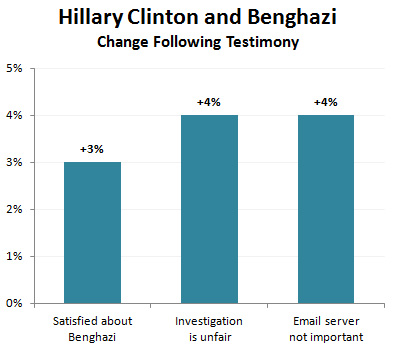
    A new NBC/Wall Street Journal poll suggests that Hillary Clinton’s testimony before the Benghazi committee was pretty successful. More people are satisfied about her account of Benghazi. More people think the continuing investigation is unfair. And more people think her email server is not an important issue.

    The changes aren’t huge, and I imagine there’s a hard base of around 35 percent who will go to their graves believing that these are indisputable examples of her unfitness to serve as president. But these are mostly the same people who think Bill Clinton spent his presidency dealing dope out of Mena airport, so there’s not much chance of influencing them in the first place.

    In other good news for Hillary, she leads Bernie Sanders by 62-31 percent, while a whopping 84 percent think she’s most likely to win the nomination. Apparently only about a third of Bernie’s supporters actually think he has much of a chance to win.