
• Jeb’s Health Care Plan: More Detail, But It Probably Wouldn’t Accomplish Much


    The standard-issue conservative “replacement” for Obamacare is a familiar hodgepodge of tax credits, health savings accounts, high-risk pools, block granting of Medicaid, tort reform, and interstate purchase of health plans. Today, Jeb Bush has broken the rules and offered up a plan that only includes the first four.

    If you’re grading on a curve, that’s a promising start, and Jeb makes things even more interesting by actually offering up a fairly detailed set of alternatives to Obamacare. I’m not sure any Republican candidate has gone anywhere near as far as he has. A few highlights:

    • He wants to “promote innovation” by speeding up FDA approvals, increasing funding for the NIH, establishing national standards for electronic health records (but, oddly, removing any incentive to abide by them), and conducting a “regulatory spring cleaning.” Some of this is standard conservative stuff, but not all of it.
    • His plan provides a tax credit that can be used to buy private health insurance for anyone who doesn’t get health insurance through their employer. However, it sounds like the credit would be pretty small, probably on the order of a few thousand dollars.
    • He wants to broaden the use of health savings accounts.
    • He wants to get rid of Obamacare’s “Cadillac tax,” but he would replace it with something that sounds to me like it’s basically identical. Maybe I’m missing something here.
    • “States would be held accountable to ensure access for individuals with pre-existing conditions.” There’s a fair amount of gibberish here, and even Jeb doesn’t seem especially confident that it will work. However, it’s meaningless anyway since insurance companies wouldn’t be required to offer policies at the same rate to everyone (aka “community rating”). “States would report on access to care,” but that’s it. It appears that there’s nothing in Jeb’s plan that prevents insurance companies from simply charging sky-high prices to anyone with a pre-existing condition.
    • There is, of course, no mandate to buy insurance. This would be catastrophic for insurance companies, except for the fact that Jeb’s plan doesn’t require them to cover patients with pre-existing conditions in the first place.
    • Jeb almost fooled me by not mentioning block-granting of Medicaid. But of course that’s in there. He calls it “capped allotments” and pairs it up with a proposal to essentially deregulate state Medicaid plans completely but still “hold states accountable for outcomes”—though there’s not a single word about exactly what this means. Jeb’s allotments would grow at the rate of inflation, which means they’d get smaller every year since medical costs typically grow faster than inflation.

    Just about every serious health care plan that truly wants to expand coverage relies on a three-legged stool: mandates, community rating, and federal subsidies. Jeb’s plan doesn’t include the first two and offers only a stingy version of the third. It’s much more detailed than your average Republican plan, but in the end it would probably expand coverage hardly at all.
  • Ben Carson Is a Paranoid Nutcase


    I’m hardly the first one to notice this, but lately Ben Carson has really been letting his freak flag fly—adding to a long history of this kind of thing. For example:
    • A few days ago Carson peddled a conspiracy theory about Vladimir Putin, Ali Khamenei, and Mahmoud Abbas all being old pals from their days together at Patrice Lumumba University in Moscow in 1968. He refused to divulge his source for this, but instead explained it this way: “That’s what I call wisdom,” Carson said. “You get these pieces of information. You talk to various people. You begin to have an overall picture. You begin to understand why people do what they do.”
    • He insisted that Hitler’s rise to power was accomplished “through a combination of removing guns and disseminating propaganda”—despite the plain historical fact that Hitler didn’t remove anyone’s guns during the period when he took power.
    • Asked if the “end of days” was near, he said, “You could guess that we are getting closer to that.”
    • He has suggested that being gay is a conscious choice because “a lot of people who go into prison go into prison straight and when they come out they’re gay. So did something happen while they were in there? Ask yourself that question.”
    • Last year, before the November elections, he predicted that President Obama might declare martial law and cancel the 2016 elections. “If Republicans don’t win back the Senate in November, he says, he can’t be sure ‘there will even be an election in 2016.’ Later, his wife, Candy, tells a supporter that they are holding on to their son’s Australian passport just in case the election doesn’t go their way.”
    • Has repeatedly endorsed the bizarre conspiracy theories of W. Cleon Skousen’s 1958 book The Naked Communist. “You would think by reading it that it was written last year—showing what they’re trying to do to American families, what they’re trying to do to our Judeo-Christian faith, what they’re doing to morality.” As my colleague David Corn notes, even most conservatives agree that Skousen was a nutcase. “He was a complete crank. He maintained that the Founding Fathers were direct descendants of the Lost Tribes of Israel and contended that a global cabal of bankers controlled the world.”

    This goes well beyond merely being a very conservative guy. These are the kinds of weird beliefs and conspiracy theories that marinate in the deepest corners of right-wing websites and email lists. It’s Alex Jones territory. It’s time to stop whispering about this, and say out loud that Carson is just not a normal conservative guy. He’s a paranoid nutcase.

  • Critics Pan New Show “21st Century”


    Charlie Stross is unhappy:

    I want to complain to the studio execs who commissioned the current season of “21st century”; your show is broken.

    I say this as a viewer coming in with low expectations. Its predecessor “20th century” plumbed the depths of inconsistency with the frankly silly story arc for world war II. It compounded it by leaving tons of loose plot threads dangling until the very last minute, then tidied them all up in a blinding hurry in that bizarre 1989-92 episode just in time for the big Y2K denouement (which then fizzled). But the new series reboot is simply ridiculous! It takes internal inconsistency to a new low, never before seen in the business: the “21st century” show is just plain implausible.

    So far, I give the 21st century two stars. It might be better if they’d just release the whole thing at once so I could binge watch it, instead of forcing me to live through this nonsense week by week.

  • It Looks Like We’re Stuck With Low Inflation


    Back in August I agreed with Brad DeLong that 4 percent inflation would be a good thing right now, but I was skeptical that the Fed could engineer this given current conditions. So I asked him what it would take. Today, I apparently made it to the top of the question pile:

    I think the answer is: We don’t know whether it is in fact possible for a central bank today to hit a 4%/year average inflation target via conventional ordinary quantitative easing. It might well require other tools. For example:

    1. Miles Kimball’s negative interest rates.
    2. Helicopter drops–that is, allowing everyone with a Social Security number to incorporate as a bank, join the Federal Reserve system, and borrow at the discount window, with the loan discharged by the individual’s death.
    3. The Federal Reserve as infrastructure bank–an extra $500 billion/year of quantitative easing buying not government or mortgage bonds but directly-financing public investments.
    4. Extraordinary quantitative easing–buying not the close substitutes for money that are government bonds but rather the not-so-close substitutes that are equities.

    I say: If we could win the argument about what the goal is, we could then begin the discussion about what policies would be needed to get us there.

    That’s pretty discouraging. Of these, #2 and #3 are almost certainly illegal, and undesirable in any case. I may not like what Congress is doing, but disbursing money is certainly under their purview—and should be. I don’t want the Fed mailing out checks or contracting for new roads and bridges.

    I don’t know if #4 is illegal. Probably not. But I’m not crazy about this either. The Fed shouldn’t be in the business of directly propping up the stock market, and certainly shouldn’t be in the business of directly propping up specific stocks.

    So that leaves only #1. This one is perfectly OK, and a few European countries have adopted negative rates recently. But there’s probably a limit to how negative these rates can be. Individuals could avoid negative rates by deciding to hold physical cash, which pays zero percent, but banks and corporations almost certainly couldn’t. I’m not sure how long it’s sustainable to essentially have two different interest rates like that.

    This is why DeLong mentions “Miles Kimball’s” negative interest rates. Kimball’s version depends on making the e-dollar into the unit of account, and this would allow negative rates of any level for any period of time. However, it would also require many years to make this transition. It’s not an option in the short term.

    So if I’m reading DeLong right, it’s not clear that the Fed could engineer 4 percent inflation at all right now. Maybe Scott Sumner has a bright idea about how we could do this.

  • I’d Give Obama’s Syria Policy a B+


    “I don’t have a lot of good things to say about the Obama administration’s Syria policy,” says Dan Drezner. He links to Adam Elkus, who calls Obama’s Syria strategy “semi-competent.” At the BBC, Tara McKelvey writes about Robert Ford, former US ambassador to Syria, who was close to the Syrian opposition and wanted to arm them when the Assad regime started to crumble. “People in the intelligence community said the time to arm the rebels was 2012,” she writes. The problem is that officials in Washington were unsure that Ford really knew the opposition well enough. “Most of the rebels, he said, weren’t ‘ideologically pure’, not in the way US officials wanted. ‘In wars like that, there is no black and white,’ he said.”
    I’ll agree on a few counts of the indictment against Obama. Now that the mission to arm the rebels has failed, he says he was never really for it in the first place. That’s cringeworthy. The buck stops with him, and once he approved the plan, hesitantly or not, it was his plan. He should take responsibility for its failure. You can also probably make a case that we should have done more to arm the Kurds, who have shown considerable competence fighting both ISIS and Assad.

    But those are relative nits, and I’d be curious to hear more from Drezner about this. He basically agrees that arming rebels hasn’t worked well in the Middle East, and there’s little chance it would have worked well in Syria. “There is a strong and bipartisan 21st-century record of U.S. administrations applying military force in the Middle East with the most noble of intentions,” he says, “and then making the extant situation much, much worse.” He also agrees that Obama’s big-picture view of Syria is correct. “The president has determined that Syria is not a core American interest and therefore does not warrant greater investments of American resources. It’s a cold, calculating, semi-competent strategy. But it has the virtue of being better than the suggested hawkish alternatives.” He agrees that those “hawkish alternatives” are basically nuts.

    So why exactly is Obama’s record in Syria “semi-competent”? Why does Drezner not have much good to say about it? My only serious criticism is that Obama did too much: he never should have talked about red lines and he never should have agreed to arm and train the opposition at all. But given the real-world pressures on him, it’s impressive that he’s managed to restrict American intervention as much as he has. I doubt anyone else could have done better.

    There is something genuinely baffling about American hawks who have presided over failure after failure but are always certain that next time will be different. But why? If anything, Syria is more tangled and chaotic than Iraq, Yemen, Libya, Afghanistan, or any of the other Middle Eastern countries we’ve gotten involved in since 2001. What kind of dreamy naivete—or willful blindness—does it take to think that we could intervene successfully there?

    Anyway, that’s my question. Given the real world constraints, and grading on a real-world curve, what has Obama done wrong in Syria?

  • Another Long, Hot Summer of Catcalling Is Coming to a Close

    Hannah Giorgis writes about the endless struggle with catcalling in New York City:

    After another summer spent shrugging off men’s loud assessments of my body any time I left my apartment, I am exhausted. And as the streets thin out and the weather cools to a temperature less accommodating of men who consider catcalling a leisure sport, I am increasingly able to pause and feel the depth of my own fatigue.

    ….Every outing involves dozens of split-second decisions. The short, loose dress or the long, form-fitting one? The almost-empty subway car or the crowded one? The shorter route or the more well-lit one?….My mind can only make so many daily calculations before it slips into what social psychologist Roy F. Baumeister calls “decision fatigue.” Processing each of these useless equations takes a biological toll on my brain, leaving it more inclined, as the day wears on, to look for shortcuts.

    Read the whole thing. Or, if you’d prefer a video dramatization of what it’s like, check out the YouTube below.

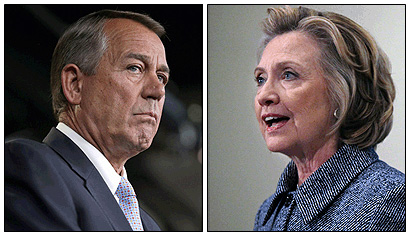
  • Report: John Boehner Is the Guy Who’s Kept the Hillary Email Scandal Alive


    Back when the Benghazi committee started up, Rep. Trey Gowdy swore that it was nothing more than an impartial search for the truth about a raid that cost four American lives. So how is that coming along? The New York Times reports:

    Now, 17 months later — longer than the Watergate investigation lasted — interviews with current and former committee staff members as well as internal committee documents reviewed by The New York Times show the extent to which the focus of the committee’s work has shifted from the circumstances surrounding the Benghazi attack to the politically charged issue of Mrs. Clinton’s use of a private email server while she was secretary of state.

    ….The committee has conducted only one of a dozen interviews that Mr. Gowdy said in February that he planned to hold with prominent intelligence, Defense Department and White House officials, and it has held none of the nine public hearings — with titles such as “Why Were We in Libya?” — that internal documents show have been proposed.

    At the same time, the committee has added at least 18 current and former State Department officials to its roster of witnesses, including three speechwriters and an information technology specialist who maintained Mrs. Clinton’s private email server.

    From the standpoint of a genuine Benghazi investigation, Hillary Clinton’s email issues wouldn’t matter. All the committee would care about is getting a look at the emails from her private server—which is now happening. For some reason, though, they care deeply about investigating that email server to death, even though it has nothing to do with the Benghazi attacks. Why is that?

    A friend of mine has tried to persuade me that Gowdy is probably playing things straight. I’ve argued that I don’t believe it. He’s a true believer, and he cares a lot more about taking down Democrats than he does about Benghazi itself, which he probably knows perfectly well has already been investigated to death. So which of us is right? This tidbit sheds a bit of light on things:

    [Gowdy] said that at one point this spring he told John A. Boehner, the House speaker, that he feared the task of investigating the email issue would distract from his committee’s work….[and] pressed Mr. Boehner to have another House committee examine the matter of Mrs. Clinton’s emails, but that Mr. Boehner had rejected the request.

    ….Senior Republican officials, who spoke on the condition of anonymity because they were discussing confidential conversations, said that Mr. Boehner had long been suspicious of the administration’s handling of the attacks and that Mrs. Clinton’s emails gave him a way to keep the issue alive and to cause political problems for her campaign. But he thought that the task was too delicate to entrust to others and that it should remain with Mr. Gowdy, the former prosecutor.

    If this is true, my friend is halfway right: Gowdy never really wanted to get distracted with politically motivated attacks on Hillary Clinton. But John Boehner did, and he figured Gowdy was the best man for the job.

    I’m not quite sure what this says about Gowdy, but it’s certainly clear that Boehner thought that manipulating the media into nonstop reporting on Hillary’s email server was a great idea. He also figured the media would take the bait. And they did.

    So Gowdy gets, oh, let’s say a C+. He tried to do the right thing, but caved in pretty quickly. Boehner gets a D. He was all about taking down Hillary Clinton from the get-go. The media gets an F. Boehner at least has the excuse of being a senior Republican leader, and attacking Democrats comes with the territory. But the media is not supposed to be so gullible that they believe everything Republicans say about Democratic leaders. In the case of Hillary Clinton, though, that rule seems to have been suspended. Again.

  • Benghazi Staffers Spent Their Days Designing Personalized “Tiffany Glocks”


    Who said this?

    He described to CNN an office environment in which employees spent their days Web surfing and sometimes drinking at work. He said staffers joined a “gun buying club” for “chrome-plated, monogrammed, Tiffany-style Glock 9-millimeters,” and some would spend hours at a time at work designing the personalized weapons.

    Answer: Maj. Bradley Podliska, a former member of the House Benghazi committee, who claims he was fired for refusing to spend his time focused solely on Hillary Clinton instead of actually investigating Benghazi. I don’t know yet if I believe him, but the whole Tiffany Glock thing sounds way too weird to have been made up.

  • Was the “California Stop” Really Invented in California?


    On my way home from lunch today I saw the billboard on the right. Seems like it should be “California Alto” or something, shouldn’t it? I guess “California Stop” is one of those things that’s famous enough that it’s always rendered in its native language.
    But I’m curious: where did “California Stop” come from, anyway? I won’t claim that I have a ton of experience driving all over the country, but I’ve driven in plenty of places both east and west, and it seems to me that people are pretty casual about stop signs everywhere. Sure enough, on a message board that posted a question about this, various folks said that in their neck of the woods it was called a:

    • St. Louis Stop
    • New York Stop
    • Hollywood Stop
    • New Orleans Stop

    This suggests that it really is common everywhere, but it’s equally common to think it’s unique to your own city/state/region. But if that’s the case, why is it so common to call it a California Stop? Did we do it first? Is it related to California pioneering the right-on-red rule? Anybody know what the deal is?

  • Have You Ever Thought About the Republican Party? I Mean, Really Thought About It?


    As much as we’ve talked about it, I wonder if we’ve really gotten our heads around the fact that Paul Ryan is literally being begged to be the leader of the Republican Party. He is Literally. Being. Begged. To be the leader of one of America’s two major parties! And he doesn’t want it, no how, no way. Because he knows there’s a substantial faction of his party that’s insane. And who would know better?

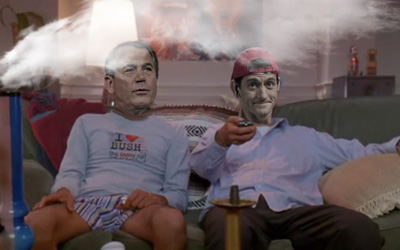
    I feel like this is one of those things that maybe you can only truly comprehend after a couple of blunts:

    Boehner: Dude, have you ever thought about the Republican Party? I mean, really thought about it?

    Ryan: I know. I know. It’s, like, insane, man. (Giggles, coughs.) This is good stuff. Medical, right?

    Boehner: That’s it! Totally insane. I mean, completely batshit fucked up.

    Ryan: But awesome. Insane but still awesome. I mean, seriously, it’s our only defense against, like, total socialism.

    Boehner: Oh man, you been reading Atlas Shrugged again? You’re bumming me out, dude.

    And while we’re on the subject, I have another idea. As thousands of people have pointed out, nothing in the Constitution says the Speaker has to be a member of Congress. This has spawned a whole cottage industry of jokes. Donald Trump! Bibi Netanyahu! Rush Limbaugh! But I have another idea: does it have to be one person? Here’s the relevant text:

    The House of Representatives shall chuse their Speaker and other Officers….

    Sure, “Speaker” is singular in that sentence, but “Speaker and other Officers” suggests that maybe leadership of the House could be shared. How about a triumvirate, like Rome in its glory days? Ryan could be one, some tea party nutcase could be another, and the third could be, um, Mia Love, who’s a black woman and the daughter of immigrants. I’m not sure how they’d make decisions, but I guess they’d figure out something. Maybe rock paper scissors.

