• How Our Constitution Indulges the Great Conservative Fantasy


    A few days ago Matt Yglesisas wrote a #Slatepitch piece arguing that Hillary Clinton “is clearly more comfortable than the average person with violating norms and operating in legal gray areas”—and that’s a good thing. In a nutshell, Democrats can’t get anything done through Congress, so they need someone willing to do whatever it takes to get things done some other way. And that’s Hillary. “More than almost anyone else around, she knows where the levers of power lie, and she is comfortable pulling them, procedural niceties be damned.”

    Unsurprisingly, conservatives were shocked. Shocked! Liberals are fine with tyranny! Today Matt responded in one of his periodic newsletters:

    A system of government based on the idea of compromises between two independently elected bodies will only work if the leaders of both bodies want to compromise. Congressional Republicans have rejected any form of compromise, so an effective Democratic president is going to try to govern through executive unilateralism. I don’t think this is a positive development, but it’s the only possible development.

    I don’t think I’m as pessimistic as Yglesias, but put that aside for a moment. Look at this from a conservative point of view. They want things to move in a conservative direction. But compromise doesn’t do that. In practice, it always seems to move things in a more liberal direction, with a few conservative sops thrown in that eventually wither away and die. This leaves them with little choice except increasingly hard-nosed obstructionism: government shutdowns, debt ceiling fights, filibusters for everything, voter ID laws, etc. etc.

    And there’s a lot of truth to this to this view. The entire Western world has been moving inexorably in a liberal direction for a couple of centuries. It’s a tide that can’t be turned back with half measures. Conservative parties in the rest of the world have mostly made their peace with this, and settle for simply slowing things down. American conservatives actually want to reverse the tide.

    That’s all but impossible in the long term. It’s just not the way the arc of history is moving right now. But American conservatives are bound and determined to do it anyway.

    This is the fundamental problem. British conservatives, in theory, could turn back the clock if they wanted to, but they don’t. Their parliamentary system allows them to do it, but public opinion doesn’t—which means that if they want to retain power, there’s a limit to how far they can fight the tide. If American conservatives were in the same situation, they’d probably end up in the same place. Once they actually got the power to change things, they’d very quickly moderate their agenda.

    It’s in this sense that our system of governance really is at fault for our current gridlock. Not directly because of veto points or our presidential system or any of that, but because these features of our political system allow conservatives to live in a fantasy world. They dream of what they could do if only they had the political power to do it, and they really believe they’d do it all if they got the chance. Thanks to all those veto points, however, they never get the chance. Full control of the government would disabuse everyone very quickly of just how far they’re really willing to go, but it never happens.

    We are living through an era in which conservatives are living a fantasy that can never be. But our system of governance denies them the chance to test that fantasy. So it continues forever. It will stop eventually, either because conservatives somehow do gain total political power and are forced to face up to its limits, or because it burns itself out through continual head banging that gets them nowhere combined with demographic changes that decimate their base. Probably the latter. It’s only a question of how long it takes.
  • Let’s Experiment With the Minimum Wage and EITC


    When you add up the minimum wage and the Earned Income Tax Credit, Brad DeLong thinks it should add up to a living wage:
    Of course, minimum-wage advocates are fearful of the following: We say raise the minimum wage, they say increase the earned income tax credit instead. We say increase the earned income tax credit, they say it is more important to reduce the deficit. We say fund the earned income tax credit by raising taxes, they say lower taxes promote entrepreneurship. We say cut defense spending, they say ISIS and Iran. The shift of attention to the earned income tax credit is then seen as—which it often is—part of the game of political Three Card Monte to avoid doing anything while not admitting you are opposed to doing anything.

    That is all very true.

    So raise the minimum wage, and then bargain back to a lower minimum wage and a higher income tax credit if it turns out that there are significant disemployment affects.

    Well, yes, that would be fine except that the same people who refuse to increase the EITC are the same ones who refuse to raise the minimum wage. We’re no more likely to get a $15 (or $12 or $13 or $14) minimum wage than we are to get a more generous EITC. Ditto for wage subsidies, which are popular in some conservative circles. The excuses may vary depending on the circumstances, but they will always add up to No.

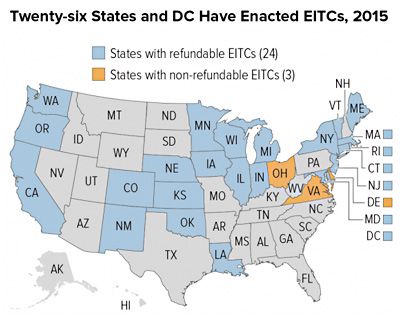
    Perhaps a better bet is to focus on the state level. Plenty of states have an EITC that piggybacks on the federal EITC, and that means there are plenty of laboratories of democracy where we could try different combinations of EITC and minimum wage to see what works best. Who knows? Maybe a few states could even be talked into trying out wage subsidies.

  • Perhaps We Should Retire the Idea That Joe Biden Is “Authentic”


    Back in August, Maureen Dowd wrote several hundred words about what a horrible person Hillary Clinton is. No surprise there. She could pretty easily write a million if the Times gave her the space. But then, having obsessed over Hillary’s sinister psyche for the thousandth time, she turned to the possibility of white knights jumping into the presidential race to save us all. In particular, there was Joe Biden, who was now reconsidering a run after the death of his son Beau:
    When Beau realized he was not going to make it, he asked his father if he had a minute to sit down and talk….“Dad, I know you don’t give a damn about money,” Beau told him, dismissing the idea that his father would take some sort of cushy job after the vice presidency to cash in.

    Beau was losing his nouns and the right side of his face was partially paralyzed. But he had a mission: He tried to make his father promise to run, arguing that the White House should not revert to the Clintons and that the country would be better off with Biden values.

    It’s a touching scene, but also an odd one: Dowd didn’t attribute it to anyone. Not even “a friend” or “someone with knowledge of the situation.” In Politico today, Edward-Isaac Dovere says there’s a reason for that:

    According to multiple sources, it was Biden himself who talked to her….It was no coincidence that the preliminary pieces around a prospective campaign started moving right after that column. People read Dowd and started reaching out, those around the vice president would say by way of defensive explanation. He was just answering the phone and listening. But in truth, Biden had effectively placed an ad in The New York Times, asking them to call.

    ….“Calculation sort of sounds crass, but I guess that’s what it is,” said one person who’s recently spoken to Biden about the prospect of running.

    ….At the end of August, while friends were still worrying aloud that he was in the worst mental state possible to be making this decision, he invited Elizabeth Warren for an unannounced Saturday lunch at the Naval Observatory. According to sources connected with Warren, he raised Clinton’s scheduled appearance at the House Benghazi Committee hearing at the end of October, even hinting that there might be a running-mate opening for the Massachusetts senator.

    Needless to say, I don’t have any independent knowledge of whether Dovere is right about this. But it sure sounds plausible, and it’s a good illustration of why you should take claims of “authenticity” with a big shaker of salt. Biden is an outgoing guy and gets along well with the press. But that just means he’s an outgoing guy who gets along well with the press. Authenticity has nothing to do with it.

    It’s one thing for people close to a candidate to leak information that makes their man look good—that’s so common I’m not sure it even has a name—but for the candidate himself to use his son’s death as a way of worming his way into a weekly column written by a woman who detests Hillary Clinton more fanatically than anyone this side of Ken Starr? I’m not quite sure what to call that, but authentic isn’t it.

  • Paul Krugman Explains the Latest Draft of the TPP


    Suppose there’s a complex public policy proposal being debated and you want to know where you should stand. However, you really don’t want to devote a huge amount of time to diving into all the details. There are just so many hours in the day, after all.

    One possibility is to simply see what people on your side of the tribal divide think about it. But that’s surprisingly unreliable. A better approach is to take a look at who’s opposed to the proposal. That’s what Paul Krugman does today regarding the final draft of the Trans-Pacific Partnership trade agreement:

    What I know so far: pharma is mad because the extension of property rights in biologics is much shorter than it wanted, tobacco is mad because it has been carved out of the dispute settlement deal, and Rs in general are mad because the labor protection stuff is stronger than expected….I find myself thinking of Grossman and Helpman’s work on the political economy of free trade agreements, in which they conclude, based on a highly stylized but nonetheless interesting model of special interest politics, that

    An FTA is most likely to be politically viable exactly when it would be socially harmful.

    The TPP looks better than it did, which infuriates much of Congress.

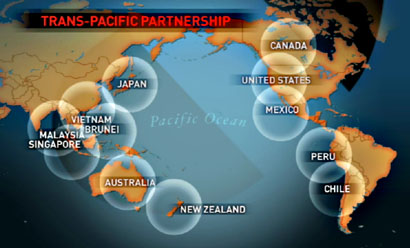
    Krugman describes himself as a “lukewarm opponent” of TPP who now needs to do some more homework. I’d probably call myself a lukewarm supporter. One reason is that the dispute resolution provisions, which provoked a lot of anger on the left, never struck me as either unusual or all that objectionable in practice. The IP stuff bothered me more, and that’s been improved a bit in the final draft. It’s still not great, but it’s not quite as horrible as before. So you can probably now count me as a slightly stronger supporter.

    But I wonder what Republicans will do? They’re the ones who are ideologically on the side of trade agreements, and they’ve spent a lot of time berating President Obama for not putting more effort into trade deals. But with campaign season heating up, it’s become more toxic than ever to support any initiative of Obama’s. Plus Donald Trump is busily working his supporters into a lather about TPP. I wouldn’t be surprised to see quite a few defections from the Republican ranks.

  • Here’s One Simple Rule For Deciding Who the Media Covers


    Paul Waldman notes today that Marco Rubio is the latest beneficiary of the media spotlight. Why?
    If history is any guide, the “outsider” candidates will eventually fall, and Rubio is the only “insider” candidate whose support is going up, not down. Scott Walker is gone, Jeb Bush is struggling, and none of the other officeholders seem to be generating any interest among voters. Rubio has long had strong approval ratings among Republicans, so even those who are now supporting someone else don’t dislike him. He’s an excellent speaker both with prepared texts and extemporaneously. When you hear him talk he sounds informed and thoughtful, and much less reactionary than his actual ideas would suggest. He presents a young, Hispanic face for a party that desperately needs not to be seen as the party of old white guys.

    This is all true, but it gives the media way too much credit. Here’s the rule they use for deciding who to cover:

    • If you’re leading or rising in the polls, you get coverage.

    That’s it. All the other stuff about Rubio has been true all along, and nobody cared about him. Now he’s rising in the polls and is currently in about fourth place. So he’s getting coverage.

    This happened first to Donald Trump, then to Ben Carson, then to Carly Fiorina, and now to Rubio. Bernie Sanders, oddly enough, remains fairly immune. Maybe this rule only applies to Republicans this year.

  • Let’s Not Rewrite History on Gun Violence


    “This is something we should politicize,” President Obama said last week after the gun massacre in Oregon. “It is relevant to our common life together, to the body politic.” Jonah Goldberg is annoyed that Obama said this even though he’s routinely spoken out against politicizing issues in the past. “He’s not about to try building consensus on gun violence among people of good faith,” Goldberg says. Then this:

    Obama’s comments on Thursday highlighted the problem with his approach to politics. He would rather go for everything he wants and get nothing, but keep the political issue, than make progress on common ground.

    Virtually none of the proposals on his gun-control wish list — more comprehensive federal background checks, closing the gun show “loophole,” etc. — would help bring down the homicide rate….Typically, mass killers don’t buy guns at gun shows. And a CNN analysis found that a comprehensive background check system wouldn’t have prevented any of the “routine” killing sprees Obama referred to, save one.

    ….After the Sandy Hook slaughter, there was a bipartisan consensus that more needed to be done on the mental health side. But Obama, fresh off reelection, rejected a piecemeal approach, largely preferring to go for a “comprehensive” solution. He ended up with nothing at all.
    Um, what? Shortly after Sandy Hook, Joe Biden released the final report of his task force on gun violence. It contained recommendations in four areas, one of which was increased access to mental health services. Several bipartisan bills that targeted mental health did indeed get introduced, and I believe Obama supported all of them. So why didn’t they pass? That’s always hard to say, but the best guess is that it’s because they all cost money, and Republicans were unwilling to vote for increased spending. So they died. Obama’s preference for a “comprehensive” approach had nothing to do with it.

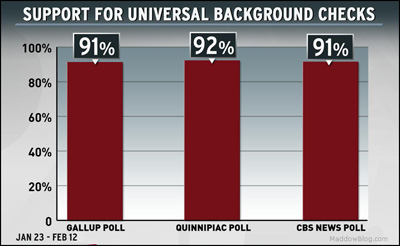
    Beyond that, sure, Obama wanted comprehensive legislation. But in the end, this got whittled down to one thing: a bipartisan bill mandating universal background checks. It was watered down repeatedly, and was about as weak as possible by the time it finally got a vote. Despite massive public support, even from gun owners, it failed after an enormous effort to reach out to all those people of good faith Goldberg talks about. I think you can guess who voted against it.1

    1It was 41 Republicans and 5 Democrats, in case you’ve forgotten.

  • Why Did Lindsey Graham Vote Against Hurricane Sandy Relief in 2013? Here Are Half a Dozen Guesses.


    South Carolina senator Lindsey Graham voted against a $51 billion aid bill for New Jersey after Hurricane Sandy, but feels differently about federal aid for the devastating floods that have racked his state. “Let’s just get through this thing, and whatever it costs, it costs,” Graham told Wolf Blitzer yesterday. Blitzer then asked him why he had opposed Sandy relief:

    “I’m all for helping the people in New Jersey. I don’t really remember me voting that way,” Graham said. Pressed further, he said: “Anyway, I don’t really recall that, but I’d be glad to look and tell you why I did vote no, if I did.”

    Well, yes, he did indeed vote against Sandy aid. I don’t know why he did it either, but I can take a few guesses:

    • He was pissed off over the nomination of Chuck Hagel as Secretary of Defense.
    • He was pissed off over the recently concluded fiscal cliff negotiations, which Republicans lost.
    • He was pissed off over the national debt and wanted to make a point about out-of-control spending before the upcoming debt ceiling showdown.
    • He was pissed off over sequester caps that prevented big increases in military spending.
    • He was pissed off over flood insurance provisions in the bill, which had been loudly denounced by the Club for Growth.
    • He was pissed off over alleged pork in the aid bill.

    Alternatively, Graham didn’t really think about it at all, which is why it’s slipped his mind by now. Maybe he just vaguely figured the bill would pass, so this was a chance to demonstrate fiscal toughness without running the risk of being held personally responsible for enormous human suffering in New Jersey. After all, 35 other Republican senators voted against it too. So why not join them?

  • Thanks to the NSA, Data Sharing With Europe Just Got a Little Harder


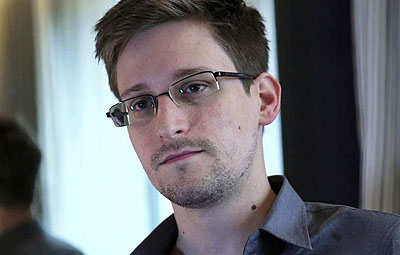
    The long arm of Edward Snowden just got a little longer today:

    Europe’s highest court on Tuesday struck down an international agreement that had made it easy for companies to move people’s digital data between the European Union and the United States. The ruling, by the European Court of Justice, could make it more difficult for global technology giants — including the likes of Amazon and Apple, Google and Facebook — to collect and mine online information from their millions of users in the 28-member European Union.

    So what does this have to do with Snowden? Since 2000, a “Safe Harbor” agreement has allowed US companies to store personal data on European nationals as long as the companies comply with a specific set of rules to minimize abuse. At the time, it was commercial abuse that everyone had in mind. Today it’s government abuse:

    Tuesday’s decision stems from a complaint lodged in 2013 by Austrian privacy activist Max Schrems over Facebook’s compliance with EU data-privacy rules. In his charge filed to the Irish data-protection authority, the U.S. social-media company’s lead regulator in Europe, Mr. Schrems claimed that allegations by former U.S. National Security Agency contractor Edward Snowden showed Facebook wasn’t sufficiently protecting users’ data because it is subject to mass surveillance in the U.S.

    There are workarounds for this, but they’re complicated and burdensome. What’s more, efforts to reach an updated agreement will be difficult since the court ruling allows privacy regulators in every country to set up their own rules. This means that negotiations with the EU almost certainly have to include every national regulator who wants a voice, since each one can essentially veto an agreement in their own country.

    Alternatively, the US could announce major reforms to its NSA spying programs. Just kidding, of course. We all know that’s unpossible.

  • Coming Soon: Quantum Computing on Your Desktop PC?


    Today has been pretty dull in the world of political news, so let’s continue trawling other parts of the global knowledge ecosystem for interesting tidbits. This one looks potentially important:

    For decades, researchers have been trying to build a computer that harnesses the enormous potential of quantum mechanics. Now engineers from the University of New South Wales (UNSW) in Australia have overcome the final hurdle, by creating a quantum logic gate in silicon — the same material that today’s computer chips are made from.

    The newly developed device allows two quantum bits — or qubits — to communicate and perform calculations together, which is a crucial requirement for quantum computers. Even better, the researchers have also worked out how to scale the technology up to millions of qubits, which means they now have the ability to build the world’s first quantum processor chip and, eventually, the first silicon-based quantum computer.

    Quantum computing is sort of like fusion power: constantly right around the corner, but never quite there. The fundamental problem is that qubits suffer from decoherence unless they’re kept completely isolated from their surrounding environment, which is pretty tough since they also need to communicate with other qubits in order to be useful. Researchers have gotten a lot better at controlling qubits in recent years, but as the UNSW paper points out, this has required the use of fairly exotic materials: “single photons, trapped ions, superconducting circuits, single defects or atoms in diamond or silicon, and semiconductor quantum dots.”

    By contrast, a two-qubit logic gate that can be implemented in silicon using standard lithographic techniques is a whole different matter. If this turns out to be for real, chips containing thousands or millions of qubits are finally within practical reach.

    This would be very cool, though only for a certain subset of problems amenable to massive parallel processing. This is inherent in the difference between standard computers and quantum computers. A standard computer with, say, 50 bits, can be in any one of 250 states at a single time. That’s about a quadrillion states. This state changes with every beat of the computer’s internal clock, and eventually you get an answer to whatever problem you’ve programmed the computer to solve. By contrast, a quantum computer with 250 qubits can be in a quadrillion states simultaneously thanks to an aspect of quantum weirdness called superposition. Once you set up the program, you just collapse the quantum state and the answer is spit out instantly.

    This is not the kind of thing you’d use to write an iPhone app. But it could be used to break some public-key encryption systems. It might also be useful for things like modeling protein folding, which is fundamentally a quantum problem that requires a tremendous amount of computing time using traditional computers. There’s also potential for exponentially faster database queries.

    And one other thing: it’s possible that large-scale quantum computing could lead to breakthroughs in emulating human thought processes and speeding up the creation of artificial intelligence. Maybe.

    Anyway, it’s fascinating stuff, and it seems as if useful quantum computing may be finally getting within reach. If it does, it would blow away Moore’s law for certain kinds of problems—possibly many more than we think once we get the hang of writing a whole different kind of code. In a few years, maybe we’ll even get customer support voice recognition systems to work properly.