• First It’s Robert E. Lee, Then the Book Burnings Start

    Chuck Myers via ZUMA

    From George Leef at National Review:

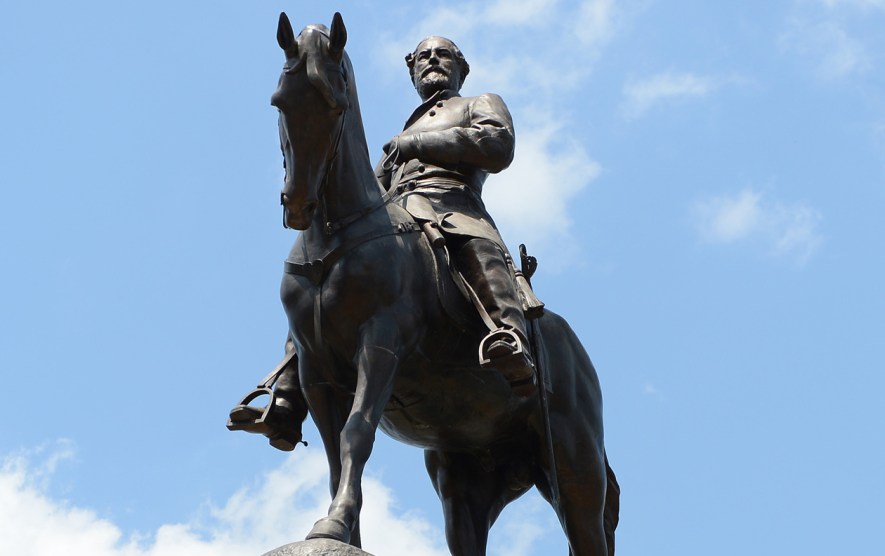
    Progressives need a steady stream of excuses for their manufactured outrage. The latest is statues and monuments that are supposedly harmful to “marginalized” people because they depict men who fought for the Confederacy (or were imperfect in other ways). Mute bits of metal and stone don’t actually do anything, don’t oppress anyone, don’t send any message. They could merely be ignored in favor of doing something constructive for the poor and supposedly “marginalized,” such as pushing for school choice or getting rid of harmful licensing laws. But that’s the last thing the Left wants.

    And of course George Washington and Thomas Jefferson are next, then the book burnings will start, blah blah blah. Good God. Where does NR find these people?

  • CDOs Are Back!

    The Wall Street Journal reports:

    The synthetic CDO, a villain of the global financial crisis, is back….In the U.S., the CDO market sunk steadily in the years after the financial crisis but has been fairly flat since 2014. In Europe, the total size of market is now rising again—up 5.6% annually in the first quarter of the year and 14.4% in the last quarter of 2016, according to the Securities Industry and Financial Markets Association.

    I’d normally be all over this kind of thing. This is how it starts. Pretty soon, the Wall Street boys will be breaking out the bottles of Cristal again. And it is worth keeping an eye on. But I decided to redraw the chart from the Journal, and I have to admit it’s a little hard to get too bent out of shape:

    If you squint, you can see a tiny blip upward at the far right end of the chart. Granted, the scale of the chart makes it look really small. Still, after soaring 600x during the housing bubble, it’s soared…1.3x since last year.

    So, yes, let’s keep an eye on this. But even I find it hard to get too worried yet.

  • Oh Just Say It: Climate Change Is (Partly) Responsible For Houston’s Flooding

    Song Qiong/Xinhua via ZUMA

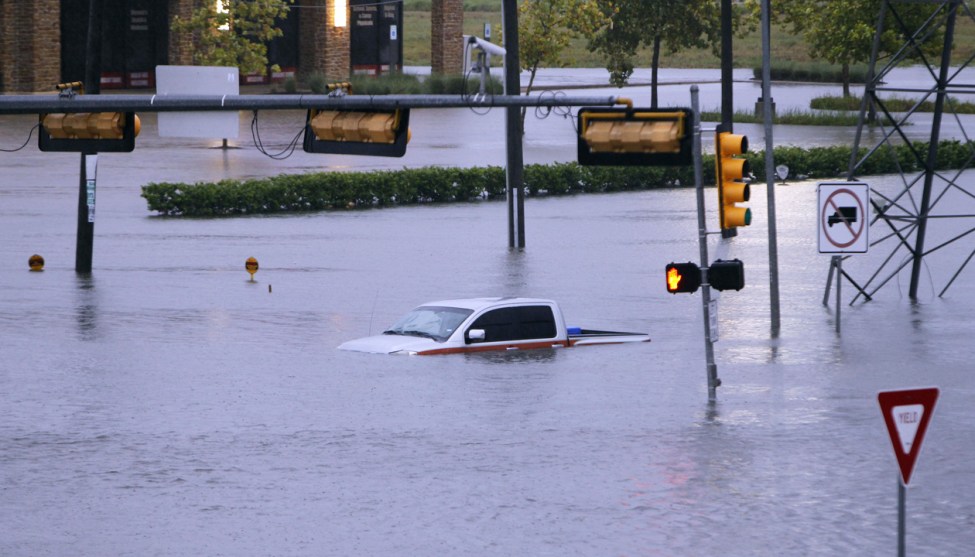
    Dara Lind reports on the “500-year” flood currently engulfing Houston:

    Tomball, Texas, Public Works director David Esquivel told a local paper there this year that the Houston area had “two 500-year storms back to back”: over Memorial Day weekend of 2015 and early April 2016. That means that Hurricane Harvey constitutes the third “500-year” flood in three years.

    ….Either Houston is incredibly unlucky or the risk of severe flooding is a lot more serious than the FEMA modeling has predicted — and the odds of a flood as bad as the ones Houston has seen for the past few years are actually much higher than 1 in 500.

    I’m going with Door #2. When everything is finally totted up, the flooding from Hurricane Harvey will probably be classified as a 1000-year flood, making this 3-year string even less likely. And while some of this probably is just coincidence, it’s almost certainly also a consequence of global warming, which creates more intense storms with higher levels of water vapor.

    I wrote about this yesterday, and naturally got some pushback. “Harvey is unprecedented because it got stalled by a front, not because of climate change,” said one tweeter. That’s true about the front, and of course no one can say that climate change “caused” the flooding. But you can say that climate change increased the probabilities. Maybe it made Harvey a little more intense. Maybe it increased Harvey’s water vapor content a little bit. Maybe it made the front a little bit stronger. Add it all up and climate change didn’t cause Harvey, but it probably made it a few percent more likely and a few percent worse than it otherwise would have been. And at the tail end of bell curves, a few percent can mean a lot. It can turn a 500-year event into a 30 or 50 or 70-year event. Multiply this by the entire country, where the probabilities average out, and you can say without a doubt that climate change will produce more drought, more wildfires, more intense storms, and more flooding.

    That’s how this stuff works. No big weather event ever has a single cause, but climate change skeptics are unwise to hang their hats on that. Likewise, I think that climate change hawks are unwise to shy away from blaming climate change for individual events. Their fear, generally, is that you can’t prove the role of climate change in any single extreme weather event, and they don’t want to open themselves to charges of alarmism. That’s admirable, but maybe just a bit too precious.

  • Bring Me Tariffs!

    Over the weekend, Jonathan Swan reported on life in the Oval Office. This happened during John Kelly’s first week as Trump’s chief of staff:

    “John, you haven’t been in a trade discussion before, so I want to share with you my views. For the last six months, this same group of geniuses comes in here all the time and I tell them, ‘Tariffs. I want tariffs.’ And what do they do? They bring me IP. I can’t put a tariff on IP.” (Most in the room understood that the president can, in fact, use tariffs to combat Chinese IP theft.)

    “China is laughing at us,” Trump added. “Laughing.”

    Kelly responded: “Yes sir, I understand, you want tariffs.”

    Tariffs, baby, we want tariffs. On what? iPhones? Computers? T-shirts? Who cares. Just bring the man some tariffs!

  • Hurricane Harvey Probably Isn’t a 500-Year Event Anymore

    Here’s a fascinating tweet from our commander-in-chief:


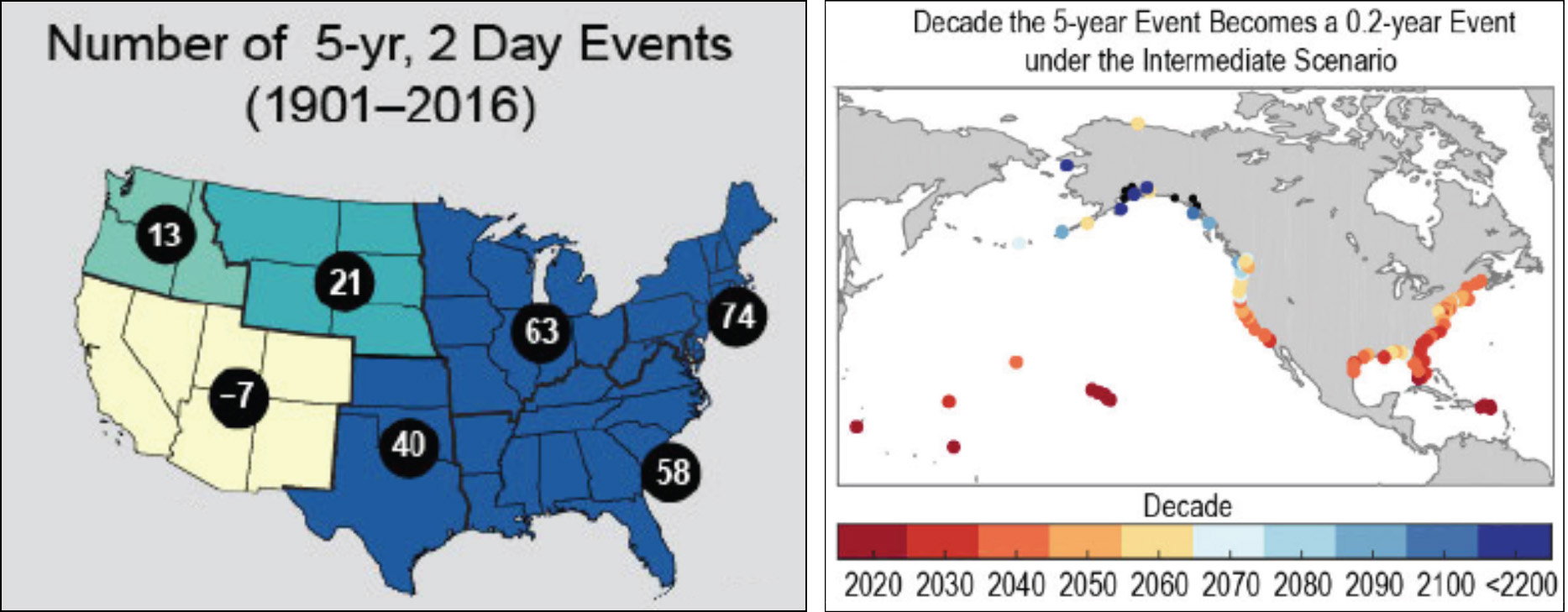
    Once in 500 years? Hmmm. Here are a couple of relevant illustrations from the Fourth National Climate Assessment, which was recently made public:

    Down on the Gulf Coast, the number of “precipitation events” that exceed the largest amount expected over five years has already gone up 40 percent since 1901. By about 2030, what used to be a 5-year event around Houston will occur every two months. This means that Hurricane Harvey used to be a 500-year event, but maybe not anymore. Maybe it’s now a 20 or 30-year event.

    These kinds of extreme flooding events will increase thanks to (a) rising sea levels, (b) an increase in tropical storm intensity (though not frequency), and (c) greater rainfall from tropical storms. Here are a few excerpts from the report:

    • Global mean sea level (GMSL) has risen by about 7–8 inches since 1900, with about 3 of those inches occurring since 1993 (very high confidence). Human-caused climate change has made a substantial contribution to GMSL rise since 1900 (high confidence)….Assuming storm characteristics do not change, sea level rise will increase the frequency and extent of extreme flooding associated with coastal storms, such as hurricanes and nor’easters (very high confidence).
    • Both theory and numerical modeling simulations (in general) indicate an increase in tropical cyclone (TC) intensity in a warmer world, and the models generally show an increase in the number of very intense TCs.
    • The average tropical cyclone rainfall rates within 500 km (about 311 miles) of the storm center increased by 8% to 17% in the simulations, which was at least as much as expected from the water vapor content increase factor alone.
    • Urban flooding results from heavy precipitation events that overwhelm the existing sewer infrastructure’s ability to convey the resulting stormwater. Future increases in daily and sub-daily extreme precipitation rates will require significant upgrades to many communities’ storm sewer systems, as will sea level rise in coastal cities and towns.

    Folks on the coast might want to think about urging President Trump to take this a little more seriously.

  • Tillerson: Trump Doesn’t Speak for the State Department

    Secretary of State Rex Tillerson talks to Chris Wallace today about American values:

    https://www.youtube.com/watch?v=fl7iZUTTrD0

    Here’s a paraphrase:

    WALLACE: Foreign leaders are questioning the president’s values.

    TILLERSON: The State Department represents American values.

    WALLACE: And the president?

    TILLERSON: No one doubts the commitment of the American government.

    WALLACE: And the president?

    TILLERSON: The president speaks for himself.

    WALLACE: But not for you?

    TILLERSON: I’ve made my own comments about that.

    So Tillerson has now joined Mnuchin, Cohn, Mattis, and the service chiefs in distancing himself from his president. Cabinet meetings must be a real joy these days.

  • Trump Asked Sessions to Drop Arpaio Case

    Sigh:

    As Joseph Arpaio’s federal case headed toward trial this past spring, President Trump wanted to act to help the former Arizona county sheriff who had become a campaign-trail companion and a partner in their crusade against illegal immigration. The president asked Attorney General Jeff Sessions whether it would be possible for the government to drop the criminal case against Arpaio, but was advised that would be inappropriate, according to three people with knowledge of the conversation.

    ….Responding to questions about Trump’s conversation with Sessions, White House press secretary Sarah Huckabee Sanders said, “It’s only natural the president would have a discussion with administration lawyers about legal matters. This case would be no different.”

    I guess nobody is surprised about stuff like this anymore, but honestly it’s like living in a banana republic these days. I wonder if Trump will ever learn that the criminal justice system is not just a plaything of the president?

    Nah.

  • Bad History and the Civil War: Survey Results!

    Yesterday I asked the hive mind about how the Civil War was taught in high school back in the 70s and 80s. The whole thread is worth reading, but here are a few highlights.

    First, I got a number of responses from folks who were in high school in the 50s and 60s. Unsurprisingly, most of them remember a pretty gauzy view of the war, and not just in the South. For example:

    MG: We spent about half the year studying the Civil War in my 5th grade social studies class in 1971-1972 at Cayuga Heights Elementary School outside of Buffalo, NY. I was a pretty good student, and here’s what I still remember:
    1. The war was fought over tariffs. Lincoln only decided to free the slaves as an afterthought.
    2. Lee was a great general.
    3. Stonewall Jackson was courageous
    4. JEB Stuart was a great cavalry leader
    5. Pickett’s charge was a bloodbath.
    6. Sherman’s march to the sea: He terrorized civilians and burned Atlanta to the ground.
    7. General Grant drank and smoked cigars.
    8. After the war, “carpetbaggers” from the north came and stuck their noses in the South’s business.

    nancy: Missouri in the 50s….I remember being taught Grant was a drunk and loser.

    paulgottlieb: I was born in 1943, and the American History I took as a child totally reflected the Dunning School bullshit: Firm but fair masters, happy, childlike slaves, and the rest a society of noble and courageous cavaliers and refined Southern Belles. And after the tragic War of Northern Aggression, the plague of greedy slimy carpetbaggers invading the South and creating a disastrous era of misrule by clown-like Negros and greedy Northerners. And this is how history was taught in the Chicago public schools. I can only imagine how it was taught in South Carolina

    In the 70s and 80s, things got better:

    emustrangler: Vermont in the 90’s seemed pretty fair. Reconstruction was given relatively brief treatment (I suspect not to cover up history, but because it is both kind of a downer, and because it didn’t involve any wars), but what was taught seemed pretty accurate and straightforward. There was a nod to “other issues” in teaching the causes of the Civil War, but slavery was treated as the primary issue of contention. The KKK, lynchings, etc were discussed. Jim Crow got a lot of attention.

    Vault Boy: North Florida in 2011 here….They didn’t shun from teaching the centrality of slavery in everything that led up to the Civil War, or as the primary cause that framed all the other causes (states’ rights, economic factors, etc.). If there’s one thing I can think of, the curriculum did mention how groups like the Klan stopped African Americans from voting, but didn’t really go into how widespread the terrorism and extrajudicial violence really were.

    Mateo: So I was in school during the 90s in NYC. We were more or less taught how evil slavery was, how the Civil War started (to a point, anyway—I wasn’t taught how the North benefited from slavery, for example, until later in life), the major battles, Reconstruction and the years before and going into Jim Crow. It was pretty explicit in its idea that slavery was the singular reason and justification for the war.

    Guscat: I studied US history in high school in the South in the 1970s. To be honest, I knew a lot more about history than my teacher did but he was very good for the period. He made it clear slavery was the main cause of the Civil War….He pretty much skipped over Reconstruction which in all fairness is a messy, in many ways kind of tedious time in US history (I read Eric Foner’s book which I found tough going and I love academic history books).

    royko: I was in public school in the suburbs of Chicago in the late 80s / early 90s….Slavery was front and center in the Civil War, as taught….Reconstruction came with negative connotations. The subtext (as I said, they were trying to be objective) was that Reconstruction somehow messed up wonderful Lincoln’s dream and led to carpetbaggers and unsavory things. And then it ended.

    prettyboywally: In Colorado in roughly 1987, I learned (and remember the textbook saying) what you’ve outlined: Equal rights forced on an unwilling white population, sullen resistance from day one until southerners were able to convince or compel the federal government to quit trying. I remember it being characterized as a briefly hopeful period, during which blacks were elected to office and able to access some of the rights they had been promised, followed by an increasingly violent period in which the KKK’s terrorism and the army/government’s frustration resulted in a desertion of black people to their fates. No nonsense about bad black government, but some mention of carpetbaggers and scalawags and their capitalizing on a defeated South to make money.

    The strongest sense I got from reading the post-70s commenters is that current instruction about the war itself is fairly good, but the Reconstruction era and beyond gets very little attention. The biggest problem isn’t so much that Reconstruction+ (i.e., 1865-1900) gets sugarcoated—although there’s clearly still some of that—but that it simply gets ignored. It’s a day or two in class and two or three pages in the textbook. Then it’s off to the robber barons and the Spanish-American War.

    I can imagine a bunch of excuses for this. It spares the feeling of Southerners. The bare truth is really brutal—maybe too brutal for high school. Reconstruction proper lasted “only” a decade, so a few days out of 180 in the school year is fair. It shows the United States in perhaps its worst light ever—racist, vicious Southerners who were enabled by racist, apathetic northerners—and national history courses in all countries tend to glide over the worst parts of their history.

    The other topic that got a lot of discussion was the role of popular culture. A number of people suggested that their sense of the war owed a lot more to movies and TV shows than to history classes. As we’ve progressed from Gone With the Wind to Roots to 12 Years a Slave, the gauzy view of the Civil War has dwindled. But there’s an obvious problem here: popular culture may have gotten better in its portrayals of slavery and the Civil War, but not Reconstruction+. The reason is equally obvious: slavery and the war are dramatic, while Reconstruction+ is tedious and dreary. There are no exciting action sequences during Reconstruction+ and no happy endings. But Reconstruction+ is at least as important as the Civil War itself, and without it there’s a whole lot of later American history that you can’t really understand.

    Needless to say, Reconstruction+ could be made both exciting and accurate. Maybe it’s time for someone to do a Roots-like miniseries that portrays the hard truth about Reconstruction+ through the eyes of a few characters that it follows for 30 or 40 years. Why not?

    POSTSCRIPT: Is there a name for the entire period from 1865-1900? I’ve been using the extremely awkward Reconstruction+ in this post, but only because I don’t have anything better.