I try not to use this space for personal stuff, but occasionally I do. Especially on weekends. So here we go.
As the kids go back to school this week, I was reminded that it’s the 50th anniversary of my 4th grade class with the amazing Mrs. Clunk. I’d like to get in touch with as many of my classmates as possible, so if by chance you’re in this picture, or even have a lead on someone in this picture, please email me and let me know. Thanks!
It’s been a fascinating afternoon. Here’s a roundup:
Hurricane Harvey will be hitting the Texas coast tomorrow morning. “This is right up President Trump’s alley,” said Tom Bossert, a Homeland Security adviser. “Not only has he showed leadership here, but his entire focus has been on making America great again. He is focused on the Americans who voted him into office, he’s focused on the Americans who didn’t vote him into office.” That’s good to hear, I guess.
Trump is also focused on undocumented immigrants. He’s urging everyone to evacuate the coastal areas, but he’s also decided to keep all Border Patrol checkpoints open as long as possible. So you have your choice: you can either stay put and risk dying, or you can evacuate and risk being picked up by the Border Patrol. Quite a guy, our president.
While everyone was focused on the hurricane, Trump also decided to pardon Sheriff Joe Arpaio. A court ordered Arpaio to stop racial profiling, and then held him in contempt when he refused. Trump’s white base should be thrilled by the pardon.
With this action, Trump is basically saying that courts have no authority to enforce the law on agents of the state. I wonder if it will be challenged in court? Everyone always says the pardon power is absolute, but I don’t think that’s ever been tested. After all, the language of the First Amendment is also absolute, but the Supreme Court has carved out all kinds of exceptions. (But who would have standing to sue?)
Sebastian Gorka has resigned from his White House position doing… something. No one has ever figured out what. “Given recent events,” he wrote in his resignation letter, “it is clear to me that forces that do not support the MAGA promise are – for now – ascendant within the White House. As a result, the best and most effective way I can support you, Mr. President, is from outside the People’s House.”
But did Gorka resign or was he fired? Here’s the New York Times: “One of the officials said that the president’s chief of staff, John F. Kelly, had telegraphed his lack of interest in keeping Mr. Gorka over the last week in internal discussions. Mr. Gorka, a deputy assistant to the president, had been on vacation for at least the last two weeks, with no clear assigned duties to hand to others, that official said.”
Hilbert and Hopper are practicing for the finals of the Synchronized Feline Staring competion. They still need some work on their tail positioning, but I think they have a pretty good chance of taking a medal this year.
I’m not sure how to research this, so I’ll just ask the hive mind: How is the Civil War and the Reconstruction Era taught these days? I’m not so much talking about the South as I am about everywhere else.
Due to an odd set of events, I never took an American history course that covered this era, and my experience would be 40 years old anyway. Nonetheless, I read a fair amount on my own back in the 80s, and roughly speaking it was all pretty consistent: lots of arguments about slavery in the antebellum period; secession of the Southern states, mostly due to slavery, followed by the war itself; a short try at doing the right thing in the decade after the Civil War; massive resistance to doing the right thing by whites in the South; and the eventual end of even that much when northerners got tired of the whole thing. Then we got lynchings, disenfranchisement, Jim Crow, and so forth.
That’s the tl;dr version, and I don’t mean to imply that every author described things the same way. But none of the stuff I read evaded the subject of slavery or retailed a gauzy portrait of the antebellum South. Nor did anyone suggest that freed slaves misruled the states they controlled, or that the rebellion against Reconstruction was anything other than simple white supremacy. There was no “Lost Cause” nonsense and no Gone With the Wind nostalgia.
In other words, I never had to “unlearn” bad history about the Civil War. The current view of the Civil War era is one that I’ve had since I first learned about it. In fact, I was surprised to learn in later years that bad history even existed.
So my question is this: for most people, everything they ever learned about the Civil War came from high school or college history classes. So how was this stuff taught back in the 70s? Was there really a lot of bad history, which is why so many people now have to unlearn it? Was the bad history confined to the South? Or did the bad history mostly ooze into people’s minds via popular culture one way or another?
I’m just curious. If you took a class during the 70s or 80s that covered the 1860-1900 period—in either high school or college—what were you taught? And what part of the country were you in when you learned it? Let us know in comments.
Is American business more concentrated than in the past? That is, do big companies control more of the market and therefore wield more market power? A knowledgable correspondent recommends a new paper by “the guru on measuring concentration in the U.S.” It contains several measures of concentration, but it seems like the best is their calculation of a GINI coefficient. This is the same GINI that’s typically used to measure income inequality. Zero means every business is of equal size while one means a single business controls the entire market. Here it is for the past three decades:
This suggests that concentration has been steadily increasing since at least 1988. And that’s exactly what the authors, Lawrence White and Jasper Yang, conclude: “We find that there has indeed been a moderate but continued increase in aggregate concentration since the mid 1990s.”
But that’s not the whole story. White and Yang also say a few other things:
“The level of aggregate concentration in the U.S. economy has little connection to the state of competition in relevant markets and thus to antitrust policy in the U.S.”
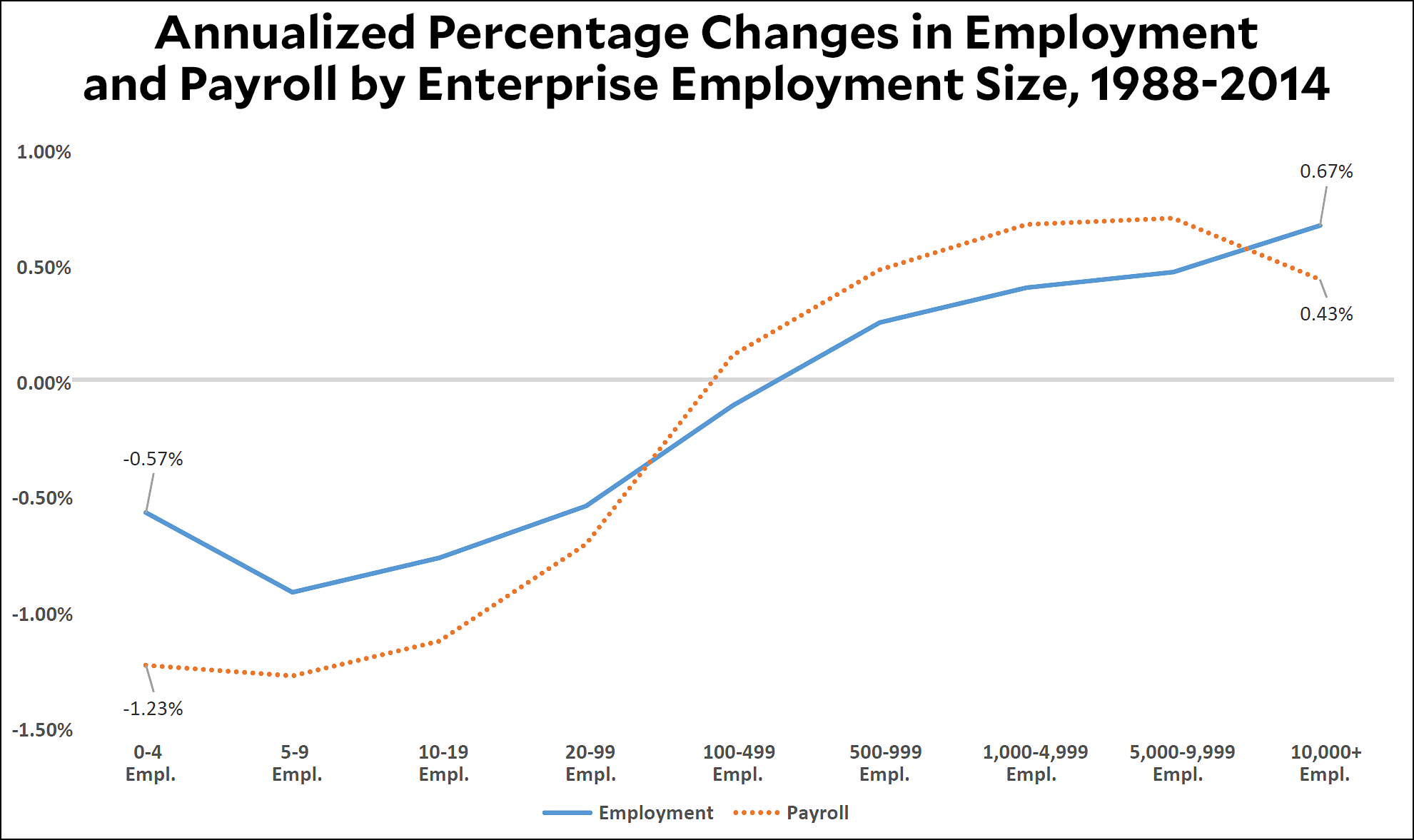
Since 1988, big companies have gotten bigger and small companies have gotten smaller. The difference is fairly dramatic:
Over time, these changes add up. Since 1988, big companies have outgrown small companies by 30-40 percent.
However, when you look at simpler measures of size, there’s not much to see. Total employment and payroll of the biggest companies has changed only slightly.
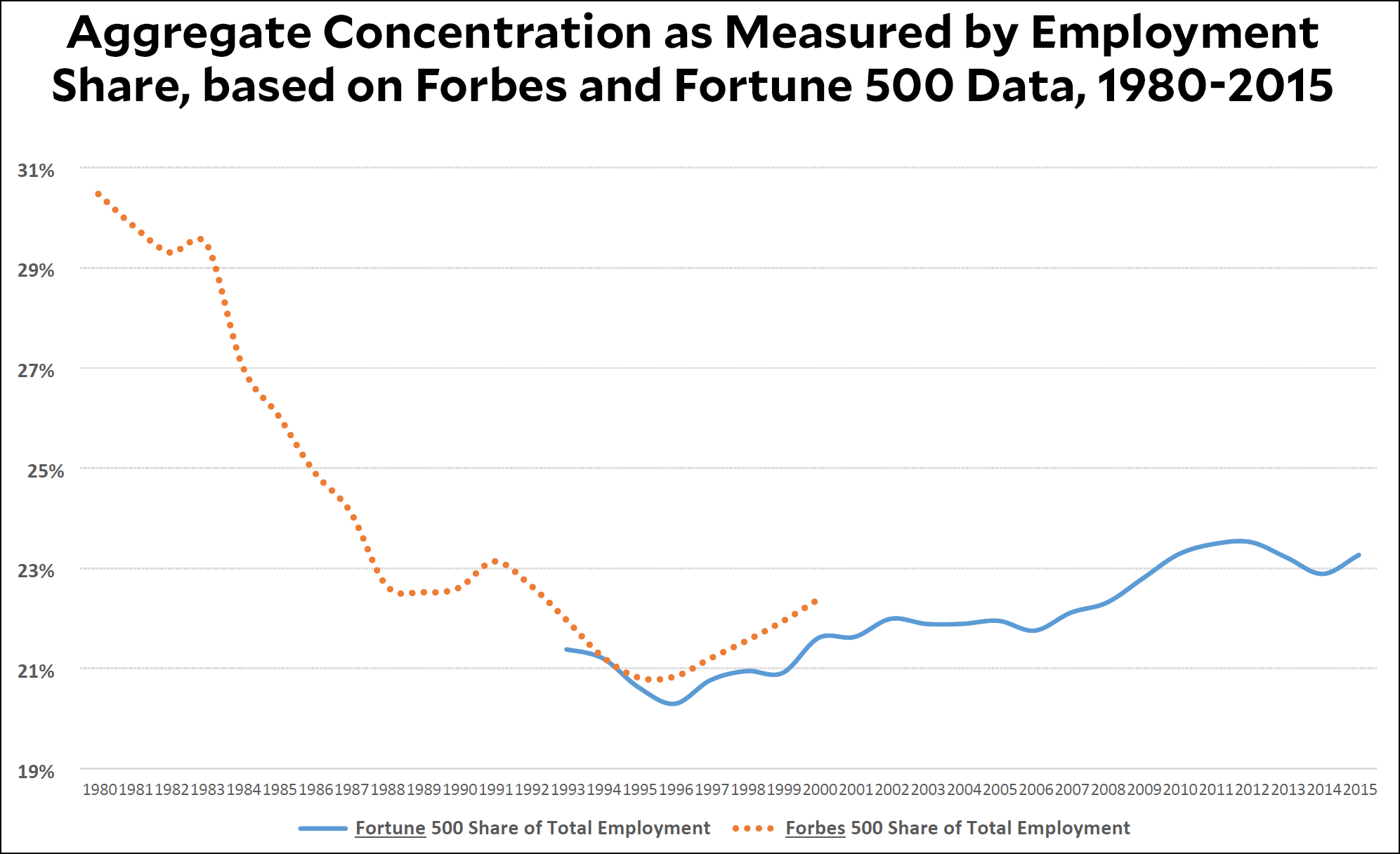
The oddest finding involves a measure of concentration of Forbes 500 and Fortune 500 companies. This goes back to 1980 and suggests that market concentration declined by a huge amount from 1980 to about 1995. The decline is so big that we haven’t come close to making it up since then:
I have to say that this seems really unlikely. Corporate concentration plummeted by a third during the 80s? Something sure doesn’t seem right about that. But this is what White and Yang report.
I’m not quite sure what to make of all this. It seems clear, based on all the measurements in the paper, that corporate concentration has grown over the past three decades by a moderate amount. Whether that’s enough to make a significant difference in political power or levels of innovation is hard to say.¹ That’s a subject for another paper.
But the allegedly huge decline in corporate concentration during the 80s seems very peculiar. Is this an artifact of deindustrialization? Or is it an economy-wide phenomenon? Or, perhaps, just a mistake of some kind, since it doesn’t seem to show up in the other data? Good question.
¹To repeat something I said the other day, I don’t necessarily think that bigger, more oligopolistic companies are bad for consumers. Prices might very well go down and product choice might very well go up. My concerns are broader. I think a decline in competition leads to less long-term innovation and to a dangerous rise in power over policymaking.
It’s possible, of course, that none of this matters very much since business is so global these days. Even if big American firms push small American firms out of business, they still have to compete with overseas firms. In that sense, it may be that corporate concentration in America has gone up but competitive pressures haven’t declined.
Gary Cohn on President Trump’s response to Charlottesville:
Citizens standing up for equality and freedom can never be equated with white supremacists, neo-Nazis, and the KKK. I believe this administration can and must do better in consistently and unequivocally condemning these groups and do everything we can to heal the deep divisions that exist in our communities.
Janet Yellen on President Trump’s desire to deregulate Wall Street:
Yellen, 71, made clear in her speech on Friday that she believes tighter regulations and standards have made the banking system safer and that while some improvements could be made, they should be modest, not structural. “The evidence shows that reforms since the crisis have made the financial system substantially safer,” Yellen said, according to prepared remarks.
Welp, Cohn and Yellen have just failed the all-important sycophant test. There go our top two contenders to lead the Fed when Yellen’s term expires. Who’s next in line? The Mooch?
After promising for months during the 2016 campaign that reforming health care would be “so easy,” Donald Trump decided to punt the whole thing to Congress after he took office. Unsurprisingly, it turned out he didn’t have a plan and had no clue about how to put one together. Long story short, health care failed and Trump promised that he wouldn’t make that mistake again. When it came time for tax reform, the White House would take the lead. So how’s that going?
Treasury Secretary Steven Mnuchin said during a July interview on ABC that the objective was to have “a full-blown release of the plan” in the beginning of September. Then, a White House official said earlier this month that September would see the release of a new tax document that would provide at least some additional detail.
And now?
Republican congressional leaders don’t expect to release a joint tax plan with the White House next month, and they’ll rely instead on House and Senate tax-writing committees to solve the big tax questions that remain unanswered, according to two people familiar with the matter.
Really?
WH official tells me the Trump Administration will not release its own detailed tax bill proposal, instead will let Hill take the lead.
Apparently the Trumpies are learning for the first time that when you put together a complex piece of legislation, lots of people will have lots of different goals. And once you put words down on paper, at least some of those people are going to be pissed. And to make it even worse, you have to make the sums add up. And you have to follow legislative rules. And no, the opposition party is not going to bail you out if you refuse to consider any of their priorities.
Policy is hard! Really, isn’t it better to just let Congress do the work so that you can complain later when it fails?
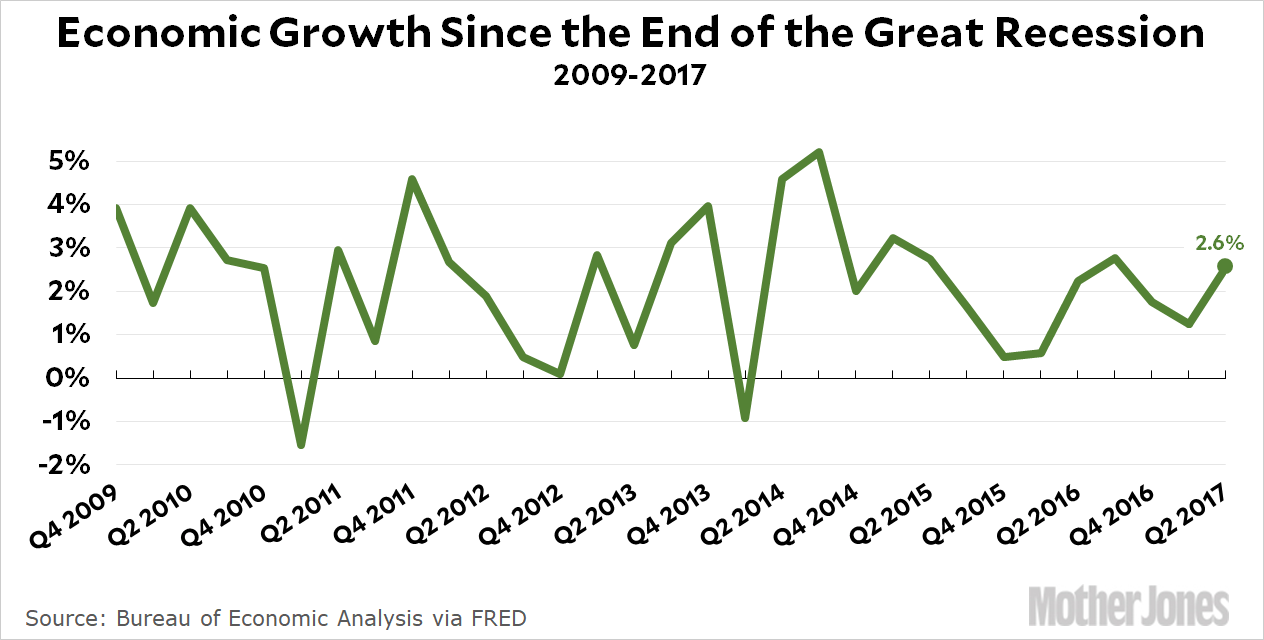
Economic growth has surged to 2.6 percent. Remember, everybody said you won’t bring it up to 1 percent. You won’t bring it up to 1.2 percent.
Fact checking is for suckers. But there are still a few of us who are at least curious about how things are going out in consensus reality. Here you go:
You may now return to the comfortable cocoon of Trumpland, where the economy is surging, terrorists are being wiped out, jobs are plentiful, and Southern heritage is being protected. Don’t you feel better already?
This is a quick note to New York City mayor Bill DeBlasio and everyone else: don’t tear down any statues of Christopher Columbus. Ditto for George Washington, the Puritans, George Custer, or anyone else you can think of who might be problematic. Just don’t.
At the risk of stating the blindingly obvious, this stuff plays into the hands of the Trumpies. The whole “Who’s next?” meme is an almost childishly transparent attempt to distract attention from Confederate statues; build support among moderates; and sow division among liberals. Don’t play the game. The answer to every question about statues is: I don’t know. Let’s tear down the memorials to Confederates who fought a war in defense of slavery, and then we can decide later if we ought to do anything more. OK?
That’s it. Easy peasy. We have a moment right now when we might be able to get some low-hanging fruit and make a difference. Let’s not screw it up by thinking it’s also a chance to redress every historical offense that Howard Zinn ever taught us.
I let this slip by, but Tuesday was my 15th anniversary of being a blogger and my 9th anniversary of working for Mother Jones. You may now commence with the old-man jokes.
Can you pitch in a few bucks to help fund Mother Jones' investigative journalism? We're a nonprofit (so it's tax-deductible), and reader support makes up about two-thirds of our budget.
We noticed you have an ad blocker on. Can you pitch in a few bucks to help fund Mother Jones' investigative journalism?
We’re halfway there, but time’s running out.
With only days left in 2025, we've made real progress toward our $400,000 goal—the funding we need to keep our nonprofit newsroom running at full
strength. But to close the remaining $200,000 gap before December 31, it will take a huge surge in reader support. Whether you've given before or this is your first time, your contribution right now will matter. Will you help us get there?
We’re halfway there, but time’s running out.
With only days left in 2025, we've made real progress toward our $400,000 goal—the funding we need to keep our nonprofit newsroom running at full
strength. But to close the remaining $200,000 gap before December 31, it will take a huge surge in reader support. Whether you've given before or this is your first time, your contribution right now will matter. Will you help us get there?