Photo by Flickr user dbking under a Creative Commons license
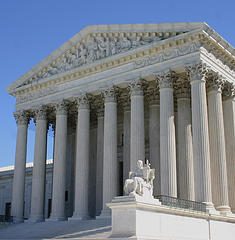
The Supreme Court finished its 2008 term on Monday with a flurry of decisions that continue to highlight the Court’s rigid ideological rift. Below, five rulings that could have a lasting negative impact on prisoners rights, the environment, and employee discrimination practices:
The Upshot: In a 5-4 decision, the Court ruled that Javaid Iqbal, one of the hundreds of Muslims rounded up after 9/11 and allegedly subjected to harsh treatment, could not challenge his detention in Court because he could not prove he was mistreated. In effect, the ruling increased the pleading requirements for prisoners, which could make it more difficult for prisoners to bring civil rights complaints to court.
See no evil: In the majority opinion, Justice Kennedy wrote that a prison supervisor is not required to challenge discriminatory practices based on the “mere knowledge of his subordinate’s discriminatory” actions.
The Upshot: In a 5-4 decision, the Court ruled that death row inmate William Osborne could not challenge his conviction with DNA technology invented after he was jailed. Senate Judiciary Committee Chairman Patrick Leahy (D-VT) said he was disappointed that the “narrow Supreme Court ruling denied access to post-conviction DNA testing for a defendant who wanted to prove his innocence.”
Prove no evil: In his dissent, Justice Stevens criticized Roberts’ ruling: “for reasons the State has been unable or unwilling to articulate, it refuses to allow Osborne to test the evidence at his own expense and to thereby ascertain the truth once and for all.”
The Upshot: The Court ruled 6-3 that an Alaska-based mining company can legally dump 4.5 million tons of waste into Alaska’s Tongass National Forest. The ruling seems to violate the intent, if not the letter, of the Clean Water Act.
Dump your evil: In response to the ruling, Earthjustice president Trip Van Noppen said in a press release that “If a mining company can turn Lower Slate Lake in Alaska into a lifeless waste dump, other polluters with solids in their wastewater can potentially do the same to any water body in America.”
The Upshot: The court ruled in a 5-4 decision that Jack Gross cannot use the “mixed motive” theory to prove age discrimination in his unlawful termination suit against his former employer. Instead, wrote Justice Clarence Thomas for the majority, Gross would have to prove that age was the only reason he was fired. This will undoubtedly make it more difficult for employees to prove age discrimination.
Read no evil: Writing for the dissent, Justice John Paul Stevens argues that “most natural reading” of the statutory language “proscribes adverse employment actions motivated in whole or in part by the age of the employee.” (emphasis mine.)
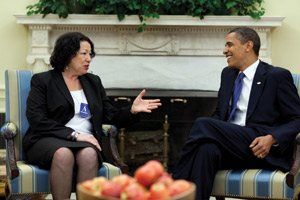
The Upshot: Reversing a decision that SCOTUS nominee Sonia Sotomayor endorsed on the appellate level, the Court ruled that the New Haven fire department subjected white fire fighters to racial discrimination when they were refused promotions when they performed well on an exam and their Black colleagues performed poorly.
Confirm no evil?: The decision will certainly add to conservative attempts to sink the Sotomayor nomination. In response to the ruling, a top anti-Sotomayor website wrote that “Frank Ricci finally got his day in court, despite the judging of Sonia Sotomayor, which all nine Justices of the U.S. Supreme Court have now confirmed was in error.” In fact, the ruling was 5-4 and Sotomayor was not once referenced directly.