<a href="http://www.flickr.com/photos/usace-tas/8202375232/">USACE Afghanistan Engineer District—South</a>/Flickr
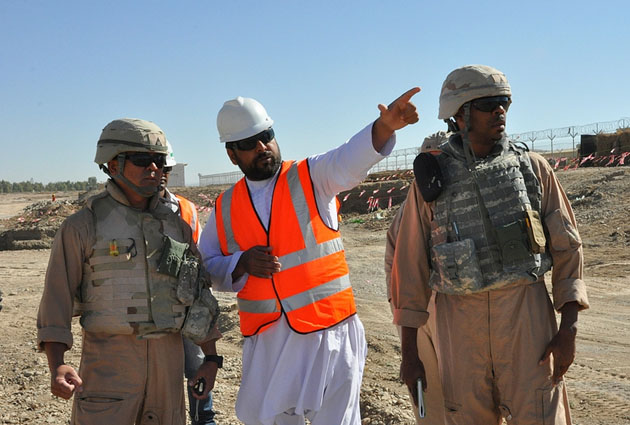
A new report released last week suggests that shoddy contracting practices are fomenting discontent and distrust among Afghan contractors, damaging efforts to foster Afghan businesses, and undermining the reconstruction effort in Afghanistan. The Special Inspector General for Afghanistan Reconstruction (SIGAR) reported that $69 million in unpaid bills owed to Afghan subcontractors have led to death and kidnapping threats, work stoppages, fraud, at least one car chase, and the use of local police forces to extract payment.
Here are some of the highlights from the report:
- In one instance, an irate Afghan subcontractor threatened to bomb the compound housing the US prime contractor and a slew of US government agencies.
- Another unpaid subcontractor, claiming his workers couldn’t buy the necessities their families needed until his bill was settled, said he would set himself on fire in front of the US Embassy in protest.
- One subcontractor threatened to use a suicide bomb to destroy a contractor’s office over a payment dispute.
- An Afghan security company’s management was held at gunpoint by its own employees, who stole weapons, ammo, and uniforms, allegedly after its prime contractor had failed to make good on its bills.
- Seeking recourse for nonpayment, a subcontractor obtained an arrest warrant for a project manager from the Afghan attorney general’s office. According to the report, the subcontractor chased down the manager’s vehicle to serve it himself, “trying to force him off the road in order to have him arrested,” but the manager escaped and took refuge at a German forward operating base.
- Stiffed Afghan subcontractors have shut down work sites, stolen equipment, and used the Afghan police to enforce work stoppages, according to the report. In one 2009 case, disagreement between a US firm and its Afghan workers derailed a multimillion dollar project building police stations in Badakhshan.
- Spurned local subcontractors have started turning to the Afghan police force to resolve disputes, obtaining arrest warrants and pursuing criminal charges to extort unpaid funds. Last month, the Wall Street Journal reported on the arrest of David Gordon, an American mechanic contracting in Afghanistan, as part of “a growing Afghan practice of arresting foreigners connected to commercial disputes.” One of the 110,404 contract workers in the country, some 33,000 of whom are US citizens, Mr. Gordon was used as leverage in a $2.4 million dispute between his employer and an Afghan firm. He was released from the Kabul jail where he was being held only after the US government intervened.
The pervasiveness of these sorts of disputes, the report claims, is “eroding support for US and coalition forces” because Afghans believe “that coalition forces failed to pay for projects that Afghans have worked on.” Between 2009 and October 2012, a quarter of the complaints SIGAR received were related to contractor and subcontractor nonpayment issues. These conflicts, the report claims, can undermine the trust and economic development that are crucial to the rebuilding effort and the coalition’s broader counterinsurgency strategy. “SIGAR investigators have found that the prime contractor’s failure to pay is often viewed by the Afghan subcontractor as a failure on the part of the US government,” the report said.