Eric Garner’s Death Is Still Haunting Bill de Blasio

His killing at the hands of a New York police officer five years ago loomed large in Wednesday’s presidential debate.

Angel Chevrestt/Zuma

Get your news from a source that’s not owned and controlled by oligarchs. Sign up for the free Mother Jones Daily.

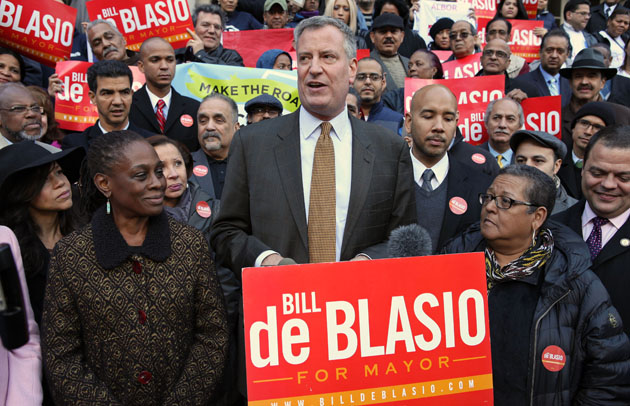
Five years to the month that Eric Garner died as the result of a chokehold meted out by New York police officer Daniel Pantaleo, 10 Democratic candidates for president stood on the debate stage in Detroit and talked about criminal justice reform. And one of those candidates, New York Mayor Bill de Blasio, can’t escape the shadow of Garner’s death.

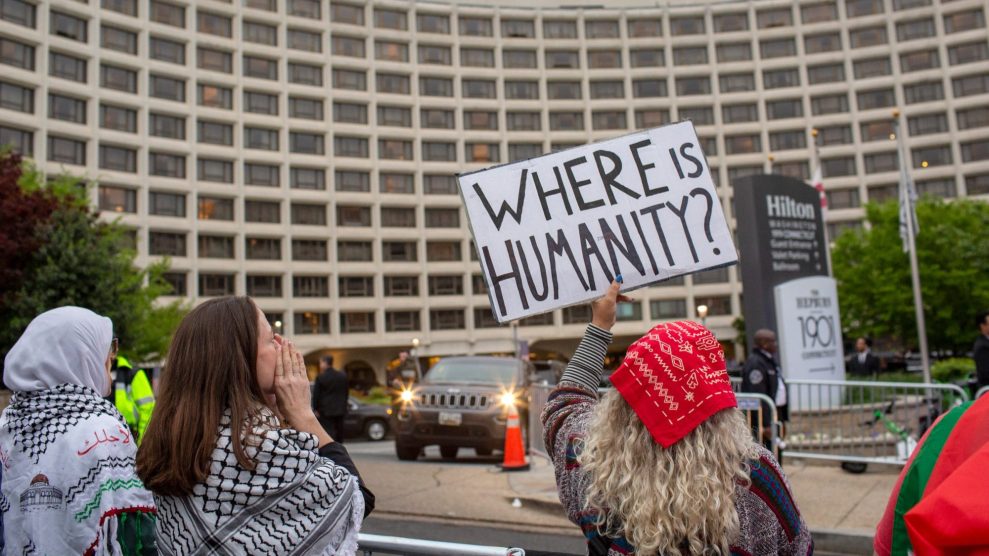
That much was clear from the start of Wednesday night’s debate, as protesters in the audience chanted “Fire Pantaleo.” The officer has so far managed to avoid prosecution for Garner’s death and remains on the city’s police force. Some observers identified the protesters as Women’s March co-founders Tamika Mallory and Linda Sarsour, though Mother Jones could not confirm their identities.

After the protesters were escorted out, former Secretary of Housing and Urban Development Julián Castro attacked de Blasio for not firing Pantaleo, saying that the officer “has not been brought to justice.”

Garner was a 42-year-old black man who was confronted by Pantaleo on Staten Island in 2014 for allegedly selling unlicensed cigarettes. The ensuing alteraction was captured on video by a bystander. The video—in which Garner can be heard repeatedly yelling, “I can’t breathe!”—went viral and set off a national protest movement against police brutality. That movement was led in part by Garner’s daughter, Erica, who staged sit-ins and protests demanding accountability for her father’s death.

A Staten Island grand jury declined to bring charges against Pantaleo, and earlier this month, the Trump administration’s Department of Justice did the same. In 2015, the Garner family reached a wrongful death settlement with New York City for $5.9 million. Still, the case took its toll. Erica Garner died from a heart attack shortly after Christmas in 2017. She was 27.

When CNN host Jake Tapper questioned the candidates about the case, observers noted that he appeared to refer to Garner as “Gardner.” (The official transcript has Tapper saying “Garner,” but here’s the clip—judge for yourself at 1:30 and 4:05.)

Garner’s surviving relatives have been steadfast in their demand for Pantaleo’s termination. “The DOJ made their decision,” Garner’s mother, Gwen Carr, told reporters recently. “We are looking for de Blasio to make his. We want him to stand up as the mayor he’s supposed to be.”

New York City’s public advocate, Jumaane Williams, has also taken aim at de Blasio, telling the mayor via the New York Times, “You cannot be president, you cannot be the Democratic nominee, if Daniel Pantaleo is still on the force.”

Instead, the officer has received a 14 percent raise while working desk duty.

Meanwhile, de Blasio has repeatedly said publicly that his hands are tied and he does not have the power to fire Pantaleo—a point of deep contention among local advocates and many observers.

What’s clear is that while de Blasio delivers a populist message nationally, he’s far from a progressive hero at home.

This story has been updated to include more details of Tapper’s apparent mispronunciation of Eric Garner’s name.


From the desk of Mother Jones CEO, Monika Bauerlein...

Newsrooms can be funded in many ways. One of the most controversial (and volatile) ways is by a for-profit corporation or a billionaire owner. We see it across the headlines on a weekly basis: the claw backs in public media, the gutting of The Washington Post, the bending over backwards to appeal to Trump and his allies.

But not here.

When Mother Jones first started publishing 50 years ago, our founders made a critical decision: to be a reader-supported nonprofit. They knew that no corporate owner would be interested in a muckraking newsroom; they also knew that no muckraking newsroom would be interested in following the agenda of a corporate owner.

And so, we’ve been reader-funded for half a century. We rely on contributions from our readers—readers like you—whether it’s $50, or $15 a month, or whatever fits your budget. People give what they can, and every donation makes a difference for our newsroom, which has grown tremendously—in size and reach and renown—since its inception in 1976.

You may be wondering: What does it take to publish an investigation? And what does my donation actually fund? The answers are one and the same: It takes people, resources, and time. And that’s what your donation funds directly.

Every donation Mother Jones receives from readers fortifies our newsroom, whether we’re covering underreported scandals out of Washington, DC, or the most important news of the day. And right now, each donation will be doubled because of our $50,000 match. So when you make a donation—$5, $50, any amount—it’ll go twice as far.

Your support keeps us going. If you’re able, donate today.

Thanks for reading.

—Monika

From the desk of Mother Jones CEO, Monika Bauerlein...

Newsrooms can be funded in many ways. One of the most controversial (and volatile) ways is by a for-profit corporation or a billionaire owner. We see it across the headlines on a weekly basis: the claw backs in public media, the gutting of The Washington Post, the bending over backwards to appeal to Trump and his allies.

But not here.

When Mother Jones first started publishing 50 years ago, our founders made a critical decision: to be a reader-supported nonprofit. They knew that no corporate owner would be interested in a muckraking newsroom; they also knew that no muckraking newsroom would be interested in following the agenda of a corporate owner.

And so, we’ve been reader-funded for half a century. We rely on contributions from our readers—readers like you—whether it’s $50, or $15 a month, or whatever fits your budget. People give what they can, and every donation makes a difference for our newsroom, which has grown tremendously—in size and reach and renown—since its inception in 1976.

You may be wondering: What does it take to publish an investigation? And what does my donation actually fund? The answers are one and the same: It takes people, resources, and time. And that’s what your donation funds directly.

Every donation Mother Jones receives from readers fortifies our newsroom, whether we’re covering underreported scandals out of Washington, DC, or the most important news of the day. And right now, each donation will be doubled because of our $50,000 match. So when you make a donation—$5, $50, any amount—it’ll go twice as far.

Your support keeps us going. If you’re able, donate today.

Thanks for reading.

—Monika

We Recommend

Latest

Sign up for our free newsletter

Subscribe to the Mother Jones Daily to have our top stories delivered directly to your inbox.

Get our award-winning magazine

Save big on a full year of investigations, ideas, and insights.

Subscribe

INDEPENDENT. BECAUSE OF YOU.

Mother Jones has no billionaires calling the shots—just readers like you making fearless reporting possible

Donate