CAMPAIGN TRAIL UPDATE….Barack Obama and John McCain have finally found something they agree on: George Bush sucks. That’s called “reaching across the aisle,” boys and girls.

CAMPAIGN TRAIL UPDATE….Barack Obama and John McCain have finally found something they agree on: George Bush sucks. That’s called “reaching across the aisle,” boys and girls.
HOUSING UPDATE….The latest news on the housing market:
Although prices continued to fall, existing-home sales climbed more than expected during September, marking the highest level of home sales activity in more than a year.
Home resales rose to a 5.18 million annual rate, a 5.5% increase from August’s unrevised 4.91 million annual pace, the National Association of Realtors said Friday.
….The home sales increase represents “a nice jump,” said NAR economist Lawrence Yun. “Hopefully, this trend can continue.”
OK, I admit it. I’m just trying to cheer you up. That “nice jump” appears to be about the only good news around today amidst an ocean of gloom. Here in California, the latest news is that home foreclosures, after jumping about a million percent over the last year, are now down. But only because of a new law that makes banks delay proceedings until 30 days after contacting the borrower. Woo hoo!
QUOTE OF THE DAY….From Alan Greenspan, testifying before Congress on the derivatives market:
“Credit default swaps, I think, have serious problems associated with them.”
Ya think? The subprime lending market may have been the trigger for our late financial collapse, but the truth is that the trigger could just as easily been mispriced risk (i.e., irrational exuberance) in a variety of other markets. If subprimes had been regulated better, maybe there would have been a bubble in commercial real estate instead. Or arctic oil drilling. Or online pet food companies. Who knows? Regardless of the trigger, however, it was only when the resulting bubble got multiplied tenfold by opaque global chains of credit default swaps that the bursting of an asset bubble went from routine disaster to worldwide financial meltdown. So yeah: there are serious problems there. Here’s more from Greenspan:
“I made a mistake in presuming that the self-interests of organizations, specifically banks and others, were such as that they were best capable of protecting their own shareholders and their equity in the firms,” Mr. Greenspan said.
….Mr. Waxman pressed the former Fed chair to clarify his words. “In other words, you found that your view of the world, your ideology, was not right, it was not working,” Mr. Waxman said.
“Absolutely, precisely,” Mr. Greenspan replied. “You know, that’s precisely the reason I was shocked, because I have been going for 40 years or more with very considerable evidence that it was working exceptionally well.”
Hmmm. Maybe not quite so well as he thought.
YUMMY, YUMMY KOOL-AID….From Mark Krikorian, commenting on Sarah Palin’s views on immigration reform:
“What Palin’s response shows is that [] she’s completely open to whatever kool-aid they want her to drink.”
He’s quite right, of course. Note, however, that this is coming from neither a liberal nor from a moderate conservative complaining that Palin is too right-wing. It’s coming from an immigration hardliner complaining that Palin is too accomodating.
Normally the hardliners don’t talk about this because Palin’s lack of interest in policy of any kind, along with her resulting willingness to drink Kool-Aid of whatever flavor is put in front of her, is a feature, not a bug. Every once in a while, though, it comes back to bite them.
But don’t worry, Mark. I’m sure she’ll learn the proper responses before long.
WANTED: FINANCE INDUSTRY A TEAM….One of the things that makes our current financial crisis even scarier than it might otherwise be (at least to me) is that no one really, truly, seems to be entirely sure of what’s going on. Even genuine experts appear to be sort of baffled by the whole thing — though that hasn’t stopped them from producing hundreds of different theories. Ezra Klein points out one of the causes of this problem, which has been at the back of my mind as well:
One sidenote of the past few months is that folks turned to economists when what they needed were finance experts. But there are relatively few finance experts who aren’t affiliated with financial institutions, and so much of their commentary is tainted.
….Asking folks who have a general education in matters of macroeconomy to evince a complete knowledge of opaque financial instruments developed in the past few years is a bit odd. But asking the folks who developed and traded those instruments to give unbiased commentary on them is little better. It’s a weird situation, and it’s why, I’d argue, you’ve had a lot more commentary on things like the bailout bill, which are fairly general in nature and can be understood using tools from traditional economics, than the specifics of the financial crisis.
I second that motion. More finance experts, please. And mortgage and securitization experts. And ratings agency experts. And central banking experts. All stirred together with a bunch of top notch macroeconomists. Unfortunately, I suppose we’d probably all have to chip in and guarantee these guys $10 million bonuses to do real analysis for us, wouldn’t we? Maybe George Soros could bankroll them.
UPDATE: Speaking of finance analysis, I wrote yesterday about a Fed paper suggesting that there was, in reality, no credit crisis at all. In fact, banks are lending like crazy! I was skeptical, but said, “Even if it turns out to be wrong, reading the explanation of why it’s wrong should be instructive.”
Mark Thoma and friends oblige with an explanation here. It’s not conclusive, I think, but it certainly suggests that the original paper I linked to was woefully simplistic.
COMPLICATED PROBLEMS….Douglas Holtz-Eakin, John McCain’s primary economic advisor, says that income inequality has gone up everywhere, not just in the U.S., and opines that “The source of that is education.” Matt Yglesias has a bunch to say about that, including this:
While there does seem to be an education-related component to the growth in inequality (specifically, the number of college graduates has not kept up with the growing labor market demand for college educated workers) there are also other factors, including the declining real value of the minimum wage and declining rates of unionization. In both cases, and all others I’m aware of, McCain takes the pro-inequality side.
I just want to quickly endorse the broader point Matt is making here. The growth of income inequality is a complex problem with multiple causes. In fact, virtually every social problem interesting enough to remain unsolved has multiple causes, and that makes them hard to address. The answer to this is not to pretend otherwise (“education” by itself certainly doesn’t explain the astronomical income growth of the top 0.1% compared to the top 1%, for example), nor is it to give up because there are lots and lots of causes and it’s hard to fix them all.
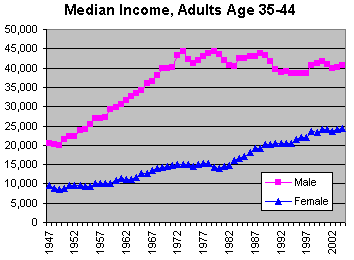
There are multiple kinds of income inequality, and assuming you care about this in the first place (and you should, both for reasons of basic fairness and because an egalitarian economy works better than a vastly unequal one) you have to address them all. You need things like minimum wage laws and the EITC to help the poor keep up. Unionization can help the working class and educational and training policies can help the middle class. Tax policies, at a minimum, should be designed to be at least modestly progressive at the high end. (Our current tax system, which features regressive state, local, and payroll taxes, and which taxes capital gains and dividends at low rates, has produced overall tax rates that are only slightly progressive. Most billionaires don’t pay an awful lot more than grocery checkers.) Things like universal healthcare can ameliorate some of the ill effects of whatever income inequality is left even after you’ve addressed the other stuff.
One way or another, though, any solution has to focus like a laser on increasing median wages to keep up with GDP growth. In the same way that TV revenue has produced an immense ocean of money for top athletes, keeping median wages flat has produced an immense ocean of extra money that sloshes around for the benefit of the tippy top executive class. Treat the middle class more fairly, and income inequality will decrease naturally. That should be Job 1 for Barack Obama’s economic team.
PROPOSITION 8 UPDATE….A new poll shows that California voters remain opposed to a ban on gay marriage:
But the poll also found that support for Proposition 8, which would amend the state Constitution to disallow same-sex marriage, has gained somewhat since a similar survey was taken in late August. The latest results show 44% in favor and 52% opposed, with a margin of sampling error of 3 percentage points.
It’s gonna be close, folks. Back in May, based on demographic fundamentals, I predicted that Prop 8 would pass 52%-48%. There’s good news and bad news that might change that, though.
The good news is that this is a Democratic year and liberal turnout at the polls might be higher than normal. The bad news is that the No forces are running bland, generic ads, while a few weeks ago the Yes forces began saturation coverage of fiendishly effective scare ads that scream, “Gay marriage will be taught to second graders!” — and the Mormon church is providing them with plenty of money to scream with. Conversely, the No side is determined that their ads not mention “gay marriage” or anything else that might potentially upset anyone, hoping that people won’t figure out what Prop 8 is about and will just vote against it because it’s vaguely “unfair.” Unfortunately, it’s hard to see that working. Given the high-wattage campaign from the Yes folks, there can’t really be many people left in the state who don’t know what Prop 8 is about.
Here in my little neck of the woods, the Yes folks are also pretty well organized. They’ve got troops of people holding signs and banners at street corners during rush hour, and I chatted with a few of the sign holders yesterday on my way to the market. They were all nice folks. Wrong, but nice, and very committed to the cause. And judging from the honking of horns as cars whizzed by, there are plenty of people here who agree with them.
But that’s Orange County for you. It’s hardly a representative sample of the state. Still, there are plenty of people who think the same way, and another couple of weeks of high-decibel Yes ads are probably going to add to their numbers. It’s gonna be close.
UPDATE: Elizabeth Gettelman has a report from Oakland about the street corner picketers there. Apparently most of them have been organized by local Mormon churches, which I guess isn’t surprising.
One of the guys I talked to on my corner last night asked if my opposition to Prop 8 was “because of the church thing,” and at first I didn’t really realize what he was talking about. As I walked away I figured it out: he wanted to know if I was turned off by the Yes campaign because I’d heard it was bankrolled by the Mormon Church. I guess they must run into that a lot.
MORTGAGE HELL….Sheila Bair, head of the FDIC, is working on a plan to help homeowners stuck with mortgages they can’t afford. One problem she faces is that any plan that helps genuinely distressed homeowners would almost certainly help plenty of others who just feel like lowering their payment terms. But even if we grit our teeth and accept that, there’s another problem:
Renegotiating troubled mortgages — as opposed to paying them off — is difficult because most have been packaged into securities and sold off to multiple investors. Mortgage servicers — companies that collect payments and work with homeowners — typically act on behalf of those investors, who often have competing interests. Getting servicers to rework mortgages has been a tough slog for the government under its existing programs, which encouraged but didn’t require industry compliance.
Ms. Bair’s proposal is designed to overcome some of these problems by significantly raising servicers’ incentives to cooperate. The government would agree to share a portion of any losses on a new, more-affordable mortgage, should it go into default.
I suspect that this consideration was behind John McCain’s plan to buy up mortgages at face value and replace them with new, cheaper mortgages. This may be a windfall for investors, but it also probably means that you don’t have to negotiate a separate agreement with all the noteholders who own a piece of the securities. The terms of most (though not all) mortgages allow them to be repaid at face value at any time, which means you don’t have to get the approval of all the noteholders to do so.
At least, that’s my guess. It would be nice to read a definitive explanation of how all this works and what the problems are with renegotiating sliced-and-diced mortgages, but I haven’t seen one yet. If anybody comes across something authoritative, let me know.
CONVERSATION OF THE DAY….Between Rahul Dilip Shah and Shannon Mooney, a pair of analysts at the credit rating agency Standard & Poor’s, chatting via IM back in 2007:
RDS: btw: that deal is ridiculous
SM: I know right … model def does not capture half of the risk
RDS: we should not be rating it
SM: we rate every deal
SM: it could be structured by cows and we would rate it
This was made public as part of a House committee hearing today. The New York Times reports on other revelations:
Among the documents uncovered by the committee was an internal board presentation delivered by [Raymond] McDaniel to Moody’s directors in October 2007. According to the presentation, he told his board: Analysts and managing directors “are continually ‘pitched’ by bankers, issuers, investors.” At times, he conceded, “we drink the Kool-Aid.”
….Mr. Waxman’s committee also cited an internal e-mail exchange between [Frank] Raiter, who had been asked to rate a collateralized debt obligation called “Pinstripe,” and Richard Gugliada, an S.& P. managing director. Mr. Raiter had requested highly detailed data about each individual loan, known as loan level tapes, to assess the creditworthiness of the loans in the security, but Mr. Gugliada wrote: “Any request for loan level tapes is totally unreasonable!!! It is your responsibility to provide those credit estimates and your responsibility to devise some method for doing so.”
Mr. Raiter responded: “This is the most amazing memo I have ever received in my business career.”
Kinda reminds you of all those Enron emails and phone conversations gloating over how they’d created the California energy “crisis,” doesn’t it. Good times.
ELECTION POOL….Do Republicans really think they might lose 34 seats in the House? Wow.
And as long as we’re on the subject, it’s time for predictions. There are three categories this year:
Winner and total electoral votes for president.
Composition of the House. Current composition is 235-199-1.
Composition of the Senate. Current composition is 49-49-2.
I suck at this, but I’ll predict (a) Obama with 310 electoral votes, (b) 250-185, and (c) 55-43-2. Leave your predictions in comments. Winner gets a free subscription to Mother Jones.

Award-winning photojournalism.
Stunning video. Fearless conversations.


