Get your news from a source that’s not owned and controlled by oligarchs. Sign up for the free Mother Jones Daily.

If you’re interested in the political blogosphere and the netroots in general, Eric Boehlert’s Bloggers on the Bus is a great read.  It’s built around potted sketches of some of the best known liberal bloggers (Atrios, Digby, Jane Hamsher, John Amato, Arianna Huffington, Glenn Greenwald, and others) and some of the blogosphere’s greatest campaign hits during 2008 (the Obama MySpace debacle, the John Hagee meltdown, the Sarah Palin eruption, the great sexism debate), and Boehlert really does a terrific job of diving in and explaining how everything unfolded.  I followed almost all of this stuff pretty obsessively in real time, but I still learned lots of details I’d never heard of before.
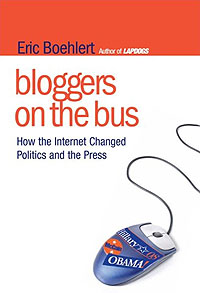
It’s a very fast, entertaining read, and since it focuses (almost) exclusively on the liberal blogosphere it mostly avoids the sense of triumphalism you might get in a more partisan book.  Which is a good thing since it ends with this:

The bad news for liberal bloggers was that as the Obama campaign unfolded, as his new commuhity-based coalition was being built and celebrated, it became obvious that bloggers were never really invited to the party.  Liberal bloggers simply never became active partners with Obama in the way they had been with the Dean insurgency four years earlier, and the way they had been with scores of Democratic politicians in skirmishes throughout the Bush years.  Why?  Mostly because Obama didn’t seem to want the bloggers around.

That’s true, isn’t it?  For all the hype, the liberal blogosphere in 2008 had its biggest impact in state and local races, just as it did in 2004.  It’s true that it was much more successful in pushing stories into the mainstream media than it was four years ago, but in terms of being active in the Obama campaign itself, it wasn’t.  And that was primarily a choice made by Obama himself, who apparently felt that the raw partisanship of the blogosphere was something he wanted to keep at arm’s length.

There were a couple of things missing from the book that struck me.  The first is specific: the Jeremiah Wright firestorm, which begged to be included in any book about the 2008 campaign, but which Boehlert inexplicably never mentions.  The second is more general: Boehlert does a good job of showing how the blogosphere managed to gain attention for stories that might otherwise have gone unnoticed, but at times his account feels too blinkered.  The mainstream media played a pretty big role in all this too, and even in a book about the blogosphere this deserves a little more attention.  At the very least, there should have been a chapter devoted to the relationship between blogs and the MSM.

But these are nits.  If you’re looking for a blog’s eye view of Campaign ’08, Bloggers on the Bus is a terrifically readable and carefully reported book.  Highly recommended.

From the desk of Mother Jones CEO, Monika Bauerlein...

Newsrooms can be funded in many ways. One of the most controversial (and volatile) ways is by a for-profit corporation or a billionaire owner. We see it across the headlines on a weekly basis: the claw backs in public media, the gutting of The Washington Post, the bending over backwards to appeal to Trump and his allies.

But not here.

When Mother Jones first started publishing 50 years ago, our founders made a critical decision: to be a reader-supported nonprofit. They knew that no corporate owner would be interested in a muckraking newsroom; they also knew that no muckraking newsroom would be interested in following the agenda of a corporate owner.

And so, we’ve been reader-funded for half a century. We rely on contributions from our readers—readers like you—whether it’s $50, or $15 a month, or whatever fits your budget. People give what they can, and every donation makes a difference for our newsroom, which has grown tremendously—in size and reach and renown—since its inception in 1976.

You may be wondering: What does it take to publish an investigation? And what does my donation actually fund? The answers are one and the same: It takes people, resources, and time. And that’s what your donation funds directly.

Every donation Mother Jones receives from readers fortifies our newsroom, whether we’re covering underreported scandals out of Washington, DC, or the most important news of the day. And right now, each donation will be doubled because of our $50,000 match. So when you make a donation—$5, $50, any amount—it’ll go twice as far.

Your support keeps us going. If you’re able, donate today.

Thanks for reading.

—Monika

From the desk of Mother Jones CEO, Monika Bauerlein...

Newsrooms can be funded in many ways. One of the most controversial (and volatile) ways is by a for-profit corporation or a billionaire owner. We see it across the headlines on a weekly basis: the claw backs in public media, the gutting of The Washington Post, the bending over backwards to appeal to Trump and his allies.

But not here.

When Mother Jones first started publishing 50 years ago, our founders made a critical decision: to be a reader-supported nonprofit. They knew that no corporate owner would be interested in a muckraking newsroom; they also knew that no muckraking newsroom would be interested in following the agenda of a corporate owner.

And so, we’ve been reader-funded for half a century. We rely on contributions from our readers—readers like you—whether it’s $50, or $15 a month, or whatever fits your budget. People give what they can, and every donation makes a difference for our newsroom, which has grown tremendously—in size and reach and renown—since its inception in 1976.

You may be wondering: What does it take to publish an investigation? And what does my donation actually fund? The answers are one and the same: It takes people, resources, and time. And that’s what your donation funds directly.

Every donation Mother Jones receives from readers fortifies our newsroom, whether we’re covering underreported scandals out of Washington, DC, or the most important news of the day. And right now, each donation will be doubled because of our $50,000 match. So when you make a donation—$5, $50, any amount—it’ll go twice as far.

Your support keeps us going. If you’re able, donate today.

Thanks for reading.

—Monika

We Recommend

Latest

Sign up for our free newsletter

Subscribe to the Mother Jones Daily to have our top stories delivered directly to your inbox.

Get our award-winning magazine

Save big on a full year of investigations, ideas, and insights.

Subscribe

INDEPENDENT. BECAUSE OF YOU.

Mother Jones has no billionaires calling the shots—just readers like you making fearless reporting possible

Donate