• Bernanke on Leverage

    The title of this post is mostly whimsy: in his speech about financial reform today, Ben Bernanke barely even mentioned leverage as a problem.  In fact, his only use of the word (in the financial sense, anyway) came toward the end when he vaguely suggested that a new government agency might be set up to, among other things, assess the potential for “broad-based increases in financial leverage…to increase systemic risks.”
    Since I think massive abuse of leverage is at the heart of what turned an ordinary asset bubble into a global meltdown, I’m disappointed that he didn’t spend more time on this.  But on a related matter, he did say this:

    However, there is some evidence that capital standards, accounting rules, and other regulations have made the financial sector excessively procyclical — that is, they lead financial institutions to ease credit in booms and tighten credit in downturns more than is justified by changes in the creditworthiness of borrowers, thereby intensifying cyclical changes.

    For example, capital regulations require that banks’ capital ratios meet or exceed fixed minimum standards for the bank to be considered safe and sound by regulators. Because banks typically find raising capital to be difficult in economic downturns or periods of financial stress, their best means of boosting their regulatory capital ratios during difficult periods may be to reduce new lending, perhaps more so than is justified by the credit environment. We should review capital regulations to ensure that they are appropriately forward-looking, and that capital is allowed to serve its intended role as a buffer — one built up during good times and drawn down during bad times in a manner consistent with safety and soundness.

    Capital ratios basically regulate the amount of leverage a bank is allowed to take on, and what Bernanke is suggesting here is that in good times, when animal spirits are high and anyone with a pulse is offered a no-down loan, capital ratios should be increased, thus reducing bank lending and keeping leverage within reasonable bounds.  In bad times, when animal spirits are moribund and deleveraging shuts down the credit pipeline, capital ratios should be decreased, allowing banks to loan more money.

    This has always struck me as a good idea.  But Bernanke doesn’t say how he thinks it should be done.  Would a board of some kind make these decisions twice a quarter, the way the Fed does with interest rates?  Or would there be some kind of automatic mechanism involved?  If the former, what confidence do we have that they’d really be willing to take the punch bowl away during boom times?  The Fed sure wasn’t willing to do so during the 2002-07 expansion.  Overall, this is a good suggestion, but it could bear some fleshing out.
  • More Losses

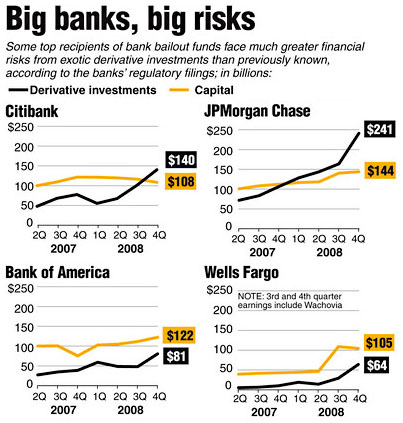
    Here’s your chart of the day, courtesy of McClatchy:

    America’s five largest banks, which already have received $145 billion in taxpayer bailout dollars, still face potentially catastrophic losses from exotic investments if economic conditions substantially worsen, their latest financial reports show.

    Citibank, Bank of America, HSBC Bank USA, Wells Fargo Bank and J.P. Morgan Chase reported that their “current” net loss risks from derivatives — insurance-like bets tied to a loan or other underlying asset — surged to $587 billion as of Dec. 31. Buried in end-of-the-year regulatory reports that McClatchy has reviewed, the figures reflect a jump of 49 percent in just 90 days.

    Meanwhile, the Wall Street Journal reports that U.S. officials are “examining what fresh steps they might need to take to stabilize [Citibank] if its problems mount, according to people familiar with the matter.”  This is in case Citi “takes a sudden turn for the worse,” which, they say hearteningly, “they aren’t expecting.”  Good to hear.

  • Quants

    Dennis Overbye has a piece in the New York Times today about “quants,” the geeks and nerds who have converged on Wall Street in recent years and tried to use mathematical models to outsmart the market and generate vast sums of risk-free cash for their employers.  I’ve read a bunch of stories in this genre, and most of them have something in common that’s always slightly puzzled me.  See if you can guess what it is based on these excerpts from Oberbye’s piece:

    Emanuel Derman….left particle physics for a job on Wall Street….”it had the quality of physics”….forerunner of the many physicists and other scientists who have flooded Wall Street….physics Web site arXiv.org….“My Life as a Quant: Reflections on Physics and Finance”

    ….Asked to compare her work to physics….There are a thousand physicists on Wall Street….Physicists began to follow the jobs from academia to Wall Street in the late 1970s….Lee Smolin, a physicist at the Perimeter Institute for Theoretical Physics in Waterloo….J. Doyne Farmer, a physicist and professor at the Santa Fe Institute.

    ….“I think physicists should go back to the physics department and leave Wall Street alone”….Eric R. Weinstein, a mathematical physicist….Nigel Goldenfeld, a physics professor at the University of Illinois….too many physicists on Wall Street.

    Did you figure it out?  What’s the deal with physicists?  They always seem to be at the center of these stories, but the fundamental tool of the quants is math.  So why not mathematicians instead of physicists?

    Overbye suggests a couple of possibilities.  #1 is the glut theory: “Physicists began to follow the jobs from academia to Wall Street in the late 1970s, when the post-Sputnik boom in science spending had tapered off and the college teaching ranks had been filled with graduates from the 1960s. The result, as Dr. Derman said, was a pipeline with no jobs at the end.”

    #2 is the affinity theory: “The Black-Scholes equation resembles the kinds of differential equations physicists use to represent heat diffusion and other random processes in nature. Except, instead of molecules or atoms bouncing around randomly, it is the price of the underlying stock.”

    Those both sound plausible, if incomplete, so here’s another thing to think about.  Even among the number crunching set, physics has a reputation as the most aggressive, male dominated branch of geekdom: only 14% of physics PhDs are women, the lowest of any of the sciences.  (Math is pretty male dominated too, but pales compared to physics: 29% of math PhDs are women.)  If the first thing that “aggressive and male dominated” reminds you of is the big swinging dick world of high finance, give yourself a gold star.  Call this the testosterone theory: physicists are attracted to Wall Street because they like the atmosphere.

    Any other theories?  Leave ’em in comments.

  • Yet More on AIG

    Here’s an odd new twist on the AIG situation.  ABC News has gotten hold of a memo AIG wrote a few days ago arguing that the Treasury needed to provide it with additional bailout funds because a failure of the company “would cause turmoil in the U.S. economy and global markets, and have multiple and potentially catastrophic unforeseen consequences.”

    No surprise there.  It might even be true.  But what’s odd is where they say the problem is centered.  Not in AIG’s high-flying CDS business, with all those counterparties demanding their billions of dollars in payouts, but in the stodgy old life insurance business:

    The systemic risk is principally centered in the “life insurance” business because it is this subsector that has the greatest variety of investments and obligations that are subject to loss of value of the underlying investments….Over the past decade, the voluntary termination rate on individual policies declined remarkably (to six percent by 2007) as consumers could obtain liquidity from numerous other sources.

    A significant rise in surrender rates — inspired by consumers’ needs for cash or because of rumored or real failure of insurance companies — could be disastrous. Because of widespread loss of liquidity, the industry would struggle to raise adequate cash to meet surrender requests. A “run on the bank” in the life and retirement business would have sweeping impacts across the economy in the U.S….State insurance guarantee funds would be quickly dissipated, leading to even greater runs on the insurance industry.

    The claim here is that a weak economy has already left strapped consumers with fewer places to obtain traditional loans, which in turn means that people are increasingly likely to cash in their life insurance policies in order to scrounge up a bit of ready cash.  That’s bad enough, but if AIG were to fail — or if there were even a rumor of failure — everyone would start lining up to cash in their policies at once.  This would cause a panic and customers of other insurance companies would start lining up too.  Since reserves aren’t big enough to pay off everyone at once, this would cause massive, cascading failures in the entire life insurance business.

    There’s plenty more in the memo about the global catastrophe that would accompany an AIG failure, but it’s mainly in bullet points and doesn’t provide much backup for their claims.  So I don’t have any good way to judge whether or not it’s true.

    But the life insurance claim is a new one on me, so I thought it was worth passing along.  I’ll be very interested indeed to hear the reaction to AIG’s “run on the bank” claim from people with experience in the business.

  • Bailing Out the Counterparties

    As we all know by now, AIG wrote hundreds of billions of dollars worth of credit default swaps that it now has to make good on.  And since the U.S. government has bailed out AIG to the tune of $150 billion or so, that means that taxpayer cash is being used to pay off a lot of those bad bets.

    But do we really want our money being used to pay off AIG’s clients?  Maybe not, says Noam Scheiber:

    As the Journal notes, the payments arise because AIG has to post collateral every time the bonds it insured take a hit….That’s scary, because as the economy continues to deteriorate, all those bonds AIG insured are going to keep deteriorating, too, and AIG will have to keep posting collateral. Which means the taxpayer, assuming we don’t let AIG collapse, is going to have to keep forking over cash.

    It does seem like it’s time to start triaging here. That is, the government needs to start figuring out which financial institutions can afford to get stiffed by AIG (by which I mean which ones won’t go under if they get stiffed), and start stiffing them. You obviously want to do it in a careful and orderly way so as not to freak out the financial markets.

    I’m open to persuasion here, but this actually sounds like the worst possible way to address the counterparty problem.  Our dilemma, as Scheiber implies, is that if AIG’s counterparties don’t get paid, some of them might go under themselves, and then we end up with a cascade of bankruptcies.  But his solution is a cure worse than the disease.  Do we really want the U.S. government deciding that certain counterparties get paid and others don’t, and doing it on the fairly arbitrary basis of stiffing the ones it thinks can best afford to be stiffed?

    Not only does this send precisely the wrong signal — if you managed your investments well you’re first in line to get shafted — but it’s practically guaranteed to be unfair.  Do U.S. counterparties get preference over foreign counterparties?  Does payment depend on who fibs the best about their financial condition?  Do we really want to prop up our worst banks in such an opaque fashion?  If we’re going to do that, shouldn’t we just do it honestly and either give them money outright or else nationalize them?

    A better way, surely, would be to figure out a way to pay off creditors based on class.  The most senior can expect 90 cents on the dollar, others will get 80 cents, and some will get nothing.  Or maybe everyone gets paid off in full.  But in any case, everyone in each class gets the same deal.  This is a system everyone is used to from ordinary bankruptcy proceedings, and it’s generally viewed as fair and equitable.  Surely that’s the way to go if you don’t want to freak out the financial markets.

  • The Fine Print

    Is AHIP, a health insurance trade group, really in favor of universal healthcare?  They say they’ve had a change of heart and now support the idea, but Michael Hiltzik is skeptical:

    As a connoisseur of health insurance lobbying practices, however, I withheld judgment until I could scan the fine print. What I found by reading AHIP’s 16-page policy brochure was that its position hadn’t changed at all. Its version of “reform” comprises the same wish list that the industry has been pushing for decades.

    Briefly, the industry wants the government to assume the cost of treating the sickest, and therefore most expensive, Americans. It wants the government to clamp down hard on doctors’ and hospitals’ fees. And it wants permission to offer stripped-down, low-benefit policies freed from pesky state regulations limiting their premiums.

    As for universal coverage, which is the goal of many reformers (if not yet the Obama administration), the industry will accept a government mandate to take on all customers, as long as all Americans are required by law to buy coverage.

    Who wouldn’t love a deal like that?  Just like Coca-Cola would be delighted with a government mandate that it sell cans of Coke to all comers in return for a government law requiring everyone to buy cans of Coke.  Ka-ching!

    But Ron Brownstein says that AHIP’s members might be willing to compromise here, promising not only to insure all comers, but to do it at a fair price.  Not the exact same price for everyone, but close:

    [AHIP’s Karen Ignani] suggested an arrangement in which insurers and the government in effect would divide the cost of insuring the biggest risks through a combination of rating reform and public subsidies. “You have to think about the ratings and the subsidy in tandem,” she argued. For instance, she noted, a pure form of community rating — in which everyone is charged the same premium regardless of their age or health status — would substantially increase rates on young healthy families (while reducing them on older or sicker people). In that instance, “you might decide well then we could subsidize those [young] individuals to cushion that,” she said. Alternately, she said, you might allow insurers to vary rates somewhat based on age, but use subsidies to ensure that say, “nobody over 55 would have to pay more than 10 per cent of income” for premiums — as California did in its reform. More details on the issue are coming: “You will hear a great deal from us soon about rating,” she said.

    This all comes via Ezra Klein, who thinks it’s quite possible that insurers are serious about this.  Unfortunately, he also argues that this is the easy part of a healthcare deal: the hard part is dealing with pharma, doctors, and hospitals.  Details here.

  • The Great Recession


    From the World Bank:

    The global economy is likely to shrink this year for the first time since World War Two, with growth at least 5 percentage points below potential. World Bank forecasts show that global industrial production by the middle of 2009 could be as much as 15 percent lower than levels in 2008. World trade is on track in 2009 to record its largest decline in 80 years, with the sharpest losses in East Asia.

    The Republican response to this, apparently, is that the U.S. government should “go on a diet.”  Words fail.

  • The Contagion Effect

    One of Ezra Klein’s readers argues that there are some practical problems to nationalization that its supporters haven’t addressed.  One of them is the contagion effect:

    Take JPMorgan Chase, for example….It continues to operate from a position of relative strength, meeting capital requirements, and it still has a significant market capitalization. Yet it has also taken TARP money. Should JPMorgan Chase be nationalized in this scenario? If you say yes, why?….And what do you do when you seize JPMorgan Chase? Do you keep management, which did better than just about anybody else? Or get rid of them? Do you really think you’re going to find a better CEO than Jamie Dimon?

    ….And if you say no, let them stay private, consider the fate of this bank if other large banks are nationalized. Investors would flee the stock, fearing it was next. Short sellers would pummel the stock. The company would face a difficult time raising capital. Business customers would flee to government-owned banks. It would be, as Blinder argues, just a matter of time.

    This is a real issue, but there’s also a fairly straightforward answer: do all the nationalizations at once.  The Treasury Department is already moving ahead with its “stress tests” of large banks, and if they chose to, these tests could be used to decide which banks need to be nationalized and which ones don’t.  Then, once the tests are done, the findings are announced at a stroke.  Banks A, B, and C are being taken over.  Everyone else gets a clean bill of health.

    If anything, this would help banks like JPMorgan (assuming they passed the stress test, of course).  After all, investors are fleeing bank stocks already, and a firm statement of who’s healthy and who’s not would give investors some basis for thinking that the healthy banks really are healthy and aren’t going to be taken over.  Business customers would also be reassured, and the Fed has made money so cheap, and set up so many term lending facilities in the past year, that non-nationalized banks would almost certainly compete on an equal footing with the banks that are government owned.  That’s how it worked in Sweden, where two banks were nationalized during their banking crisis without bringing down the others.

    There are plenty of technical and operational issues with nationalizing gigantic banks, but the contagion argument strikes me as one that can be addressed fairly effectively.  If the tests are seen as fair, and the results are announced all at once, the system will not only survive, it’s likely to be strengthened.

  • Withdrawing from Iraq

    We are finally starting to get out of Iraq:

    The U.S. will reduce its military presence in Iraq by 12,000 troops over the next six months as part of the first major drawdown since President Obama announced his plan to end combat operations in the country next year, U.S. military officials in Baghdad said Sunday.

    ….The plan calls for the number of U.S. Brigade Combat Teams to drop from 14 to 12. Two brigade teams that had been scheduled to redeploy in the next six months will not be replaced. A British brigade will also leave Iraq without being replaced, taking the final British combat troops out of Iraq.

    When the American move is completed, it would reduce the U.S. military presence in Iraq to about 128,000 troops, dipping for the first time below the number of troops in the country before then-President Bush ordered the buildup he referred to as the “surge” in 2007.

    It’s only a start.  And it’s not a big one.  But it’s still an important milestone as well as the partial fulfillment of a campaign promise, and I didn’t want it to pass without at least noting it.

  • Maintaining the Banks


    Atrios sez:

    I know I’ll make this point a billion times before this is all over, but there’s a difference between thinking that well run financial intermediaries (which, in theory, competition will create) are necessary for a modern economy and believing that the semi-oligopolistic system of financial intermediaries which have demonstrated beyond all reasonable doubt that they’re at best incompetent and most likely some combination of incompetent and incredibly corrupt should be maintained at a cost of hundreds of billions of dollars (optimistically) in taxpayer money.

    I don’t really get this.  Aside from the nitpicky point that the United States actually has one of the least oligopolistic banking sectors in the developed world, what’s being argued here?  That we should let the existing banks fail?  That we should temporarily nationalize them?  Which ones?  And if we do, how should we treat all their creditors and counterparties?  That’s the big question (not whether shareholders should get wiped out — of course they should, but they’re mostly wiped out already), and it doesn’t go away just because we nationalize TitanoBank instead of shoveling cash down its gaping maw in return for preferred shares.  In fact, it makes the question even more salient, since in a post-nationalization world Uncle Sam would be legally on the hook for all those claims.

    As for the cost of all this, we might as well suck it up.  We’re way beyond the point of thinking we’ll get out of this mess without spending a trainload of taxpayer dough one way or another.  This debacle is going to cost us hundreds of billions of dollars no matter what we do.

    And when it’s over, guess what?  Pretty much all the same people will be in charge.  A few senior executives will be out of jobs, but that’s about it.  And the ones who replace them won’t be much different.  The fact is that these people did what they did not because they’re stupid, but because the system practically begged them to act the way they did.  That’s what’s broken, and fixing it depends mostly on what kind of new financial regulations we put in place going forward.  I guess we’re still in firefighting mode and don’t have time to address that right at the moment, but I’d sure like to start hearing more about it sometime soon.  In the long run, figuring out an effective way to regulate leverage, wherever and however it appears, is probably a lot more important than deciding which bureaucratic solution we should use to clean up the corpses currently littering the battlefield.