
Back in the early 90s Joel Garreau wrote a book called Edge City. Basically, an edge city is a suburb, but it’s a suburb that has the usual sprawl of stucco houses plus at least five million square feet of leasable office space. In other words, it’s a self-contained community where people can both live and work, and until the mid-70s such places really didn’t exist. Today they’re ubiquitous. So what happened? Garreau explains:
When I started asking developers when, exactly, they first thought it plausible to build quarter-of-a-million-square-foot office monoliths out in some cow pasture, far from the old downtowns, I found it eerie how often the year 1978 came up….The only thing I’ve discovered that begins to account for that nationwide pattern is that 1978 was the peak year in all of American history for women entering the work force. In the second half of the 1970s, unprecedentedly, more than eight million hitherto non-wage-earning women went out and found jobs. The spike year was 1978.
That same year, a multitude of developers independently decided to start putting up big office buildings out beyond the traditional male-dominated downtown….The new advantage was proximity to the emerging work force. These Edge City work centers were convenient for women. It saved them time. This discovery was potent. A decade later, developers viewed it as a truism that office buildings had an indisputable advantage if they were located near the best-educated, most conscientious, most stable workers — underemployed females living in middle class communities on the fringes of the old urban areas.
Italics mine. This passage has stuck with me ever since I first read it. Three decades ago employers discovered that as long as their jobs didn’t require much in the way of physical strength — and fewer and fewer jobs did — women were a better employment bet than men. Since then, 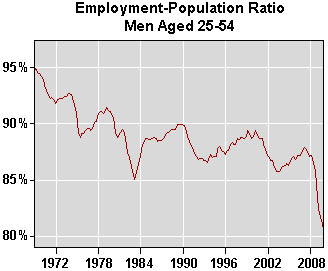 this has become more apparent with every passing year. Which brings us to the recession of 2008-09, as described by Don Peck in the Atlantic:
The weight of this recession has fallen most heavily upon men, who’ve suffered roughly three-quarters of the 8 million job losses since the beginning of 2008….In November, 19.4 percent of all men in their prime working years, 25 to 54, did not have jobs, the highest figure since the Bureau of Labor Statistics began tracking the statistic in 1948.
….According to W. Bradford Wilcox, the director of the National Marriage Project at the University of Virginia, the gender imbalance of the job losses in this recession is particularly noteworthy, and — when combined with the depth and duration of the jobs crisis — poses “a profound challenge to marriage,” especially in lower-income communities. It may sound harsh, but in general, he says, “if men can’t make a contribution financially, they don’t have much to offer.”
Noted without comment, because I really don’t quite know how this is all going to shake out. But I wouldn’t be surprised if we’re entering not merely a slow recovery in general, but an era in which the male employment ratio hovers permanently around 80% even for those in their prime working years. For now, though, just consider this some raw data.
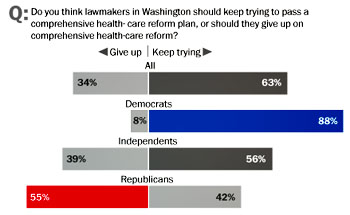 That’s something to work with. The Fox News wing of the Republican Party obviously isn’t in the mood for compromise, but this is a reminder that there’s still a quieter, non-Fox wing that would like to see some things get done. And as the chart on the right shows, 63% of the country thinks “lawmakers in Washington” should keep trying to pass comprehensive healthcare reform, including 42% of Republicans and a firm majority of independents. It’s not clear what all these people think they’re signing up to when they say they want “comprehensive” reform, but that’s still a pretty healthy level of support. At the very least it should help stiffen a few Democratic spines in Congress.
 Paul Krugman
 The Predator has become for President Obama what the cruise missile was to President Bill Clinton — an easy way to appear like he is taking tough action against terrorists, when he is really shying away from the hard decisions needed to protect the United States.
 George Packer is getting beat up for dissing Twitter, and now he says he’s getting beat up for
  Somehow I missed this when it came out, but last week Richard Serrano and David Savage wrote a piece in the LA Times about what really happened during the
 Ross Douthat suggests that we liberals are being too hard on Rep. Paul Ryan’s “Roadmap for America’s Future.” In particular,



