Get your news from a source that’s not owned and controlled by oligarchs. Sign up for the free Mother Jones Daily.

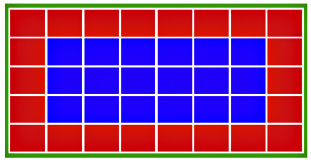
Quick: does this diagram have more blue squares or more red squares?

Time’s up! There are more red squares. But according to Berkeley’s Eduardo Andrade, most people overestimate the number of blue squares when they’re lumped in the middle like this. Scatter them around in different ways and you can reliably get people to guess that there are more red squares or that there are the same number of both. This makes the visual display of information important:

It is relatively easy to bias people’s visually-based estimates. As experiment 1 demonstrates, estimations of the actual proportion of winning squares differed by almost 30 percentage points when the winning-on-the-edge vs. winning-in-the-middle formats were contrasted (30.7% vs. 57.6%). Surprisingly, people are often tempted to rely on the costless and apparently ‘‘infallible’’ visual input. Experiment 2 showed that an astonishing 75% of participants in the ‘‘pictorial format only’’ condition acknowledged that they did not systematically compute the actual probabilities before making a betting decision that involved their own participation fee.

I don’t know if this is really all that surprising or not, but there you have it. In any case, this reminds me of the old chestnut about why, when you look up something in a map book, the thing you’re looking for always seems to be right on the edge, forcing you to flip back and forth between two pages. Answer: because most of the map is on the edge. The outermost 15% of a page contains half the map. The outermost 20% contains two-thirds. So the odds of finding something near the center seems like it ought to be high but in fact is surprisingly low. Thus the annoyance factor.


Via Kevin Lewis of the Boston Globe.

YOUR GIFT DOUBLES THROUGH FRIDAY

Right now, every dollar you give goes twice as far—but only until Friday’s midnight deadline. This is the moment to make your support count double.

In a climate where journalists face mounting pressure to back down, stay silent, or soften their reporting, Mother Jones refuses to flinch. We’re pushing back against intimidation and delivering fierce, independent journalism that holds power accountable—no matter who’s trying to silence us.

But here’s the reality: We’re a nonprofit newsroom with zero corporate backing and no financial cushion. We depend entirely on readers like you to fund the investigations that matter most.

Friday’s 2X match deadline is coming soon. We need you on the team right now. Please chip in and double your impact.

YOUR GIFT DOUBLES THROUGH FRIDAY

Right now, every dollar you give goes twice as far—but only until Friday’s midnight deadline. This is the moment to make your support count double.

In a climate where journalists face mounting pressure to back down, stay silent, or soften their reporting, Mother Jones refuses to flinch. We’re pushing back against intimidation and delivering fierce, independent journalism that holds power accountable—no matter who’s trying to silence us.

But here’s the reality: We’re a nonprofit newsroom with zero corporate backing and no financial cushion. We depend entirely on readers like you to fund the investigations that matter most.

Friday’s 2X match deadline is coming soon. We need you on the team right now. Please chip in and double your impact.

We Recommend

Latest

Sign up for our free newsletter

Subscribe to the Mother Jones Daily to have our top stories delivered directly to your inbox.

Get our award-winning magazine

Save big on a full year of investigations, ideas, and insights.

Subscribe

Support our journalism

Help Mother Jones' reporters dig deep with a tax-deductible donation.

Donate