Today, Brad Plumer takes on one of my favorite fuzzy questions: why does it take so damn long to build stuff these days? There are several obvious candidates/caveats:
- Environmental rules are a lot tougher. You can’t just toss up a road these days and blithely ignore its impact on nearby streams and habitats.
- There are a lot more legal delays than there used to be. Some come from NIMBY opposition, some come from interest groups, and some come from property owners. Put them all together and you spend a lot more time in court than you did in the past.
- Building something brand new in a relatively empty area is pretty easy. Building a replacement in a place congested with infrastructure, especially when you have to keep the old thing operating until the new thing is finished, is a lot harder.
- We’re probably fooled by the length of time that a few high-profile projects take. We all carp about how it’s taken over a decade to build the Freedom Tower — though the original WTC took that long too — but we barely notice that a hundred
 routine projects went ahead simultaneously and took no more time than they ever have.
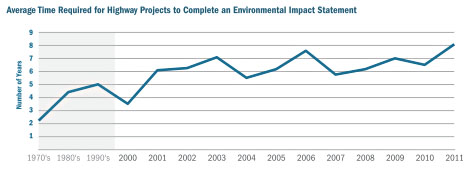
On the environmental front, it turns out that approvals for big projects really do take a lot longer than they did in 1970: eight years on average instead of two, according to the Regional Plan Association of New York, New Jersey, and Connecticut. Does that mean environmental rules should be relaxed? Brad urges caution:
[As] the report notes, it’s quite possible to build large roads and bridges very quickly under existing environmental rules. Consider Minneapolis. Back in 2007, the city’s Mississippi River Bridge on I-34W collapsed, killing 13 people. It was a widely publicized disaster. Lots of headlines. What’s more, Minneapolis needed to rebuild the bridge immediately — it was a crucial route with heavy traffic. So all the local and federal agencies huddled together to make it work. And they managed to leap through all the environmental hoops and rebuild the bridge in less than 14 months:
Despite its urgency, the project was not granted a single waiver or exemption from the permitting or environmental review process. It completed the same NEPA steps as would any typical transportation project of a similar scope and scale. The only difference was the level of federal leadership and advanced coordination that occurred. All federal agencies and project sponsors understood their roles and responsibility and began work immediately upon hearing of the tragedy.
In a sense this is unfair. It’s always possible for emergency projects to move quickly if you’re willing to suck up resources and attention from other projects. But this isn’t free: those other projects pay the price. In another sense, though, that’s the whole point: if we streamlined agency coordination and committed to proper staffing, we could give that level of resources and attention to a lot more projects. If the RPA report is right, delays aren’t inherent in the process, they’re merely a product of how much money we’re willing to spend.
However, this still doesn’t answer the question of why environmental approvals take so much longer than they used to. Are the rules more complex? Is agency coordination worse? Or are we understaffing the agencies compared to the 70s? The RPA report has plenty of suggestions for improvement, but it doesn’t answer that.