Employers Are More Tolerant of Long Jobless Spells When the Economy Is Bad

Get your news from a source that’s not owned and controlled by oligarchs. Sign up for the free Mother Jones Daily.

Tyler Cowen links today to a new paper that, at first glance, comes to an unsurprising conclusion: the longer you’ve been out of work, the less likely you are to get a job interview. Employers generally figure there’s a reason that someone has been out of work for a long time, so resumes and job applications with long jobless spells usually get tossed aside. This is, obviously, especially bad news during a recession, when lots of people have long periods of unemployment through no fault of their own.

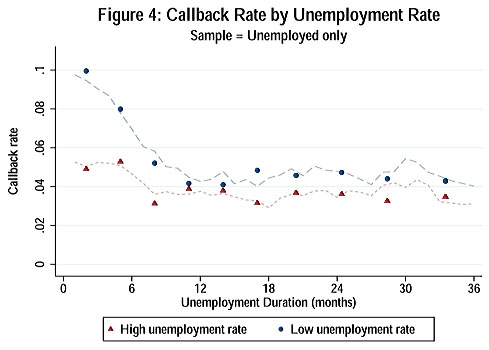
But if you look a little closer, the study (here) has a bit of a silver lining. It turns out that when the economy is in good shape, employers do indeed discriminate against job applicants who have been out of work for a while. That’s the blue line in the chart below, which shows that applicants initially get callbacks about 10% of the time, dropping sharply to only 4% of the time after they’ve been unemployed for eight months.

But take a look at the red line. That’s the callback rate when the economy is bad. The overall callback rate is lower, as you’d expect, but it also doesn’t go down as sharply. It starts out a bit above 5% and then declines to a bit below 4%. That’s still a drop, but not a huge drop. Apparently, when the economy is bad employers really do cut some slack for people who have been out of work for a while. I’m actually a little surprised by this, but it certainly makes sense.

On the other hand, if you’ve been out of work for a year, the state of the economy hardly matters anymore. It’s just really hard to get anyone to give you a chance.

DECEMBER IS MAKE OR BREAK

A full one-third of our annual fundraising comes in this month alone. That’s risky, because a strong December means our newsroom is on the beat and reporting at full strength—but a weak one means budget cuts and hard choices ahead.

The December 31 deadline is closing in fast. To reach our $400,000 goal, we need readers who’ve never given before to join the ranks of MoJo donors. And we need our steadfast supporters to give again—any amount today.

Managing an independent, nonprofit newsroom is staggeringly hard. There’s no cushion in our budget—no backup revenue, no corporate safety net. We can’t afford to fall short, and we can’t rely on corporations or deep-pocketed interests to fund the fierce, investigative journalism Mother Jones exists to do.

That’s why we need you right now. Please chip in to help close the gap.

DECEMBER IS MAKE OR BREAK

A full one-third of our annual fundraising comes in this month alone. That’s risky, because a strong December means our newsroom is on the beat and reporting at full strength—but a weak one means budget cuts and hard choices ahead.

The December 31 deadline is closing in fast. To reach our $400,000 goal, we need readers who’ve never given before to join the ranks of MoJo donors. And we need our steadfast supporters to give again—any amount today.

Managing an independent, nonprofit newsroom is staggeringly hard. There’s no cushion in our budget—no backup revenue, no corporate safety net. We can’t afford to fall short, and we can’t rely on corporations or deep-pocketed interests to fund the fierce, investigative journalism Mother Jones exists to do.

That’s why we need you right now. Please chip in to help close the gap.

We Recommend

Latest

Sign up for our free newsletter

Subscribe to the Mother Jones Daily to have our top stories delivered directly to your inbox.

Get our award-winning magazine

Save big on a full year of investigations, ideas, and insights.

Subscribe

Support our journalism

Help Mother Jones' reporters dig deep with a tax-deductible donation.

Donate