• Quote of the Day: Why Republicans Like Voter ID Laws


    From Pennsylvania House Majority Leader Mike Turzai, telling a friendly audience about the state legislature’s accomplishments this year:

    Voter ID, which is gonna allow Governor Romney to win the state of Pennsylvania, done.

    Apparently this drew a “loud round of applause,” and why not? Photo ID laws like Pennsylvania’s are mainly about politics, and everyone knows it. They suppress turnout primarily among minorities, the poor, and the young, and those are well-known Democratic-leaning constituencies. In a close election, Pennsylvania’s law might very well allow Romney to win the state.

    Anyway, it’s good to hear someone admit this. Usually they’re smart enough to pretend that voter ID laws are about preventing voter fraud.

    (Via Steve Benen.)

  • Chart of the Day: September Best Month to Put Your Money Under a Mattress

    UPDATE: It turns out there’s nothing to this after all. Joshua Hedlund has the whole story here.


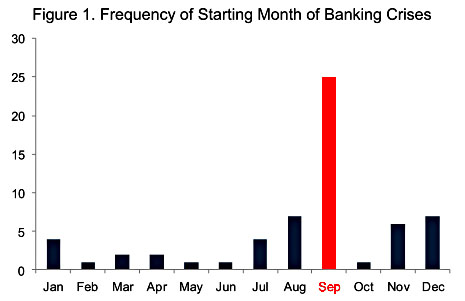
    Here’s the weirdest chart you’re likely to come across today. It comes from a paper by Luc Laeven and Fabián Valencia and shows the starting month of all modern banking crises (i.e., those after 1970). By a huge margin, banking crises mostly start in the second half of the year, and the overwhelmingly most dangerous month is September.

    Greg Ip tentatively suggests this might have something to do with the fact that October 30th marks the fiscal year-end for American mutual funds, but he’s not really convinced, and I don’t think I am either. Perhaps we could get a better answer if we grouped crises not by month, but by astrological sign. Are all those September crises in Virgo or Libra? Inquiring minds want to know.

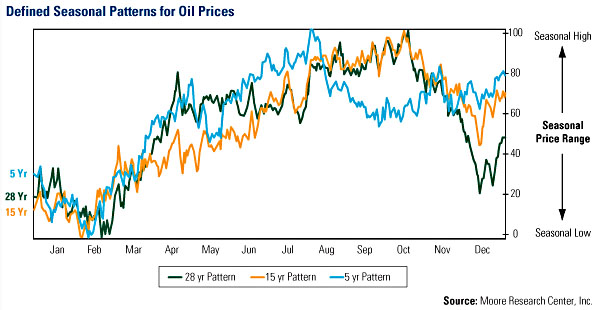
    UPDATE: I suppose there are lots of other things that show a similar pattern and thus might be related, but a reader sends along this one, which is sort of interesting. Maybe it’s all about the oil!

  • Save the Planet: Tint Your Car Windows

    I’m feeling a little under the weather today—don’t ask, you don’t want to know—though on the bright side Kaiser Permanente tells me that I passed my recent stress echo with flying colors. So I guess my heart will continue beating properly for another few years anyway. Still, I’m afraid I just can’t spend the entire day blogging about the Supreme Court. Can’t. Do. It. So instead, here’s a bit of trivia from Climate Progress:

    On this first day of summer, many car owners are likely to experience the following scenario: enter your car to leave work for the day and the temperature is sweltering—much hotter than outside. The ignition, steering wheel, and seat surface are almost too hot to touch. You roll down your windows or turn on the air conditioner (or both) to get some air moving to quickly mitigate the sauna-like conditions…This is more than just a nuisance on hot days. Of the oil consumed by U.S. passenger vehicles, 5.5 percent is used for air conditioning.
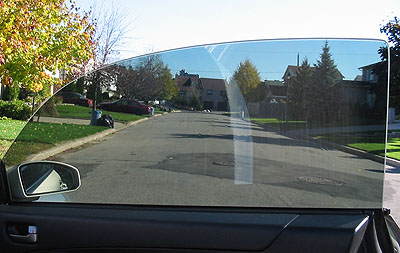
    The article goes on to talk about a bunch of high-tech/low-energy ways to keep cars cooler, but they missed my favorite one: window tinting. Here’s my story.

    Last year, Marian decided to buy a Prius. This was, unfortunately, right after the earthquake in Japan, and Priuses were in short supply, making it a seller’s market. Not only were no discounts available, but dealers were charging well above list price. However, because Toyota doesn’t allow dealers to just baldly mark up their cars above list, they instead loaded a bunch of accessories onto every car on the lot and then charged highway robbery prices for them. So here’s the way car shopping worked: Instead of going to several dealers and dickering over price, we went to several dealers and compared the crap that they added to the car. At one dealer it was LoJack and a chassis “undercoating.” I practically laughed at that one. I didn’t realize anyone still had the balls to try selling undercoatings anymore, especially in Southern California. At another dealer, it was a (supposedly) super-duper GPS and a few other doodads. Then, finally, we found a dealer who had added only one thing to their cars: window tinting. And they were only charging about twice what it was worth, which really wasn’t bad under the circumstances. So we bought one of their cars.

    All I can say is that I was mightily impressed. This wasn’t dark tinting like celebrities get so you can’t see into their cars, it was just a modest gray tint. But it lowers the temperature of the car by a good 5 or 10 degrees when it’s sitting out in the sun. It’s really a big difference, much bigger than I would have guessed. I’ll never get another car without it. And if I’m helping save the planet at the same time, that’s a pretty nice bonus.

    Front page image: ronfromyork/Shutterstock

  • A Hodgepodge From the Supreme Court


    So we have three Supreme Court rulings today. In a nutshell:

    • The court mostly overturned Arizona’s immigration law, but let stand the provision allowing police to ask for immigration papers if they have a “reasonable suspicion” someone is in the country illegally.
    • The court stuck down a Montana campaign spending law, essentially reaffirming Citizens United.
    • The court banned sentences of life without parole for minors.

    Can we read any tea leaves here? Probably not. The immigration ruling was a patchwork compromise. The campaign spending ruling is conservative but unsurprising. The sentencing ruling is basically liberal, but also unsurprising given past rulings. There’s not much insight here into how they might rule on Obamacare. But we’ll know soon enough anyway.

    UPDATE: More on the Montana campaign finance law here from Andy Kroll.

  • The Future of Cyberwarfare


    Tyler Cowen has a question:

    Didn’t it just come out in The Washington Post that the United States helped attack Iran with Flame, Stuxnet and related programs? If they did this to us, wouldn’t we consider it an act of war? Didn’t we just take a major step toward militarizing the internet? Doesn’t it seem plausible to you that the cyber-assault is not yet over and thus we face immediate questions looking forward? Won’t somebody fairly soon try to do it to us? Won’t it encourage substitution into more dangerous biological weapons?

    I do understand that these are fairly superficial questions and that I do not have the expertise to write a detailed and insightful blog post on these topics. Still, it seems odd not to mention them at all. While I read in limited circles, I do not see many writers devoting much attention to the matter. Shouldn’t this have set off a large-scale national debate?

    My take is this: we’ve all but declared war on Iran already, and everyone knows it. We’ve assassinated their scientists, imposed crippling sanctions, and essentially declared that we’re ready to mount a massive air strike against them in the near future. Under those circumstances, a bit of cyberwarfare hardly seems like a huge escalation.

    What’s more, we all assume that other countries, China especially, are already hard at work on digital weapons. Our intelligence services have been warning about a “cyber Pearl Harbor” since before 9/11. It’s not a taboo area. So when the open secret that we’re working on this stuff becomes an even more open secret, hardly anybody really cares about this non-news.

    They probably should, though.

  • Six Minutes With Karl Rove

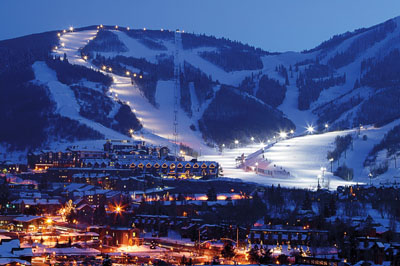
    The New York Times has a story today about a stupendous Mitt Romney shindig for wealthy donors in Park City, and for the most part the event turns out to be just what you’d imagine these things are like. Flawlessly executed, as you’d expect from Romney, packed with GOP stars, backstopped by gorgeous scenery, sprinkled with speeches about how President Obama is destroying America, and crowned by glimpses of Romney himself in between the barbecued beef, chicken and salmon.

    But really, the story saves the best for last:

    Mr. Rove playfully mocked a Wall Street banker for his casual wardrobe: a baseball cap, gray hooded sweatshirt and a pair of worn bluejeans. You’re the most underdressed banker I’ve ever met,” Mr. Rove told him.

    After Mr. Rove walked away, the gaggle of men excitedly recounted the conversation, reveling in their access. “That’s the price of admission right there,” one donor said to another. “Your six minutes with Rove.”

    Honest to God, I don’t get this. Sure, I suppose everyone likes to be schmoozed. But seriously? These wealthy, powerful, connected men are as excited as schoolboys because they got to chat with Karl Rove for six minutes? Isn’t that kind of pathetic? Are the lions of our overlord class really that insecure about their stations in life?

    NOTE: This post is entirely nonpartisan. I don’t doubt that Democratic donors act pretty much the same way.

  • Anne-Marie Slaughter’s Time-Saving Microwave Tips


    Approximately everyone in the world has already commented on Anne-Marie Slaughter’s cover story in this month’s Atlantic, “Why Women Still Can’t Have It All,” so I’m not going to. I’m not female, not a parent, and don’t have a hugely demanding job, so I’m unusually poorly qualified to have an opinion anyway. However, I can’t resist highlighting this passage:

    Louise Richardson, now the vice chancellor of the University of St. Andrews, in Scotland, combined an assistant professorship in government at Harvard with mothering three young children. She organized her time so ruthlessly that she always keyed in 1:11 or 2:22 or 3:33 on the microwave rather than 1:00, 2:00, or 3:00, because hitting the same number three times took less time.

    Hey! I do that too. Melting butter? 0:55. Nuking a potato? 5:55. Reheating Chinese food? 2:22, stir it up a little, then 1:11. Etc. And I do this despite the fact that my time is organized exactly the opposite of ruthlessly.

    I suppose there’s a lesson to be learned from this, but I’m not sure what. Maybe my readers have some ideas. As for the actual point of Slaughter’s piece, I agree with the near-universal consensus that (a) the title of the piece is grating, (b) the framing of the piece is grating, (c) the cover photo is grating, but (d) the substance of the piece is worthwhile. The latter was, frankly, a little surprising to me because the gist of Slaughter’s complaint seemed so obvious that I was annoyed she felt like she had to spend 12,000 words to convince me. But I guess maybe it’s not so obvious as I thought.

    By the way, aside from the microwave thing, the most popular time-management technique seems to be waking up at 4 am. Assuming, that is, that you consider this a “time management” technique. I’ll let each of you decide that for yourself.

  • Henry Blodget Says it All Today


    Headline of the day, from Henry Blodget:

    Corporate Profits Just Hit An All-Time High, Wages Just Hit An All-Time Low

    Actually, let’s make that headline of the decade. Click the link to see the relevant charts.