• Friday Cat Blogging – 22 June 2012

    As regular readers of Friday catblogging know, I don’t use my camera’s flash very often. Mostly that’s because I just don’t like direct flash much, but it’s also because “laser eye” in cat pictures is far worse than red eye in human pictures. You have to shoot from a pretty extreme angle to avoid it.

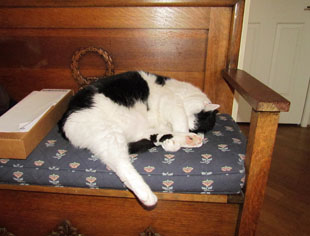
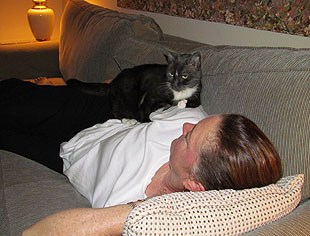
    But sometimes you gotta do what you gotta do, and last night was one of those times. On the left, Marian is tuckered out on the sofa and Domino has decided she makes a pretty good bed. On the right, Inkblot has churned through his usual cycle of favorite places and decided that the antique bench is once again his favorite place. That should last another week or so. They’re so cute when they drape a paw over their eyes, aren’t they?

  • Why I Hate Social Media, Part 386


    Why do I hate social media so much? I guess I’m just antisocial. (Seriously. I am.) But there’s also this, from the Clay Shirky interview I just posted about:

    Wired: What developments — companies, products, technologies, whatever — really get you excited right now?

    Shirky: I don’t know if you’ve played with news.me, have you seen this thing?

    Wired: No I haven’t.

    Shirky: So news.me sits on top of bit.ly, and it also sits on top of your social graph in Twitter and it just forwards you the five most popular stories among everybody you follow, not based on the number of times the link was circulated, but the number of times individual people you follow clicked on that link. It really has become my favorite piece of email of the day. I’ve tried lots of curation services and have really been wrestling with the serendipity problem in one form or another in news since the 1990s, when I did some work with Walter Bender’s group up at MIT. And this is the first thing I’ve seen that’s actually done it.

    That sounded kind of interesting, so I went over to News.me to sign up and try it. First they needed my email address. Fine. Then I had to add my Twitter account. Fine again. But here’s what I had to allow the news.me folks to do:

    • Read Tweets from your timeline.
    • See who you follow, and follow new people.
    • Update your profile.
    • Post Tweets for you.

    Say what? I have to give them the authority to update my profile and post tweets under my name? I don’t know if this requirement is a News.me thing or a Twitter API thing, but it’s ridiculous. Obviously they need read access to my timeline and followers in order to put together their custom-built compilation of news pieces and email them to me. But they don’t need write access to my account. And they didn’t get it. They still have my email address, though. I guess I’ll never get that back from them.

    Once again, though, I’m left scratching my chin. Am I wildly overreacting? Does no one care about this kind of thing anymore? Should I just shrug and let it go? Or is this every bit as intrusive as I think it is? Can someone under the age of 25 please help me out?

    UPDATE: Mike Young, chief technology officer at News.me, replies in comments:

    I wanted to try to explain why we ask for both read and write permissions for Twitter when signing up for News.me. You are right to give pause and be concerned with any applications that ask for this, but hopefully this will help explain things a bit.

    When building a Twitter app, you can ask for (only) two sets of permissions: “read” and/or “write.” The read part is obvious, as you mentioned — we collect the tweets in your stream throughout the day and display what we think are the most interesting stories for you in our daily email, as well as our iphone and ipad apps. We ask for “write” permissions to your account so that you can do things like share/tweet articles (or retweet) from our iPhone, iPad and upcoming web application. The only way to do this from any third-party Twitter application, like News.me, is if you authorize “write” access. Since News.me spans across email, iphone and ipad (and soon the web), we ask for both read and write access if you log in to News.me via any of those platforms.

    One things to note: Twitter doesn’t let you get more granular when you ask for “write” permissions like Facebook does. You noted that the Twitter dialog shows things like “this app can ‘update your profile'” which we never do, or would ever want to do, but we can’t tell Twitter that we don’t want access to that. It’s either all or nothing with Twitter. Facebook gives you much more granular controls so that, as a developer, you only ask for what you really need and it’s very clear to the user which data the application will have access to. It’s not the case with Twitter, but I believe that will change soon.

    I hope this helps explain things a bit! We take this very seriously, and obviously have some work to do to make this more clear to our users. Happy to discuss further or answer any more questions here or on email.

    Hmmm. I still think they could make write access optional for folks who don’t care about retweeting from within their app. Still, that’s the explanation and I wanted to pass it along.

  • It’s Back to the Future for Presidential Campaigns


    Wired posted an interview a few days ago with internet guru Clay Shirky. This part is getting a lot of attention:

    Wired: Are you seeing anything interesting in how this election is being conducted or covered online?

    Shirky: Clinton used mailing lists in ’92, and every election since then — famously Howard Dean to Barack Obama — has involved considerably more imaginative use of social media. And this election has not. I’ve been quite surprised by that.

    I had a student looking at Super PACs a while ago, and we said, “Let’s try and find out what the Super PACs’ social media strategy is.” As she came back about 10 days later, she said, “I think I know what the Super PAC’s social media strategy is: Don’t use it.” That’s exactly the whole point of being a Super PAC, to be able to spend unlimited money on the kind of media where no one has the right or the ability to respond, and to minimize transparency. This election feels to me, right now, more Nixon-Kennedy than Obama-McCain because television has become the tool of choice for the source of unlimited fundraising. Politicians like television better; nobody gets to yell back to you if you’re yelling on TV.

    I’m not sure this is right. Super PACs aren’t focusing on social media because, rightly or wrongly, they don’t think that’s their strong suit. A social media campaign is better suited to an organization with a personal flavor or a longer planning horizon, like a presidential campaign or one of the major party national committees. It’s nearly impossible to gin up any kind of viral enthusiasm for a faceless organization like Crossroads GPS.

    So the real question isn’t what Super PACs are doing, it’s whether the Romney and Obama campaigns are using social media in any new and imaginative ways. And here, Shirky seems to be right. I can’t remember reading a single piece this year about some creative new use of social media from the campaigns. Maybe that’s because the mainstream media is bored with social media, but I doubt it. If they can get themselves interested in dressage and “the economy is doing fine,” they can get themselves interested in whiz-bang new war room strategies based on whatever new new thing is supposedly putting Facebook out to pasture. But they haven’t. That means either the campaigns are keeping this stuff very, very quiet, or else they aren’t really doing anything new. The former is unlikely, so it’s probably the latter. But why?

  • Good Politics Maybe Not Such Good Policy Lately

    Will Wilkinson acknowledges that Darrell Issa’s campaign to crucify Eric Holder over the Fast & Furious program is probably just an election-year witch hunt. But he doesn’t care:

    The executive has taken far too much power from the legislative branch, much to the detriment of democratic principles. I don’t much care why in a particular case Congress wishes to assert its prerogatives against the executive. Whenever it finds the motivation, I’m for it. So this is an election-year ploy I’m happy to see. The people’s representatives in government have a right to the information they need to hold the agents of the state accountable. They’ve asked. The executive has an obligation to comply. It’s that easy.

    Meanwhile, over at the Washington Post, Charles Krauthammer argues that President Obama’s newfound belief that he can unilaterally change immigration laws is “naked lawlessness”:

    Prosecutorial discretion is the application on a case-by-case basis of considerations of extreme and extenuating circumstances. No one is going to deport, say, a 29-year-old illegal immigrant whose parents had just died in some ghastly accident and who is the sole support for a disabled younger sister and ailing granny. That’s what prosecutorial discretion is for. The Napolitano memo is nothing of the sort. It’s the unilateral creation of a new category of persons — a class of 800,000 — who, regardless of individual circumstance, are hereby exempt from current law so long as they meet certain biographic criteria.

    This is not discretion. This is a fundamental rewriting of the law.

    I think both of these gentlemen are overstating things. In the case of the F&F fishing expedition, it’s not actually quite “that easy.” There are legitimate grounds to exert executive privilege, and Obama might be exercising one of them.

    As for Krauthammer, overstating things is his stock in trade. As he knows very well, given limited resources, presidents have routinely set national enforcement and prosecutorial priorities at a policy level: more time on X, less time on Y, don’t bother with Z. It’s hardly unprecedented.

    And yet, can I say that I think they both have a point? Sure, Issa submarined his own credibility by refusing Holder’s offer to let his committee “review” the documents he wanted to see, but at the same time, I’m not gullible enough to believe that all the documents Issa has subpoenaed are truly protected conversations. Some may be, but I suspect that many are simply embarrassing. As with every other executive privilege case I can think of, I sure wish there were some sort of neutral third party that could adjudicate this stuff. Some third branch of government or something. That would help things along, wouldn’t it?

    As for mini-DREAM, presidents may set enforcement priorities, but Krauthammer is right when he says it’s rare to see such a sweeping decision to simply not enforce the law under specific circumstances. As much as I approve substantively of what Obama has done, I think the authority of the president to ignore laws he doesn’t like is — or at least should be — distinctly limited. Mini-DREAM sets a bad precedent.

    I don’t think either of these things are huge issues. Nowhere near as big as any of half a dozen national security policies I can think of. Mostly this is just election-year politics, red in tooth and claw. Nonetheless, I’m uneasy with both of these decisions.

  • Time to Let Greece Go?

    Ezra Klein surveys the current attitudes of Germany and other northern European countries and asks, “Is Europe trying to kick Greece out?”

    One plausible story I’ve begun to hear is that an increasing number in the euro zone actually want to drive Greece out. The idea, basically, is that Greece is such an unsalvageable basket case, and its economy is so much weaker than anyone else’s, and its governments have been so much more dishonest and difficult to deal with, that solving Greece’s problems would mean rewarding irresponsibility while not solving them would mean an endless cycle of crisis. At some point, it’s better just to cut them off and cauterize the wound.

    The funny thing about this is that everyone might be better off if Germany and Greece negotiated a (relatively) amicable agreement to do this. Germany would be better off because they don’t want to prop up Greece forever. Greece would be better off because re-adopting the drachma and devaluing it would solve their underlying problems of inflation and capital inflow and give them a chance at a genuine recovery. And the eurozone would be better off because it would be rid of the country least suited to be a member.

    Obviously there’s still the risk of contagion in this scenario: if Greece can negotiate an exit, why not Spain and Italy and Portugal too? But that’s a looming danger in any case, and simply acknowledging what’s common knowledge — that Greece never should have been part of the eurozone in the first place — might do everyone a world of good. A friendly deal that made Grexit as smooth as possible; kept Greece in the EU; and included some IMF support to cushion the blow might actually be the least bad bet for everyone.

  • How Politics Shapes the Supreme Court


    Ilya Somin argues that there’s been less flip-flopping on the individual mandate than liberals think. In fact, plenty of conservatives have opposed it all along. I think that’s considerably overstated, but I’ll let it slide. Instead, ponder this:

    It is certainly true that courts would be unlikely to strike down a major federal law that enjoyed broad bipartisan support. In that sense, the opposition of the GOP and the willingness of 28 state governments to file lawsuits against it played a crucial role. One can say the same thing for almost every major case challenging the constitutionality of a prominent law. None of them are likely to succeed in the face of overwhelming bipartisan opposition.

    A friend writes in to wonder what this means:

    Note the emphasis on the party here — that played a “crucial role.” What is interesting here is the view that if one “party” lines up in full opposition and marshals its lieutenants in the states to press the issue in the courts, then any arguments upholding its constitutionality become much more suspect, the challenge more valid today — even if it was invalid yesterday. And courts should acknowledge that and be more willing to overturn the legislative decision due to the lack of bipartisanship. So, a 60-40 party-line vote in the Senate is less valid than a 51-50 vote as long as the 51 had a bipartisan mix and the state-generated challenges are a bipartisan mix as well. In each case, regardless of the merits. Or, more precisely, the merits don’t come into play until the politics says they come into play.

    Given the Roberts Court’s rulings to date and certainly their public hearings, it’s hard not to agree with Somin’s point….It’s a frightening paradigm and one that moderates and Democrats would — and should — abhore. But just dismissing it as absurd doesn’t mean it isn’t firmly in place and in full operation now.

    If this is right, it means that the Republican Party’s enthusiasm for unanimous obstruction is more than just a purely political strategy aimed at slowing legislation and appealing to its tea party base. It’s also targeted at supposedly nonpolitical actors like the Supreme Court, giving them an opportunity to overturn a “partisan” law rather than one that’s more broadly accepted. In theory, that shouldn’t matter, but in practice it does. It’s really a very nicely integrated strategy, much as Fox News has a nicely integrated strategy between its “news” shows and its “opinion” shows. It’s pretty smart.

  • What Really Happens If the Supreme Court Strikes Down the Mandate?

    <a href="http://www.shutterstock.com/pic.mhtml?id=45883753">Rena Schild</a>/Shutterstock


    As everybody waits with bated breath for the Supreme Court to release its ruling on Obamacare (maybe Monday!), the fashionable parlor game among the chattering classes is to figure out what the impact of different kinds of rulings would be. So let’s play! But most of the alternatives are uninteresting. If the court upholds the law, then everything goes forward as planned. If they strike down the entire law, then everything stops. The only interesting question is: What if they strike down the individual mandate but uphold the rest of the law?

    We can game this out, but first you have to understand just who would be most upset by a ruling like this. The answer is: insurance companies. You see, the Affordable Care Act (ACA) requires insurance companies to accept anyone who applies for coverage and to charge everyone (with some specific exceptions) roughly the same rate. This works fine if insurance companies get a random selection of customers. They can easily figure out the average cost of care for this random group and then charge everyone that average, plus a little extra so they make some money. Nice and neat.

    But without a mandate, they’re unlikely to get a random selection of customers. Instead, healthy folks will probably stay out of the market and buy coverage only when they come down with some kind of serious illness. This is a disaster for insurers. They aren’t getting regular premium payments from these customers, but they still have to pay for their million-dollar proton beam therapy when they get prostate cancer. Too much of this kind of behavior and they’ll be out of business. That’s why this dynamic is called a “death spiral.”

    So what happens if the mandate is overturned? Here’s one possible scenario, along with my guesses about the likelihood of each step:

    1. Congress deadlocks on any kind of solution (p=100%).
    2. In 2014 the law goes into effect as scheduled (p=100%).
    3. The death spiral starts as the healthiest segment of the uninsured decides to stay uninsured (p=99%).
    4. However, thanks to the expansion of Medicaid and the subsidies for private insurance, the death spiral happens very slowly. The number of people who buy insurance at the last minute is relatively small (p=90%).
    5. Insurance companies raise premiums across the board to make up for this (p=100%).
    6. Because this happens slowly, the premium increases are small enough and justifiable enough that the Department of Health and Human Services mostly approves them (p=80%).
    7. For all practical purposes, insurance companies replace emergency rooms as the funder of last resort for the uninsured (p=70%).
    8. The death spiral turns out to have an end point. Premiums go up for a while until a new equilibrium is found, and then they stabilize. (Though of course health care costs in general will probably continue to go up. But this is separate from premium increases caused by the death spiral.)

    This is a very rosy scenario. The usual objection is that No. 4 is wrong and, in fact, the death spiral happens more quickly—say, within four or five years. In this case, insurance companies will genuinely be in dire straits and will begin to put so much pressure on Congress that even conservatives realize they have to do something. By the time this happens, ACA will be so entrenched that repealing it just isn’t in the cards, which means that either Congress passes a constitutionally approved version of the mandate (for example, by making it a tax credit) or else nationalizes health care even further.

    Overall, this is the most optimistic possible set of outcomes. In both cases, ACA is basically safe, either because the law’s other provisions dampen the effect of the death spiral or because Congress is forced to take action in order to save the insurance industry.

    Do I believe this? Actually, yes. Despite the fact that I think overturning the mandate would be a constitutional disaster, I’m not convinced it would inevitably be a health care disaster. It would unquestionably create a fair amount of unnecessary uncertainty, but in the end, things would probably work out okay as long as Democrats have the spine to continue defending the basic law. Time will tell about that.

    UPDATE: In #7, I changed “provider of last resort” to “funder of last resort.” Obviously insurance companies don’t actually provide health services, they just pay for them.

  • The Washington Post Says Mitt Romney Outsourced Jobs….Or Maybe Not

    Glenn Kessler of the Washington Post dings the Obama campaign today for claiming that Bain Capital “shipped jobs to China and Mexico” while Mitt Romney was CEO:

    Upon hearing this ad was under consideration for a tough rating, the Obama campaign supplied reams of additional SEC documents regarding Romney’s ownership in Bain after he left for the Olympics, most of which we had examined previously when we first looked at this question. The campaign also supplied SEC documents showing that two of these companies, Modus and SMTC, as well as one called Stream International (a predecessor of Modus), earned money in part by helping other companies subcontract work overseas. Some of this business predated Romney’s departure from Bain, but thus far it seems a slim case for this particular ad.

    Twelve hours later, Tom Hamburger of the Washington Post filed a story suggesting the case isn’t so slim at all:

    A Washington Post examination of securities filings shows the extent of Bain’s investment in firms that specialized in helping other companies move or expand operations overseas.

    ….Bain’s foray into outsourcing began in 1993 when the private equity firm took a stake in Corporate Software Inc., or CSI….Two years after Bain invested in the firm, CSI merged with another enterprise to form a new company called Stream International Inc. Stream immediately became active in the growing field of overseas calls centers….By 1997, Stream was running three tech-support call centers in Europe and was part of a call center joint venture in Japan, an SEC filing shows.

    ….The corporate merger that created Stream also gave birth to another, related business known as Modus Media Inc., which specialized in helping companies outsource their manufacturing….According to a news release issued by Modus Media in 1997, its expansion of outsourcing services took place in close consultation with Bain.

    ….Another Bain investment was electronics manufacturer SMTC Corp….The company said that communications and networking companies “are dramatically increasing the amount of manufacturing they are outsourcing and we believe our technological capabilities and global manufacturing platform are well suited to capitalize on this opportunity.”

    So who’s right, the Washington Post or the Washington Post? I excerpt, you decide.

  • Maybe It’s Time to Shut Down the Commerce Department

    Kevin Williamson reacts to the news that John Bryson has resigned as Secretary of Commerce:

    The existence of the Commerce Department, a.k.a. the Department of Corporate Welfare, suggests that Washington has little institutional confidence in free markets and believes that markets must be guided by the sorts of geniuses who end up working in the Commerce Department.

    Possible reactions:

    A. Agitate for better personnel at the Commerce Department.

    B. Abolish the Commerce Department.

    I’m voting for B.

    This is our lucky day! It turns out that back in January President Obama asked Congress for the authority to do just that, so all we have to do is put together a bipartisan consensus of National Review pundits and Mother Jones pundits and we should be all set.

    Of course, there are some details to work out here, just like there always are when people suggest getting rid of cabinet departments. The Commerce Department, for example, includes the Census Bureau. Can’t get rid of that. BEA produces some pretty useful statistics. NOAA does good work on that whole hurricane prediction thing. NIST is handy to have around so we know what time it is and how long an inch is supposed to be. Patents and trademarks really need to be kept going. And someone has to negotiate trade agreements.

    Anyway, it turns out Obama wants to keep all that stuff and just put it into a new agency with a different name, which means that even his optimistic estimate is that deep-sixing Commerce would only save $3 billion per year. Nothing wrong with that, but it’s not exactly earth-shaking stuff. Williamson might want the ax to swing a little harder, but I’m not sure how much harder it can really swing.

    In any case, this is a good example of the problem with people — usually people running for president — using the elimination of cabinet departments as conservative applause lines. It sounds good, but it’s like taking potshots at the visible parts of icebergs. What you really want to do is look below the waterline and ask which agencies all those presidential wannabes are planning to get rid of. After all, just shuffling them around into other departments doesn’t save much money.

  • Mitt Romney Kinda Sorta Takes a Stand on Immigration


    Surprise! Mitt Romney, who was immigration’s most strident foe during the primaries, has suddenly discovered that “we can find common ground here, and we must.” Also unsurprisingly, he’s still declining to take a firm stand on President Obama’s mini-DREAM order:

    “Some people have asked if I will let stand the president’s executive action,” he said. “The answer is that I will put in place my own long-term solution that will replace and supersede the president’s temporary measure.”

    Okey dokey. More mush from the wimp, I guess.

    UPDATE: More detail here from Adam Serwer.