• Quote of the Day: GOP Leader Says Obama Using the IRS to Punish His Enemies


    From Mitch McConnell, the Republican leader in the Senate, describing the Obama campaign on Fox News last Friday:

    What they’re trying to do is intimidate donors to outside groups that are critical of the administration. The campaign has rifled through donors’ divorce records. They’ve got the IRS, the SEC and other agencies going after contributors trying to frighten people and intimidate them out of exercising their rights to participate in the American political discourse….Of course, the temptation of anybody in power is to try to silence your critics.

    If that were true, I’d be the first to call for Obama’s impeachment. But it’s not, of course. McConnell just figures he can say whatever he wants and no one will really call him on it. And he’s right about that.

    Michael Tomasky has more on the bigger picture here.

  • The Fed’s Own Forecasts Show That It Needs to Loosen Up

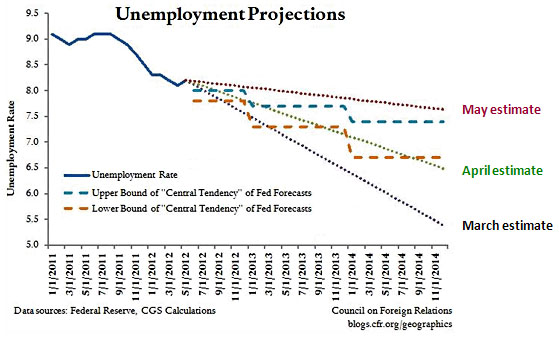
    Will the Fed finally decide to loosen up a bit and do something to prop up our fragile economy? Maybe! Brad Plumer points us to this chart compiled by the Council on Foreign Relations that explains why they might. Back in March, the Fed thought unemployment was falling nicely and would reach 6.5% by the end of next year. By May they were far more pessimistic, predicting that unemployment would be only barely below 8% by then. And, as Brad says, that’s not all:

    Of course, there’s more than the unemployment rate to consider. Jobless claims have been ticking upward of late. Retail and manufacturing is weakening. The housing market is still flailing along. Plus, Fed officials will have to consider whether Europe still poses a threat to the U.S. recovery. But the [CFR] graph lays the choice out starkly. If the rough patch in May wasn’t just a blip, then the Fed will be failing to achieve its own stated goals for unemployment.

    It’s past time for the Fed to do something about this, and it’s not just Paul Krugman saying so. The Fed’s own forecasts are saying it too.

  • Why the Microsoft Surface Tablet Will be Great Even if it Sucks

    Last night Microsoft announced that it will take on Apple directly in the tablet market by designing and selling its own device. Farhad Manjoo is excited:

    For the first time in its history, Microsoft is taking PC hardware as seriously as it does software. The software giant is coming around to a maxim that archrival Steve Jobs always held dear—that the best technologies come about from the tight integration of code and manufacturing, and that no company can afford to focus on just one half of that equation.

    ….During the last couple years, the software company has been working to make its next version of Windows perform amazingly well on touchscreen tablets….But after investing so much to create a great tablet interface, Microsoft risked losing the battle on hardware. Many of its traditional PC partners—Samsung, Asus, Dell, and HP—have already tried to take on Apple with rushed, ill-considered, cheaply made tablets. Microsoft would have been foolish to rely on that gang of losers to create tablets that were worthy of the new Windows. With the Surface, the company is taking its future into its own hands.
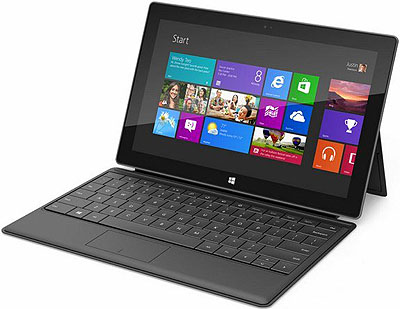
    On two different levels, I don’t get this. First off, there doesn’t really appear to be anything all that special about the hardware Microsoft announced. It seems perfectly competent, and maybe even a little better than competent. But it’s basically a 10-inch tablet with a few ports, a kickstand to prop it up, and a nifty-looking integrated cover/keyboard. All in all, it’s a nice package but, as near as I can tell, nothing revolutionary. And nothing in Microsoft’s presentation suggested to me that Windows 8, the software that runs the Surface tablet, won’t work just as well on Samsung and Asus hardware as it does on theirs.

    But that’s the least of my puzzlement. The main source is this: the most important aspect of the Surface tablet — by a mile — isn’t that Microsoft is paying a bit more attention to hardware. It’s the fact that the Pro version is both a tablet and a real computer. This is huge, and it’s huge whether you’re an Apple fan or a Windows fan.

    Here’s the thing: I have an iPad. I like it! Millions of other people like it. But let’s be honest: it’s a toy. It doesn’t have a file system you can use. It doesn’t run real apps. It can’t exchange data with your Mac easily. It has a bunch of limitations on what you’re allowed to do with it. (You can’t upload files via a website, for example.) Put all this stuff together, and for most of us the iPad simply can’t replace our main computer. In fact, it doesn’t even play very well with our main computer.

    In the Mac world, a tablet that actually ran Mac OS, made data exchange easy, and supported regular apps, would be great. But Apple doesn’t appear to have any plans for such a device, and this is what really sets the Surface tablet apart. If you live in the Windows world, as millions of us do, the Surface concept is very, very seductive. As a tablet, the Metro interface offers the casual ease of use that you want in a tablet. Toss in the keyboard/trackpad add-on, plug in a bigger display, and the Windows interface allows you to use it as your primary computer. Or, if not quite that, at least as a full-powered secondary computer. That’s huge.

    Now, obviously, the devil is in the details, and there are lots of details Microsoft hasn’t yet addressed publicly. How much will the Surface tablet cost? What’s the battery life? Does Windows 8 suck? How about Bluetooth? GPS? 4G data support? Is Intel’s Ivy Bridge chipset any good? How fast is it? Etc.

    The answers to these questions might very well be disappointing. See George Ou’s comment here for more on that. Put this all together, and I think it’s quite possible that Microsoft might very well fail in its newfound dedication to hardware — which I suspect is far more about profit margins than about a sudden appreciation for the “tight integration of code and manufacturing” in any case. But even if Microsoft does fail, other hardware manufacturers are almost certain to step in with devices that make the right set of tradeoffs and allow Windows 8 tablets to perform genuine double duty as casual plaything and serious computer. Whether it comes from Microsoft or Apple, that’s the future of the tablet.

  • ACA’s Mandate is Nothing New, and the Supreme Court Knows It

    The primary legal argument against Obamacare’s individual mandate turns on the distinction between activity and inactivity. Conservatives say that although the Commerce Clause gives Congress considerable power to prevent activity, it’s never been interpreted to give Congress the power to penalize inactivity. But the Affordable Care Act forces private citizens to purchase a commercial product, and that’s a bridge too far.

    This has been debated endlessly, and since I’m not a lawyer or a constitutional scholar it hardly matters what I think about it. But from a layman’s point of view, I’ve always had two big problems with this theory:

    • It’s brand new. Prior to the passage of ACA, no one had ever seriously brought this up as a legal distinction. It was invented solely as a way of justifying a court decision to overturn ACA.
    • It’s not even true except in the most hyperlegalistic sense.

    The second point requires some explanation. So here it is: the truth is that the federal government forces you to buy commercial products or engage in commercial activity all the time. If you buy a car, you must buy airbags along with it because federal regulations require it. If you want to travel overseas, you must submit a pair of photos along with your passport application, and the only way to acquire these photos is by engaging in private commerce. Or take this, from Cato’s Ilya Shapiro:
    There is a qualitative difference between regulating or prohibiting existing economic activity and mandating that someone engage in such activity. When Randy Barnett [] first articulated that distinction and labeled the new assertion of federal power “unprecedented,” that’s what he meant: Congress has never forced people to engage in economic activity. Not during the New Deal — nobody had to become a farmer or buy wheat — nor during the Civil Rights Era — if you didn’t want to serve blacks, you could shut down your restaurant or hotel.

    This is what I mean by hyperlegalistic. Did the Civil Rights Act force you to serve blacks in your diner? In every practical sense, yes, of course it did. The vast majority of motel and restaurant owners don’t have the option of simply shutting down their businesses. Likewise, you don’t have to buy a car and you don’t have to travel overseas, but in practical terms in modern America, there are millions of people who don’t really have that choice.

    There are thousands of examples like this, where the federal government forces you to engage in a commercial transaction of some kind. In fact, it’s so common that most people barely even realize it. But you would, literally, have to be a hermit to avoid them all. In the real world, these requirements are essentially mandates to engage in a particular type of commercial activity, enforced by the police power of the state.

    What’s more, the police power of the state is actually applied fairly sparingly in the case of ACA. If you’re poor, you qualify for Medicaid. If you’re a little less poor, the government provides generous subsidies to buy insurance. And if you decide not to buy insurance anyway, the penalty is pretty modest: $695 per adult or a maximum of 2.5% of income. That’s way less than the penalty for refusing to serve blacks in your roadside diner.

    This is why it would be such an outrage for the Supreme Court to overturn the mandate. It’s simply not unprecedented, at least not in any practical sense. The federal government effectively forces us to buy lots of stuff, and it’s done so for decades. If you dig deep enough, you can find a shard of difference between all these cases and the ACA mandate, but that’s all it is: a shard. It’s a million miles from the kind of deep constitutional principle that you should have if you want to overturn a piece of landmark legislation duly passed by Congress and signed into law by the president.

  • Chart of the Day: Civilian Drone Deaths

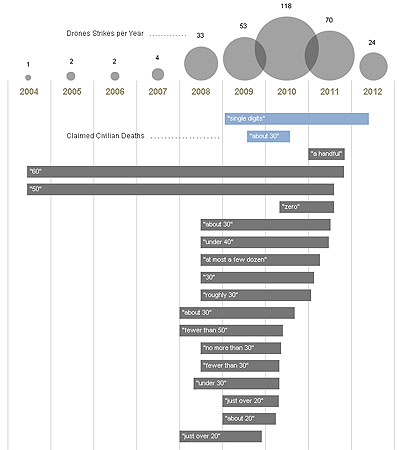
    The chart below comes from ProPublica reporters Justin Elliott, Cora Currier and Lena Groeger. (Click here for a larger, interactive version.) It shows the various claims about civilian drone deaths from administration sources over the years, varying from “a handful” in 2011 to 50 or 60 over the course of seven years. As Elliot shows in an accompanying piece, these claims haven’t been consistent over time.

    To be honest, my initial reaction to this is that I’m surprised at how consistent the claims have been, not how inconsistent. A few of them clearly don’t add up, but with only a couple of exceptions they’ve pretty uniformly told reporters that there have been about 30 civilian deaths over the past two or three years and perhaps 50 or 60 over the life of the program.

    But consistency is probably the least of the issues here. As the New York Times reported a couple of weeks ago, the Obama administration “counts all military-age males in a strike zone as combatants […] unless there is explicit intelligence posthumously proving them innocent.” Given that methodology, it’s a miracle that the administration has fessed up to any civilian deaths. If there’s a lesson from this, I’d say it’s not that officials sometimes give differing estimates of civilian deaths. I’d say it’s the fact that, in truth, they probably don’t have the slightest idea how many civilian deaths they’ve caused.

  • Dealing With the Dog Days

    Last week I finally decided that summer had come early this year. It’s normal for me to struggle to fill the blog during the dog days of July and August, but June? And yet, I’ve been struggling ever since I got back from vacation. There’s just not much going on aside from campaign inanities. Summer has come early.
    Boo hoo, you say? Well, Jonathan Bernstein says there’s more at stake here than whether my job is a little harder than usual:

    Here’s the story. First of all, the whole political world is, basically, in hurry-up-and-wait mode right now. One huge story, at least, will break soon; the Supreme Court decision on the Affordable Care Act will show up sometime in the next couple of weeks, although two weeks is still an eternity of time on the cable news networks. [But there’s not much else]….All of this creates a whole lot of reporters with little to report on — and a whole lot of empty time on the cable news networks, the newspapers, the blogs, the new talk radio shows and the rest of it.

    And what academic research tells us is that slow news days create scandals. That’s what Brendan Nyhan and other media researchers have found….[So] it’s no surprise that mid-summer, when lots of newsmakers are on vacation (and when little is happening even in the sports world), is when stories such as the “ground zero mosque” or Shirley Sherrod’s supposed racism took off. Not just those; any kind of meaningless hype, whether it’s a supposed gaffe or some meaningless polling random variation, is going to get far more attention than it deserves.

    That sounds pretty plausible. If there’s no news, you have to make up some news of your own. So you get the WaWa touchpad and “the private sector is doing fine” and tax breaks for Ann Romney’s horses and a thousand other micro-gaffes to fill the dead air. Jonathan says there isn’t much to be done about this except to beg reporters to at least be aware of what’s driving all this fluff. However, he does have a few suggestions, including this one:

    Second: substance, substance, substance. The candidates really do have positions on issues of public policy. They really would enact them if elected. Some of those are, I promise, about things that will affect readers and viewers in fascinating ways. You’re not going to be able to fit much of that in once the fall campaign starts; between polling (much more meaningful then, by the way), and charges and countercharges, and whatever other real news is out there. This is a great time to get a little substance reporting in. Hey, another advantage: It’ll pay off for reporters who actually know the issues in the fall.

    That would be nice. Of course, most candidates aren’t willing to commit themselves on the details of their policy preferences, and Mitt Romney in particular has already straightforwardly admitted that he isn’t going to tell us squat until after the election. Too dangerous. People might vote against him if they knew the details of his policies. And there are only so many times you can write policy pieces if the candidates give you nothing but sound bites to work with.

    And speaking of sound bites, here’s a pet peeve for the dog days of the summer: can we banish forever the idiotic misspelling sound byte? I know they sound the same, but seriously, sound byte doesn’t even make sense. So just stop it, OK?

  • Blame Congress if the President Attacks Iran

    Doug Mataconis notes that although plenty of conservatives criticized President Obama for intervening in Libya last year, none are willing to criticize candidate Mitt Romney for saying that President Mitt Romney wouldn’t “need to have a war powers approval or special authorization for military force” in the case of Iran. But why not?
    If anything, this is an even more brazen thumb in the eye of Separation of Powers and Congressional War Powers than Obama’s decision to intervene in Libya, which was limited mostly to Americans acting in a support role while the British and French conducted most of the combat operations. What Romney is saying is that he, as President, [can] decide on his own to commit an act of war on behalf of the United States that nearly every analyst who has looked at the issue concludes poses an extremely high risk of exploding into a wider regional war and/or inspiring acts of terrorism against the United States, Israel, and American interests abroad. Economically, the consequences of such a decision could be catastrophic if it results in the explosion in oil prices that most experts in that field expect would come out of any attack against Iran. And Romney believes that, under the Constitution, he would be perfectly free to make the decision to take that down that road all by himself.

    True enough, and I’m on Doug’s side here. I’m willing to cut presidents some slack on small bombing operations1, but a military strike on Iran would pretty clearly not be a small operation. It would consume days or even weeks and would obviously be a major act of war. As far as I’m concerned, major acts of war require congressional approval.

    Still, I think Republicans are mostly off the hook on charges of hypocrisy. I wish it weren’t so, but as near as I can tell, Romney’s position is the same as Obama’s, which in turn is the same as George Bush’s and Bill Clinton’s. The majority view in both parties, I think, is that the president could order a massive air strike against Iran on his own authority.

    Would this be legal? You can argue otherwise — and I would — but in practical terms it’s unquestionably legal. If the executive branch thinks it’s legal; the legislative branch thinks it’s legal (or, at least, declines to oppose it); and the judicial branch refuses to interfere, then it’s legal by the only standard that matters. I don’t even really blame either Obama or Romney for claiming this authority. I probably would too if I were president and Congress didn’t have the guts to call me on it. If Congress routinely refuses to exert its own authority in the national security realm, it’s Congress that’s to blame when presidents arrogate too much of it. They could put a stop to it anytime they wanted.

    1Yes, yes, I know. This makes me a small-scale warmonger. So be it.

  • Why Liberals Lose


    In primary contests, why are conservatives more successful at nominating conservatives than liberals are at nominating liberals? There are dozens and dozens of theories about this, most of them focused on something to do with organizational power, but in addition to all the theories, there’s an actual answer to this question. Nick Baumann has it here. It should probably be tattooed on every liberal’s forehead until we all finally face up to it and figure out how to address it.

  • What It Will Mean If the Supreme Court Strikes Down Obamacare

    <a href="http://www.flickr.com/photos/gouldy/3920727328/in/photostream/">Gouldy99</a>/Flickr


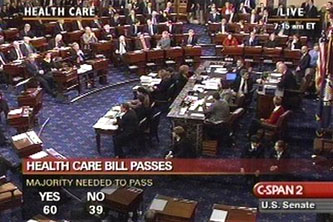
    Two years ago, when President Obama signed the Affordable Care Act into law, the idea that its individual mandate provision was unconstitutional was laughable. There was no case law, no precedent, and frankly, no serious argument that the federal government’s Commerce Clause power didn’t give it the authority to mandate purchase of health insurance if it wanted to. That’s why Democrats didn’t bother looking for a clever alternative—many of which were available—in order to avoid including an explicit mandate in the law. They didn’t think they needed to. Of course it was constitutional. Even Randy Barnett, the law professor who popularized the activity/inactivity distinction that opponents latched onto as their best bet against the mandate, initially didn’t really think it was anything but a long shot.

    So how did that conventional wisdom change so dramatically in only two years? Ezra Klein writes about this in the New Yorker this week, but hell, Ezra’s a liberal. He’s probably sort of flummoxed too. Instead, let’s hear what a nonliberal has to say about it:

    Orin Kerr says that, in the two years since he gave the individual mandate only a one-percent chance of being overturned, three key things have happened. First, congressional Republicans made the argument against the mandate a Republican position. Then it became a standard conservative-media position. “That legitimized the argument in a way we haven’t really seen before,” Kerr said. “We haven’t seen the media pick up a legal argument and make the argument mainstream by virtue of media coverage.” Finally, he says, “there were two conservative district judges who agreed with the argument, largely echoing the Republican position and the media coverage. And, once you had all that, it really became a ballgame.”

    This is, needless to say, a powerfully depressing analysis. For all practical purposes, Kerr is agreeing that conservative judges don’t even bother pretending to be neutral anymore. They listen to Fox News, and if something becomes a conservative talking point then they’re on board. And that goes all the way up to the Supreme Court.

    Maybe. The Supremes haven’t handed down their ruling yet, and they could still surprise us. Because the truth is still the same as it was two years ago: the distinction between activity and inactivity—i.e., whether the federal government can mandate specific activity in addition to prohibiting it—has no historical basis at all. It was invented out of whole cloth. There’s no precedent, no language in the Constitution, and for the most part, not even any discussion about it in the legal literature prior to 2009. It’s simply not something that anyone ever took seriously until it became the only plausible attack line against a piece of liberal legislation that conservatives wanted to overturn.

    If the court does overturn the mandate, it’s going to be hard to know how to react. It’s been more than 75 years since the Supreme Court overturned a piece of legislation as big as ACA, and I can’t think of any example of the court overturning landmark legislation this big based on a principle as flimsy and manufactured as activity vs. inactivity. When the court overturned the NRA in 1935, it was a shock—but it was also a unanimous decision and, despite FDR’s pique, not really a surprising ruling given existing precedent. Overturning ACA would be a whole different kind of game changer. It would mean that the Supreme Court had officially entered an era where they were frankly willing to overturn liberal legislation just because they don’t like it. Pile that on top of Bush v. Gore and Citizens United and you have a Supreme Court that’s pretty explicitly chosen up sides in American electoral politics. This would be, in no uncertain terms, no longer business as usual.

  • Conservatives Decide Not to Take Obama’s Mini-DREAM Bait


    WARNING: I didn’t watch any Fox News this weekend so I might be wrong about this. But so far, it seems to me that the leading lights of conservatism have managed to keep their troops under control on the immigration front. President Obama announced his mini-DREAM DHS directive on Friday, and Time’s Massimo Calabresi describes Mitt Romney’s choices:

    He could play it safe, accentuating whatever slight differences might exist between the nascent Rubio plan and the one Obama had just unveiled with full fanfare. That would be a tough sell, since Obama appeared to have crafted his measure explicitly to steal Rubio’s thunder. Alternatively, Romney could go bold, embrace the President’s plan, perhaps even go a step further, become a champion of immigration reform and shift his bets from the base to Latinos.

    In an interview for Sunday’s Face the Nation on CBS, taped Saturday in Pennsylvania where Romney was campaigning, Romney showed he was opting for the cautious response.

    Other conservatives seem to have mostly followed suit. I did read several items over the weekend complaining that Obama was abusing presidential power by declaring which laws he’d enforce and which ones he wouldn’t, but frankly, even those seemed a little pro forma. For the most part, everyone seemed to be lying low, afraid that furious denunciations of the usual sort would torpedo their chance of winning any Latino votes this November.

    So have conservatives really decided to back down on this? Have they kept their troops pretty much in line? Is the spittle-flecked stuff being restricted to private email lists? Any Fox News watchers out there care to weigh in?