• Why I Think Unions Are Doomed


    Harold Meyerson asks today, “Are American unions history?” In the private sector, which is what really matters, I think the unfortunate answer is yes. Private sector union density has already declined to about 7 percent, which is well below the level at which unions have any serious political power, and I see no chance of that number rising significantly. In the simplest possible terms, here’s why I think that:

    1. Manufacturing accounts for only about 10 percent of the workers in America.
    2. Thus, the only way for private-sector unionization rates to rise substantially is to organize big swaths of the service sector.
    3. Under current law, it’s all but impossible to organize new industries.
    4. Except at the margins, current law won’t change as long as Republicans and conservative Democrats control at least 40 votes in the Senate.
    5. Republicans and conservative Democrats will control at least 40 votes in the Senate approximately forever.

    I’m curious: wishful thinking aside, is there anything wrong with this argument? I’d very much like something to be wrong with it. But I can’t think of anything. Comments are open if you have any ideas.

  • Healthcare Reform: Still Not a Mistake

    A few days ago I wrote a post disputing the idea that President Obama made a mistake by pursuing healthcare reform in 2009 instead of focusing like a laser solely on the economy and pushing for more stimulus spending. In a nutshell, I don’t think Obama could have gotten a bigger stimulus bill in February, and with employment figures steadily improving throughout the year I don’t think Congress would have passed a second stimulus bill in October. Sean Trende doesn’t agree, and provides three reasons I’m wrong:
    1. It was clear by August that the recession was deeper than anticipated.
    2. If the Congress could be persuaded to pass health care reform, it also could have passed a second stimulus.
    3. Obama might have gotten more by playing small ball. (This is, perversely, illustrated with a reference to the New Deal.)

    These kinds of counterfactuals are impossible to prove conclusively either way, but I just don’t buy this one. Yes, by August we knew the recession was worse than we thought, but the fact remains that employment figures were ticking up in a promising way and the previous stimulus bill had been passed only six months earlier. I just don’t see any way that Ben Nelson and the other red-state Democrats would have been willing to pass a second stimulus of any significant size in late 2009.

    I’m not impressed with #2 either. Healthcare reform has been a Democratic dream for nearly a century, and even at that Obama was only barely able to get his entire caucus to stick together and pass it. And that was for a pretty modest bill. A temporary stimulus bill just doesn’t have the same historical heft behind it.

    Then there’s #3. This one is a little more interesting. Obama, says Trende, shouldn’t have passed a single big stimulus bill:

    Instead, the president would have been much better off breaking the stimulus up into five or six pieces, spread out over his first 100 days. His presidency would have had a very different narrative attached to it if the first major piece of legislation passed by his administration had been $275 billion in tax cuts — or even better, two or three pieces of tax-cut legislation, grouped by subject — followed a week later by the unemployment compensation, followed a week later by the infrastructure spending, followed a week later by health care and education assistance, finished off with a miscellaneous bill.

    For one thing, the headlines would have been dominated by the tax cuts, aid to the unemployed and to education, and so forth. Instead, there was a massive, amorphous “stimulus” with a $787 billion price tag for people to digest.

    Quite frankly, Republicans would have supported at least some of the measures — in fact, the “mini-stimuli” approved throughout late 2009 and 2010 almost all passed with substantial Republican support. So it would have been with a “pure” tax-cut bill that kicked off the president’s term.

    As it became clear that the downturn was worse than expected, additional rounds of tax cuts and spending legislation would have been easier to pass, since Obama likely would have maintained a higher approval rating (remember that it was the perception of massive spending, rather than the economy, that initially drove down his approval ratings).

    This is….plausible. I think it’s a stretch, but it’s plausible. Still, I’m just not persuaded that there were any Republicans who would have repeatedly supported spending bills of any substantial size if only Obama had metered them out gradually instead of asking for one or two big packages. I find it far more likely that two or three of them would have gone along for a few months and then backed off. Ditto for the gang of centrist Democrats. And the Republican message wouldn’t have changed much either. Instead of “Obama is responsible for the biggest spending bill in history,” it would have been “Every month it’s another $100 billion. When does the out-of-control spending stop?”

    Bottom line: there’s abundant evidence that Obama couldn’t have gotten a bigger stimulus bill in February than the one he got. And with the economy improving and hundreds of billions of dollars in stimulus spending still waiting to get into the pipeline, I simply don’t see any way that he could have rounded up 60 votes in the Senate for further stimulus in the fall. From the outside, it always seems possible that some small change in strategy might have saved the day, but that’s rarely the case in real life. And so it is here. I think it’s naive to believe that a little more cleverness about how the spending bills were spaced out would have changed anything very much. There only so much that cleverness can accomplish.

    UPDATE: Noam Scheiber takes the other side of this argument, saying today thatof course health care reform made it harder for Obama to get more stimulus and speed up the recovery.” He makes some good points, but in the end I don’t find him a lot more persuasive than Sean Trende. It’s always easy to take the rosiest possible view of a strategy that wasn’t followed, but in real life an economy-centric strategy would have run into a lot of roadblocks that nobody is thinking about three years after the fact.

    In the end, however, it turns out that I can live with Noam’s final conclusion: “We can debate the size of this effect—and I’m willing to believe it was second-order rather than first-order—but the existence of a tradeoff seems undeniable to me.” I’ll buy that, but honestly, I think it makes the case for focusing on healthcare rather than the opposite. If the effect of the healthcare focus was only second order, that means an economy-centric strategy would have produced only a modest amount of extra stimulus. But nobody thinks that a modest amount of extra stimulus would have had much impact on the actual state of the economy — and that’s what’s most important. The actual economy. Not messaging or small blips in Obama’s approval ratings. The actual economy. Another trillion dollars would have made a difference. Half a trillion dollars might have made a difference. But a couple hundred billion? That would have been a drop in the ocean.

  • Times Have Changed, It’s Okay to Lie

    Last month David Corn noted that Mitt Romney was claiming that “government” would control half the economy once Obamacare was up and running. He’s still saying it, and today Glenn Kessler of the Washington Post gives it a score of four Pinocchios and says Romney should drop it. “No amount of tweaking will get it right,” he says.

    That’s true: this particular claim is untweakable. Romney adviser Eric Fehrnstrom twists himself in knots trying to justify it, but it doesn’t do any good. There’s just no way to pretend there’s any real basis for Romney’s claim.

    It also doesn’t matter. Politicians have increasingly discovered over the past couple of decades that even on a national stage you can lie pretty blatantly and pay no price since the mainstream media, trapped in its culture of objectivity, won’t really call you on it, limiting themselves to fact checking pieces like Kessler’s buried on an inside page. And because virtually nobody except political junkies ever sees this stuff, it doesn’t hurt their campaigns at all.
    This discovery — that you can tell almost any lie without paying a price — is, in some sense, an example of national politics becoming a lot more like local politics. Blatant lying has always been routine in local races that don’t get a lot of press coverage, but the brighter media spotlight kept at least a bit of a lid on it in higher-profile races. However, with the splintering of the mainstream national media in recent years and the rise of the web and social media, national politics is local again. And being called on your lies by the occasional earnest fact checker now matters about as much as it does when a local columnist for a weekly newspaper calls you on it.

    It takes a while for people to realize that norms have changed and to take advantage of it. Lots of politicians are probably still reluctant to lie too brazenly because they’re still working under the old rules, where the national media might call you on it and it might actually make a difference. The smart ones have figured out that this isn’t how it works anymore. Romney’s one of the smart ones.

  • My Crystal Ball for Politics in 2024


    The journal Democracy has put together a package of short essays for its latest issue about the likely face of American politics in 2024. Most of the contributors focused on one or two big trends and how they’re likely to play out over the next dozen years, but I took a different tack. Instead I identified six big trends: 

    1. America will keep getting older.
    2. If Obamacare survives the Supreme Court, the social welfare state of FDR and LBJ will be more or less complete.
    3. Economic growth is going to be slow.
    4. The fact of climate change will become undeniable.
    5. The Republican Party will continue getting whiter and the Democratic Party will continue getting browner.
    6. Computational horsepower will continue growing.

    What does all this mean? Probably nothing good, but a bleak outcome isn’t inevitable. Click the link to read my guesses.

  • The Disaster of Republican Economic Policies


    A few days ago the Congressional Budget Office released a short analysis explaining why the $5.6 trillion surplus they projected for the decade following 2001 instead turned into a $6.1 trillion deficit. Bruce Bartlett summarizes:

    Putting all the numbers in the C.B.O. report together, we see that continuation of tax and budget policies and economic conditions in place at the end of the Clinton administration would have led to a cumulative budget surplus of $5.6 trillion through 2011 — enough to pay off the $5.6 trillion national debt at the end of 2000.

    Tax cuts and slower-than-expected growth reduced revenues by $6.1 trillion and spending was $5.6 trillion higher, a turnaround of $11.7 trillion. Of this total, the C.B.O. attributes 72 percent to legislated tax cuts and spending increases, 27 percent to economic and technical factors. Of the latter, 56 percent occurred from 2009 to 2011.

    Even if we absolve George W. Bush of responsibility for those “economic and technical factors” — mainly the Great Recession — his policies are still responsible for a turnaround of about $8.4 trillion in the deficit projections. In other words, if we had merely hung onto the policies of the Clinton administration, paid for things like Medicare Part D, and avoided the disastrous war in Iraq, we would have entered the Great Recession with one of the lowest debt levels in the advanced world. That in turn would probably have kept the housing bubble a bit smaller than it was, making the Great Recession a little less catastrophic, and would have given us more headroom for fiscal stimulus in 2008 and 2009, which also would have reduced both the length and depth of the recession.

    But none of that happened thanks to Republican economic policies. This year, they swear they’ve learned their lesson and will never do this again. Do you believe them?

  • Why Obama Caved In on National Security

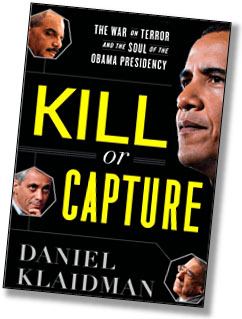
    I just finished reading Daniel Klaidman’s Kill or Capture, a book about the evolution of Barack Obama’s national security policy during the first three years of his administration. It’s a good book to read if you want an answer to the question, “What happened?” That is, what happened to the idealistic Obama of the 2008 campaign who was going to shut down Guantanamo, end indefinite detention, try terrorist suspects in civilian courts, take civil liberties more seriously, and end the rabid secrecy of the Bush era? How did he turn into the guy who not only didn’t do any of that stuff, but became a drone-obsessed killing machine in the process?
    According to Klaidman, part of the answer is that Obama changed as he learned more about the reality of the fight against Al Qaeda. Another part of the answer is that, like all presidents, he succumbed to institutional and bureaucratic pressure. But for my money, the most telling passage of the book suggests that an equal part of the answer is that he simply never received any serious support from his own party.

    Here’s the passage. To set the scene, it’s 2009 and Rahm Emanuel has just negotiated a deal with Senate Democrats to lift the congressional ban on the transfer of prisoners from Guantanamo in return for providing Congress with 45 days notice before any prisoner could be moved. This was, practically speaking, a distinction without a difference: 45 days was plenty of time to stir up a shitstorm of opposition that would prevent any prisoner from ever being transferred, and everyone knew it. But when White House aides held a meeting with the Democratic caucus, they found out it still wasn’t enough:

    The administration officials nearly got their heads taken off, as anxious senators demanded to know how the White House planned to manage the exploding politics of terrorism. “Where’s your plan?” they shouted over and over again. Among the most agitated were liberals like Barbara Boxer and Barbara Mikulski, who were up for reelection. These were the same representatives who had pilloried the Bush administration for its fear-mongering tactics in the war on terror, but behind the grand doors of the LBJ Room, all politics were local. We’re going to get clobbered back home, the Democrats protested.

    An adviser to [David] Ogden, watching the drubbing unfold in horror, handed a note to Ronald Weich, the Justice Department’s assistant attorney general in charge of congressional relations. It simply read, “I fear for our Democracy.” Weich, who knew the Hill as well as anybody in Washington, turned the piece of paper over and scrawled on the other side: “Welcome to my world.”

    Obama knew all along that Republicans would pound him on national security issues, and as time went by it became increasingly obvious that this pounding would be extremely effective. But one of the things that made it almost inevitable that Obama would end up caving in on so many of his promises was the fact that Democrats wouldn’t help him fight back. In the end, maybe that didn’t matter. Maybe public opinion was simply too hardened on these issues. But the plain fact is that if the entire national security apparatus and the opposition party and public opinion and your own party are pretty much all lining up on the same side, there’s not much a president can do. This doesn’t get Obama off the hook, but it does go a long way toward explaining why he seemed to concede ground so quickly. If Klaidman is right, Obama struggled with this stuff persistently, but in the end no one was ever able to come up with alternatives that were both effective and politically feasible. Welcome to Washington.

  • Why is My Hometown the Safest City in America?


    Here’s the latest news from my hometown of Irvine:

    In 2011, for the eighth year in a row, the Orange County city had the lowest violent crime rate of any U.S. city with a population larger than 100,000, the FBI said Monday. Irvine — population 214,872 — reported only 120 violent crimes last year, the same number as the year before.

    I’ve never understood this. Irvine is your basic upper middle class suburban community, and it’s no surprise that our crime rate is low. But why is it consistently the lowest in the entire country? And not just that, but the lowest by quite a margin. If you look at the raw data, the violent crime rate in Irvine is 56 per 100,000. The second safest city is Naperville, Illinois, clocking in at 79 per 100,000. That’s a big jump from first place to second.

    So what’s the deal? Why is it that year after year Irvine is so astonishingly safe, even compared to other upper middle class suburban cities? What’s our secret?

    (If you’re curious, the most dangerous city in America is currently Flint, Michigan, with a violent crime rate of 2,337 per 100,000. Detroit is #2 and St. Louis is #3.)

  • Fed: Income and Wealth Have Plummeted

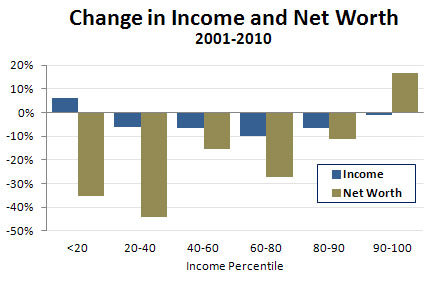
    The Federal Reserve published its triennial look at family income and wealth today, and it ain’t pretty. The chart on the right provides the basics. The poorest families (far left) showed a slight gain in income since 2001 but a 35% loss in wealth. The richest families (far right) showed flat incomes and a 16% increase in wealth. The families in the middle — the vast majority of the country — showed substantial losses in both income and wealth.

    Overall, median net worth dropped 27% between 2001 and 2010. For middle class families this overwhelmingly represents housing wealth: the housing bust since 2007 more than wiped out all the gains they saw during the housing boom. And although there have been gains in paying off debt since then, they’ve been small:

    Despite these setbacks, consumers have continued to spend surprising amounts of money in recent years, helping to keep the economy growing at a modest pace. The survey underscores where the money is coming from: Americans are saving less for future needs and making little progress in repaying debts.

    ….The report highlighted the fact that households had made limited progress in reducing the amount that they owed to lenders. The share of households reporting any debt declined by 2.1 percentage points over the last three years, but 74.9 percent of households still owe something and the median amount of the debt did not change.

    It’s unlikely that these numbers have changed substantially in the past 18 months. If you want to know why the recovery has been so sluggish, you don’t need to look much further than this.

  • The Fight Over Evolution Isn’t Actually All That Important

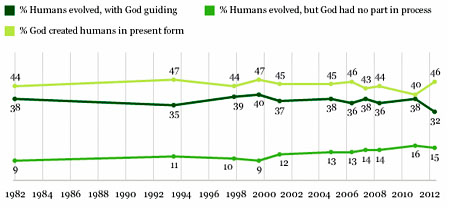
    I’m not especially trying to pick on Andrew Sullivan here, but today he echoed a meme that I now feel like I’ve heard a million times and that really, really needs some pushback. He’s responding to Gallup’s latest survey about evolution, in which 46% of Americans say God created humans in their present form sometime in the past 10,000 years:
    This chart is a useful tonic to anyone feeling optimistic about bringing the country together….I’m not sure how many of the 46 percent actually believe the story of 10,000 years ago. Surely some of them know it’s less empirically spported than Bigfoot. My fear is that some of that 46 percent are giving that answer not as an empirical response, but as a cultural signifier. That means that some are more prepared to cling to untruth than concede a thing to libruls or atheists or blue America, or whatever the “other” is at any given point in time. I simply do not know how you construct a civil discourse indispensable to a functioning democracy with this vast a gulf between citizens in their basic understanding of the world.

    Come on. This 46% number has barely budged over the past three decades, and I’m willing to bet it was at least as high back in the 50s and early 60s, that supposed golden age of comity and bipartisanship. It simply has nothing to do with whether we can all get along and nothing to do with whether we can construct a civil discourse.

    The fact is that belief in evolution has virtually no real-life impact on anything. That’s why 46% of the country can safely choose not to believe it: their lack of belief has precisely zero effect on their lives. Sure, it’s a handy way of saying that they’re God-fearing Christians — a “cultural signifier,” as Andrew puts it — but our lives are jam-packed with cultural signifiers. This is just one of thousands, one whose importance probably barely cracks America’s top 100 list.

    And the reason it doesn’t is that even creationists don’t take their own views seriously. How do I know this? Well, creationists like to fight over whether we should teach evolution in high school, but they never go much beyond that. Nobody wants to remove it from university biology departments. Nobody wants to shut down actual medical research that depends on the workings of evolution. In short, almost nobody wants to fight evolution except at the purely symbolic level of high school curricula, the one place where it barely matters in the first place. The dirty truth is that a 10th grade knowledge of evolution adds only slightly to a 10th grade understanding of biology.

    Now, I think evolution should remain in high school texts anyway. Why? Because it’s true. Biology is a science, and evolution is one of the pillars of modern science. For me, that’s a cultural signifier every bit as much as a literal reading of the Bible is for 46% of the country. But you know what? I could spend an entire day arguing politics and economics and culture with a conservative and never so much as mention evolution. It’s just not that important, and it doesn’t tell us much of anything about our widening political polarization. We should keep up the fight, but at the same time we shouldn’t pretend it has an epic significance that it doesn’t. I’m not optimistic about anyone or anything “bringing the country together,” but not because lots of people choose to deny evolution. Frankly, that’s one of the least of our problems.

  • Breaking: Conservatives Still More Disciplined Than Liberals

    On May 31, Tod Kelly TIVOed three hours of prime-time Fox News and three hours of prime-time MSNBC. Then he watched them. As a nickel summary, let’s just say he was…. unimpressed. It was almost exclusively spittle-flecked ranting for all six hours except for Rachel Maddow. His entire (long) summary is here, but here’s one interesting observation:

    All three shows on FOX essentially cover the same four stories, in different orders. (Those stories are the Wisconsin recall, birtherism, planned parenthood promotes gender-based abortion, and the obligatory anti-Obama story.) There is some variation in the Obama smack-downs, but all of the others hammer home the exact same arguments using the exact same verbiage; each is pretty much interchangeable with the other, and might well have been penned by a single source.

    ….On the other hand, MSNBC has only one story covered by all three programs: the obligatory anti-Romney segments, which do not have the uniformity in commentary that FOX has with its anti-Obama segments. (And the truth is that grouping Maddow’s commentary with Shultz’s or O’Donnell’s is a huge stretch. Shultz and O’Donnell’s Romney rants seem more akin to the FOX anti-Obama screeds, politics aside.) Past that there is very little overlap at MSNBC. Whereas FOX’s shows have the appearance of a concerted and strategized effort, the hosts of MSNBC are all over the map.

    And there you have it: liberalism vs. conservatism in a nutshell. We may be able to rant as well as they do, but we’re just not as disciplined about it. The Fox hosts get their marching orders in the morning, and off they go. The memes of the day get promoted in lockstep. (And, as Tod would have noticed if he’d watched all day, these same memes are promoted, sometimes subtly and sometimes not, throughout the day on other programs as well.)

    But liberals? Well, over the past few years we’ve decided that we’re willing to yell into the camera too if that’s what it takes to compete, but by God no one tells us what to say. That’s just too humiliating. However, I suspect that this is at least part of the reason that conservative memes find their way into the mainstream media more often and more forcefully than liberal memes. They just repeat theirs more vigorously. Pretty good strategy, huh?