• Did Union Members Turn Against Unions on Tuesday?


    Conservatives have made a big deal out of the fact that 38% of households with a union member voted for the union-busting Scott Walker in Tuesday’s election in Wisconsin. For example, here’s the New York Post:

    Republican Gov. Scott Walker’s successful battle to keep his job during this week’s Wisconsin recall election got a lift from an unexpected quarter — voters from union households….“The union members, they’ll support us,” said presidential candidate Mitt Romney during a campaign stop in Texas. “Without the union members who support our campaign and support conservative principles — we wouldn’t have Scott Walker win in Wisconsin if that weren’t the case.”

    Walker’s labor vote was a surprise for the first-term incumbent, given the outcry over his policies that wiped out collective-bargaining rights and automatic dues collection for public-employee unions. And that chunk of the union vote contributed to his comfortable 7 point win, 53-46, over Democrat Tom Barrett.

    Actually, this is exactly the opposite of surprising. Take a look at past elections. In 2004, 38% of union members and 40% of voters in union households voted for George Bush.  In 2008, 39% of union members and 38% of voters in union households voted for John McCain.  In 2010, 37% of voters in union households nationwide voted for Republicans, and that’s also the share of the union vote that Walker got in Wisconsin that year.

    For better or worse, about 37% of union members vote for Republicans, both nationwide and in Wisconsin. On Tuesday they did it again. So whatever lessons there are from Tuesday’s election, the idea that union members are somehow abandoning their own cause isn’t one of them. On that score, nothing interesting happened at all.

  • Our Trench Warfare Future

    Ross Douthat puts last night’s results in Wisconsin in a broader context:
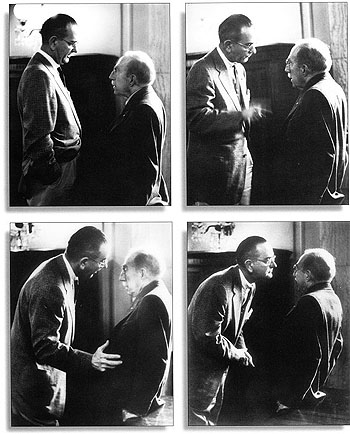
    To understand the broader trends at work, a useful place to turn is Jay Cost’s essay on “The Politics of Loss” in the latest issue of National Affairs. For most of the post-World War II era, Cost argues, our debates over taxing and spending have taken place in an atmosphere of surplus. The operative question has been how best to divide a growing pie, which has enabled politicians in both parties to practice a kind of ideologically flexible profligacy. Republicans from Dwight Eisenhower to George W. Bush have increased spending, Democrats from John F. Kennedy to Bill Clinton have found ways to cut taxes, and the great American growth machine has largely kept the toughest choices off the table.

    But not anymore. Between our slowing growth and our unsustainable spending commitments, “the days when lawmakers could give to some Americans without shortchanging others are over; the politics of deciding who loses what, and when and how, is upon us.” In this era, debates will be increasingly zero-sum, bipartisan compromise will be increasingly difficult, and “the rules and norms of our politics that several generations have taken for granted” will fade away into irrelevance.

    I think you have to strain a bit to derive that big a lesson from a single recall election in a medium-sized state, but for a variety of reasons I agree that economic growth is probably going to be fairly modest in the medium term — over, say, the next decade or two. And this does indeed imply a sort of trench warfare style of politics, with everyone fighting over scraps because the pie isn’t growing as fast as it used to. Anyone who’s worked in a high-flying company that had to deal with a sudden slowdown in growth knows what I’m talking about. The departmental infighting can get pretty vicious.

    Anyway, I have a short piece in Democracy that should be online next week making exactly this point, along with a few others. It’s about the likely shape of politics a decade from now, and although I have a couple of optimistic things to say about that, it’s not, as you can probably guess, an especially cheerful take.

  • Europe’s Creditanstalt Moment is Ticking Ever Closer


    This paragraph from Martin Wolf has been much quoted over the past day:

    Before now, I had never really understood how the 1930s could happen. Now I do. All one needs are fragile economies, a rigid monetary regime, intense debate over what must be done, widespread belief that suffering is good, myopic politicians, an inability to co-operate and failure to stay ahead of events. Perhaps the panic will vanish. But investors who are buying bonds at current rates are indicating a deep aversion to the downside risks. Policy makers must eliminate this panic, not stoke it.

    This describes my own reaction to events of the past year or so perfectly. Still, I think this paragraph from the same piece might be more important:

    It is often forgotten that the failure of Austria’s Creditanstalt in 1931 led to a wave of bank failures across the continent. That turned out to be the beginning of the end of the gold standard and caused a second downward leg of the Great Depression itself. The fear must now be that a wave of banking and sovereign failures might cause a similar meltdown inside the eurozone, the closest thing the world now has to the old gold standard. The failure of the eurozone would, in turn, generate further massive disruption in the European and even global financial systems, possibly even knocking over the walls now containing the depression.

    To the extent that I continue to hold out a shred of optimism, this is why. European policymakers may be in nearly terminal denial, but I still think that when they finally and fully stare into the abyss and understand that it’s staring back at them — when their Creditanstalt moment comes — they’ll act. They won’t want to, and they’ll wait until the 59th minute of the 11th hour to do so. But when the big hand on the clock is finally just seconds away from ticking past midnight, they’ll do what needs to be done.

    This is the worst of all solutions except for the one in which they don’t act at all. But it will prevent a rerun of the 1930s. I hope.

  • Wisconsin Sounds Labor’s Death Knell


    Ezra Klein looks at labor’s loss in Wisconsin last night and sounds their death knell:

    For a long time, a lot of the energy has been devoted to the question of “how do you revive the labor movement?” The truth is, at this point, you probably can’t. You can slow decline. And you can score isolated wins. But it’s hard to see a real turnaround in labor’s fortunes.

    But if you take labor’s decline as a given, then another question presents itself: How do you limit the resulting corporate power over elections and legislators? And that’s much more possible, even in a post-Citizens United world. There’s legislation, like the Fair Elections Now Act, that could publicly finance elections. There’s legislation, like the DISCLOSE Act, that could force so much transparency on corporate spending that it ceases to be an attractive option.

    Republicans have had great success arguing that organized labor has too much political power. So much success, in fact, that it seems clear that labor will soon have too little. But last night showed that Democrats aren’t going to get very far simply disputing Republican claims on this point. Rather, they should argue that all interest groups have too much political power, and unite behind legislation that would weaken them.

    I think that’s about right. But Ezra himself points out the problem with this idea: as labor gets ever weaker and corporations get ever stronger, “Democrats will have to be that much more solicitous of business demands in order to keep from being spent into oblivion.” So where does the backing come from to pass legislation that would weaken corporate interests? This is perhaps the big political/institutional question of the next couple of decades: what replaces labor as a broad-based, nationwide countervailing force against the power of business? The answer, unfortunately, remains elusive.

  • Transit of Venus Blogging

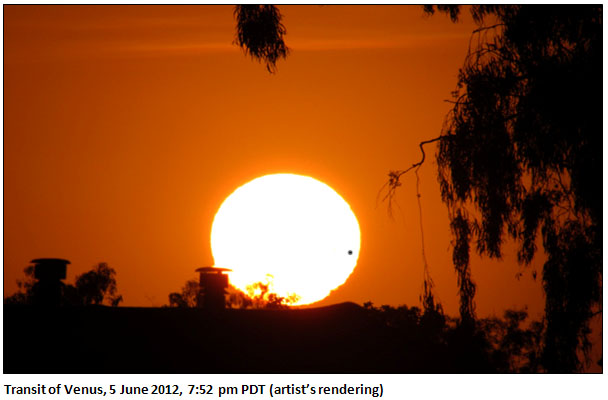
    Here it is, the last transit of Venus in our lifetimes (assuming we don’t figure out how to download ourselves into cyberspace sometime soon, that is):

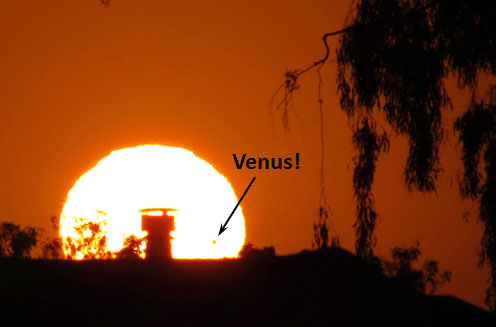
    Ah, just kidding. I photoshopped that little black dot in. But if I had been able to get a picture of the transit, it would have looked something like that. Probably.

    Actually, I’m not sure why I didn’t see anything. I didn’t have any special filters, so I had to wait until sunset to get a picture. Still, Venus should have been near the edge of the disk but not gone by then, and it’s big enough that it should have shown up even with my little camera. But no. There was nothing there. I’m not sure why. But it was a very clear day, so maybe the sun was still too bright for my camera’s sensors and Venus just got washed out. Nonetheless, according to the LA Times, if I’d been able to see anything, Venus would have been about where I put it.

  • Should Barack Obama Be More Like LBJ?

    I’m catching up on stuff that I missed while I was on vacation, and today I read the big New York Times piece on Barack Obama’s terrorist “kill list.” I’ll have more on that later — I’m still digesting it at the moment — but in the meantime one sentence of the story caught my attention for an entirely unrelated reason:

    When the administration floated a plan to transfer from Guantánamo to Northern Virginia two Uighurs, members of a largely Muslim ethnic minority from China who are considered no threat to the United States, Virginia Republicans led by Representative Frank R. Wolf denounced the idea. The administration backed down.

    That show of weakness doomed the effort to close Guantánamo, the same administration official said. “Lyndon Johnson would have steamrolled the guy,” he said. “That’s not what happened. It’s like a boxing match where a cut opens over a guy’s eye.”

    Like thousands of other people, I just finished reading the fourth volume of Robert Caro’s biography of Lyndon Johnson and it made me even more impatient with people who are constantly complaining about Barack Obama’s wimpiness compared to LBJ. The second half of Caro’s book is about the first few months of Johnson’s presidency, and legislatively it’s primarily about how he won passage of two big bills: a major tax cut and the 1964 Civil Rights Act. So let’s go down the list of things LBJ did:

    • Category 1 might be called straight-up corruption: threatening to sic the FBI on someone, or holding up FDIC approval for a bank merger. I think we can all agree that even if these levers of power were still open to Obama, we wouldn’t want him to use them.
    • Category 2 is legal but toughminded political bullying: threatening to close a military base in someone’s district, or telling NASA to direct spending to someone’s pet program. For better or worse, though, this kind of leverage is simply far less open to presidents today than it was 60 years ago.
    • Category 3 is personal relationships with senators, which Johnson had plenty of. But there’s no way for Obama to invent that kind of thing. He could schmooze more than he does, but he just doesn’t have multi-decade father-son relationships with the old bulls of the Senate and there’s no way he can invent them out of whole cloth. What’s more, Caro’s book makes it clear that, in the end, those relationships were of minor importance anyway.
    • Category 4 is ordinary horse-trading. To get the tax bill passed, for example, LBJ had to agree to Harry Byrd’s demand that the federal budget be kept under $100 billion. (His close relationship with Byrd did exactly nothing to soften Byrd on this point.) Obama can do this kind of thing too, of course, and he has. If anything, in fact, the big liberal complaint about Obama is that he does too much of it.
    • Category 5 is coaxing/cajoling/flattering Republicans. Obama has tried this plenty, though, and has even succeeded a bit. It was two or three Republican votes that ended up passing the stimulus bill, the financial reform bill, and the Lilly Ledbetter Act. Ditto for most of the pieces of the lame duck session at the end of 2010. But I don’t think anyone will disagree much if I say that this avenue is basically closed off. Modern Republicans are just not willing to compromise these days, and nothing Barack Obama does or says will change this. He simply doesn’t have any leverage over them.
    • Category 6 is an intimate knowledge of Senate procedure. However, it’s not clear how much this really helped Johnson, nor is it clear that Obama has ever suffered from its lack. I don’t think there are any secret levers of procedural power in the Senate that he could have used but hasn’t.

    None of this is to say that Obama has used every bit of clout he has, or that a little more hard-nosed bargaining might not have done him some good here and there. Nor is to deny that LBJ had a natural instinct for finding pressure points he could exploit. But for the most part, the tools that LBJ used just flatly aren’t available to Obama. And of the ones that are, he’s used them.

    So can we stop hearing about how much more Obama could have gotten done if only he’d been more willing to really use the power of the presidency, like LBJ did? There’s no more than the tiniest grain of truth to it. Washington DC is a far different place today than it was in 1964, and Obama has to deal with his Washington, not LBJ’s.

  • Fighting Back Against Big Water

    Regular readers know that one of my pet peeves is the notion that everyone should drink eight glasses of water a day. And that’s water and only water. Coffee, tea and Diet Coke don’t count.

    It’s nonsense. There was never any science behind this in the first place, and the food you eat contains much of the water you need to stay healthy in the first place. Basically, if you’re thirsty, drink something. That’s pretty much it. Today, Spero Tsindos of La Trobe University joins the fight in an editorial in the June issue of Australian and New Zealand Journal of Public Health:

    Mr Tsindos believes that encouraging people to drink more water is driven by vested interests, rather than a need for better health. “Thirty years ago you didn’t see a plastic water bottle anywhere, now they appear as fashion accessories.”….He also discusses the role of water in our constant quest for weight loss. “Drinking large amounts of water does not alone cause weight loss. A low-calorie diet is also required.”

    “Research has also revealed that water in food eaten has a greater benefit in weight reduction than avoiding foods altogether. We should be telling people that beverages like tea and coffee contribute to a person’s fluid needs and despite their caffeine content, do not lead to dehydration.”

    Good luck, Spero! The 2-liter myth never seems to die no matter how many people go after it, though. But I think Mother Jones readers are too smart to fall for it. If you like bottled water, fine. But you don’t need it. Tap water is fine. Juice is fine. Coffee is fine. Colas are fine. And you only need them when you’re thirsty. There’s no need — or benefit — to guzzling vast quantities of water just to meet some arbitrary quota. More details here if you don’t believe me.

    UPDATE: A med student tweets a response:

    You wouldn’t believe how many people come to the doctor’s office complaining of “headaches” that are nearly always dehydration….Part of it is that I live in Arizona, but the point being: the 2-liter myth is very useful in counseling those patients to drink more.

    Up above, I said, “If you’re thirsty, drink something.” But there’s actually a second part to this advice: “Don’t be an idiot.” That’s sort of the unvoiced second part to all advice, though, isn’t it? In this case, it basically means that if it’s 90 degrees in the shade and you’re working in the garden or touring a city or something like that, drink plenty of water. When I was schlepping around Rome last week, I was careful to drink plenty of water even when I wasn’t feeling especially thirsty.

    But now we get into a philosophical debate. Cynics will argue that, like it or not, there are plenty of idiots in the world. And if the 2-liter myth helps them out, why not spread it around? I won’t pretend that I have a gigantic problem with that, but I do think you still need to be careful. These myths have downsides too, especially when a steady stream of people hear them from practicing physicians and think of them as medical facts. So while it might make clinic life a little harder, I’d still recommend telling the truth instead. At the very least, don’t present the 2-liter myth as a firm rule. Just suggest it as a rough guideline on hot days for patients who apparently have a problem with their sense of thirst.