• Yet More Evidence That We Are Becoming More Politically Polarized

    The Pew Research Center has released the latest version of its American Values Survey, and the headline result is that although the values gap hasn’t changed much by age or gender or race or anything else, it has continued to increase by political affiliation. The differences between Democrats and Republicans remained steady throughout the late 80s and 90s, but since 2000 have gone up from 11 percentage points to 18 percentage points. And the gap is continuing to grow.
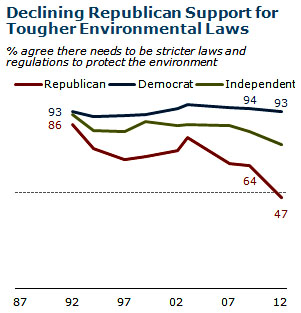
    The most dramatic change is in environmental views. Take a look at the chart on the right. Back in 1987, there was hardly any daylight between Democrats and Republicans. Everyone agreed we needed strict environmental regs. But Republican support for environmental regulations dropped during the early 90s, and then, after ticking back up a bit, cratered completely during the Bush and Obama adminstrations, plummeting from 79% to 47% over the past decade. Some of this is probably due to the GOP’s general move toward the right during that time, but I’d guess that it’s mostly a response to global warming. Until 2003, the environment was a roughly bipartisan cause, but since then it’s become overwhelmingly identified with climate change, which in turn has become a violently political issue. We’d need more detailed polling to confirm what Pew seems to show here, but what it seems to suggest is that the partisan war over climate change has poisoned Republican support for environmental regulations more generally.

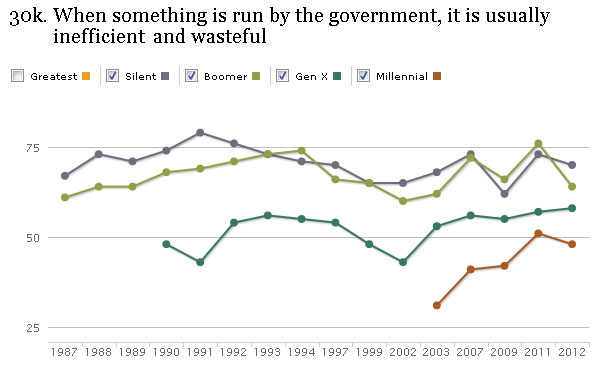
    In related news, Pew has put up an interactive database that allows you to scroll through the questions they’ve been asking since 1987 and view the trends by age, gender, party, etc. There’s some interesting stuff there. For example, take a look at the question below, sorted by generation. Over the years, most of us have retained roughly the same view of whether the government is wasteful and inefficient. The postwar (“Silent”) and Boomer generations hover around 65% and Gen X hovers around 55% — with very little change as members of those generations get older. But Millennials are different. In 2003 they were pretty optimistic about government-run programs, with only about 30% saying they were wasteful. Today, though, nearly 50% think that. In the course of only a decade, they’ve become far, far more cynical about government programs.

    Why? Is this related to the Iraq War? To the Bush/Rove administration more generally? To the stimulus bill? (The numbers went way up between 2009 and 2011.) Or were they just unnaturally optimistic during their 20s and are now catching up to everyone else? Any guesses?
  • Even Small Businesses Need More Regulation Than Private Citizens

    Matt Yglesias agrees that vehicles driving on city streets need to be regulated, but he’s not happy about stringent regulations on low-cost commercial transport options like van-sharing services:

    The problem arises not when vehicles are regulated, but when using a vehicle to transport other people for money is regulated much more stringently than using a passenger vehicle in a non-commercial manner. The problem, of course, is that few people can depend on friends and family to drive them around everywhere. So very stringent curbs on commerce in transportation means that people need to overwhelmingly depend on owning their own vehicle and then transporting themselves with it on a non-commercial basis. This is a huge problem for certain classes of people (the vision impaired, the elderly, the poor) and leads to a lot of avoidable traffic congestion and air pollution.

    The solution, however, isn’t to somehow stop regulating the practice of driving vehicles. It’s to level the regulatory playing field between a guy driving a friend’s stuff across town in a van to repay a favor and a guy driving five strangers across town in a van in exchange for money he’s going to use to pay the rent.
    This deserves some pushback, especially since Matt has previously made similar arguments about the regulation of restaurants and commercial food processing operations. The problem is that commercial operations are just fundamentally different from private ones: they serve a lot more people, thus producing more potential for disaster, and their economic incentives are aligned differently. As a private car owner, I have a fairly obvious incentive to drive safely and to keep my car in decent shape. It’s not a perfect incentive, but at least it’s there. I’d just as soon not kill myself, after all.

    But in a commercial operation, I just want to make money. My incentive is to hire the cheapest driver I can find and to skimp on maintenance as much as I can. That’s especially true for small-time operators who don’t have national reputations to worry about and who can just disappear if something disastrous happens. Because of this, the case for stricter regulation of commercial enterprises is pretty obvious.

    Matt’s post is a riff on a longer post by Diana Lind, who addresses this tension pretty well:

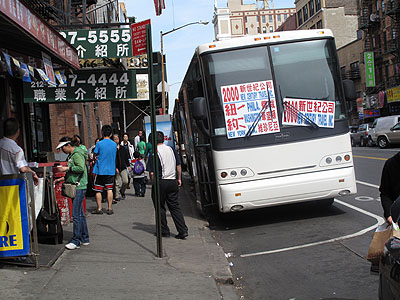
    There needs to be a middle ground between rolling death traps and a transportation system that is killing our economy. New York Sen. Chuck Schumer’s proposal of creating a clearly posted letter-grade system to identify the quality of Chinatown bus services is a great one; this model could be applied to other kinds of new transit providers that serve niche markets. Auctioning off transportation licenses or city-owned property to support infrastructure for alternative transportation modes could be a new source of revenue in other cash-strapped cities.

    That sounds roughly right to me. We routinely exempt small businesses from certain kinds of regulations, and there’s no reason why we can’t do something similar here, providing small, low-cost transport operations with the option of following a less rigid set of regulations as long as this is clearly disclosed. But that regulation is still going to be different — and more stringent — than regulation of private vehicles.

  • Bonus Cigarette Tax Blogging: Why Prop 29 is Such a Terrible Idea


    For my California readers, a bit more on Prop 29 today. This is the initiative that raises taxes on cigarettes by a dollar a pack and earmarks the proceeds for cancer research. I said yesterday that I opposed it because I was generically opposed to ballot-box budgeting, but I probably wasn’t clear about what was really objectionable here. However, Michael Hiltzik did it for me while I was off vacationing in Rome:

    The real problem with Proposition 29 is its mandate to lock in a huge revenue stream for the narrow purpose of cancer research. That’s a worthy endeavor, to be sure, but there are other pressing needs for the money.

    Gov. Brown’s latest budget proposal calls for cuts of $1.2 billion in Medi-Cal and $900 million in CalWorks (a relief program for families with children) and steep cuts in financial aid for college students and in court budgets. The University of California and Cal State systems are becoming crippled by 20 years of cutbacks in state funding, leading to soaring tuition charges. Tobacco-related illnesses create some of the burden on Medi-Cal and other public healthcare programs, yet a minimal portion of Proposition 29 revenue, if any, would go to helping taxpayers carry that burden.

    With the overall state budget gap approaching $16 billion, how can anyone make the case for diverting a huge chunk of $800 million a year in new revenue to long-term scientific research, whether in California or not? Even if you believe that case can be made, the proper place to make it is in the Legislature, where all these demands on the budget can be weighed and balanced against one another — not at the ballot box, where the only choice is to spend it the way the initiative’s drafters choose or not to raise it at all.

    [Don] Perata rationalizes these provisions by arguing that this is the only way to get a tax measure passed in 21st century California. “I completely agree that the University [of California] is in real jeopardy of losing its reputation,” he told me, “but the people who are interested in supporting a tax don’t want it to be distributed by the Legislature.” This attitude is “killing us,” he agreed, but added, “you don’t win any campaigns by telling the public they’re wrong.”

    I’m not the world’s biggest proponent of sin taxes. They tend to be regressive and, in any case, one man’s sin is another man’s pleasure. Still, within reason, I don’t mind raising cigarette taxes, and if the initiative process is the only way to do it, I could probably hold my nose and vote for Prop 29.

    But I’m not interested in earmarking nearly a billion dollars a year of state revenue for cancer research, and you shouldn’t be either. In fact, you should be violently opposed. On a proper list of state priorities, it wouldn’t rank in the top ten. Probably not in the top 50. Locking in a revenue stream like this forever, to be disbursed by a carefully selected board that’s wide open to conflict of interest problems, is a travesty.

    Or, as Hiltzik puts it: “The weighing of intention vs. result here is fairly straightforward. Raising $800 million a year for the state: Good. Discouraging smoking via a harsh tax: Great. Sequestering the money for a limited purpose: Bad. Really bad.”

  • In the Battleground States, It’s Already Campaign Season

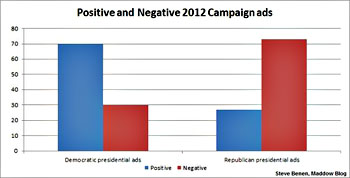
    Steve Benen passes along a bit of raw data today about the kinds of ads that the Obama and Romney campaigns are running:
    Perhaps now would be a good time for a quick reality check. Josh Green cited research from Kantar Media’s Campaign Media Analysis Group, which found that 63,793 presidential campaign ads have been broadcast since the start of the general election campaign on April 10. As Green noted, the data uncovered a noteworthy trend: “Democrats are running a largely positive campaign, while Republicans are running a mostly negative one.”

    That’s….amazing. Not the fact that Democratic ads are 2:1 positive while Republican ads are 2:1 negative — exactly the opposite of the media spin you’re likely to hear these days — but the fact that the two campaigns have run 63,793 ads in six weeks. That’s 1,400 ads per day six months before the election. Yikes.

  • The Left and Right are Not Equally Crazy, Part 794


    Tyler Cowen highlights a comment from Scott Sumner’s blog:

    It’s incredibly frustrating. The political and policy world falls into two camps:

    1. Those who believe no stimulus is necessary, everything is supply-side.
    2. Those who believe stimulus is necessary but only fiscal stimulus can or should supply it.

    ….I feel like to both the centre left and the right, Milton Friedman is too heretical now — too right-wing for the left obviously and too left-wing for the right. Consequently, everything about monetarism has been stripped out of the public consciousness and we are left with vulgar Keynesianism and vulgar Austrianism.

    We truly live in a Dark Age of economics.

    Statement #1 is correct. Nearly all modern conservatives believe that no stimulus, either fiscal or monetary, is appropriate right now. It’s all about maximum pain and austerity. This truly is the equivalent of treating a patient with leeches.

    But where does statement #2 come from? The liberal economists I read do indeed believe that we need fiscal stimulus, but unless I’m misreading them badly, they’d all welcome looser monetary policy as well in one form or another. That might be NGDP targeting (Sumner’s policy preference), it might be further rounds of QE, it might be a higher tolerance for inflation, or it might be something else. Whatever their particular policy preferences, though, I can’t think of a single liberal economist who hasn’t criticized Ben Bernanke for not combating the recession more actively.

    This is the kind of weird false equivalence that drives everyone on the left crazy.

  • The Myth of Harry Truman and the Do-Nothing Congress

    Paul Krugman says that although Team Obama has been reluctant to complain about Republican obstructionism, they don’t really have much choice anymore:

    They can point with pride to some big economic achievements, above all the successful rescue of the auto industry, which is responsible for a large part of whatever job growth we are managing to get. But they’re not going to be able to sell a narrative of overall economic success. Their best bet, surely, is to do a Harry Truman, to run against the “do-nothing” Republican Congress that has, in reality, blocked proposals — for tax cuts as well as more spending — that would have made 2012 a much better year than it’s turning out to be.

    As an empirical matter, this is true. Basically, the Republican strategy for the past three years has been this:

    1. Do everything humanly possible to prevent the economy from recovering.
    2. Wait for 2012.
    3. Run a campaign focused on the fact that the economy is lousy.

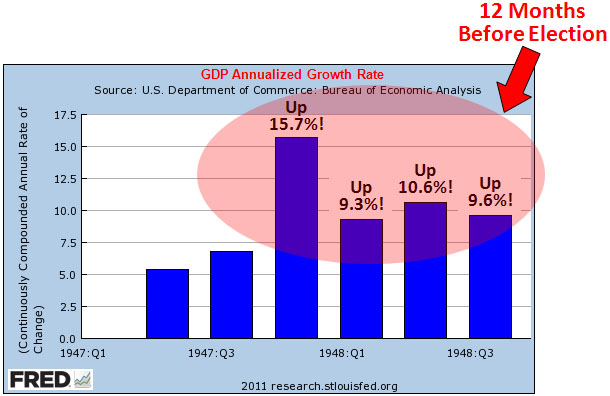
    As a political matter, however, it’s not likely that pointing this out will do Obama any good. Harry Truman and the do-nothing Congress may be the stuff of legend, but guess what? That probably had little to do with Truman’s victory. Truman won because the economy was on a tear for the entire year before the 1948 election: Nominal GDP skyrocketed (chart below) and real GDP was growing at a pretty healthy clip too. Economically speaking, it was a terrific peacetime performance.

    Obama doesn’t have this. He’s got about 3% nominal growth and 2% real growth. There might be justice in blaming this on Republicans, but probably not electoral victory.

  • The White Working Class Doesn’t Believe That Obamacare Will Help Them


    A couple of years ago I had lunch with Mickey Kaus and happened to mention something about his 1991 book, The End of Equality. The book sort of implicitly describes a deal in which liberals accept welfare reform and stop worrying about income inequality, and in return conservatives calm down and start to support increased spending on social programs that benefit everyone. The problem, I said, is that liberals pretty much did what he suggested, but never got anything in return.

    Nonsense, he replied. Everything’s right on schedule. We passed welfare reform in 1995, and now, a decade later, we’re getting a start on national healthcare. And that’s only happening because the white working class is less agitated about the notion that their tax dollars are all being hoovered up by Washington and then shoveled out to lazy malingerers.

    That’s not a connection I’d ever made. And yet….maybe. It might just be true. Today, though, Ron Brownstein marshals some survey evidence that it’s not. In poll after poll, more people believe that Obamacare will make them personally worse off than will make them personally better off:

    The problem, as on almost all issues relating to government’s role, is centered on whites, particularly those in the working class….Just 18 percent believe the law will leave their family better off, compared to 38 percent who believe they will be worse off as a result.

    ….Gallup Polling in March 2010 found that while few whites expected to personally benefit from the law, a majority of them believed it would benefit low-income families and those without health insurance. That suggested they viewed health care reform primarily as a welfare program that would help the needy but not their own families.

    ….Democratic strategists have long viewed a program expanding access to health care insurance as a key to combating the widespread sense among whites, particularly those in the working class, that government only takes their money and redistributing it to the poor, without offering any tangible assistance in their own often economically-precarious lives. Instead, as the latest Kaiser Poll shows, the targets of that effort remain entirely unconvinced that the law will benefit them. Rather than ameliorating their skepticism that government will defend their interests, it appears to have only intensified it.

    Basically, Brownstein suggests that working class whites continue to misunderstand their own interests. Obamacare will benefit them more than almost any other group, but a barrage of misinformation from the Glenn Becks and Rush Limbaughs of the world has convinced them otherwise. They continue to think that only other people will benefit.

    Some of this is surely the fault of the Obama administration, which hasn’t done enough to sell its own program. But it’s also an indication, as if we needed yet another one, that welfare reform really didn’t change public attitudes much at all. All the people who used to be convinced that their taxes were being funneled directly into the pockets of inner city layabouts are still convinced that’s the case. Not much has changed at all.

  • California Propositions

    When I returned home, I was greeted by a flood of email from one reader asking if I’d post my usual California ballot initiative guide. There are only two of them on tomorrow’s ballot, so why not. In case you don’t remember my general biases about the initiative process (nickel summary: I’d be happy to see it go away completely), you can read about them here. With that out of the way, here’s how I plan to vote:

    1. Term Limits: YES. On balance, term limits are a bad idea. But California voters approved them two decades ago and don’t seem inclined to remove them. Given that, Prop 28 is probably the best we can do right now. Instead of a 14-year term limit, split into six years in the Assembly and eight years in the Senate, it provides for a single 12-year term limit, all of which can be spent in one house. This would eliminate the ridiculous situation California is in now, where top leaders in the Assembly almost never have more than four years of legislative experience. Putting neophytes in charge of legislation is absurd, and we’ve been paying the price for this for a long time. Prop 28 isn’t a panacea, but it’s an improvement.

    1. Cigarette Tax Hike: NO. Regular readers know how I feel about ballot-box budgeting. It’s a scourge. I don’t have a problem with higher cigarette taxes, and yes, cancer research is a worthy cause. But there are lots of worthy causes, and it’s the legislature’s job to figure out which ones deserve funding on a year-to-year basis rather than enshrining specific priorities into law forever. We’re already funding dumb stem cell research and a dumb bullet train thanks to ill-conceived ballot measures, and we’re still paying off the dumb revenue bonds that Governor Arnold foisted on us in 2004. This has to stop. I don’t care how worthy the cause is.

    On Prop 29, I’ll concede that reasonable people might think circumstances are special in California. A previous ballot initiative (the infamous Prop 13) requires a two-thirds majority in the legislature to increase taxes, which means that in practical terms there’s really no way for things like cigarette tax hikes to happen aside from ballot measures. That’s true, but I don’t find it convincing. Passing an endless stream of ticky-tack budget patches that become permanent parts of the legal code just isn’t a solution. It only makes things worse. If Californians won’t allow the legislature to increase taxes, they should live with the consequences. Maybe eventually they’ll figure out that this particular piece of Prop 13 was a bad idea.