• Oil Prices are Down, and That’s Very Bad News

    Stuart Staniford reviews the recent rise and then collapse of oil prices today, and concludes that it’s the economy, stupid:

    So whither these trends now? On the one hand, it seems clear that the recent downward forces on prices will continue….Spain’s difficulties rescuing Bankia, and the fact that there are likely still a lot of not-fully-discounted bad loans in Spain’s banks, suggest that the Spanish government is near the end of its rope….And then there is the continued inability of the polarized US political system to come to grips with major challenges — particularly the upcoming expiry of the Bush tax cuts and the automatic spending cuts that will be triggered around the end of this year. All this is chilling stock markets everywhere, particularly as no-one really knows what the implications for the global financial system will be if pieces start to fall off the Eurozone as it trundles forward.

    These kinds of considerations suggest that the downward break in oil prices could continue quite a lot further.

    But if that happens, Saudi Arabia will probably cut production and prices will rise again. So oil prices may fall in the short term, but will probably stay around $100 in the medium term.

    Generally speaking, we’re finally living in the world of peak oil. Or call it plateaued oil if you like, since we seem to have hit a rough plateau in oil production that’s likely to continue for quite a while. This is the world of the vicious circle: when the economy gets better, demand for oil goes up and oil prices spike. This causes the economy to tank, which sends demand for oil down. Rinse and repeat. Add to that the effect of external events on oil prices (the Arab Spring, pipeline breakdowns, embargoes on Iran, etc. etc.) and world economic growth is likely to remain both sluggish and unstable for the foreseeable future, held hostage to OPEC oil production until we get serious about alternative energy. And since, in this brave new world, the price of oil gyrates frequently and erratically, it’s hard to get people serious about this. If oil were, say, permanently above $200 per barrel or so, we’d be building wind farms and installing PV solar at breakneck speed. But whenever the price of Brent falls below $90 or so, everyone gets nervous and wonders if wind farms and solar arrays are really such good investments after all.

    The uncomfortable truth is that we’d probably all be better off if the federal government simply taxed oil variably at a rate that set the all-in price at $200 no matter what the market price was. That would be high enough to get everyone serious about more reliable energy sources and stable enough that investors would be falling all over themselves to fund alternative energy projects. And since it’s oil price spikes that hurt the economy more than high oil prices per se, this probably wouldn’t even have a major impact on growth.

    It’ll never happen. But something like it probably should. There’s enormous upside both economically and environmentally, and the revenue would help address the federal deficit problem everyone pretends to be worried about. Conversely, the downsides are pretty modest and manageable. Wouldn’t it be nice if any of this actually made a difference in Washington DC?

  • How I Spent My Summer Vacation

    Now that I’m back, I’m going to try everyone’s patience by posting a really, really long slide show about my exciting family vacation to Copenhagen and Rome. However, it’s all under the fold, so if you’re not interested, just scroll on by.

    There are basically no pictures of famous sights here. It’s always been a bit pointless to take pictures of this kind of stuff, and these days it’s super duper pointless. Want a picture of the Colosseum? Google will deliver hundreds of top notch photos to your desktop in seconds. Why bother taking your own?

    So instead, I took pictures of cats. And pictures of other animals. And a few annoyingly arty pictures of tiny bits of famous sights. Plus a few other things that I felt like including and that gave me an excuse to write about something interesting. Click the link to start.

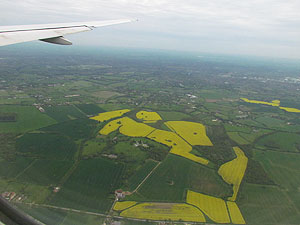
    SAS Flight 504, London-Copenhagen

    After an uneventful connection at Heathrow, we flew into Copenhagen on Thursday the 17th. This is a picture of the Zealand countryside just south of Kastrup Airport. The light splotches are mustard rapeseed fields. The darker splotches are whatever else they grow in Denmark. Wikipedia can probably fill you in on the details.

    Copenhagen

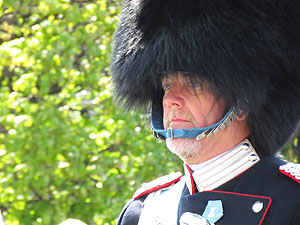
    This is the leader of the royal guards, marching toward Amalienborg Palace for the changing of the guard. The Danes have the whole royalty thing down pretty well: keep a bit of the pageantry and glamour around because it’s kind of cool and retains a link to their national history, but keep it modest and don’t take it all too seriously.

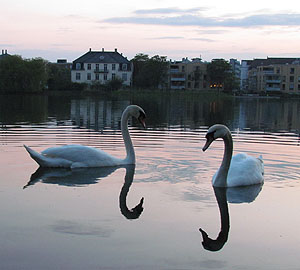
    Copenhagen — Saturday Swan Blogging

    I didn’t see any cats in Copenhagen, so instead here are a pair of swans on one of Copenhagen’s lakes, near the Tycho Brahe Planetarium. Not as adorable as cats, but they’re pretty things anyway, aren’t they?

    By the way, are you wondering why I did no blogging during this trip, even though I said I would if time, energy, and Wi-Fi permitted? There’s a story there. But first, some cats.

    Køge — Sunday Cat Blogging

    My family lived in Køge, about 20 miles south of Copenhagen, for eight months in 1967 while my parents were researching a biography of Danish film director Carl Dreyer. One of my sister’s friends at the time was a girl named Anni, who now lives on a small farm outside of town. She has three cats. This is the mama cat.

    Køge

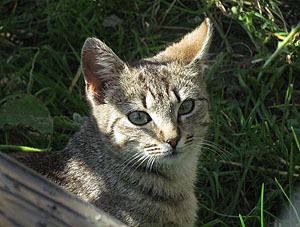
    This is one of her babies.

    Anyway, about the lack of blogging. Here’s the story. On May 16th at 5:18 pm, my iPad calendar app beeped to let me know that our flight was leaving in 30 minutes. So I put the iPad down, picked up my duffel, and went to stand in line to board the flight.

    Køge

    This is another one of her babies.

    You already know how this ends, right? An hour into the flight I opened my duffel and there was no iPad. It was sitting on a seat at LAX. Luckily, Marian had the presence of mind to report this to a flight attendant, who had the captain radio all the pertinent information back to Los Angeles.

    Køge

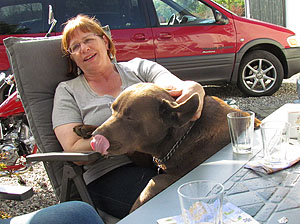
    This is Simba, companion to the farm cats and possibly the world’s most sociable dog. That’s my sister buried underneath.

    Anyway, the iPad story turned out well. They found my iPad and sent me an email a couple of days later telling me where to pick it up when I got back. But in the meantime, no iPad meant no blog posts.

    And now a short intermission in praise of United Airlines. We all complain a lot about poor service, and in fact I tweeted a nastygram about the teensy seats on our United flight from LA to Heathrow while we were on the tarmac in LA. But when I lost my iPad, United really shined. The flight attendant took down all my information. The captain radioed it all back to LAX. Someone there went out to look for it. The baggage services folks emailed me a couple of days later to tell me they had it, and offered to Fed Ex it to me overnight if I wanted. (I didn’t.) When I got back, they retrieved it for me in seconds. Nice work, United Airlines! You saved me a world of grief.

    I now return you to our regularly scheduled vacation blogging.

    Esbønderup

    On Tuesday we visited friends in Esbønderup, a town in the north part of Zealand. This is their local church, which follows the standard design of nearly all village churches in Denmark.

    Esbønderup

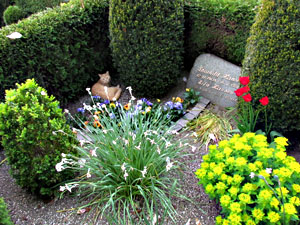
    The grave plots in the churchyard are all separated by small hedgerows and are kept up meticulously. It’s really amazingly peaceful and lovely. And as you can see, all that peacefulness and loveliness attracts feline attention.

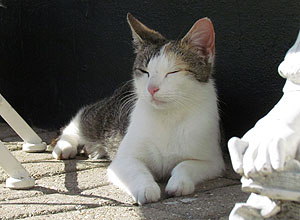
    Esbønderup — Tuesday Cat Blogging

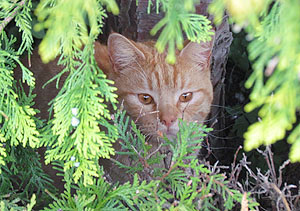
    Here’s a closer look at the church cat. He was too shy of strangers to get close to, but seemed well taken care of and obviously at home among the hedges.

    Copenhagen — Wednesday Duckling Blogging

    On our final day in Copenhagen we found a pair of ducklings swimming around in the pond at Christiansborg Palace. Mama duck was ignoring them completely.

    Next stop: Rome, the eternal city, eternally overrun by cats.

    Rome — Thursday Cat Blogging

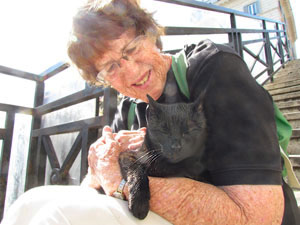
    In Rome we stayed at the Pensione Barrett, a small and, um, idiosyncratic hotel overlooking the Largo Argentina, once the site of the old Roman Senate and now the home of the Argentina cat sanctuary. On the left you see my mother, from whom I inherited my love of cats, making friends with one of the resident felines.

    Rome — Thursday Credit Card Blogging

    While we’re admiring the Argentina cats, maybe I should get everyone up to date on the great credit card problem that I blogged about before I left. Do dumb American credit cards work in Europe, where they’ve mostly made the switch to smart cards? I don’t have a definitive answer, but I did learn a few things.

    Rome — Thursday Credit Card Blogging

    On our first night in Copenhagen I used my Visa card to pay for dinner. The waiter was flustered for a bit and had to ask someone a question, but eventually he pushed the right buttons and was able to print out a receipt for me to sign. I considered this an ominous sign.

    Rome — Thursday Credit Card Blogging

    The next day I went to the train station to buy tickets to Malmø. I bought them at the counter from a live human being, not a machine, but it didn’t matter. No go on the credit card. However, my debit card worked OK with its shiny new 4-digit PIN code. Would it have worked with its old 6-digit PIN? I’ll never know.

    Rome — Thursday Credit Card Blogging

    At that point I just started using the debit card for everything and it worked fine. When we got to Rome, however, Marian suggested I hadn’t really given the credit card a fair trial, so I started using it regularly. And in Rome, at least, there was no problem. It just worked. Nobody made a peep about it or had any trouble at all.

    Rome — Thursday Credit Card Blogging

    So: based on my limited experience, I’d say that American credit cards are potentially a problem in Denmark, though not impossible to use, and not a problem at all in Italy. American debit cards seem to work fine everywhere.

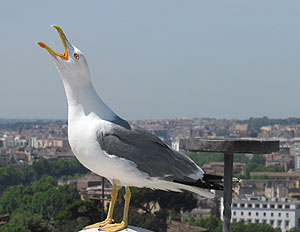
    Rome — Friday Seagull Blogging

    An elevator to the top of the Vittorio Emmanuel monument was installed a few years ago and a friend recommended taking the ride. It was a good recommendation. The view of the entire city really is pretty fabulous. On the left, at the top of the monument, is a seagull squawking, a sound we heard much of while we were in Rome.

    Rome

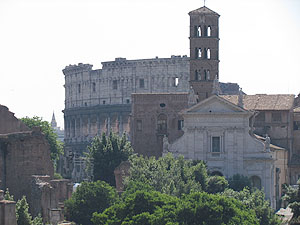
    I know I said there would be no standard sightseeing photos, but if I don’t post at least one, how will you know I was really in Rome at all? This is from the top of the monument and shows the Colosseum in the background.

    Rome — Sunday Cat Blogging

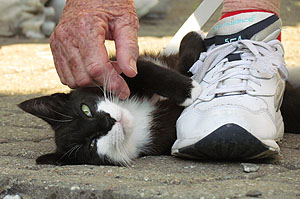
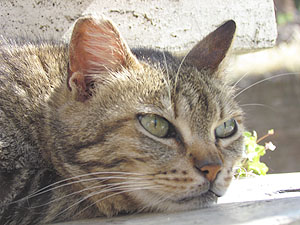
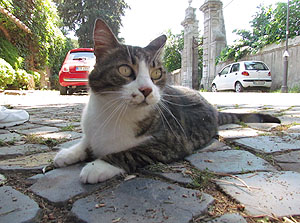
    On Sunday we walked out along the Appian Way and met this cat. He was a very friendly, sociable critter.

    Rome

    I’m not even sure what these are, but they were growing along the Appian Way and they’re kind of pretty, all backlit by the sun like that. [Note: from comments, apparently this is Hare’s Tail Grass, a native of the Mediterranean region.]

    Rome — Sunday Moon Blogging

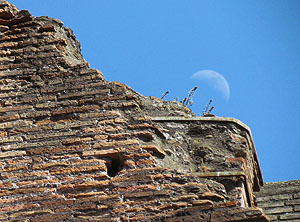
    After we finished with the Appian Way, we walked up the Aventine as part of my mother’s quest to visit all seven of the famous seven hills of Rome, and then visited the Baths of Caracalla. The moon was up, so that’s the picture you get: a tiny sliver of the ruins of the baths with a half moon in the background.

    Rome

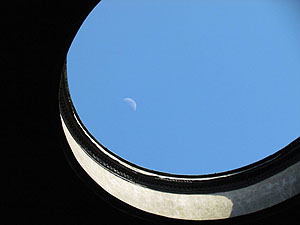
    This made me wonder if I could see the moon through the oculus of the Pantheon, so when we got back to the hotel I walked over to take a look. No dice. I walked out, ordered a gelato, and waited a bit. When I went back in, there it was. As always, Google is your friend if you want a more conventional photo.

    Vatican City

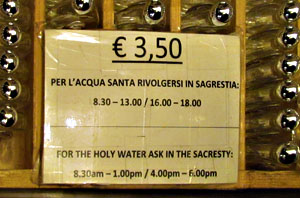
    This is from the gift shop in St. Peter’s. For some reason, I was unaccountably amused at the idea that holy water takes a lunch break. I guess I’m just easily amused sometimes.

    Ostia Antica — Tuesday Cat Blogging

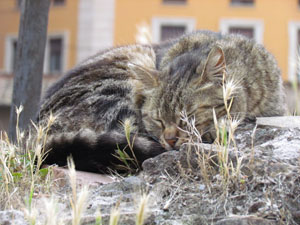
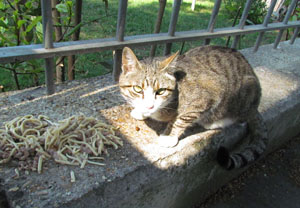
    Ostia Antica may not be as fully preserved as Pompeii, but it’s a short 30-minute train ride from Rome and quite a nice little day trip. Recommended. We found this cat near the entrance. As you can see, in Italy even the cats eat pasta.

    Ostia Antica

    Red poppies were blooming all over Rome while we were there. These particular red poppies were blooming in the ruins of Ostia Antica.

    Rome — Tuesday Cat Blogging

    I took this picture at the Ostiense train station when we returned from Ostia Antica. It earned me a reprimand from a guard. Apparently terrorists must be fond of sizing up transit bombing opportunities by taking pictures of cats in train stations.

    Rome — Tuesday Cat Blogging

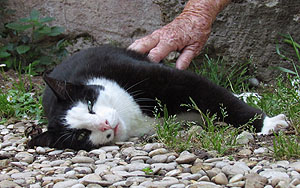
    The Protestant Cemetery in Rome is the final resting place of John Keats and Percy Shelley and the current resting place of many, many cats. This black-and-white cat was very sociable and occupied my mother for a good long while.

    Rome — Tuesday Cat Blogging

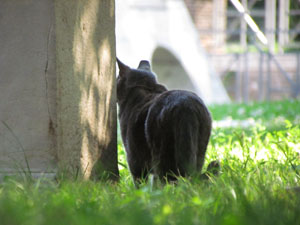
    This is a somewhat less sociable cat in the cemetery, peering warily out from behind a gravestone.

    Rome — Tuesday Cat Blogging

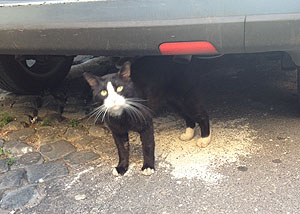
    We ate in Trastavere after the visit to Ostia Antica and encountered this cat along the way. As you can see, pictures taken with an iPhone just aren’t as good as pictures taken with a real camera.

    Vatican City

    On Wednesday, while waiting to visit the Vatican Museums, the pope appeared. Why? Beats me. Italian TV explained it all later that night, but it was, you know, in Italian. However, I see now that he was there to grouse about coverage of a leaks scandal that I didn’t even know had happened.

    Vatican City

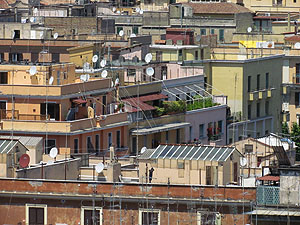
    This is from a window in the Vatican Museums. Rome is apparently just a vast collection of dish antennas with a bunch of buildings to support them all.

    Lufthansa Flight 450 — Frankfurt-LA

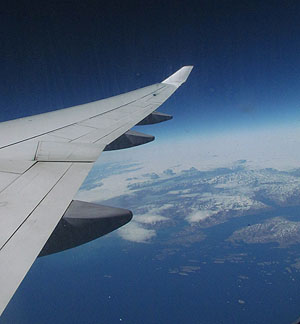
    Our flight to Frankfurt sat on the tarmac for an hour after landing due to a massive failure of the Frankfurt Airport’s computer system. However, our connecting flight was delayed by only 15 minutes, so we made it aboard by mere minutes. Then we were delayed for another hour by a medical emergency. In the end, though, we were only a little late. This is the west coast of Greenland from the window of our 747. It’s not nearly as green as the chamber of commerce might like you to believe.

    So that’s our vacation. With a couple of exceptions, it was all pretty nice and we did everything we planned to do. But here’s a question for the hivemind. One thing that really got to me on this trip was the astounding size of the crowds in Rome. It felt like it was just wall-to-wall humanity, with gigantic tour buses belching out packs of 40 or 50 tourists every couple of minutes. By the end of the week it felt much more oppressive than it did the last time I was there in 2002.

    Obviously Rome is a crowded city, and it’s not as if it’s been empty the times I’ve been there before. (Though Marian and I were both amused at the almost complete absence of people in Roman Holiday, which we watched before the trip.)  So here’s my question. Was I just more sensitive to the crowds this time around? Or have they really gotten worse? If so, why? Is late May a busier season than late September? Was 2002 a light tourist year because it was still shortly after 9/11? Are tour groups more popular than they used to be? Anybody have any ideas about this?

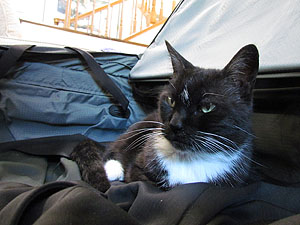
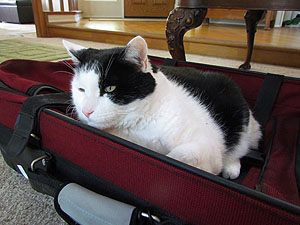
    And now, as your reward for reading to the very end, some real catblogging. Thanks to the computer failure in Frankfurt, our luggage decided to take the scenic route home and arrived at our door shortly before midnight on Friday. We unpacked Saturday morning, and both suitcases were immediately claimed as snoozing spots. Domino staked out the big gray suitcase and Inkblot settled into the smaller red suitcase.

    Regular political blogging will recommence on Monday. In the meantime, enjoy the rest of your weekend.

  • Quote of the Day: Inflation Credibility is Not Really Our Big Problem These Days


    From Paul Krugman, bemoaning the fact that the European Central Bank has adopted such tight monetary policy:

    The fact is that the ECB is highly credible: most observers, me included, are quite sure that it is totally allergic to inflation and relatively indifferent to the collapse of the real economy.

    Yeah, I really don’t think the ECB has any inflation credibility issues at this point. Neither does the Fed. But they very definitely have some serious growth credibility issues.

    So, anyway, as this post suggests, I’m back from Europe. Did their financial crisis affect me? Nope. Not a bit. But I will say this: in a fit of paranoia that I won’t pretend was fully rational, I took $2,000 in cash with me, something I’ve never done before. Why? I dunno. Just in case. I figured if the eurozone chose last week to collapse in panic, U.S. hundred-dollar bills might be a nice, 100% sure source of liquidity. Silly of me, I suppose, but there you have it.

    And with that, I want to take this chance to thank all my guest bloggers for the past couple of weeks: Adam Serwer, Erik Kain, and Heather “Digby” Parton. I mean, not only did they write a lot of great stuff while I was gone (and you do follow them at their home blogs, don’t you?), but they even kept up Friday Catblogging. How great is that? Adam’s herd of Garfields is….impressive, no? And thanks also to Kate Sheppard, for extra bonus catblogging.

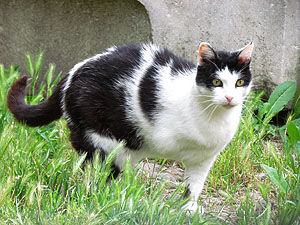
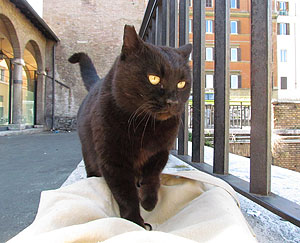
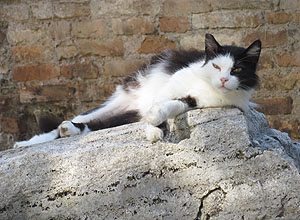
    All this means that nobody has any reason to complain of cat withdrawal symptoms, which means I really have no excuse for writing an interminable Cat Tour of Europe™ post tomorrow. But I’m going to anyway. I know you’re all looking forward to it, aren’t you?

  • Friday Cat Blogging (Bonus Round!) – 1 June 2012

    I have to end my week guest blogging for Kevin in the only appropriate way. It’s Friday. And you know what that means:

    Photographs by Heather Digby

    Photographs by Heather Digby

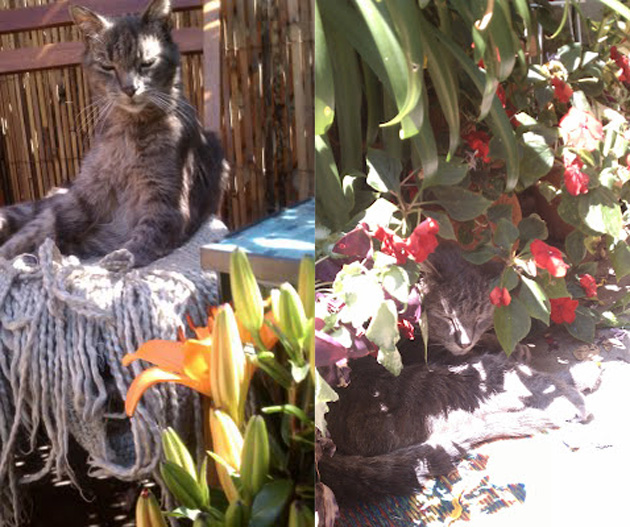
    That’s Rhubarb, my 15-year-old lap warmer, lolling on his chair in the garden.

    (I have had the pleasure of meeting Inkblot and Domino in person and let me tell you they are even more impressive than they look in pictures.)

    Many thanks to Kevin and the fine folks here at Mother Jones for making it easy and thoroughly pleasurable to blog here. Have a great weekend, everyone. And come visit me at Hullabaloo.

  • Friday: Cat, Blogging

    With Kevin out on vacation, I volunteered my cat, George, for some Friday blogging action. (I usually blog over on Mother Jones‘ environmental blog, Blue Marble.) 

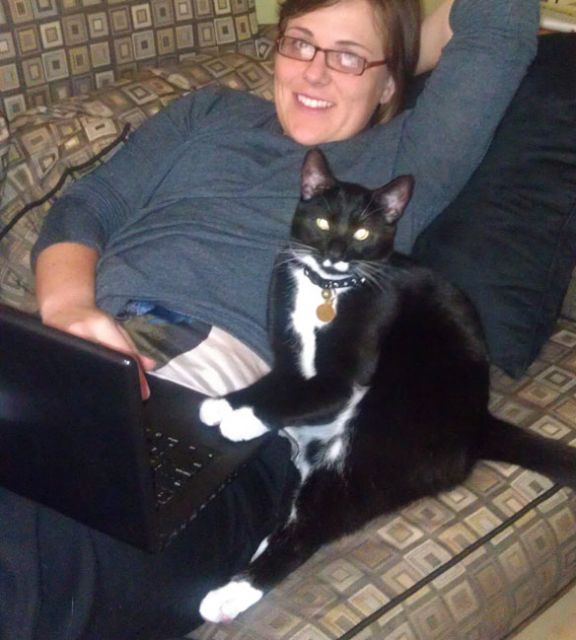
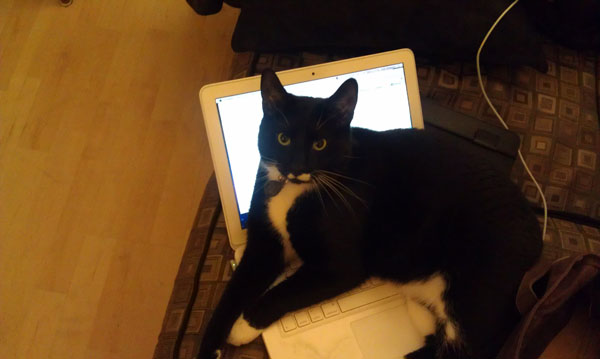
    George is way more involved in the lives of the humans he shares his home with than any other cat I’ve encountered. Most cats ignore you, or only occasionally deign to hang out. But George is always all up in your business, trying to do what you’re doing. Including (actually, especially) when you’re trying to blog:

    Photos by Deen Freelon. Photos by Deen Freelon. 

    Kevin is back next week, so you’ll get the full Inkblot and Domino treatment. In the meantime, happy Friday.

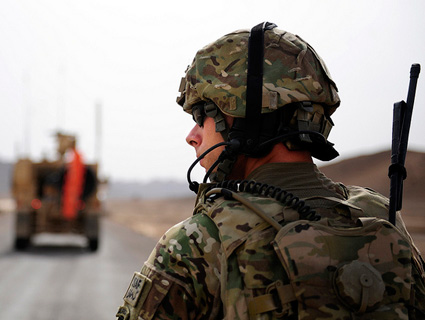
  • The Right’s Version of Military Heroism

    <a href="http://www.flickr.com/photos/soldiersmediacenter/7248329464/in/photostream">US Army</a>/Flickr


    Earlier in the week the discussion was all about what defines a hero, and the question came up frequently about when we became so reverent toward military service. Now, it’s probably true that we’ve always had a special place for martial heroism, most societies do. But as one who grew up in a military family I can say that it’s changed a bit over the years in this country. Military service in the two World Wars and Korea was respected, but it was also the subject of satire and criticism to an extent that I honestly don’t think you could do today. There’s not even a Sergeant Bilko or Mister Roberts, much less scathing satire like Catch-22. (In fact, have we had even one great wartime novel emerge during our last 10 years of non-stop war?)

    The question is why that would be, and I think the consensus is that it’s a response to the Vietnam Syndrome and the poor way that Vietnam vets were treated by civilians. President Obama referred to it himself in his speech the other day:

    When the honourable service of the many should have been praised, you came home and sometimes were denigrated when you should have been celebrated. It was a national shame, a disgrace that should have never happened.

    He’s right about that. But I’m fairly sure that he and virtually everyone else has no idea who were among the worst perpetrators.

    I discussed Vietnam constantly during the Bush administration on my blog. And this quote from Rick Perlstein (when he was in the middle of researching his epic history of the era Nixonland) may be the one that shocked people the most:

    In the now-classic study The Spitting Image: Myth, Memory, and the Legacy of Vietnam, sociologist Jerry Lembke established that the only actual documented examples of the frequently repeated canard that Americans spat upon returning Vietnam veterans came from the kind of World War II veterans who wouldn’t let their brothers back from Vietnam join local American Legion and Veterans of Foreign Wars posts beause they were seen as shameful, as polluted. (The New York Times reported on the phenomenon here.)

    They were the kind of veterans who — Gerald Nicosia tells the story in his history of Vietnam Veterans Against the War — greeted the antiwar veterans who had marched 86 miles from Morristown, New Jersey to Valley Forge, Pennsylvania, just like George Washington’s army in 1877.

    The World War II veterans heckled them: “Why don’t you go to Hanoi?” “We won our war, they didn’t, and from the looks of them, they couldn’t.”

    A Vietnam vet hobbled by on crutches. One of the old men wondered whether he had been “shot with marijuana or shot in battle.”

    I forgot, too, about their political interference in a prominent trial. The Legion post in Columbus, Georgia, home of Lt. William Calley’s Fort Benning jail cell, promised they would raise $100,000 to help fund the appeal of the man convicted of murder in the My Lai Massacre “or die trying”: “The real murderers are the demonstrators in Washington,” they said, “who disrupt traffic, tear up public property, who deface the American flag. Lieut. Calley is a hero….. We should elevate him to saint rather than jail him like a common criminal.”

    (There’s more here about my own recollection of growing up in those times surrounded by people who said exactly that sort of thing.)

    Let me be clear. There is little debate about whether Vietnam vets were treated badly by some left-wing protesters. I’m not saying that never happened. But it’s a lot more complicated than that, and it was as true then as it is now that “the troops” are revered as heroes on the right only as long as they support wars.

    I bring this up because I think that unless we can grapple with the real facts of that era, we will not understand that this right-wing pressure to unquestionably portray military service as a sacred act of heroism is self-serving and limited to those who agree with them. Recall this famous exchange on Rush Limbaugh’s show back in 2007:

    CALLER2: They never talk to real soldiers. They like to pull these soldiers that come up out of the blue and talk to the media.

    LIMBAUGH: The phony soldiers.

    CALLER 2: The phony soldiers. If you talk to a real soldier, they are proud to serve. They want to be over in Iraq. They understand their sacrifice, and they’re willing to sacrifice for their country.

    It’s always been this way with Limbaugh and the like—and still is.

    Heather Digby Parton is guest blogging while Kevin Drum is on vacation.

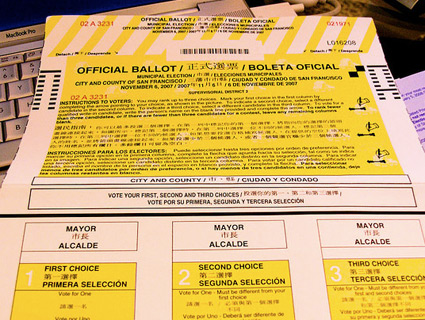
  • Are We About to See Another Stolen Presidential Election?

    <a href="http://www.flickr.com/photos/37996588780@N01/1839524552/">John Manoogian III</a>/Flickr


    From the time I started blogging about a decade ago I’ve been writing somewhat frantically about the GOP efforts to suppress the vote. This should not be surprising since I started writing online in the aftermath of the most dubious election result in history: the infamous Bush v. Gore.

    Vote suppression has been with us for centuries, of course. Jim Crow was built on it. Very famous and important Americans have participated in it, including former Chief Justice William Rehnquist. But according to a 2004 report by the Center for Voting Rights it wasn’t until the Jesse Jackson campaign in the 1980s that the Republicans began to organize nationally:

    Democratic activist Donna Brazile, a Jackson worker and Albert Gore’s campaign manager in 2000, said “There were all sorts of groups out there doing voter registration. Some time after the ’86 election, massive purging started taking place. It was a wicked practice that took place all over the country, especially in the deep South. Democrats retook the Senate in 1986, and [Republican] groups went on a rampage on the premise they were cleaning up the rolls. The campaign then was targeted toward African-Americans.” As in the past, Republicans justified the purges in the name of preventing the unregistered from voting. But Democrats charged vote suppression.

    They formed a group called the Republican National Lawyers Association for the purpose of manipulating the voting laws in all 50 states to the benefit of the party. Of course, they said it was for the purpose of stopping “voter fraud” but since there was and is no evidence of voter fraud, vote suppression was the obvious intent. They learned the ins and outs of all local and state voting rules and figured out how to use them for their own electoral advantage. And with the help of other conservative groups like ALEC, they set about making it harder to register and harder to vote. They really made their bones in the 2000 recount, when the call went out the morning after the election for their lawyers to descend on Florida. The rest is history. Well, it’s deja vu all over again. Here’s Ari Berman:

    Back in 2000, 12,000 eligible voters—a number twenty-two times larger than George W. Bush’s 537 vote triumph over Al Gore—were wrongly identified as convicted felons and purged from the voting rolls in Florida, according to the Brennan Center for Justice. African Americans, who favored Gore over Bush by 86 points, accounted for 11 percent of the state’s electorate but 41 percent of those purged. Jeb Bush attempted a repeat performance in 2004 to help his brother win reelection but was forced to back off in the face of a public outcry.

    Yet with another close election looming, Florida Republicans have returned to their voter-scrubbing ways. The latest purge comes on the heels of a trio of new voting restrictions passed by Florida Republicans last year, disenfranchising 100,000 previously eligible ex-felons who’d been granted the right to vote under GOP Governor Charlie Crist in 2008; shutting down non-partisan voter registration drives; and cutting back on early voting. The measures, the effect of which will be to depress Democratic turnout in November, are similar to voting curbs passed by Republicans in more than a dozen states, on the bogus pretext of combating “voter fraud” but with the very deliberate goal of shaping the electorate to the GOP’s advantage before a single vote has been cast.

    The whole story is shocking in its brazenness.

    “The reality is that in jurisdictions across the country, overt and subtle forms of discrimination remain all too common,” Holder said this week.

    I have long wondered why the Democrats haven’t seemed to take this seriously. It’s been happening in slow motion, but it’s been happening in plain sight. It wasn’t just the 2000 election, although that should have been enough for the Democratic party to launch a full scale defense against this sort of connivance. And it carried on throughout the following decade in elections throughout the country. You’ll recall that even the US Attorney firing scandal was largely about their failure to flout election laws in favor of Republicans. Better late than never, the Democrats seemed to wake up this week:

    Attorney General Eric Holder told members of the Congressional Black Caucus and the Conference of National Black Churches on Wednesday that the right to vote was threatened across the country. “The reality is that in jurisdictions across the country, both overt and subtle forms of discrimination remain all too common and have not yet been relegated to the pages of history,” Holder told the audience, made up of black church and political leaders, during a faith leaders summit in Washington. He also reaffirmed the Justice Department’s commitment to the Voting Rights Act, and in particular, the section of the law which prohibits certain states from making changes to their election laws without first getting federal approval, and which has been the focus of several recent court challenges.

    And he followed through:

    The Justice Department sent a letter to Florida Secretary of State Ken Detzner Thursday evening demanding the state cease purging its voting rolls because the process it is using has not been cleared under the Voting Rights Act, TPM has learned. DOJ also said that Florida’s voter roll purge violated the National Voter Registration Act, which stipulates that voter roll maintenance should have ceased 90 days before an election, which given Florida’s August 14 primary, meant May 16. Five of Florida’s counties are subject to the Voting Rights Act, but the state never sought permission from either the Justice Department or a federal court to implement its voter roll maintenance program. Florida officials said they were trying to remove non-citizens from the voting rolls, but a flawed process led to several U.S. citizens being asked to prove their citizenship status or be kicked off the rolls.

    It’s not that I care so much that the Democrats win. But I really care that Americans are allowed to vote and have their votes counted and I expect that most people care about that too. In this regard there is a big difference between the two parties: the Republicans have organized around suppressing the vote while the Democrats have organized around expanding it. The problem, as usual, is that the Democrats haven’t been nearly as good at it.

    Republican state governments around the country have been working overtime to manipulate the electoral laws and shut down the Democrats’ organizing institutions, from ACORN to unions, and wealthy plutocrats have put huge money behind the effort. With the exception of Wisconsin, the Democrats have been behaving like potted plants in response. One would have thought the 2000 election would have been enough to energize them to protect the franchise, but it clearly wasn’t. Let’s hope it doesn’t take another stolen election to convince them.

    Heather Digby Parton is guest blogging while Kevin Drum is on vacation.

  • Mitt Romney Knows About Crony Capitalism


    Mitt Romney has been playing the crony capitalism card lately, talking up the Solyndra stimulus-money debacle and falsley accusing the Obama administration of lining the pockets of “friends and family.” But it turns out that Romney may need to take a long, hard look in a mirror:

    When Romney was governor, the state handed out $4.5 million in loans to two firms run by his campaign donors that have since defaulted, leaving taxpayers holding the bag.

    The two companies—Acusphere and Spherics Inc.—stiffed the state on nearly $2.1 million in loans provided through the state’s Emerging Technology Fund, a $25 million investment program created while Romney was governor in 2003 that benefitted 13 local firms.

    Acusphere, a biotechnology firm headed by a Romney campaign donor, got $2 million in 2004 that it was supposed to put toward a $20 million manufacturing facility in Tewksbury, which never became fully operational…

    The loans were approved by a seven-person advisory board that included two Romney appointees and three Romney campaign contributors, a Herald review found.

    Meanwhile, stimulus funds have actually been remarkably well managed. Michael Grunwald at Time’s Swampland blog writes:

    The Department of Energy has handled $37 billion in stimulus money, more than its annual budget. Overall, the federal government has distributed over $800 billion in stimulus money. Where are the sweetheart deals? Where are the actual outrages that are provoking outrage? During the debate over the stimulus, experts warned that as much as 5% to 7% of the stimulus could be lost to fraud. But by the end of 2011, independent investigators had documented only $7.2 million in fraud, about 0.001%. As I’ve written, reasonable people can disagree whether the stimulus was a good thing, but it’s definitely been a well-managed thing.

    If you want to talk about actual crony capitalism at the federal level, the problem isn’t so much a vast conspiracy as it is a magnificently complex web of elected officials who want to keep their own jobs by keeping jobs in their home districts and states. That bland reality makes the real problems with more equitable spending at the federal level even more intractable.

    Meanwhile, Romney’s broader argument against the stimulus is incoherent. He blasts Obama for job losses during his administration, but under a Romney administration during that same period of economic crisis, with no stimulus money, job losses almost certainly would have been much more severe. There’s a time for austerity, and it isn’t during a recession.

  • New York City Should Tax Soda, Not Ban It

    John Cole reacts to the new anti-large-soda ban that Mayor Michael Bloomberg is pushing in New York City:

    Stupid, paternalistic, and completely unenforceable. My old platoon sergeant once told me that when it comes to keeping the guys in line, you never make a rule you won’t enforce, you never make a rule you can’t enforce, and you never make a rule you shouldn’t enforce. This new ban fails on at least the first two.

    Cole’s platoon sergeant gives the same advice parents get. Don’t make rules for kids that you can’t or won’t enforce, and if you do make rules then you’d better stick to them or your kids will just ignore them entirely.

    Majiscup – The Papercup & Sleeve Log/FlickrI get the feeling we’ll see a lot of that kind of ignoring going on in New York City when this ban goes into effect. As John points out, people can just buy two 16-ounce sodas instead of one 32-ounce soda. So what’s next? A ban on the number of sodas you can buy at one time?

    Whatever public-health costs the ban may defer could be offset by the costs of attempting to enforce it in the first place. Meanwhile, Bloomberg lends credence to the “nanny state” alarmists who will rightfully hold this up as a bad example of government interfering in the economy.

    Rather than banning soda, how about having the government just raise taxes on it? Taxing sugary drinks would put downward pressure on consumption of those drinks without any enforcement, and revenue could be pumped into public health and education efforts, effectively killing two birds with one stone.

    The other day George Will said: “Donald Trump is redundant evidence that if your net worth is high enough, your IQ can be very low and you can still intrude into American politics.” I don’t think Bloomberg has fallen quite so low as Trump, but his reckless policies have more dire implications for the people of New York than the birther-bloviations of a reality TV star.

    Money can buy a lot of things, but it can’t buy common sense.

    Erik Kain is guest blogging while Kevin Drum is on vacation.

  • John Edwards and Perverted Justice

    Chuck Liddy/ZUMA


    I have not watched the Edwards trial and I am not intimately familiar with the details of the evidence. But like Amanda Marcotte, I’m glad he was not convicted. I hope the prosecution decides to let it go. Being a horrible person is not a criminal act. If it were, we wouldn’t be able to build enough prisons.

    But Amanda explains the real reason why prosecutors should close this case. In this day and age, in this era of obscene electoral profligacy, the pursuit was simply ludicrous:

    With the news of Karl Rove crowing about how he intends to spend $1 billion in untraceable funds to beat Obama in 2012, it looks particularly ridiculous for the government to waste resources on a showboat prosecution. Even the conservative news magazine National Review had to denounce the prosecution as a waste. John Edwards has been disgraced, humiliated and run out of politics. Bringing the full force of the law down on him on top of it all just seems greedy.

    In my opinion it was a witch trial, done more to exorcise society’s demons than to serve as a rational application of the law. Edwards behaved abominably and his life is ruined because of it. But I long ago stopped being shocked by people who, in the midst of personal crisis, behave with a lack of character and morals. I’m afraid that at this stage in my life I’ve seen too much of it to be so very, very sure that I can sit in judgment from afar.

    Arcane federal election law is flouted every single day in ways that seriously threaten our democracy; using it merely to further humiliate an unpopular cad is a serious misuse of resources.  But I suppose we have to give credit where credit is due. Wall Street gamblers and high flying bankers have so far been smart enough not to do the one thing that can get important, high-profile, white males in trouble with the law: get caught paying for unauthorized sex. Other than that, it’s clear that pretty much anything goes.