• A Businessman in the White House

    I see that the mainstream press is starting to pick up on the idea that Americans rarely elect presidents whose primary identity is as a business leader. Here is Bloomberg’s David Lynch:

    Since 1900, few former businessmen have made it to the Oval Office. The most prominent was the nation’s 31st president, Herbert Hoover, whose handling of the economy during the Great Depression cemented his reputation as a failure.

    ….“Our entire system of government is meant to preclude models and skills used in the corporate world, which may be why presidents with business experience are not our most successful presidents,” says Barbara Perry, a senior fellow at the University of Virginia’s Miller Center.

    Well, there are always exceptions, and maybe Romney will be one. But I have to laugh at this anecdote near the end of the piece. The setting is a Staples offsite board meeting:

    “It’s after dinner. People are getting tired. Some directors are rolling their eyes,” [Staples founder Tom] Stemberg recalls. “Mitt was wide awake and he started to give us a little spiel.” Citing his experience with superlative management teams at corporations such as General Electric Co. (GE), Romney told the exhausted executives: You can decide to be mediocre or you can decide to be a great company.

    With that, the division chiefs, who moments earlier had offered up easily reachable goals, began competing to promise the loftiest earnings. “He would get you to stretch,” Stemberg says.

    Uh huh. I’ve seen meetings like that. It’s not exactly Hollywood-worthy when division heads try to lowball their goals and the CEO pushes back. In fact, I’d say that describes just about every corporate planning meeting ever held. And you know what? The CEO usually wins. Why? Not because he’s an inspirational genius who’s gotten everyone to “stretch,” but because he’s the CEO. In the end, the corporate VPs really don’t have much choice in the matter.

    I dunno. I can’t say that I’ve seen much evidence of Romney’s inspiring side. Still, I suppose he might have one but just doesn’t waste it on us rubes. We’ll see.
  • The Disappearing Man, a Follow-Up

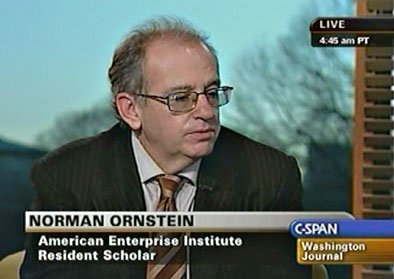
    Greg Sargent digs a little deeper into Bob Somerby’s observation that the Sunday chat shows seem to be suddenly shy about booking uber-quotemeister Norm Ornstein now that he’s written a book blaming Republicans for our nation’s political ills:

    I ran this thesis by Ornstein himself, and he confirmed that the book’s publicity people had tried to get the authors booked on the Sunday shows, with no success.

    “Not a single one of the Sunday shows has indicated an interest, and I do find it curious,” Ornstein told me, adding that the Op ed had well over 200,000 Facebook recommends and has been viral for weeks. “This is a level of attention for a book that we haven’t received before. You would think it would attract some attention from the Sunday shows.” 

    Ornstein also noted another interesting point. Their thesis takes on the media for falling into a false equivalence mindset and maintaining the pretense that both sides are equally to blame. Yet despite the frequent self-obsession of the media, even that angle has failed to generate any interest. What’s more, some reporters have privately indicated their frustration with their editorial overlords’ apparent deafness to this idea.

    Go figure. At the very least, you’d think they’d invite Ornstein and just book him opposite some Republican who could take the other side of the argument. So why haven’t they? Maybe they couldn’t find any Republicans willing to do it. It’s sort of a no-win proposition, after all. And without a he-said to balance Ornstein’s she-said, I guess he’s too hot to handle.

  • Health Insurers Required to Credit Obama When Sending Out Rebate Checks


    It’s rebate time! One of the geekier aspects of Obamacare is that it allows insurance companies to spend no more than a maximum of 20% on overhead costs (15% for large group plans). The rest of your premium dollars have to be spent on actual healthcare. This part of the law went into effect on January 1, which means that starting soon, any insurance company that spends more than 20% on overhead has to send out rebates to customers.

    But here’s the election-year angle on this. Not only do insurance companies have to send out rebates to lots of people, they have to tell them exactly why they’re getting the rebates. Here are the first two sentences of the letter as mandated by HHS:

    This letter is to inform you that you will receive a rebate of a portion of your health insurance premiums. This rebate is required by the Affordable Care Act — the health reform law.

    The checks aren’t huge. The Kaiser Family Foundation estimates that individuals will receive an average of $127, though the average amount will be over $200 in some states. The average rebate in small and large group plans will be smaller, but a fair number of people will receive rebates over a hundred dollars.

    Does this matter? Maybe a little bit. I’d guess that it depends on whether the Obama campaign decides to make healthcare a significant talking point this year. If they do, this will have an effect. If they decide to duck the issue, it probably won’t.

  • Washington DC’s Missing Men


    Norm Ornstein and Thomas Mann are the most quoted men in Washington. They have been for years. A couple of weeks ago they released a new book, and normally this would mean plenty of Sunday chat show bookings. But this book wasn’t the usual pox-on-both-your-houses tome. Instead, they came right out and said it: Republicans are the big problem in American politics right now. Bob Somerby thinks this has gotten them on the wrong side of the Sunday bookers:

    But now, the pair of scholars are missing—and no one is saying a word about it! Yesterday, for the third straight week since that book appeared, Ornstein failed to turn up on a Sunday news program. Mann was missing too. No one asked them about their book—the book which says that our current decline is the fault of only one party.

    For decades, they were the most-quoted experts in Washington. Now, the Sunday programs can’t find them! Bob Schieffer can’t locate his trusted old friends. David Gregory is mystified too!

    I really don’t know if there’s anything to this. But it’s certainly a provocative observation. Where are Mann and Ornstein?

  • Obama’s Support of Gay Marriage Probably a Wash

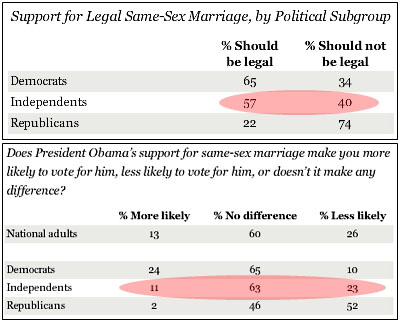
    A couple of days ago Gallup surveyed the U.S. citizenry about President Obama’s decision to come out in favor of same-sex marriage. In their poll, a larger number said it would make them less likely to vote for Obama than more likely.

    Robert Wright is skeptical, largely because he doesn’t believe that 52% of Republicans are truly less likely to vote for Obama now. “Do you really think that 52 percent of Republicans had a greater than zero percent chance of voting for Obama in the first place? Me either. And if the chances of your voting for Obama are zero, how can his position on gay marriage reduce them?”
    Fair point! But I’m skeptical — or maybe puzzled is a better word — for a different reason. Take a look at the two Gallup polls on the right and zero in solely on independents. Independents, by a pretty wide margin, think same-sex marriage should be legal. And yet, independents, again by a fairly wide margin, say they’re less likely to vote for Obama because he now thinks same-sex marriage should be legal.

    This isn’t an impossible result. If the anti-marriage forces feel much more strongly than the pro-marriage forces, you could get this result. But their intensity would have to be a lot higher. If you take these numbers seriously, 57% of the antis are unhappy enough to be less likely to vote for Obama while only 19% of the pros are happy enough to be more likely to vote for him.

    Again, not impossible. Maybe there really is an intensity gap that big. Or maybe most of the pros never believed in Obama’s “evolution” in the first place while lots of the antis did. Who knows? But it’s an odd result.

  • Playing Chicken in the Eurozone


    Will Greece leave the eurozone? Will Germany squawk loudly but bail them out in the end? Matt Yglesias answers with this headline today:

    On Greece, Everyone’s Bluffing—Including the Greeks

    The headline is sort of spoiled by writing a post to go with it, because in a way it says all that needs to be said. This is what makes it so hard to figure out what everyone is up to. After all, if you’re doing a good job of bluffing, the whole point is that your bluff will seem extremely reckless and credible, especially to outside observers like me. My own guess is that the underlying dynamics — Greek government chaos, public opinion in Germany, small country disgust with Greece, capital flows within Europe — are moving toward breakup, but if everyone is doing a good job of bluffing that’s exactly what they’d want me to believe. So I guess I don’t really know.

  • Friday Cat Blogging – 11 May 2012

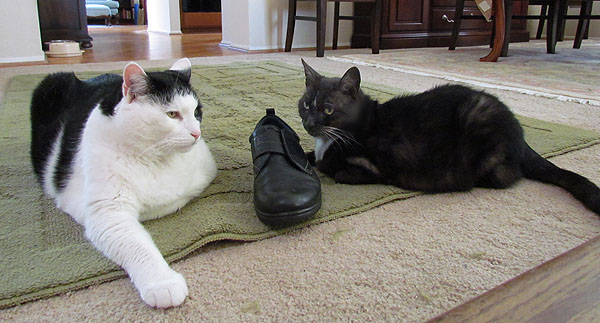
    Today you get both cats in one picture, drawn together by the ever-so-seductive aroma of a freshly removed shoe. There’s just something magical about it that they can’t resist.

    And now the news: today is your last glimpse of Inkblot and Domino for the next three weeks. Try not to let the weeping and wailing get out of hand. In a few days I’m off on vacation, and while I do plan to continue catblogging while I’m gone, there’s no guarantee of success. It depends on (a) finding foreign cats, and (b) prodding my iPad to successfully upload my pictures to the Mother Jones servers. But I’ll do my best.

    UPDATE: And here’s a travel question for the hivemind. Wells Fargo has just informed me that my debit card won’t work in Europe unless I switch my current 6-digit PIN to a 4-digit PIN. That’s no big deal, but I still want to know if this is true. I’m aware that antiquated American-style cards sometimes don’t work at all in European machines, which require smart cards, but if they do work, do they require 4-digit PINs? Anyone have recent experiences they can share?

  • A Wee History of the Census

    Steven Taylor reports today on a boneheaded effort by House Republicans to kill off the American Community Survey, an annual program supported not just by mushy-headed liberals, but by conservative think tanks and the business community. It’s an invaluable source of information about the state of the country, but because it’s conducted by the Census Bureau it’s become a tea party bête noire. They’re convinced that because the Constitution calls for a decennial “enumeration,” then by God, that’s all they can do. They can count heads and nothing more. Anything else is an intolerable invasion of privacy.

    I wonder if these guys have ever actually looked at an old census record? Taylor mentions the historical evidence that James Madison himself wanted to count much more than heads and that, in fact, more than a mere count has been done in every census since 1790. What’s more, the government has conducted other, more detailed censuses routinely since the early 19th century.

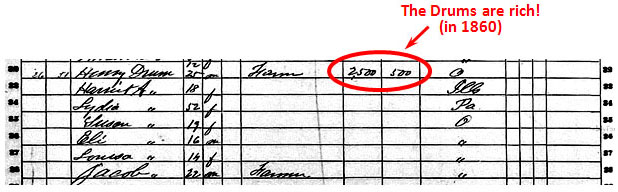
    In any case, if you want to see a real invasion of privacy, check out this snippet from the 1860 census:

    That record shows my great-grandfather Eli, my great-great-grandmother Lydia, and Eli’s brother Henry as head of family. And those two numbers? Those are the values of his real estate and his personal estate. In other words, my ancestors weren’t really all that rich, since $2,500 is only about $70,000 in today’s dollars, and there was probably a mortgage on the farm. Nonetheless, Uncle Sam demanded this information from everyone, and when I was looking at the recently released 1940 census I noted that they asked about annual income in that one. Other censuses have routinely asked for ages, birth dates, education levels, occupations, national origin of parents, whether you owned a radio, and so forth. This is nothing new. The tea partiers really need to learn a little history before they sail off on these crusades of theirs.

  • In Modern Finance, Dumb is Better Than Smart


    Felix Salmon explains a bit more today about how JPMorgan managed to report a $2 billion trading loss on Thursday: it was almost certainly the result of a poorly conceived risk model that seemed like it should work but, in fact, didn’t pass the common sense test. At the end, I think he comes to exactly the right conclusion:

    This is why Basel I turned out to be much more robust than Basel II. Your sophisticated platform needs to be built on a foundation of dumb rules: simple limits on how big any one position can get, on how much exposure you can have to any one counterparty, or in general on any trade which is based on the hypothesis that your desk is smarter than anybody else on Wall Street.

    Those kind of rules won’t prevent all blow-ups, of course, but they’ll help. They would have prevented this one, and they would have put an end to Jon Corzine’s disastrous MF Global trades, as well.

    The problem is that traders hate dumb rules, because they cap the amount of money they can make. And traders have enormous power at investment banks these days, because they make the lion’s share of the profits. That’s why it’s important that the CEO of an investment bank not be a trader. And certainly it’s crucial that the CEO shouldn’t have his own trading account and buy and sell from his Blackberry during meetings, as Corzine did. That’s just a recipe for disaster.

    Yep. Dumb, blunt rules are the only kind that can work in the playpen of modern finance. We simply don’t understand the world well enough to pretend that we can regulate things in minute detail, and we sure as hell don’t have regulators who are either smart enough or can move fast enough to stay ahead of the rocket scientists trying to outwit them. That’s not just impossible in practice, it’s pretty much impossible even in theory. It’s just plain impossible.

    But dumb-as-rocks rules about capital requirements and trading limits and collateral requirements and term structures? Yeah, that can work. In fact, Drum’s Principle (if Jamie Dimon can have a principle, so can I) is that financial regulations only work if they clearly cap the amount of money that traders can make. That’s one way you can tell whether new rules like Dodd-Frank and Basel III are working: if the financial sector keeps making as much money as ever, they aren’t.

    Bottom line: financial regulations are only effective if they’re so dumb that traders simply can’t maneuver around them. Those are the kinds of rules we need.

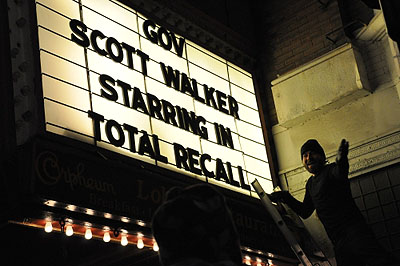
  • Scott Walker’s Recall Probably Not a Sign of Impending Doom

    In the LA Times today, “lifelong Democrat” Jonathan Zimmerman explains why he’s uncomfortable with the recall campaign against Wisconsin’s Republican governor, Scott Walker:

    The recall epitomizes the petty, loser-take-all vindictiveness of contemporary American politics. And if you don’t agree, I’ve got two names for you: former California Gov. Gray Davis and U.S. Sen. Dianne Feinstein. Remember Davis? In 2003, he became just the second governor to be recalled in U.S. history. A year earlier, voters had elected Davis to a second term. As budget and energy woes engulfed California, however, Republicans saw an opportunity to get rid of him.

    ….As a liberal, I’m troubled by the prospect of voters unseating an elected official over taxes. Or abortion. Or gun control. If you can recall leaders for any political reason, sooner or later your own ox will be gored. I’m also worried that the Wisconsin recall, which has drawn nationwide attention and money, will trigger a vicious cycle of partisan retribution. Your guy didn’t win in November? No problem. Start a recall drive now.

    I have some sympathy for this point of view. In fact, back in 2003 this was pretty much how I felt. So after Arnold won that year’s recall election in California, I waited for the other shoe to drop. And waited. And waited. And kept waiting.

    This year it finally dropped, but it took nearly a decade. So what we have is two high-profile recall attempts in nine years. This doesn’t really seem like the tit-for-tat avalanche that I feared back in 2003.

    In fact, Zimmerman admits as much. As he relates California’s history, we recalled a mayor in 1909, another one in 1938, and then saw a spike of recall attempts in the 70s, culminating in the 1983 recall attempt of Dianne Feinstein when she was mayor of San Francisco. And then….nothing. The wave receded until Gray Davis was recalled in 2003.

    I think Zimmerman has an obviously relevant point here, and it becomes ever more relevant as our national politics becomes ever more polarized. And yet….we just haven’t seen a mighty wave of serious recall attempts since 2003. I thought we might, but I was wrong. It’s something to keep an eye on, but it’s also worth keeping in mind that Walker pretty plainly chose to govern in a far more hard-nosed, extreme, and deliberately hostile fashion than he campaigned on. Not only is it no surprise that he produced a massive backlash, but that backlash almost seemed to be part of his plan from the start. I’ll stay alert to Zimmerman’s misgivings, but for the moment I don’t think Walker’s fate is a canary in the coal mine. Unlike Gray Davis, who mostly just got screwed by Enron and never deserved to be recalled, Walker overreached, he did it deliberately and calculatedly, and now he’s facing the consequences. That’s politics.