Dave Weigel complains today that too many rich people have no idea how income taxes work. They’ve heard that Obama wants to raise tax rates on people who make more than $250,000, so they’re working on ways to keep their income right at $249,000. After all, if they go over the threshold, they’d suddenly have to pay the higher rate, and it would be a net loss.
This isn’t true, of course. Obama is only proposing to raise tax rates on income over $250,000, so if your income goes up to $251,000, you only pay the higher rate on the extra $1,000. The tax bill on your first $250,000 stays exactly the same.
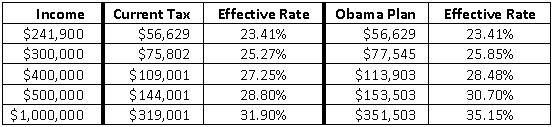
But that’s hard to explain, and we’re all about solutions here, not petty griping. So I have the answer: an EZ-to-Read table that compares total taxes paid under the old Bush rates and the proposed Obama rates. It starts at $241,900 because that’s $250,000 minus the standard deduction, and it’s for married couples filing jointly.
Example: under the current Bush tax rates, a couple making $300,000 pays $75,802, or 25.27% of their total income. Under Obama’s plan, the rate goes up on the amount over $241,900, so they pay a whopping $2,000 more, or 25.85% of total income. Millionaires will pay $32,000 more. Raw data here. Share this with all your rich friends!
Pew Research has some great news for those of you who loathe mainstream media campaign coverage. In their study of how the press reported on the 2012 presidential campaign, they say that Obama’s media coverage turned around dramatically during the final week of the campaign, moving from a net 13 points negative to a net 10 points positive. It must have been Hurricane Sandy, right? Guess again:
Much of that surge in positive coverage, the data suggest, was tied to Obama’s strategic position, including improving opinion polls and electoral math, rather than directly to positive assessments of Obama’s response to Superstorm Sandy.
….When it came to mainstream news coverage, a leading cause of Obama’s more upbeat narrative in the last week was that the horse-race coverage about his campaign-stories focused on strategy, polls and the question of who is winning-became more positive: 37% were clearly favorable in tone while 16% were unfavorable. That is considerably more upbeat than it had been for most of the final two months of the campaign….During the final week, 46% of all press coverage of the campaign focused on horse-race and strategy stories, larger than the 39% that was devoted to such issues throughout the entire race.
So there you have it. In the final week, the press finally figured out that Obama was leading in the polls, and the press always writes more glowingly of winners than losers. Yay press corps!
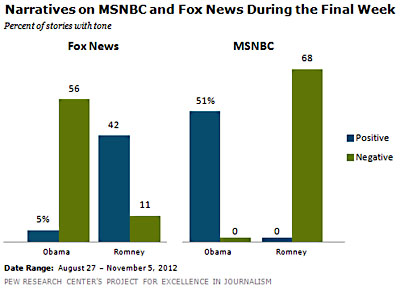
In other news, Pew also charted the coverage of Romney and Obama on Fox News and MSNBC. Their conclusion: both networks had favorites, but “in the final week of the campaign, both Fox News and MSNBC became even more extreme in how they differed from the rest of the press in coverage of the two candidates.” Italics mine. Which network was the most extreme, though? Anyone who thinks that MSNBC hasn’t yet become fully Foxified might be surprised at the answer, but Pew found that in the final week MSNBC aired precisely zero stories that were either positive about Romney or negative about Obama. Welcome to the 21st century news bubble.
Yeah, I think we knew that. Here’s the rest of the quote:
I can tell you what recorded history says, I can tell you what the Bible says, but I think that’s a dispute amongst theologians and I think it has nothing to do with the gross domestic product or economic growth of the United States. I think the age of the universe has zero to do with how our economy is going to grow. I’m not a scientist. I don’t think I’m qualified to answer a question like that. At the end of the day, I think there are multiple theories out there on how the universe was created and I think this is a country where people should have the opportunity to teach them all. I think parents should be able to teach their kids what their faith says, what science says. Whether the Earth was created in 7 days, or 7 actual eras, I’m not sure we’ll ever be able to answer that. It’s one of the great mysteries.
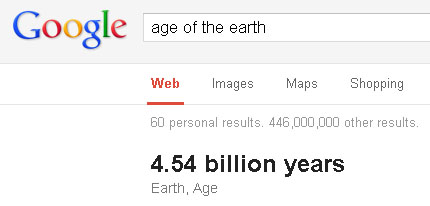
As it happens, both Rubio’s church and the secular god Google agree on this question, so there’s not much excuse for him to pretend he doesn’t know. Still, for the record, I have no objection to anything Rubio says here. I agree that the age of the Earth has nothing to do with economic growth and I agree that parents should be able to teach their kids what their faith says. It would be nice if Rubio had added that science classes should teach kids science, but he managed to dodge that bullet—barely. Maybe next time someone will follow up on this.
Besides, all the fuss over this quote has obscured the real quote of the day from Rubio, about his love of hip hop:
The only guy that speaks at any sort of depth is, in my mind, Eminem.
Okey dokey. My favorite Eminem song, by the way, is “The Way I Am.” I’ll bet you’re surprised I even have a favorite Eminem song, aren’t you? So am I.
Whenever you hear tax or budget forecasts, they’re (almost) always made over a 10-year timeframe. For example, letting the high-end Bush tax cuts expire will raise about $800 billion over ten years. Last year’s debt ceiling deal reduces discretionary spending by $1.5 trillion over ten years. Etc.
But how big are these numbers? You can’t get a sense for that unless you know how big the budget and the deficit are projected to be over ten years, and those aren’t numbers most of us have at our fingertips. So here they are, courtesy of the CBO:
10-Year Spending: $46 trillion.
10-Year Deficit: $10 trillion
These numbers are based on CBO’s “alternative fiscal scenario,” which accounts for their best guess about what policies are likely to be in place over the next decade. Now you know.
(For the record: The CBO’s alternative fiscal scenario assumes that the Bush tax cuts are extended; the payroll tax holiday expires; the AMT is indexed for inflation after 2011; Medicare payment rates for physicians’ services are held constant at their current level; and that Congress overturns the sequestration cuts that were part of the debt ceiling agreement last year.)
Dan Drezner laments the increasing tendency for American diplomats in dangerous places to be cut off from the residents of their host countries. And he’s afraid that the death of Ambassador Chris Stevens in Benghazi is just going to make it worse:
If U.S. diplomats have to do the bulk of their work behind fortresses, then pretty soon there will be no difference between their worldview and those of the four-star generals….Rather than the simple mantra of “never again” when reacting to the death of Ambassador Stevens, the life and mission he desired should be valorized a bit more. Stevens knew that the best way to advance U.S. interests in Libya was to be on the ground. Doing that from embassies that resemble Orwell’s Ministry of Truth is a difficult task.
There is a tradeoff between protecting U.S. officials overseas and promoting their ability to advance the national interest. I fear the pendulum has swung way too far towards the protection side, and Stevens’ death will only exacerbate that shift. The cruel irony is that Stevens, of all people, would have abhorred that shift. Better that we openly acknowledge the risk that foreign service officers face in overseas postings, recognize the bravery and loyalty that their service entails, and let them do their f***king jobs.
Roger that. And although not too many people want to reopen this conversation, it’s still worth asking some hard questions about why we need these fortress embassies in the first place. The answer, obviously, is that a helluva lot of people, especially in the Middle East, hate us. Why? Well, just in the past couple of decades we’ve launched military operations against Afghanistan, Iraq, Pakistan, Yemen, Somalia, and Libya—just to name the half-dozen most direct and overt cases. Sure, it’s possible that residents of the Middle East don’t really care much about this, but hate us for our freedoms instead, but what are the odds?
President Obama wants to let the Bush tax cuts for the rich expire, which would allow top marginal tax rates to increase from 35 percent to 39.6 percent. Andrew Sullivan isn’t sure this is a hill for Obama to die on:
My overall view is that the most important thing is to increase revenues, not rates necessarily. I can understand why Obama wants to get the top rate back to Clinton levels — and it would require much deeper inroads against deductions than the GOP has previously accepted. But [] I’d give on this if I were Obama — in order to see if the GOP could come up with removal of tax deductions for those earning over $250,000 that would bring in the same amount of revenue. If they don’t want a rate increase, ask them how to get the same amount of money from the same group of people by ending deductions. Call their bluff — and show you are not wedded to redistribution that could even theoretically impede growth and entrepreneurialism.
I concede that this would be interesting. Mitt Romney spent an entire campaign insisting that he could close enough loopholes and deductions to make up for his proposed 7 percent rate cut on the wealthy. Democrats scoffed, but Republicans all insisted that Romney’s plan was eminently feasible and that details would be forthcoming during tax negotiations after the election. Well, the election is over, tax negotiations have started, and their goal is considerably easier since they only have to make up for the 4.6 percent rate cut that keeping the high-end Bush tax cuts entails.
There are two upsides to working with Republicans on this. First, Obama gets to look sweetly reasonable. You want to close deductions instead of letting the higher rates expire? Let’s reason together, my friends. Show me your plan.
Second, I think a big part of Obama’s strategy here is to break the Grover Norquist stranglehold—and the Norquist blood oath isn’t about never voting for a rate increase, it’s about never voting for a net revenue increase, no matter how you get there. Obama wants Republicans on record voting for something that breaks that oath, and closing a bunch of deductions works as well as a rate increase.
If I were part of the Republican leadership, though, I wouldn’t take the deal. Their problem is the mirror image. First, if they’re going to break the oath, it doesn’t matter how they do it. Closing deductions doesn’t buy them anything. Second, closing a bunch of deductions is something that will be forgotten very quickly, leaving a low top rate in place that will be an easy target for Democrats who want to soak the rich even further. Frankly, Republicans would be better off just agreeing to the higher top rates now, leaving them an easier job of protecting the rich in the next round of tax reform.
To start off this short week, I’d like to add my voice to the many on the left who are endlessly amused at how thoroughly Mitt Romney is being thrown under the bus by the right for the heinous crime of….saying nothing more than what most of them have believed for a long time. He thinks Obama won by promising lots of goodies to poor people and minorities, and unless I’ve misunderstood several decades worth of conservative complaints, that’s a pretty mainstream view on the right. “We are reaching the tipping point where the majority of Americans are recipients of government programs,” said uber-mainstream conservative George Will earlier this year. “The tactic of the Democratic Party is to run up the dependency ratio in this country until you get 50-60 percent of Americans dependent on the government […] at which point they figure the party of government will always win.” A few weeks after Will made his comment, Mother Jones released the infamous 47 percent video, which prompted Ron Brownstein to write:
Far from a gaffe, Romney’s remarks reflected both a long-standing belief among conservatives that the nation faces a “tipping point” in which growing dependency will create an insurmountable electoral majority for big government — and Democratic candidates. Rep. Paul Ryan of Wisconsin, Romney’s running mate, has delivered similar arguments for years. “We risk hitting [a] tipping point in our society where we have more takers than makers,” he said recently. “President Obama’s policies are feverishly putting more people into the column of being takers than makers … being more dependent.”
The conservative Heritage Foundation, in the latest edition of its “Index of Dependence on Government” likewise concluded earlier this year: “Perhaps the greatest danger is that the swelling ranks of Americans who enjoy government services and benefits for which they pay few or no taxes will lead to a spreading sense of entitlement that is simply incompatible with self-government.”
Conservatives believe that liberals are intent on creating a welfare state that saps initiative, leads to moral decay, makes voters more dependent on government, and helps cement the Democratic Party’s hold on power. They’ve been saying this forever. But when Mitt Romney says it in slightly blunter terms than we’re used to, they practically barrel over each other running for the exits.
Poor Mitt. Conservatives never liked him in the first place, so he tried hard to say all the things they wanted him to say. But once he lost, he was an instant pariah. He was saying the stuff they wanted him to say during a campaign, not realizing that the rules had changed. Once the campaign was over, that exact same stuff was a rather too blunt admission of what conservatives believe. He was betraying the cause, not helping it. The price he’ll pay is a banishment from the conservative movement even more thorough than George Bush’s. Conservatives are not kind to their losers.
So how did Sam Wang, our resident expert do? Answer: pretty well. A month before the election, he called the presidential race dead on and missed the Senate race by only one seat. His House prediction was off by 16 seats, but in fairness, he was in the middle of incorporating redistricting/incumbency effects when I asked him for his forecast on October 6, and he warned me that this might change things. His later forecast was considerably more accurate.
Still, the rules were best forecast a month ahead of the election. So who won? Here are all the commenters who got the presidential split correct:
Jeff Gauvin
President: Obama 332, Romney 206
House: 215 D, 220 R
Senate: 52 D/I, 48 R
Ziggy
President: Obama 332, Romney 206
House: 215 D, 220 R
Senate: 54 D/I, 46 R
Jason Broccardo
President: Obama 332, Romney 206
House: 215 D, 220 R
Senate: 56 D/I, 44 R
jharp
President: Obama 332, Romney 206
House: 215 D, 220 R
Senate: 55 D/I, 45 R
Oddly, all four predicted an identical House split, so the winner is jharp, who got the Senate split dead on. However, there’s an honorable mention co-winner too:
Kadzimiel
President: Obama 303, Romney 235
House: 202 D, 233 R
Senate: 55 D/I, 45 R
Kadzimiel was almost dead-on for both the House and Senate, and missed the presidential split only by Florida, which was a genuine nail-biter that could have gone either way.
So that’s that. The 2012 election is in the books. Kadzimiel and jharp are co-winners of the forecasting contest, and if you guys will send me your email addresses I’ll try to persuade the powers-that-be to sign you up for a free MoJo subscription for 2013. Congratulations!
Over the past couple of weeks, a lot of people have had a lot of advice for the Republican Party. Compromise more. Compromise less. Appeal to Hispanics. Stick to conservative fundamentals. Nominate better candidates. Improve your ground game. Etc. Some of this advice is good, and some of it is probably not so good.
But I’d like to congratulate Charlotte Allen for possibly the worst advice ever offered to a party in defeat. This is truly — um, hold on. Sorry. Revise and extend. What I meant was that this is the best advice ever offered to a party in defeat. I totally think she’s onto something here. Republicans should absolutely do this.
From a “senior U.S. official,” commenting on talking points from the intelligence community that blamed the Benghazi attacks on extremists:
The controversy this word choice caused came as a surprise.
That’s a nicely understated way of putting it. In a normal world, of course, this word wouldn’t cause any controversy. It’s a perfectly good word. But in a world where, um, political extremists are desperate to gin up a scandal, it’s taken on an almost surreal quality.
Today’s Benghazi news revolves around David Petraeus’s appearance before Congress this morning. Most of the descriptions of his testimony have come from Democratic members of Congress, and they’ve emphasized that Petraeus signed off on the talking points that were given to Susan Rice before she taped her TV interviews a few days after the attacks. Why haven’t we heard more from Republicans about this? I assume it’s because Petraeus didn’t really help their coverup narrative much. However, Dave Weigel points out that Peter King has talked to reporters, and to his credit, was skeptical of Petraeus’s testimony that he had called it a “terrorist” attack from the start:
King said Petraeus had briefed the House committee on Sept. 14, and he did not recall Petraeus being so positive at that time that it was a terrorist attack. “He thought all along that he made it clear there was terrorist involvement,” King said. “That was not my recollection.”
Later, King talked to CNN about the final interagency talking points that used the word extremist rather than al-Qaeda terrorist:
Q: Did [Petraeus] give you the impression that he was upset it was taken out?
KING: No.
Q: You said the CIA said “OK” to the revised report —
KING: No, well, they said in that, after it goes through the process, they OK’d it to go. Yeah, they said “Okay for it to go.”
King still insists, along with everyone in Fox-land, that we need to get to the bottom of who changed the word. This is stupefyingly dumb, since everyone knows this is exactly the kind of thing that happens when talking points go through a bureaucratic approval process. Still, if Congress wants to dig into this, I guess that’s fine. In fact, I should make clear that although the scandal/coverup narrative is, if anything, getting even more ridiculous over time, there are plenty of legitimate questions for Congress to address. For example:
Why did the talking points end up referring to extremists rather than terrorists? (It’s dumb, but if they want to interrogate the interagency process, I guess that’s fine.)
Why did it take so long to figure out what happened in Benghazi?
Should the attacks have been anticipated?
Who was responsible for the response to the attacks? What went wrong? Were troops available that weren’t used?
Was security in Benghazi inadequate based on what we knew before the attacks?
This is all perfectly reasonable stuff for Congress to investigate. It’s not likely to uncover any kind of deep scandal, but if it’s done seriously it might help us avert attacks like this in the future, or respond to them better when they do occur.
Can you pitch in a few bucks to help fund Mother Jones' investigative journalism? We're a nonprofit (so it's tax-deductible), and reader support makes up about two-thirds of our budget.
We noticed you have an ad blocker on. Can you pitch in a few bucks to help fund Mother Jones' investigative journalism?
We’re halfway there, but time’s running out.
With only days left in 2025, we've made real progress toward our $400,000 goal—the funding we need to keep our nonprofit newsroom running at full
strength. But to close the remaining $200,000 gap before December 31, it will take a huge surge in reader support. Whether you've given before or this is your first time, your contribution right now will matter. Will you help us get there?
We’re halfway there, but time’s running out.
With only days left in 2025, we've made real progress toward our $400,000 goal—the funding we need to keep our nonprofit newsroom running at full
strength. But to close the remaining $200,000 gap before December 31, it will take a huge surge in reader support. Whether you've given before or this is your first time, your contribution right now will matter. Will you help us get there?

 than the 39% that was devoted to such issues throughout the entire race.
 not sure we’ll ever be able to answer that. It’s one of the great mysteries.
 Dan Drezner laments the increasing tendency for American diplomats in dangerous places to be cut off from the residents of their host countries. And he’s afraid that the death of Ambassador Chris Stevens in Benghazi is
  party of government will always win.” A few weeks after Will made his comment, Mother Jones released the infamous 47 percent video,



