Hey look! Domino is up on the fence today. She used to follow Inkblot up there whenever he got the urge to explore, but I think this is the first time she’s done it since he died. I guess she’s finally feeling a little more independent.


Hey look! Domino is up on the fence today. She used to follow Inkblot up there whenever he got the urge to explore, but I think this is the first time she’s done it since he died. I guess she’s finally feeling a little more independent.
David Petraeus, late of the CIA, testified today before the Senate. Just by doing this, he batted down one of the dumber conspiracy theories surrounding Benghazi, namely that the expose of his affair with Paula Broadwell—or the coverup of his affair prior to the election, depending on which account you read—was somehow designed to prevent him from testifying before Congress. As it turns out, Congress can subpoena anyone it wants, so this was moronic from the start. And in the event, Petraeus was happy to 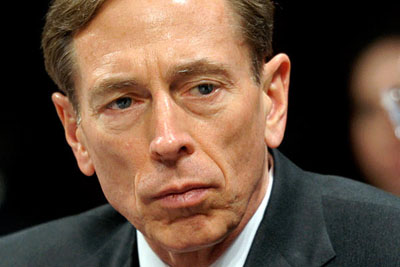 testify voluntarily and no one tried to stop him.
So now let’s move on to conspiracy theory #2: The Obama administration knew what really happened in Benghazi, but sent Susan Rice out to the Sunday talk shows to lie about it. How did that turn out?
Lawmakers said Petraeus testified that the CIA’s draft talking points written in response to the assault on the diplomat post in Benghazi that killed four Americans referred to it as a terrorist attack. But Petraeus told the lawmakers that reference was removed from the final version, although he wasn’t sure which federal agency took out the reference.
Democrats said Petraeus made it clear the change was not made for political reasons during President Barack Obama’s re-election campaign. “The general was adamant there was no politicization of the process, no White House interference or political agenda,” said Rep. Adam Schiff, D-Calif. “He completely debunked that idea.”
….Petraeus testified that the CIA draft written in response to the raid referred to militant groups Ansar al-Shariah and al-Qaida in the Islamic Maghreb but those names were replaced with the word “extremist” in the final draft….Sen. Mark Udall, D-Colo., said Petraeus explained that the CIA’s draft points were sent to other intelligence agencies and to some federal agencies for review. Udall said Petraeus told them the final document was put in front of all the senior agency leaders, including Petraeus, and everyone signed off on it. “The assessment that was publicly shared in unclassified talking points went through a process of editing,” Udall said. “The extremist description was put in because in an unclassified document you want to be careful who you identify as being involved.”
….Schiff said Petraeus said Rice’s comments in the television interviews “reflected the best intelligence at the time that could be released publicly.”
So that’s where we are. The interagency process removed the word “terrorist” and, for security reasons, replaced “Ansar al-Shariah” with “extremists.” There was no political pressure to do this, and everyone signed off on the final draft. So that’s what Susan Rice got: a brief set of talking points that said there had been protests in Benghazi inspired by those in Cairo, which had subsequently evolved into an assault on the consulate by “extremists.” And that’s what she said on TV.
The part about the protests turned out to be wrong. And Ansar al-Shariah was eventually firmly identified. But on September 15, four days after the attacks, this was what the intelligence community believed.
If that’s your scandal, you have a pretty low bar for scandals.
Dylan Matthews writes today about a proposal from Sen. Mark Begich to fix Social Security’s finances:
The Begich bill would lift the current payroll tax cap, which exempts wages in excess of a certain amount ($110,100 this year) from the tax….According to the Congressional Research Service, a change like that would almost entirely wipe out the program’s long-run actuarial imbalance. Specifically, it would eliminate 95 percent of the shortfall.
….But Begich’s bill doesn’t just increase taxes for high earners….
Dylan breezes by this a little quickly for my taste. Lifting the payroll cap is an idea that comes up a lot, but it’s worth acknowledging what it really means. If you’re a high earner—let’s say $500,000 per year—you currently pay 12.4 percent of $110,100 in payroll taxes. That’s $13,652, or 2.7 percent of your income. Under Begich’s proposal, you’d pay the full 12.4 percent on all your income.
That’s a total tax increase and a marginal tax increase of 9.7 percentage points. That’s huge. It’s four times the increase we’d get from letting the high-end Bush tax cuts expire and double the marginal increase.
That would, obviously, be a massive political battle. But what’s worse from my perspective is that it imposes this huge tax increase for one tiny purpose: saving Social Security. That’s crazy. We shouldn’t waste a big tax increase like this just to save Social Security, especially when there are lots of better ways of doing this that would require far less pain. Raising the payroll tax cap a bit to get it back to its historic level (covering 90% of income, or maybe a bit more) is a perfectly good idea. Eliminating the payroll tax cap is an idea that I don’t think even liberals ought to be happy about.
The deficit hounds at the Pete Peterson foundation asked a bunch of think tanks to come up with their own deficit plans, and the results are sort of interesting at a 100,000 foot level. Here are their projected spending levels 25 years from now:
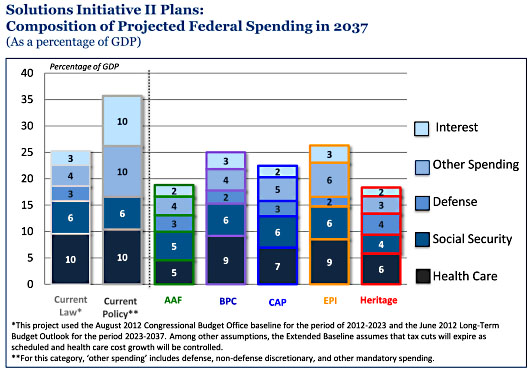
Of the right-wing think tanks, the Heritage Foundation is in fantasyland. They want to reduce spending to 18 percent of GDP, which is just flatly not going to happen. Social Security will not be cut by a fifth from current levels, and domestic spending will not go down to 3 percent of GDP. They’re clearly not even bothering to put forth a reality-based proposal.
AAF is slightly better at 19 percent of GDP, and they have an interesting VAT-like tax proposal that actually has the potential to increase economic growth and produce more revenue than our current system. And although they cut Social Security spending compared to promised future levels, at least they don’t pretend that we can actually cut it from current levels.
Of the lefty think tanks, BPC and EPI are too aggressive for my taste. I don’t think there’s any question that federal spending is going to increase over its historic levels (typically around 19-20 percent of GDP) by 2037. Healthcare costs are going to keep rising even if we do a great job of controlling them, and we have to face up to that. Nonetheless, I’d like to at least have a goal of keeping spending in the low 20s.
So sign me up for CAP’s vision. Their plan includes some small cuts in future benefit growth for Social Security, domestic spending at a more achievable 5 percent of GDP, and healthcare at 7 percent of GDP. That last will be tough to meet, but it’s a worthwhile goal. And their overall spending target is a bit under 23 percent of GDP. That strikes me as about right. It’s reality-based, but still makes a serious effort to keep spending under control.
There are more details at the link, but sometimes it’s worthwhile to get a big-picture view of what everyone is proposing. This is a useful chart in that regard.
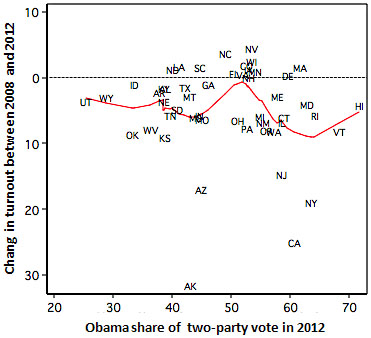 Here’s a pretty interesting chart from Seth Masket showing how much voter turnout changed between 2008 and 2012. Some of the outliers are obvious: Arizona and Alaska went down because they didn’t have candidates on the ticket this year. New York and New Jersey went down because of Hurricane Sandy. California is a mystery.
What’s more interesting, though, is the pattern. I’m just eyeballing this, but it looks like there really was an enthusiasm gap. Obviously three big Obama states were way below their 2008 levels. Beyond that, though lots of states at or below the red line were also Obama states in 2008 (Ohio, Pennsylvania, Oregon, Vermont, etc.). Conversely, lots of states above the red line were McCain states (South Carolina, Idaho, Texas, Georgia, etc.). There are plenty of exceptions, so I might be off base here, but my quick read of this data is that if state-by-state turnout had stayed at 2008 levels, Obama would have won the popular vote by nearly as much as he did four years ago. I imagine it would be easy for someone with the raw data to stick it in a spreadsheet and find out for sure.
Tyler Cowen finds an old article showing that perception of inflation is usually much higher than actual inflation, and that women overestimate it much more than men. Why?
Is it possible that a high perception of inflation is largely the result of a relatively low real income, perhaps mixed in with a slight unwillingness to blame oneself for imperfect labor market prospects? Does this help explain why tight money and stagnant median income have come together?
I’m just guessing, but these don’t seem like hard questions. People overestimate inflation because (a) they notice price increases much more than price decreases, and (b) the emotional impact of a few outliers with very high increases is unusually strong. And women overestimate inflation more because they tend to do more grocery shopping than men, thus exposing themselves to prices more routinely.
I can see how those with low incomes would also be more sensitive to price increases, so it makes sense that they also tend to have high estimates of inflation. But I’ll bet you ten bucks—no, wait, better make that twenty—that an unwillingness to blame oneself for imperfect labor market prospects plays no role at all. I’d be fascinated to even hear a plausible mechanism for that.
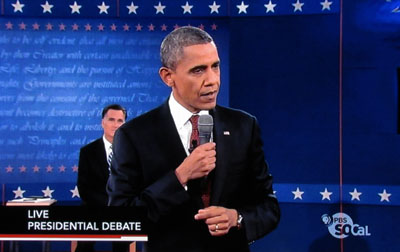 Paul Waldman explains why Republicans have gone batshit crazy over Benghazi:
So what’s going on here? I can sum it up in two words: scandal envy. Republicans are indescribably frustrated by the fact that Barack Obama, whom they regard as both illegitimate and corrupt, went through an entire term without a major scandal. They tried with “Fast and Furious,” but that turned out to be small potatoes. They tried with Solyndra, but that didn’t produce the criminality they hoped for either. Obama even managed to dole out three-quarters of a trillion dollars in stimulus money without any graft or double-dealing to be found. Nixon had Watergate, Reagan had Iran-Contra, Clinton had Lewinsky, [and don’t forget that Bush had the Plame affair and the Abramoff scandal! –ed] and Barack Obama has gotten off scott-free. This is making them absolutely livid, and they’re going to keep trying to gin up a scandal, even if there’s no there there. Benghazi may not be an actual scandal, but it’s all they have handy.
Yep. They’re just convinced that Obama runs a gang of Chicago thugs who are lying and cheating behind the scenes at every opportunity. It’s a foundational story on the tea-party right. Unfortunately, the reality is that whatever else you think of Obama, he’s one of the straightest arrows we’ve had in the White House since….forever. He runs a tight ship organizationally, and on a personal level he’s so intolerant of personal peccadilloes that he sometimes seems almost inhuman. It would be astonishing if he could actually avoid a serious scandal for an entire eight-year term, but if anyone can do it, it’s probably Obama.
And yes, it’s driving Republicans crazy. Even the ones who don’t want to impeach him at least want to bring him down to earth a bit. So they latch onto anything they can. It’s all starting to seem kind of desperate, but I doubt they’re going to let that stop them. After all, it eventually worked against Clinton.
Over at CAP, Sarah Ayres and Michael Linden have a post about how much the Simpson-Bowles plan proposes to increase revenues (i.e. taxes). The press usually reports it as $1.2 trillion, they say, but the real number is $2.7 trillion. Why the difference? It depends on what timeframe you use (eight years vs. ten years), your baseline (current law vs. current policy), and a few other things. In other words, it’s complicated.
I think this is a good reason why we should all stop talking about changes in revenue and spending compared to current levels. There are just too many games you can play with that. Instead, we should simply pick a year, and then describe what happens that year under the plan in question. So we might pick, say, 2017, and report what the budget will look like under various proposals. That’s much harder to fudge.
Simpson-Bowles, for example, says that in 2017 their plan produces about $3.6 trillion in revenue and $4 trillion in spending, for a deficit of $421 billion, or 2.3 percent of GDP. (It’s Figure 16 in this report.) Those are the three numbers we should want to see. Obviously we’re also interested in the details of how they raise revenue and cut spending, and those details might continue to be tricky to describe. But the basic figures we should be interested in aren’t how much spending and taxes go up or down, which are too easy to manipulate, but simply what spending and taxes will be.
I don’t imagine this is going to happen anytime soon, but I thought I’d toss it out there.
Michael Kinsley is tired of the exit poll charade. TV analysts, he says, almost certainly know the results of the election early in the evening, but aren’t allowed to say so until the polls close. So they engage in a weird dance:
Exit poll data is supposed to be used for demographic insights only, not to predict the result. You can say, “Republicans are doing well tonight among upper-middle class white men aged 35 to 45, wearing red sweater vests and answering to the name of ‘Champ.'” But you can’t say, “Chances are better than even that Obama’s got it in the bag.”
You can learn a lot from tiny samplings by comparing them with past results. By 6 p.m. Eastern time on election night, CNN undoubtedly knew that President Obama was almost certain to win reelection. And it pretty much knew the electoral college count. But it thought it best to deny this information to its viewers.
I happen to agree that the exit poll charade is a little wearying, even though the motive behind it is reasonable. But in this case, I’m not sure Kinsley is right. If the nets really knew who was going to win Ohio and Virginia by 6 pm, they would have called them at 8:01, when the polls closed. But they didn’t. They didn’t call Ohio until after 11 pm. Sure, it was obvious before then that things were trending in Obama’s direction, but the timing of their calls suggests that, in fact, they weren’t “almost certain” until well after 6 pm. The election may not have been a “tossup,” as so many folks pretended, but it was still pretty close.
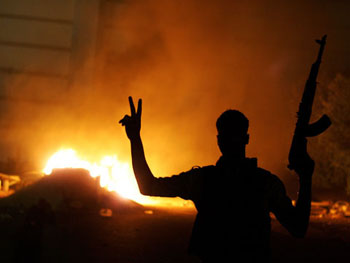 Matt Steinglass makes a point about the whole Benghazi “coverup” narrative that I didn’t have space to make in my post yesterday. He agrees that Susan Rice did nothing wrong, but says there’s more to it:
This is absolutely right as far as it goes, but it doesn’t go far enough. At the most fundamental level, the reason it is absurd to suspect the existence of a “cover-up” over the Benghazi attack is that such a cover-up could not have had any conceivable goal. Back to the beginning: the underlying accusation about Benghazi is that the Obama administration deliberately mischaracterised the terrorist attack there as having grown out of a spontaneous demonstration because that would be less politically damaging. Such a cover-up would have made no sense because the attack would not have been less politically damaging had it grown out of a spontaneous demonstration. The attack on the Benghazi compound would not have been any less politically difficult for the administration if it had grown out of a riot, nor would any normal voter have expected it to be less politically damaging, nor would any normal campaign strategist have expected any normal voter to have expected it to be less politically damaging.
As best I can tell, the suggestion from the right has been that Obama didn’t want to admit that Benghazi was a terrorist attack because….well, I’m not sure, exactly. Something about how this would blow a hole in his claim to be decimating al-Qaeda via drone attacks. Or maybe it would remove some of the luster from being the killer of Osama bin Laden. Or something. But one way or another, the story is that Obama was deeply afraid of admitting that terrorists are still out there and want to do us harm.
This has never made a lick of sense. If anything, the continuing existence of terrorists justifies his drone attacks. And it certainly wouldn’t do him any harm in an election. The American public routinely rallies around a president responding to a terrorist attack.
Dave Weigel has more here, responding to Sean Higgins, who manages to read all the transcripts of Rice’s Sunday show appearances and still claim that she somehow misled the public. “There is considerable evidence that they knew even the day of the attacks that there had in fact been no protests and that the attacks were planned,” says Higgins. “Who knew what when and whether the administration was trying to cover it up is precisely what Congress is trying to determine.”
Actually, there’s considerable evidence that on September 15, when Rice taped her appearances, the CIA told her there had been protests in Benghazi earlier in the day. The CIA turned out to be wrong about that, but it simply makes no sense for them to have made this up. If it does anything at all, it only makes their response look worse. This whole thing is a conspiracy theory with no conceivable motive. It’s a wild, scattershot attack hoping to take down someone, somewhere, just to claim a scalp. It’s disgusting.

Award-winning photojournalism.
Stunning video. Fearless conversations.


