• The Gerrymander Effect, Take 2

    Earlier today I linked to a post from Eric McGhee suggesting that the post-2010 gerrymandering of the House by Republican legislatures had only a modest effect on this year’s results. You will be unsurprised to learn that I got a lot of pushback on this, which prompted me to go back and check out other research on the subject. Before I got too far, though, I remembered that Sam Wang had done a bunch of work on this, so I went over to his site to see what he came up with.

    His methodology is too complicated to try to summarize, but here are his conclusions:

    • Prior to 2010, there was no systematic, nationwide effect from gerrymandering. (See here for more on this.) There was an incumbency effect, in which the majority party has a tendency to keep its majority, but otherwise no net lean in the direction of either Democrats or Republicans when you account for district lines in all 50 states.
    • The 2010 redistricting was more one-sided than in past years.
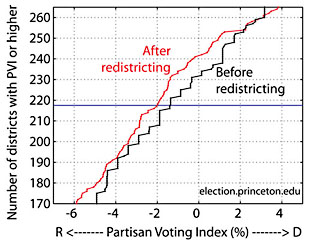
    • As a result, there’s now a net, systematic, nationwide lean in the direction of the Republican Party. The size of their advantage is calculated as the average vertical distance between the red and black lines in the chart on the right, which turns out to be 6.3 seats.

    So the 2010 redistricting really was unusually partisan. But the size of the Republican advantage turns out to be about six seats, very similar to what Eric McGhee came up with. The incumbency effect is about double that, for a total built-in Republican advantage of roughly 20 seats. Accounting for uncertainty, the Republican advantage is 10-30 seats, which is right in line with how much they outperformed the popular vote this year.

    I’m interested in further research on this subject, but for now we’ve got two methodologies that produce pretty much the same result. The Republican gerrymander following the 2010 census has given them a permanent tailwind of about six seats, and they’ll keep this for the rest of the decade. Combine that with the incumbency effect, and Democrats are unlikely to regain the majority unless they win about 52 percent of the popular vote.

  • Romney: Obama Won the Election by Doing Stuff That People Liked

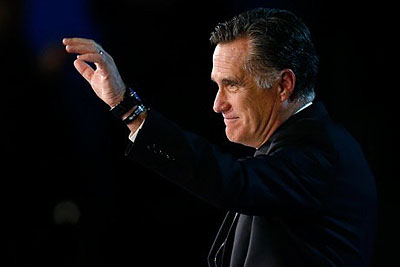
    Mitt Romney told his donors today that President Obama won last week because of the “big gifts” that he gave to “the African-American community, the Hispanic community and young people.” According to the New York Times, here’s what he said:

    With regards to the young people, for instance, a forgiveness of college loan interest, was a big gift. Free contraceptives were very big with young college-aged women. And then, finally, Obamacare also made a difference for them, because as you know, anybody now 26 years of age and younger was now going to be part of their parents’ plan, and that was a big gift to young people. They turned out in large numbers, a larger share in this election even than in 2008.

    ….You can imagine for somebody making $25,000 or $30,000 or $35,000 a year, being told you’re now going to get free health care, particularly if you don’t have it, getting free health care worth, what, $10,000 per family, in perpetuity, I mean, this is huge. Likewise with Hispanic voters, free health care was a big plus. But in addition with regards to Hispanic voters, the amnesty for children of illegals, the so-called Dream Act kids, was a huge plus for that voting group.

    I’m inclined to cut Romney some slack on this. Sure, it’s a little crude and a little defensive, but it’s basically right. The HHS decision on contraceptives became a cornerstone of Obama’s pitch to women (though it wouldn’t have had much effect if Republicans hadn’t gone nuts over it). The mini-DREAM Act was explicitly part of his outreach to Hispanics. And Obamacare was certainly an effort to provide big healthcare subsidies to millions of people who aren’t currently insured. This is all garden-variety politics.

    What’s missing, of course, is that Romney played the same game. He appealed to rich people (and the middle class) with his promises of big tax cuts. He appealed to conservative Christians and Roman Catholics with his promise to reverse the contraceptive decision. He appealed to the elderly with promises to restore the $716 billion he claimed Obama had taken away from Medicare. Etc. Again, this is garden-variety politics. I can’t really get too worked up about it.

  • Welcome to the Fever Swamps: Agenda 21 and the Fall of America


    Of all the inexplicable tea party conspiracy theories that started making the rounds after the 2008 election, perhaps the most inexplicable of all is their obsession with Agenda 21. In real life, Agenda 21 is an earnest sustainable development initiative created by the UN two decades ago, and its impact on the world has been just about as negligible as you might imagine. But down in the fever swamps, it’s the thin tip of the spear leading us toward a black helicopter future in which Americans are herded into urban concentration camps and forced to eat tofu.

    What’s that? You think I’m exaggerating? Well, it is something I might do if I thought I could get a laugh out of it. But no such luck, folks. For a true descent into madness, check out two fine pieces of investigative reporting right here at MoJo. The first is here, starring Glenn Beck, and the second is here, starring the Georgia Republican state senate caucus. Enjoy!

  • Today in Good News: Obama Vigorously Defends Susan Rice

    At his press conference today, President Obama got pretty heated when he was asked about threats from Lindsey Graham and John McCain to block the nomination of Susan Rice to be Secretary of State. Here’s his response:

    Let me say specifically about Susan Rice: She has done exemplary work….If Senator McCain and Senator Graham and others want to go after somebody, they should go after me. And I’m happy to have that discussion with them. But for them to go after the U.N. ambassador? Who had nothing to do with Benghazi? And was simply making a presentation based on intelligence that she had received? To besmirch her reputation is outrageous.

    Graham doubled down as soon as he heard this:

    Mr. President, don’t think for one minute I don’t hold you ultimately responsible for Benghazi. I think you failed as Commander in Chief before, during, and after the attack….Given what I know now, I have no intention of promoting anyone who is up to their eyeballs in the Benghazi debacle.

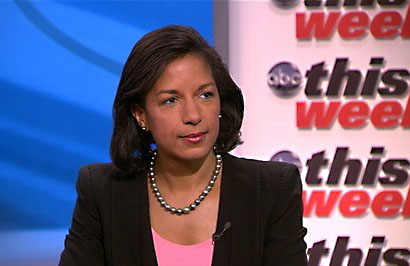
    The insanity over this has become positively Clintonian. Here’s what Susan Rice actually said on the Sunday talk shows about the Benghazi attacks of September 11:

    • Early in the day, there were demonstrations in Cairo inspired by a hateful YouTube video.
    • This in turn appeared to have inspired a “copycat” protest in Benghazi.
    • That protest was then “hijacked” by extremists, who used it as an excuse to storm the consulate and murder four Americans.

    That’s it. That’s the formulation she used on Face the Nation, Meet the Press, This Week, and State of the Union. She was very cautious, too, emphasizing that an investigation was ongoing and this was the “best information” available at the time. And it was: this was what the intelligence community told her in briefings before she taped those interviews.

    Out of all that, the only thing she got wrong was her suggestion that there had been a copycat protest in Benghazi. “The facts are there was never a riot,” Graham said, and he was right. But he said that a month later. By then, everyone knew there hadn’t been any riots. Back on September 15th, when Rice’s TV appearances were taped, we didn’t.

    Berating Rice, who had nothing to do with Benghazi aside from representing the administration on these talk shows, is nuts. The intelligence community was wrong about one relatively unimportant fact, and Rice passed along that mistake. That’s it. There’s no coverup, no conspiracy, no incompetence, no scandal.

    And one more thing: mainstream press outlets that report on this need to start being more careful. No breezy summations suggesting that “Rice blamed the attacks on a video.” She didn’t. If you’re going to report on this, you need to report on what Rice actually said, and you need to make clear why she said it. This is real life, not a video game.

  • Obama Refuses to Get Tough on Taxes


    How committed is President Obama to letting the Bush tax cuts for the rich expire? At his press conference today, he gave a fuzzy answer, so Chuck Todd followed up and asked him if he’s absolutely committed to repealing the Bush tax cuts for the rich, no ifs, ands, or buts.

    Obama declined to say yes. He said he wouldn’t accept revenue increases that come from dynamic scoring magic or from vague loophole closing, but he’s committed to compromise. The American people demand it. Blah blah blah.

    This is not a very promising start. Getting Republicans to support an extension of the middle-class cuts without an extension of the high-end cuts was always going to be hard. Without a rock-solid commitment to veto any bill that maintains a 35 percent top marginal rate, it’s even harder. Unless I’m missing something, Obama just left the door wide open to some kind of kludgy compromise that keeps top-end rates at their Bush-era levels.

    UPDATE: For what it’s worth, most of my readers and commenters seem to think I’m wrong about this. The rough consensus appears to be that Obama is indeed firm about letting the high-end tax cuts expire, but it’s not smart politics to draw lines in the sand in a major public forum. That could well be true. I might be reading too much into this. We’ll see.

  • Chickens, Beer, Books, Banks, and Glasses: Do You Recognize the Theme?

    See if you can spot the common theme in three different pieces that I happened to read today. First up is “Obama’s Game of Chicken,” a piece in the Washington Monthly that tells the story of how small chicken farmers are now practically indentured servants to big poultry processors. The evolution of the industry started in the 50s, when processors changed from an open-market model to a contract model, but things remained OK all the way through the end of the 70s:
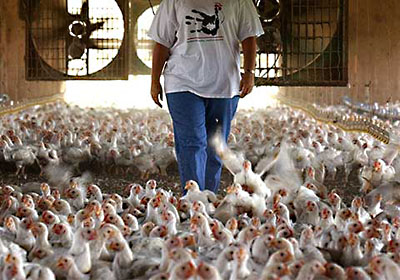
    If a farmer didn’t like the terms offered by one company, he could, at the end of the contract period, simply switch to another. The basic balance of power between the farmers and the companies remained in place.

    The change that finally upended this balance came in 1981. A group of Chicago School economists and lawyers working in the Reagan administration introduced a new interpretation of antitrust laws….Under Reagan, the Department of Justice narrowed the scope of those laws to promote primarily “consumer welfare,” based on “efficiency considerations.” In other words, the point of antitrust law would no longer be to promote competition by maintaining open markets.

    ….Although the change was strongly opposed by centrists in both parties, a number of left-wing academics and consumer activists in the Democratic Party embraced the new goal of promoting efficiency. The courts also soon began to reflect this political shift….In 1980, the four biggest meatpacking companies in the country controlled 36 percent of the market. Ten years later, their share had doubled, to 72 percent.

    Next up is “Last Call,” another piece in the Washington Monthly, about the fact that two gigantic multinational corporations now control manufacturing and distribution of 80 percent of the beer sold in America:

    Prior to the 2008 takeover, Anheuser-Busch generally accepted the regulatory regime that had governed the U.S. alcohol industry since the repeal of Prohibition. It didn’t attack the independent wholesalers in control of its supply chain, and generally treated them well. “Tough but fair” is a phrase used by several wholesale-business sources to describe their dealings with the Busch family dynasty. Everyone was making money; there was no need to rock the boat.

    All that changed quickly after Anheuser-Busch lost its independence….Today, with only one remaining real competitor, MillerCoors, the pressure it can put on its wholesalers is extraordinary. A wholesaler who loses its account with either company loses one of its two largest customers, and cannot offer his retail clients the name-brand beers that form the backbone of the market. The Big Two in effect have a captive system by which to bring their goods to market.

    …. So distributors are caught in an impossible bind: they either do the brewer’s bidding, including selling their businesses to favored “Anchor Wholesalers,” or they lose Anheuser-Busch InBev as a client. And if the wholesalers try to push back? Anheuser-Busch InBev will get rough.

    Finally, here is Tyler Cowen on how he expects the publishing industry to evolve:

    I expect two or three major publishers, with stacked names (“Penguin Random House”), and they will be owned by Google, Apple, Amazon, and possibly Facebook, or their successors, which perhaps would make it “Apple Penguin Random House.” Those companies have lots of cash, amazing marketing penetration, potential synergies with marketing content they own, and very strong desires to remain focal in the eyes of their customer base. They could buy up a major publisher without running solvency risk. For instance Amazon revenues are about twelve times those of a merged Penguin Random House and arguably that gap will grow.

    I made it too easy, didn’t I? For more to cogitate about here, you might also want to revisit a recent 60 Minutes program about the eyewear market, and also think about how well the consolidation of the financial industry has worked out for us over the past decade or two.

    Both parties, but Republicans especially, mostly spend their time protecting not the free market, as they insist, but big business interests. This is decidedly not the same thing, and it might well be that three or four vertically integrated giants in practically every industry isn’t really all that good for the rest of us. This is just a thought, but in the long run, maybe competition really is a good thing. 

  • Mandate, Schmandate: The Republican View of Elections


    Paul Ryan, echoing perhaps the most popular GOP talking point of the week, says President Obama doesn’t have a mandate because the American public returned a big Republican majority to Congress. As he told ABC News, if the public had really given Democrats a mandate, “they would have put Nancy Pelosi in charge of the House of Representatives.”

    Yeah, yeah. In 2008, the American public handed Barack Obama a huge victory and gave Democrats massive majorities in both the House and Senate. If you believe in mandates, that was as big as they come. And Paul Ryan didn’t care. He opposed everything Obama did from day one. Ditto for the rest of the House Republican caucus.

    In other words: who cares? Like everyone, Republicans believe in mandates when they win and they don’t believe in them when they lose. Can we please stop talking about this nonsense?

  • Gerrymandering Not as Big a Deal as You Think

    Democrats won over half the vote in House races this year, but still got blown out by Republicans, who return to Washington with a big majority of seats. Why? The obvious story is gerrymandering: Republicans in state legislatures drew themselves a whole lot of cozy districts last year that made it hard for Democrats to win.

    Personally, I’ve been skeptical of this story for a couple of reasons. First, the research I’ve read in the past suggests that gerrymandering has only a modest effect. Not zero, but not huge, either. Second, as you may recall, Republicans blew the doors off Democrats in 2010, before any of this gerrymandering was done. That means they were the incumbent party going into 2012, and incumbents have a natural advantage.
    But this is just my guess. What does the Science™ say? Eric McGhee brings the analysis:

    We’ll drop our regular model and go bare bones. Two steps: 1) identify the relationship between this year’s actual election returns and the 2008 presidential vote in each district (calculated by Daily Kos), 2) use this relationship plus the 2008 presidential vote in the old districts to estimate what would have happened under the old lines. No incumbency, no assumptions about national climate. For the redistricting story to hold, this exercise must eliminate the discrepancy between Democratic vote share and seat share. Otherwise, something else is going on.

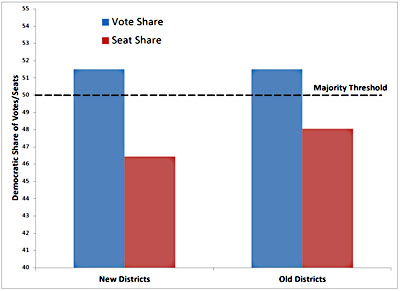
    ….Democrats do gain more seats under this simulation—seven more total—but fall far short of matching their predicted vote share. The point should be clear: even under the most generous assumptions, redistricting explains less than half the gap between vote share and seat share this election cycle.

    In other words, even with the old 2008 district lines, Republicans still would have won a majority of seats this year. The new lines gave them, at most, seven additional seats, and McGhee thinks that even this probably overstates things. Bottom line: gerrymandering isn’t nothing, but it’s not a game changer. It’s not the real story here.

  • Hindsight Bias and Obama’s Victory

    Brendan Nyhan writes today about the metamorphosis of campaign coverage:

    The media has undergone a strange change of mindset. Immediately before last Tuesday’s election, many reporters and commentators ignored or dismissed the consensus among forecasters and betting markets that President Obama was very likely to defeat Mitt Romney and acted instead as if the candidates were neck and neck or Romney was ahead. Afterward, however, coverage of how Obama won betrayed far less uncertainty about the outcome of the election, which was frequently portrayed as a fait accompli—an inevitable consequence of how Romney’s image was defined by Obama’s early ads or overwhelmed by the President’s superior ground game.

    Brendan says this is a result of hindsight bias, and I suppose that’s true, sort of by definition. But there’s nothing unique here. Before the Super Bowl, sports talkers chatter about how well the two teams are matched up. After the game, they talk about how the winner managed to win. Why? Because the game is over. They now know what worked and what didn’t.

    I’m not sure it’s really fair to call this “bias.” Once a contest is over, and you know who won, you also have a better idea of which tactics won. In the case of the 2012 election, reporters have concluded that defining Romney early worked and that Obama’s ground game made a difference. If he had lost, they would have concluded the opposite. They might be wrong in those conclusions—hell, historians are still arguing about why the South lost Gettysburg even after 150 years of study—but there’s nothing irrational about it. I happen to agree that reporters tend to overdo this, paying too little attention to things like economic fundamentals and the power of incumbency, but still, once you know how something turns out, it’s perfectly sensible to conclude that the winner’s tactics were effective and the loser’s tactics weren’t.

  • President Obama’s Brand New Tax Plan That’s a Year Old


    Back in 2011, when President Obama was negotiating with John Boehner over extension of the debt ceiling, he offered up a deal that included $800 billion in tax increases (over ten years). While Boehner was waffling, a bipartisan committee produced a deal that would raise taxes by $1.2 trillion. Obama went back to Boehner and said he couldn’t stick with the old deal when a bunch of Republicans had already agreed to $1.2 trillion, so that was his new offer. Boehner turned him down and talks collapsed.

    Now a year and a half has passed and Obama just won reelection. So what’s his offer now? $1.6 trillion over ten years. Take that, Republicans! The reaction from liberals has been generally positive: they’re impressed that Obama is opening with a strong hand and upping the ante now that he has a mandate from the public.

    But there’s really no news here. Obama’s proposal is the same one he campaigned on. A brief description is here, and a more detailed description from the Tax Policy Center is here. Here are the big ticket items:

    • Allow the Bush tax cuts on high earners to expire. $849 billion
    • Limit itemized deductions to 28 percent, close some loopholes and deductions on high earners, eliminate tax breaks for oil and gas companies, eliminate the carried interest loophole, plus a few other items. $584 billion
    • Create a special “Buffett Rule” tax rate for millionaires. $47 billion
    • Restore the estate tax to 2009 levels. $143 billion
    • Limit corporate income shifting to low-tax countries. $148 billion
    • Other miscellaneous tax increases and reductions. About -$200 billion
    • Total: $1.6 trillion

    Bottom line: there’s nothing special about this proposal. It’s pretty much the same as the one in his 2013 budget, and it’s pretty much the same one he’s been running on for the past year. It surely didn’t come as any surprise to Boehner or the rest of the Republican caucus, and it shouldn’t be a surprise to anyone else either.