• Ohio: Not That Big a Deal After All


    Just in case you haven’t read this yet, here’s a remarkable statistic: even if Romney had won Ohio, Florida, and Virginia, he still would have lost. This makes it all the weirder that he and his team were so sure they were going to win all the way to the end. After all, it’s plausible that if turnout had been slightly different he could have reeled in those three states, which he lost by only two or three points. But which state would have been the fourth? Pennsylvania? He lost it by 5 points. Colorado? 5 points. New Hampshire? 6 points. Iowa? 6 points. Nevada? 7 points. Wisconsin? 7 points. What possible turnout models could they have been cooking up in their back rooms that convinced them any of those states were truly in play?

  • Global Warming Even Worse Than We Thought

    How bad is global warming likely to be? Some models say bad, other models say really bad. So a couple of climate scientists lined up all the models and compared how they did on one specific metric that could be easily measured: relative humidity over the past ten years. Which model did the best?

    Looking back at 10 years of atmospheric humidity data from NASA satellites, the pair examined two dozen of the world’s most sophisticated climate simulations. They found the simulations that most closely matched humidity measurements were also the ones that predicted the most extreme global warming.

    ….“The models at the higher end of temperature predictions uniformly did a better job,” Fasullo said. The simulations that fared worse — the ones predicting smaller temperature rises — “should be outright discounted,” he said.

    The most accurate climate simulations were run by the United Kingdom’s Met Office, a consortium in Japan and a facility at the National Center for Atmospheric Research.

    Who knows. Maybe humidity is just a weird outlier. Anything’s possible, especially if you’re bound and determined to insist that climate change is no big deal. But if this research is right—and it’s hardly the first to suggest that global warming is likely to be worse than we think—you can forget the idea of the world warming by 2 degrees C by the end of the century. Try 5 degrees instead. And then kiss your ass goodbye.

  • The GOP’s Immigration Problem Goes Way Beyond Immigration

    Losing a couple of elections in a row to a radical socialist can apparently make your life flash before your eyes. Here is Sean Hannity on immigration:

    We’ve got to get rid of the immigration issue altogether. It’s simple to me to fix it. I think you control the border first. You create a pathway for those people that are here. You don’t say you’ve got to go home. And that is a position that I’ve evolved on. Because, you know what, it’s got to be resolved. The majority of people here, if some people have criminal records you can send them home, but if people are here, law-abiding, participating for years, their kids are born here, you know, it’s first secure the border, pathway to citizenship, done, whatever little penalties you want to put in there, if you want, and it’s done.
    That’s a mighty quick evolution! But Matt Yglesias wrote a sharp column yesterday pointing out that a quick pivot on immigration won’t be enough to solve the GOP’s problem with Hispanics:

    The reality is that the rot cuts much deeper. The GOP doesn’t have a problem with Latino voters per se. Rather, it has a problem with a broad spectrum of voters who simply don’t feel that it’s speaking to their economic concerns. The GOP has an economic agenda tilted strongly to the benefit of elites, and it has preserved support for that agenda—even though it disserves the majority of GOP voters—with implicit racial politics.

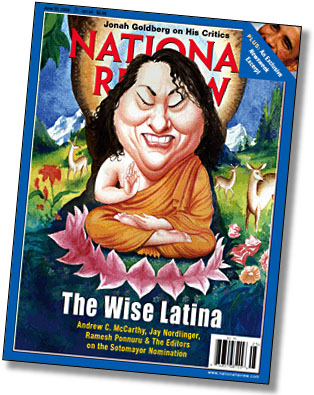
    Consider the GOP’s deeply racialized campaign against Supreme Court Justice Sonia Sotomayor. What was so surprising about this—and I know I’m not the only fair-skinned English-dominant person with a Spanish surname who was genuinely shocked—was that conservatives could have easily opposed her purely on policy grounds. Sotomayor is a fairly conventional Democrat on constitutional issues, and that would have been ample reason for conservatives to criticize her. Indeed, Justice Elena Kagan was attacked on precisely those grounds. But rather than tempering opposition with at least some recognition that Sotomayor’s life story might be a great example for immigrant parents trying to raise children in difficult circumstances, the country was treated to a mass racial panic in which Anglo America was about to be stomped by the boot of Sotomayor’s ethnic prejudice. The graduate of Princeton and Yale Law, former prosecutor, and longtime federal judge was somehow not just too liberal for conservatives’ taste but a “lightweight” who’d been coasting her whole life on the enormous privilege of growing up poor in the South Bronx.

    I know they don’t want to hear this, and I know that a lot of Republicans are deeply invested in a belief that liberals, not conservatives, are the real racial scaremongers. And I also know that it’s almost impossible to talk about this because even the slightest suggestion of racial hostility is instantly toxic.

    But as Bernie Goldberg admitted earlier this year, “There is a strain of bigotry — and that’s the word I want to use — running through conservative America….That has to leave the conservative movement….I am sick of it.” He’s right. Lightening up on immigration won’t be enough. Like it or not, conservatives are going to need a much more thorough housecleaning if they want to survive in an increasingly diverse future. No more gratuitous ethnic mockery. No more pretense that reverse racism is the real racism. No more suggestions that minorities just want a handout. No more screeching about the incipient threat of Sharia law. No more saturation coverage of the pathetic New Black Panthers. No more complaining that blacks get to use the N word but whites don’t. No more summers of hate on Fox News. No more tolerance for Dinesh D’Souza and his “roots of Obama’s rage” schtick; or for Glenn Beck saying Obama has a “deep-seated hatred of white people”; or for Rush Limbaugh claiming that “Obama’s entire economic program is reparations.” No more jeering at the mere concept of “diversity.” And no more too-clever-by-half attempts to say all this stuff without really saying it, and then pretending to be shocked when you’re called on it. Pretending might make you feel virtuous, but it doesn’t fool anyone and it won’t win you any new supporters.

    That’s just a start. One way or another, the Republican Party simply has to stamp this out. And not just because they need to do it to survive, but because it’s the right thing to do. That still counts, doesn’t it?

  • The Triumph of the Zinger

    Here is the most depressing thing I’ve read today:

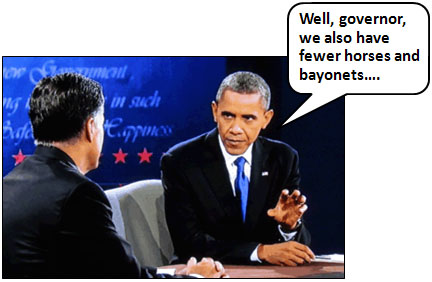
    Seven minutes into the first presidential debate, the mood turned from tense to grim inside the room at the University of Denver where Obama staff members were following the encounter….“We are getting bombed on Twitter,” announced Stephanie Cutter, a deputy campaign manager, while tracking the early postings by political analysts and journalists whom the Obama campaign viewed as critical in setting debate perceptions.

    ….Mr. Obama, who had dismissed warnings about being caught off guard in the debate, told his advisers that he would now accept and deploy the prewritten attack lines that he had sniffed at earlier. “If I give up a couple of points of likability and come across as snarky, so be it,” Mr. Obama told his staff.
    I understand the political realities as well as anyone. But the idea that the President of the United States was forced to respond to poor reviews on Twitter (!) by promising to memorize attack zingers is pretty deflating. I know this is actually perfectly rational under the circumstances, but I still hate having my nose rubbed in how dumb our political discourse makes us sometimes.

    And speaking of that, have I mentioned before that I’ve always felt kind of sorry for Mitt Romney? Aside from the fact that he’s rather more comfortable with transparent lies than I am, he actually seems like a decent guy with decent instincts. Sure, he wanted to be president really, really badly, but lots of people want to be president a little too eagerly for comfort. It’s an occupational hazard of the office. Unfortunately for Romney, he happened to want to be president in an era when the Republican base forced him to embrace lunacy in order to win their support. So he did what any good businessman would do: he gave the customers what they wanted. And lost.

    But you know what? It was a close election. Obama really was vulnerable. And even granting that Romney is a pretty stiff campaigner, I’ll bet that if he’d run as the same center-right guy who was governor of Massachusetts for four years, he would have won. After all, there were obviously a lot of people out there who were looking for a moderate, competent alternative to Obama, and if Romney had been allowed to campaign as that kind of candidate for four years instead of just the final four weeks, does anyone really think he wouldn’t have been able to attract another percentage point or two in the key swing states?

  • Obamacare’s Incredible High-Wire History


    Now that the election is over, it’s safe to say that Obamacare has survived. And that officially gives it the distinction of having the diciest history of any major law in American history. It passed the Senate by zero votes in 2009. It survived constitutional challenge thanks to a single last-minute switch from Chief Justice John Roberts in 2012. And it weathered the Republican threat of repeal five months later when President Obama won reelection by a narrow 51-49 percent margin.

    If any of those things had changed by even a hair, Obamacare would be dead. Surely no big law in history has come that close to extinction that many times, has it? It’s a real survivor, Obamacare is.

  • Why Isn’t There a Republican Version of the DLC?


    There are a small number of prominent moderate Republican apostates around. David Frum. Andrew Sullivan. Ross Douthat on certain subjects. But given the obvious need for the party to rein in its crazies, why isn’t there an apostate organization that fills the same centrist niche the DLC filled for Democrats in the 80s? The perfect person to explain this would be Ed Kilgore, who was policy director for the DLC back in the day, and apparently someone at the New Republic read my mind and assigned him to write a column about this. It’s an insightful look at what motivated the creation of the DLC and why something similar isn’t likely to happen on the right. Ed lists five reasons, and I was especially intrigued by #2:

    Alienated elected officials. The DLC’s real “base” was among congressional, state and local elected officials—not just in the South, but in every competitive state and region—who feared the national party (and the interest and constituency groups that were thought to control it) were in the process of dragging them towards defeat. The dominant Republican office-holders today at every level are products of two GOP landslides—1994 and 2010—that were accompanied by an aggressive, ideologically conservative message. On that basis, there’s no reason to think that any Republican revolt against the “presidential party” will be “centrist” in any tangible way.

    The whole piece is worth a read. The Republican Party desperately needs an active, creative DLC of its own, but if Ed is right, it simply doesn’t have the internal incentives to support one. For the foreseeable future, it will remain Michele Bachmann’s party, not Mitt Romney’s.

  • Climate Change Didn’t Cause Hurricane Sandy, But it Sure Made it Worse

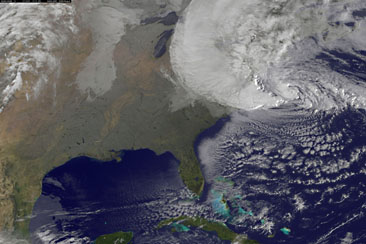
    There are a bunch of technical reasons why climate change made Hurricane Sandy worse than it would have been, but Chris Mooney reports today that there’s also a very simple reason: global warming has raised sea levels by about eight inches over the past century, and this means that when Sandy swept ashore it had eight extra inches of water to throw at us.

    It turns out, eight inches matters a lot. First of all, using Climate Central’s Surging Seas tool, [meteorologist Scott] Mandia estimated that 6,000 more people were impacted for each additional inch of sea level rise….Moreover, there is also reason to think that the second inch, so to speak, is worse than the first one. That’s because of basic physics. Water flowing atop a surface—say, a New York City street—has its energy sapped by the friction of dragging along that street. However, if the water level is higher, it’ll flow faster, because the water higher above the surface experiences less friction. “If you had an inch of water running down the street, you’d see all kinds of turbulence in it, which is basically energy being lost,” Strauss explains. “But if the water were a foot above it, you’d see more sheet-like movement, which is a more powerful motion.”

    Speed matters a great deal in the context of a storm surge, because the surge is only temporary and will recede. So how far it penetrates before doing so is partly a function of its speed.

    And there are still more reasons to think that increasing the size of a storm surge by eight inches really matters. Consider the US Army Corps of Engineers’ “depth-damage” functions, which the Corps uses to study how much flood damage grows with an increasing water level. The upshot here, says Mandia, is that “the damage is exponential, it’s not linear.”Or in other words, as the water level increases, the level of damage tends to rise much more steeply than the mere level of water itself.

    So that’s that. No shilly shallying. No caveats. “There is 100 percent certainty that sea level rise made this worse,” says sea level expert Ben Strauss. “Period.”

    And by the way, this is also why climate change is so much worse for a place like Bangladesh than it is for us: they have an enormous amount of very low-lying territory. They can adapt to a small, slow rise in sea level during normal times, but they can’t adapt to the fact that monsoons become exponentially worse when sea level is higher. That extra eight inches turns into millions of tons of extra water, all delivered within a few hours to a place with nowhere near the infrastructure to handle it. So when you think about sea level rise, don’t think about the shoreline advancing a bit and forcing people to move slightly farther inland. Think instead of storms and the extra millions of tons of water it delivers. That’s climate change, and that’s about as concrete as it gets.

  • Politically, Unions Are Between a Rock and a Hard Place


    Kathleen Geier points out that, as usual, labor played a big role in Tuesday’s Democratic victory:

    Labor’s political power extends far beyond the 12% of American workers who are members of labor unions. Unions provide the ground troops that are essential for get-out-the-vote campaigns; this election cycle, they were particularly crucial in battleground states like Wisconsin and Ohio, which are union states. In particular, this year, unions played an even more active role in GOTV efforts than in the past, because as a result of the Supreme Court’s Citizens United decision, for the first time, unions were able to call and canvass not just union households, but nonunion homes as well.

    The big question is, in return for all that massive support, what can labor expect the Democrats to deliver?

    The answer is: not an awful lot, really. So why do unions continue to pour so much effort into Democratic campaigns?

    Prospect theory gives us the same answer as common sense: for most people, fear of loss is a more powerful motivation than anticipation of gain. And that’s obviously what keeps unions working for Dems: they might not get very much out of it, but they know that they’ll lose a helluva lot under Republicans.

    This is a lousy deal for unions. Every election they put a ton of work in, knowing that they won’t really get much more than dribs and drabs if Democrats win. But they’re rightfully scared to death of what Republicans will do to them if they get into office. Democrats are well aware of this, which means they know they don’t need to offer anything more than dribs and drabs. So they don’t.

    I keep thinking there ought to be a way for Republicans to leverage this. I’m not sure what it is, but even if they did nothing more than declare a truce of sorts, fear of loss might disappear as a motivating factor for unions. And with that, Democrats might lose a big chunk of support. But I suppose it’ll never happen. Hatred of labor is just bred too deeply into their DNA.

  • In the Crunch, Citizens United Turned Out to Be a Big Fizzle

    Dave Weigel makes a good point this morning at the same time that he answers a question of mine. The subject is the apparently poor use of money by Republican super-PACs:

    Here’s the problem: Some of the big money went to organizing. I hung out multiple times with volunteers for American Majority, Americans for Prosperity, and FreedomWorks, all of which got sizable donations in order to turn out votes. Tea Partiers signed up, taking literature from home to home, trying to repeat the magic of 2010. It did not work. It wasn’t just that the ads were lame, it was that the organizing was monumentally less effective than OFA’s four-year campaign.

    I’ve been wondering just how much of that Super-PAC money went to organizing, rather than simply saturating the airwaves with the 10,000th anti-Obama ad. Now I have at least an idea: it was a fair amount. It wasn’t all ads.

    Here’s what’s interesting about that: I think Super-PACs can be reasonably effective with independent ads. I don’t know how effective they were in this election cycle, but if they weren’t, they can learn from their mistakes and get better. What’s more, the conventional wisdom here is true: Super-PACs can sometimes be more effective than campaigns because they have the freedom to run nasty ads that a campaign might not officially want to be associated with.

    But organizing is different. Done properly, it’s simply far more efficient for organizing to be centralized. You can target more precisely, you can make sure nothing falls through the cracks, and you can make sure that people get called with the right message and don’t get barraged by multiple organizers. Unless I’m missing something important, Super-PACs will simply never be as good at organizing a national campaign as a highly-disciplined central organization.

    And that’s pretty important. I suspect that one of the lessons of 2012 is that we’ve roughly hit saturation on presidential advertising. There are only so many hours of TV broadcasting in the day, and only so many repetitions of a message that are effective. Citizens United might have unleashed a flood of Super-PAC money, but there might no longer be anywhere for it to go because the ground game really is as important as everyone says, and the best ground game comes from either the campaign itself or the party apparatus. If that’s true, it may turn out that Citizens United isn’t the end of Western civilization after all, but for reasons none of us realized two years ago.
