• 2013 Might Finally Be the Year of Filibuster Reform

    “The Senate’s recent overuse of the filibuster,” says newly elected independent senator Angus King, “has stalled progress on practically every issue of importance in America. The 60-vote requirement that it creates is not in the Constitution.” Reforming the filibuster was one of his signature campaign issues, and Harry Reid said this summer that he agreed. He’s committed himself to filibuster reform when the new Senate term opens in January.

    So will it happen? The safe answer is no, but this might actually be the perfect time for it. You see, there are usually two big obstacles to filibuster reform: the opposition party and the governing party. The opposition party doesn’t want reform because it’s afraid of what the governing party can do without it. And the governing party doesn’t want reform because it’s afraid of what the opposition party will do if they win control in the next election.
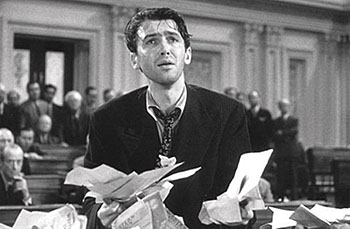
    But guess what? We’re in a bit of an unusual situation right now. The Democratic Party has a president in the White House, which means that Republicans won’t be able to run roughshod over them for at least four years—and the odds are at least decent that it might be longer. Likewise, the Republican Party has a big majority in the House, which means that Democrats can’t run roughshod over them. And this majority looks to be durable for at least four years too.

    So filibuster reform would have a very small effect right now, mainly making it easier for the majority to confirm presidential nominations. Obviously Republicans wouldn’t be too happy about that, but they can’t keep obstructing judicial nominations at their previous pace for four more years anyway, so it’s not the biggest deal in the world. If Democrats were willing to agree to serious but moderate reforms, there’s a chance they could actually get Republicans to go along with it.

    Not a big chance, but a chance. We live in interesting times.
  • California’s Prop 30 Passes, But Probably Wasn’t Necessary Anyway


    On Monday I wrote that if California’s Proposition 30 passed, it would mark a symbolic end to the tax revolt started by Proposition 13 three decades ago. Well, it passed. But it turns out that it might not even have been necessary. Thanks to redistricting and the long, slow slide of the Republican Party in California, it looks as though Democrats might very well win two-thirds majorities in both houses of the legislature once all the votes from Tuesday are counted.

    Which means they could have skipped the initiative and simply passed a tax increase on their own. It’s a fitting bit of irony for an election cycle that was filled with it.

  • Republicans Have Lost Their 60-Year Advantage on National Security


    I’ll probably end up doing a bunch of random post-election reaction stuff today, so let’s start with Dan Drezner:

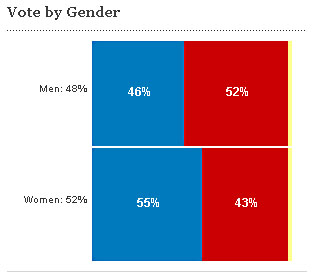
    A glance at the exit polls showed that Obama won the foreign policy question pretty handily. Only five percent of respondents thought that foreign policy was the most critical issue in this campaign — but of those five percent, voters went for Obama over Romney by 56% to 33%. Voters were also more likely to trust Barack Obama in an international crisis (57%-42%) than Mitt Romney (50%-46%).

    This is the first exit poll in at least three decades where the Democrat has outperformed the Republican on foreign policy and national security. And I guarantee that whoever runs from the GOP side in 2016 will not have a ton of foreign policy experience. The GOP has managed to squander an advantage in perceived foreign policy competency that it had owned for decades. This — combined with shifts on social issues and demographics — will be a problem that the Republicans are going to need to address.

    Thanks, George Bush! We like to say that Americans have short memories, and that’s true in a way. On the other hand, a majority of voters still blame Bush for the lousy economy more than they blame Obama, and the Bush destruction of the Republican brand on foreign policy still seems to be going strong too.

    A razor-thin loss hardly means that the Republican brand is doomed, but I don’t think there’s much question that the GOP, in general, is moving in the wrong direction and its extremist wing is finally catching up to it. In four years, they’ll likely face both a growing economy and an electorate that’s a couple of points browner than it is today, and that’s going to be a strong headwind. Add to that growing tolerance for things like gay marriage and a Democratic advantage (or tie) on national security issues, and they face a pretty tough future.

  • We Should Phase Out the Bush Tax Cuts


    Matt Yglesias alerts me to an “excellent idea” from Maine’s newly-elected independent senator, Angus King:

    I was in favor of ending the Bush-era tax cuts immediately, but after continued poor employment numbers, we need a more nuanced approach. We should consider pegging the sunset of these tax cuts to something non-arbitrary, like a certain amount of GDP growth, or a lower level of unemployment. This would avoid the unproductive brinkmanship that Congress engages in over this issue — and could prevent our fragile recovery from being further slowed down.

    I appreciate the sentiment behind this, but it’s too technocratic to succeed. It also sets up some really bad incentives: if you really hate higher taxes, does this give you a motivation to oppose policies that would be good for the economy?

    But something similar would be nearly as good: let all the Bush tax cuts expire, but phase them out. Maybe a third in 2014, a third in 2015, and a third in 2016. That would be good for the economy now, and good for deficit reduction in the future.

    I know, I know: this isn’t going to happen. I’m just looking for something to write about during the hours in which we continue to know nothing about how the election is going. You may now return to your previous TV-watching activities.

  • Lines of 150 People and 90 Minute Waits in Akron, Ohio

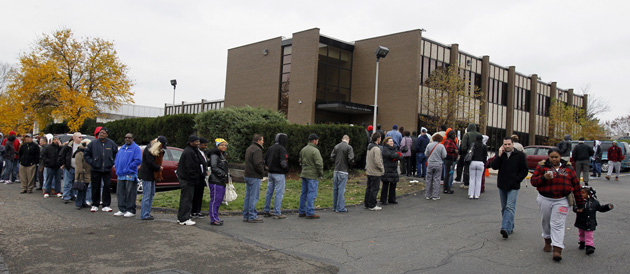
    Long lines for early voting in Akron, Ohio yesterday. Paul Tople/MCT/ZUMAPRESS.com


    At 6:40 this morning, when the Joy Park Community Center in Akron, Ohio, opened up to voters, as many as 150 people were already in line. Two observers told Mother Jones that the polling place opened 10 minutes late due to troubles with one of its optical scanners, which tallies votes.

    The community center also had trouble with an audio device meant to assist hearing-impaired voters, according to Daniel Greenfield, an election observer volunteering for the Obama campaign. The machines were back up and running two to three hours later, he said. It’s unclear whether the troubles were caused by malfunctions or by poll workers not knowing how to operate the machines.

    Either way, the hiccups didn’t help ease the frustrations of the voters facing waits of 60 to 90 minutes. An election observer who asked not to be identified told us that voters had complained about poll workers being disorganized and having disagreements “within earshot of people trying to concentrate on their ballots.”

    The Joy Park Community Center is one of several polling stations in the Akron area that has experienced delays and voting-machine problems today. “We did have difficulty setting them up this morning throughout the county,” conceded Joseph P. Masich, director of the Board of Elections in Summit County, where Akron is located. Masich declined to address the machine malfunctions at Joy Park.

    “The Board of Supervisors just didn’t allocate enough” poll workers, says an Obama poll watcher. “That may even be intentional.”

    Greenfield said the delays were mainly due to a shortage of poll workers, not mechanical problems. Joy Park had three poll workers on site, handling anywhere between 25 to 150 voters in line. “What really is slowing things down is understaffed poll workers,” Greenfield said. “The Board of Supervisors just didn’t allocate enough. That may even be intentional.”

    Some evidence suggests that long Election Day waits are more common in areas with large black populations—such as Akron, whose population was 32 percent in 2010. One MIT/CalTech survey found that blacks waited an average of 27 minutes to vote in 2008, more than twice as long as any other racial group.

    Charles Stewart III, a MIT professor who coauthored the report, says the lines have less to do with race than with the difficulty of anticipating where long lines will form, and allocating staff and resources accordingly.

    At the same time, Stewart acknowledges that black voters are more likely to vote in person than absentee, and are more likely than whites to vote early. This might help explain the large early turnout at Joy Park. “Once the line forms, the election official is often too hamstrung to do anything about it,” Stewart said.

  • Deciphering Fox News


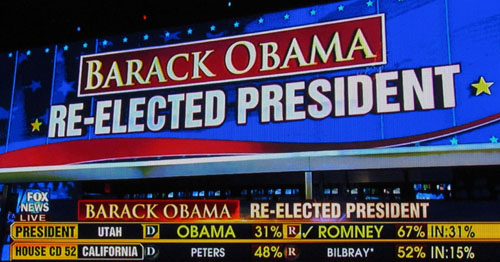
    Just reading wall posters here, but the talking heads on Fox are not sounding very energized tonight…. 

  • It’s the Machines, Stupid

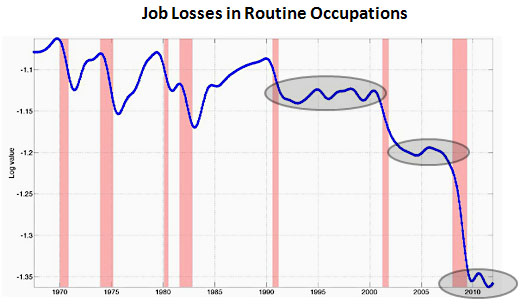
    Mark Thoma draws my attention today to a paper by Henry Siu and Nir Jaimovich that tries to explain why recent recessions have prominently featured jobless recoveries. They break down jobs into three categories: non-routine cognitive jobs, non-routine manual jobs, and routine jobs. What they show is two things:

    • Most of the job losses during the past three recessions have come from the ranks of occupations coded as routine.
    • And unlike previous recessions, these jobs don’t come back during the subsequent recoveries. The chart below shows the permanence of these job losses in the aftermath of our last three recessions.

    So why is this happening? Siu and Jaimovich conclude that it’s the machines, stupid:

    Automation and the adoption of computing technology is leading to the decline of middle-wage jobs of many stripes, both blue-collar jobs in production and maintenance occupations and white-collar jobs in office and administrative support. It is affecting both male- and female-dominated professions and it is happening broadly across industries — manufacturing, wholesale and retail trade, financial services, and even public administration.

    This is only the tip of the iceberg, and better education can only make a small dent in it. I suspect that over the next several decades, this is going to be one of our most serious economic issues, but it’s one that we’ll mostly try to deny because the solution is so intractable. So instead we’ll make up other explanations and continue to flail around. But like it or not, machines are going to get more and more competent over time, and they’re going to perform more and more of the work. Eventually we’ll have to face up to it.

    UPDATE: A regular reader emails in a comment:

    Have you ever watched “How It’s Made”? The extent of factory automation, even in places you wouldn’t expect, like food production, is mind-boggling. It’s impossible to watch even one episode and come away wondering where the manufacturing jobs went. It almost doesn’t matter if they went overseas — the bigger issue is that they don’t require humans anymore. All that’s left is for us to automate the factory automation factory and we’ll be all done….

    This comment, of course, would have been delivered to me by an actual human being 20 years ago.