• Would Mitt Romney Be Good For Short-Term Economic Growth?

    Matt Yglesias makes the case that Mitt Romney might be better for short-term economic growth than Obama:

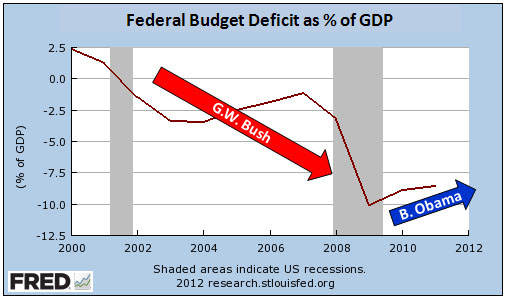
    Insofar as I have to guess, I think short-term growth will be faster under Romney than Obama for three reasons. First, in the post-1980 era you get bigger budget deficits with Republicans in the White House than with Democrats and that’s a good thing in the short-term. Second, the Federal Reserve seems to be biased and delivers looser monetary policy with Republicans in the White House. Third, Republicans are much more likely to promote short-term economic growth at the expense of environmental concerns.

    Maybe! However, I don’t think his second and third items hold water. The Fed does seem to be biased in favor of Republican administrations, but this is mostly in the last year before an election. What’s more, Fed policy is already pretty loose by historical standards; Ben Bernanke doesn’t seem to think very highly of the current Republican Congress; and by 2015 the economy is likely to be in pretty good shape no matter who’s president. On the environmental front, I think you could make the case that weaker regulations might spur growth a bit in the medium term, but not in the short term. Partly this is because it takes a fair amount of time to turn things around even via executive order, and partly it’s because, despite conservative wailing, the Obama EPA really hasn’t done very much that, even arguably, is more than marginally harmful to economic growth. Coal plants are in trouble mostly because of competition from cheap natural gas, not because Obama is killing them off.

    But that does leave Matt’s first reason, and that one is….surprisingly hard to judge. If Romney is elected, the House will immediately vote to restore the Bush tax cuts and possibly cut taxes even further. But can they get enough Democrats in the Senate to peel off and support them? Maybe. Spending is similar. If Obama is president, Republicans will almost certainly be adamant about implementing spending cuts. If Romney is president, they might decide to compromise on some modest cuts and just let it go. Maybe.

    So it’s no sure thing, but yes: the chances are probably higher of running big deficits under Romney than under Obama. Republicans won’t call it stimulus, they’ll call it tax cuts on the one side and restoring our military to greatness on the other, but tomayto, tomahto. It’s all the same, and it’s probably a bit more likely if Romney is elected.

    In other words, Republicans will agree to help rescue the economy only if we put their guy in the White House. Capiche?
  • Poor Early Voting Turnout Apparently a Big Plus for Republicans


    I love this headline from Katrina Trinko over at NRO:

    RNC: In Key Swing States, More Republicans than Democrats Haven’t Already Voted

    Got that? No? Let’s allow the RNC to explain:

    [Democrats] are cannibalizing their Election Day voters. The great turnout operation they claim to have isn’t turning out enough new or sporadic voters; they’re largely getting their reliable voters to vote early instead of on Election Day.

    The Republican strategy has been the reverse of the Democrats’. We have turned out our voters who aren’t as likely to come to the polls on Election Day, securing their votes during early voting. Now, all that remains to do is give our reliable voters the final reminder needed to get them to the polls Tuesday. And we have many more reliable voters left than the Democrats.

    Let’s translate: Democrats are kicking our butts in early voting, so, um, that means they’re losing. We, on the other hand, are cleverly saving up all our votes for Election Day.

    Uh huh.

  • Voter Suppression Enters the Home Stretch

    Mike Tomasky writes today about something that a lot of us have spent the past couple of years deploring: the increasingly naked Republican campaign to suppress the nonwhite vote.

    Up to now its measures were local and somewhat haphazard—scare-tactic fliers circulated in black neighborhoods, GOP elections officials “forgetting” to ship the right number of voting machines to minority areas, that sort of thing….Now, though, in these past couple of years, the GOP strategy has been institutionalized. It’s come above ground, and the thugs in black outfits distributing handbills in the dead of night before Election Day have been replaced or at least supplemented by thugs in suits and ties trying to put a respectable sheen on this obviously anti-democratic business.

    This is why NAACP president Benjamin Jealous calls the current Republican tactics “James Crow Esquire”: the tactics may not be as as brutal as they were 50 years ago, but the goal is the same. Ed Kilgore, a son of Georgia, comments:
    That’s probably fitting. This election does, after all, follow a four-year period in which conservatives have gotten into the habit of publicly proclaiming things they used to keep to themselves: anyone receiving any sort of government assistance is a “looter” or a “taker;” poor and minority people “vote themselves welfare;” voting is a “privilege, not a right;” people who don’t pay federal income taxes shouldn’t be allowed to vote, etc., etc. The desire to suppress votes to one extent or another has gotten deeply into the DNA of a party that considers itself under siege by demographic change.

    And quite predictably, two of the more brazen GOP pols, Florida Gov. Rick Scott and Ohio Secretary of State Jon Husted, are making a spectacle of themselves in their zeal to restrict voting opportunities. If one of them showed up outside an early polling place with a bullwhip and police dogs, it wouldn’t seem out of place, and many of their “base” supporters would lustily cheer. After all, when Husted defies a judge to require voters to fill out forms establishing their right to vote, or when Scott turns away voters standing in line for hours, that’s some more “looters” who won’t have the opportunity to take away the good virtuous folks’ tax dollars or (earned!) Medicare benefits.

    When it comes to photo ID laws, Republicans at least have the outward semblance of an argument: they’re trying to prevent voter fraud. There’s no evidence of more than a tiny handful of people ever committing the kind of fraud that photo ID would stop, but at least it’s an argument. But pair that up with the recent jihad against early voting hours, and even the pretense of an argument goes away. There’s nothing these two things have in common except for their unusually negative impact on demographic groups—including blacks, Hispanics, students, and the poor—that tend to vote for Democrats. It’s the GOP’s last-ditch effort to stave off demographic apocalypse.

    Is there any kind of silver lining here? Probably not, but if there is one, it’s this: it might backfire. The GOP has been so ravenous in its desire to suppress the vote of groups it doesn’t like that it might make them more motivated than ever to vote. We’ll see.

    In the meantime, the MoJo team is following reports of voter suppression throughout the election tomorrow. Our summary of voter suppression around the country is here. Check out the main site and the political blog to keep up to date.

  • California Propositions – November 2012


    Tomorrow is voting day, so here’s a recap of my recommendations on California’s 11 ballot initiatives. The original post, which contains a bit more detail, is here.

    1. Temporary tax hike to benefit schools: YES. State general fund spending has been cut significantly over the past few years, and in real per-capita terms is substantially lower than it was a decade ago. There’s just no more room to squeeze, and Prop 30 is a pretty good compromise measure that provides the extra funding we need.

    2. Miscellaneous budget and local government reform: NO. This is a hodgepodge of good ideas and bad ideas that doesn’t pass a high enough bar to deserve support.

    3. Paycheck protection: NO. This isn’t a nonpartisan reform that affects both unions and corporations. It’s a zombie initiative—the third of its kind in the past 14 years—that devastates the political power of unions without affecting corporations at all. It’s a scam.

    4. Auto insurance: NO. This initiative is good for Mercury Insurance, whose CEO is bankrolling it, but not for the rest of us.

    5. Replace the death penalty with life in prison without possibility of parole: YES. The death penalty simply doesn’t work in California. It’s time to face up to this and get rid of it.

    6. Human Trafficking: NO. These kinds of laws should be written by legislatures, not carved into stone forever by ballot initiatives.

    7. Three strikes: YES. Prop. 36 modifies our three-strikes law so that 25-to-life sentences are imposed only if the third strike is a serious one. This is just common sense.

    8. GM food labeling: NO. The current scientific consensus doesn’t support the notion that GM foods are hazardous to human health. Aside from that, Prop 37 places requirements on supermarkets that are overly burdensome, and also has the usual initiative problem that its rules are written in stone. But this is an evolving subject, and when the science changes the law should be able to change with it. It’s an issue that should be left for the legislature. For a different view, check out Tom Philpott’s rebuttal here.

    9. Temporary tax hike to benefit schools: NO. Prop. 38 competes with Prop. 30 as a tax measure to benefit public schools. Prop 30 is a better bet.

    10. Tax treatment for multistate businesses: YES. This initiative fixes a dumb tax deal passed several years ago. It produces better incentives for businesses and raises a bit more money too.

    11. Redistricting: YES. This is a referendum, not an initiative. A Yes vote will uphold the state Senate redistricting plan approved by the California Citizens Redistricting Commission.

  • Election Forecasting Update – 4 November 2012

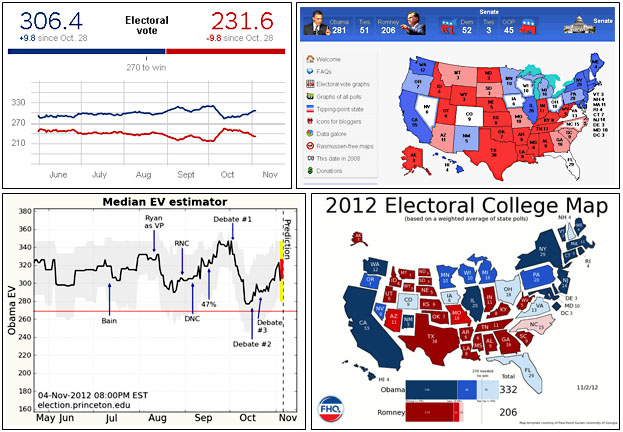
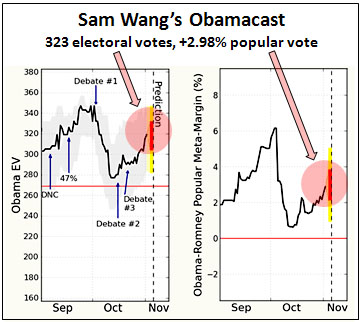
    Here’s my penultimate update on the status of the most popular presidential forecasting models. On the top are Nate Silver and Andrew Tanenbaum; on the bottom are Sam Wang and Josh Putnam. Sam’s model showed an unnerving single-day decline in Obama’s numbers today, but all four models still predict a convincing Democratic victory, with Obama winning an average of 305 electoral votes.

    So what are the odds that these models are wrong? The basic polling itself is almost certainly sound, so there are really only two ways that the polls could be significantly off:

    • The few remaining undecided voters could all break for Romney. However, this is unlikely given the polling numbers we’re seeing, since they’d have to break something like 80%-20% to overcome Obama’s lead in the key swing states. There’s no precedent for that.
    • On the great gittin’ up day, all those folks who say they support Obama might not get to the polls in the same numbers as all the super-energized Romney supporters. But this is basically just an assertion that the likely voter screens are wrong on virtually all the polls, something that seems unlikely since the screens are little more than questions asking whether you plan to vote. They’ve worked in the past, and there’s no reason to think they won’t work this year just as well. For all practical purposes, the “enthusiasm gap”—if it exists—is already accounted for in the polling numbers.

    But suppose there is a systematic bias in the polls. How big would it have to be in order for Romney to win? This is what Sam Wang’s “meta-margin” tells us, and it currently stands at 2.72%. That’s how far off the polls would have to be—either because undecideds break heavily for Romney or because the pollsters’ likely voter screens are wrong—in order for Romney to win, and it’s a pretty big number. It’s unlikely that either of these effects is anywhere near that large.

    What else? Conservatives are currently pinning some of their hopes on poll internals, which show independents breaking strongly for Romney. However, Nate Cohn suggests this is just an artifact of the Republican Party’s lousy brand image these days: the tea party has driven away lots of centrist Republicans, who now call themselves independents even though they still plan to vote for Romney. This is likely what’s driving up Romney’s share of the “independent” vote.

    For myself, I’m still predicting an Obama win for two reasons. First, models that are based on fundamentals suggest that Obama—an incumbent presiding over a so-so economy—should score a modest win. Second, Obama is leading in nearly all the polls two days before the election, and that also suggests a modest win. There’s no magic here. Both of the models that seem like reliable predictors are pointing in the same direction, so that’s the direction I’m leaning too. I guess I’d add to that one anecdotal piece of evidence: the Romney campaign is spending a lot of time complaining that the polls are wrong, and that’s usually something that only losing campaigns do. In any case, we’ll know in 48 hours.

  • Chart of the Day: The Power of the Right-Wing Echo Chamber

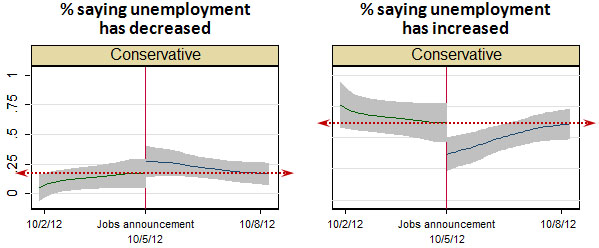
    Via John Sides, here’s a fascinating little data point about the power of the conservative echo chamber. A couple of days ago Brian Schaffner wrote a post about a UMass poll he conducted across several days in early October. One of the questions was whether unemployment had increased or decreased over the past year. The correct answer, of course, is that it had decreased: at the time the poll was conducted, unemployment over the previous twelve months had declined from 9.1 percent to 8.1 percent.

    As you’d expect, liberals were more likely to answer this question correctly since it jibes with their political preferences. Interestingly, though, the poll was taken over the period October 2-8, and right in the middle of that week the unemployment figures for September were released. As you’ll recall, unemployment dropped sharply in that report, down to 7.8 percent, and the fact that this was part of a longer-term trend was widely reported.

    Everyone saw this news, and polling on October 5 showed a sharp increase in the number of people who knew that unemployment was down. But here’s the interesting thing: among liberals and independents, the number getting the answer right stayed higher over the next several days. Apparently the news sunk in. But among conservatives, the number getting the answer right started to decline immediately. Within three days, as the chart below shows, they were answering the question exactly the same as they had before the unemployment report came out. Schaffner comments:

    It is important to recall that Republicans immediately started questioning the veracity of the jobs numbers, with some suggesting that the Obama administration had “cooked the books” for political gain….In short, conservative elites provided conservative voters with an argument that allowed those conservative voters to bring the information from the jobs report into line with their pre-existing political preferences. The end result was that liberals updated their beliefs about the unemployment rate based on the jobs report while conservatives ultimately did not.

    This is the power of the Drudge/Fox/Limbaugh axis. I don’t doubt that liberals do the same thing with news that discomforts them, but I’ll bet they don’t do it quite as fast or as strongly. We lefties just don’t rely on hardcore ideological news sources as much. Too much reality seeps in whether we like it or not. Conservatives don’t have this problem.

  • Gears Turn, Lights Blink, and Mitt Romney Tells Us His Favorite TV Shows

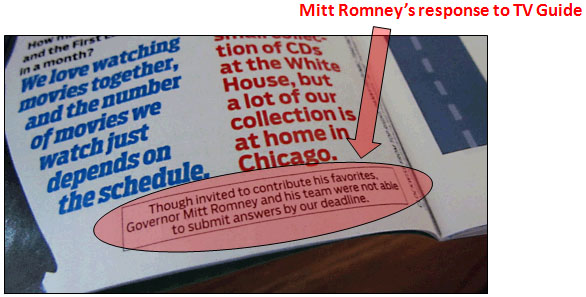
    For their final pre-election issue, TV Guide asked President Obama about his favorite TV shows. You’ve probably read about this: he likes Homeland, Boardwalk Empire, and Modern Family. And SportsCenter. Lots and lots of SportsCenter. But what about Mitt Romney? Has even TV Guide succumbed to liberal Hollywood bias, refusing to give him equal time? Is Walter Annenberg rolling in his grave?

    No. TV Guide asked Romney about his favorite shows, but apparently he spent too much time focus-grouping his answers to make their deadline. Wouldn’t want to accidentally offend any key voter demographics, after all! However, once the Romneytron 3000 finished its calculations, it turned out that he likes Modern Family, Justified, 30 Rock and NCIS. A perfect blend of critical favorites and middlebrow taste. I’d expect no less from him.

  • Obama is Bad on Civil Liberties, But Romney Would Be Much Worse

    Like a lot of liberals, I’m not very happy with President Obama’s handling of national security and civil liberties issues. Just to name a few of them, I think drone strikes are overused; U.S. citizens overseas shouldn’t be targeted for assassination without judicial oversight; surveillance rules should be considerably stricter; and the state secrets privilege ought to be reined in. At the same time, I recognize that a lot of this stuff is dictated more by public and congressional opinion than it is by Obama himself, so I tend to be a little more tolerant of Obama’s poor record than some.
    In any case, Mark Kleiman reminds us all today that Mitt Romney would be even worse. Last year Romney was asked whether he thinks waterboarding is torture. Here was his extremely matter-of-fact answer:

    I don’t, but I don’t….I’m not going to lay out the list of what is and what is not torture….We will have a policy of doing what we think is in our best interest. We’ll use enhanced interrogation techniques which go beyond those that are in the military handbook right now.

    Obama’s track record on civil liberties is poor. At the same time, Obama at least tried to close Guantanamo; Romney wants to double it. Obama and Eric Holder at least made an effort to hold civilian trials for terrorist suspects; Romney is contemptuous of them. Obama banned torture; Romney wants to bring it back. And Obama has been restrained on intervention in Syria and Iran; Romney is eager to set red lines and begin directly arming rebels.

    Anyone whose vote is based on civil liberties and national security issues ought to be aware of what it means to do anything that makes a Romney victory more likely. As bad as you think things are now, it means implicitly supporting the election of someone who would make them appreciably worse. It’s sophistry to pretend otherwise.