• The US Economy Is Kind of Meh

    A couple of years ago, wonky bloggers started really digging into new releases of economic data. When GDP numbers were released, you could find a dozen posts diving deep into the weeds and explaining why the numbers did or didn’t really matter: defense spending was artificially up, inventory gains were wacky, the timber industry had an unusually good quarter, etc. etc.

    Then that got tiresome, as everyone realized that there are details like that every quarter. Most of the time, the headline number is pretty much the best indication we have of how the economy is doing.

    Now we’ve entered a third phase, in which the fashionable thing is to discount even the headline number because it’s just going to get revised next quarter anyway. So who knows?

    I have a feeling that people who are new to economic analysis go through these phases routinely, while the wise old hands nod along and wait for them to pass. Now a new generation has done this, and a few years from now we’ll all be nodding along with a smile when a fresh batch of kids comes along and discovers that GDP reports and employment reports come with loads of detail to analyze and are always revised once or twice before they settle down.

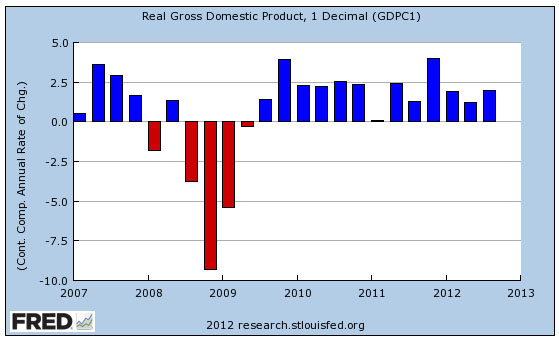
    In the meantime, GDP grew 2% last quarter. That’s not terrible, but not great. We need to do considerably better if we want to get unemployment down to acceptable levels. And like it or not, that’s about as much as we know: the economy isn’t terrible and isn’t great. It would be nice to know more, but we don’t.
  • Obama’s Ground Game Advantage May Not Be As Big As It Looks

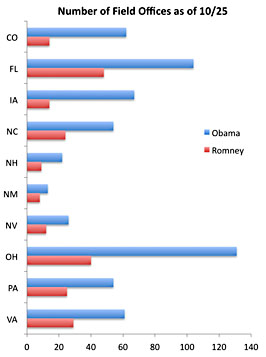
    The chart below has been making the rounds over the past couple of days. It shows how many field offices each campaign has in the top ten swing states, and it’s pretty stunning. Obama has twice as many offices as Romney in Virginia. Twice as many in Florida. Three times as many in Iowa. And more than three times as many in Ohio.

    What’s going on? Our working assumption should be twofold: (a) the Romney campaign has plenty of money, and (b) they aren’t idiots. So what’s the deal? I’ve been meaning to mention something about this, but today Seth Masket does it for me. He makes three suggestions, and I suspect the third one is probably correct:
    He’s counting on field organizational efforts from the parties, church organizations, and other allied groups to do the same sort of things that the Obama offices are doing.

    There’s been a disconnect in the ground games of the major parties for some time. Democrats tend to rely on paid, professional operations, while Republicans rely more on volunteer efforts, largely from evangelical churches. This is something that actually works in the Republicans’ favor, since volunteer efforts from friends and neighbors tend to be more effective at switching votes than professional phone banks. (Also cheaper.) On the other hand, the professional organizations are often more thorough, and are better at the actual logistics of getting people to the polls.

    In any case, I wouldn’t be surprised if that’s what’s happening here. This is just a difference in the way the parties handle elections these days, not necessarily an indication that the Obama organization is kicking Romney’s ass.

  • Romney-Ryan’s Real Poverty Plan: Soak the Poor

    So what would Mitt Romney and Paul Ryan do for the poor and the working class if they were elected? Let’s recap:

    • They would allow the payroll tax holiday to expire. This would immediately raise taxes on everyone, and would hit the working poor especially hard.
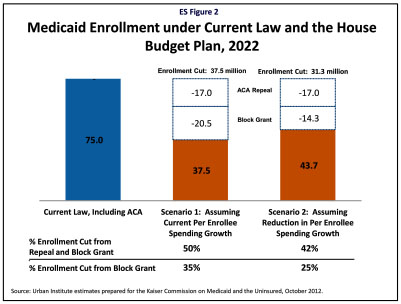
    • They would repeal Obamacare, which would immediately kick about 17 million low-income earners and their family members off of Medicaid.

    • In addition, they want to block grant Medicaid and cap its growth. In some states, this wouldn’t have a big immediate impact. In other states, conservative governors and legislatures would use their newfound authority to limit enrollments and cut benefits substantially. Over time, all states would have to cut enrollments dramatically, probably by another 15-20 million within a decade.
    • If they pursue the cuts outlined in Paul Ryan’s budget plan, they would cut funding for SNAP (food stamps) by more than $100 billion over the next decade. The Center on Budget and Policy Priorities estimates that this would reduce enrollment in the program by at least 8 million people.
    • They would cut funding for Planned Parenthood and other reproductive health organizations. This would especially hurt poor women, since they don’t have the resources to pay for services at full-cost clinics.
    • They would cut the college tax credit, the child tax credit, and the earned-income tax credit. All of these are programs designed to help the working poor.

    This is a short post. Sometimes it’s better to lay out the facts simply and starkly, because Romney’s priorities really are pretty stark: He wants to cut taxes on the rich and cut spending on the poor. That’s Romney’s real poverty plan.

  • How to Fire People the Citigroup Way


    Ten days ago, Citigroup’s Vikram Pandit walked into the chairman’s office for what he thought was a routine meeting:

    Instead, Mr. Pandit, the chief executive of Citigroup, was told three news releases were ready. One stated that Mr. Pandit had resigned, effective immediately. Another that he would resign, effective at the end of the year. The third release stated Mr. Pandit had been fired without cause. The choice was his.

    I like it! The only thing that could have made it better would have been a fourth press release stating that Pandit was deeply remorseful for his poor performance and was voluntarily accepting a position as a teller in Citi’s Fargo branch as a way of demonstrating his earnest desire to redeem himself through honest labor alongside the workers he had let down. No need to go so easy on the guy, after all.

  • This Weekend May Seriously Test Your Loyalties

    This is a drag. Tyler Cowen draws my attention to a study that suggests a home team win by a local college football team shortly before an election boosts the vote for an incumbent president. The biggest effect, oddly enough, is for the game ten days before the election, not the game right before the election. A win this weekend could boost the local vote for the incumbent by a stunning 2.59 percentage points.

    Right away, I’m going to say I don’t believe this. It’s just too big an effect. But you can’t be too careful, can you? And that sets up some conflicts. My USC Trojans, for example, are playing Arizona this weekend, and a USC win would have no effect. Who cares if Obama gooses his winning percentage in California by a point or two? A win by the Wildcats, however, might just put Arizona over the top for Obama.

    Or how about Penn State vs. Ohio State? I have some residual loyalty to Penn State because my father taught there for a year and my sister was born there. What’s more, as a Pac-12 guy, hating Ohio State is bred into my genes. But Pennsylvania isn’t in play. Ohio is, and if an Ohio State win gives Obama an extra point or two in the Buckeye State, that could determine who wins the election.

    Luckily, Ohio State is a big favorite, so it probably doesn’t matter. Nonetheless, for the first time in my life, I might just be rooting for them.

  • Chart of the Day: The Federal Reserve Loves Republicans

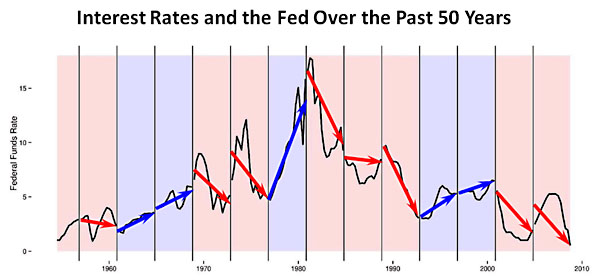
    Republicans may have taken to hating the Fed in recent years, but University of Michigan political scientist William Clark tells us today that the Fed sure loves Republicans. In every single presidential term over the last five decades, interest rates have risen between the beginning and end of Democratic administrations and dropped during Republican administrations:

    This is actually even more sinister than it looks. Clark says that, even after controlling for macroeconomic conditions, it appears that “as elections draw near, the Fed adopts a looser monetary policy when Republicans control the White House.” In this, he’s echoing Jamie Galbraith, who wrote a paper in 2007 showing exactly the same thing. In fact, he demonstrated that the Fed systematically intervenes during election years, but in opposite directions depending on which party holds the White House. Controlling for economic conditions, the Fed loosens more than expected when Republicans are seeking reelection and tightens more than expected when a Democrat is seeking reelection.

    Of course, this might all just be a big coincidence. I report, you decide.

    POSTSCRIPT: Fairness dictates that I acknowledge Ben Bernanke as the exception to this rule. He couldn’t actually lower interest rates for Barack Obama, since rates were already near zero when he took office, but Bernanke has certainly engaged in several rounds of nontraditional monetary easing during Obama’s term.

    Of course, fairness also requires me to acknowledge that Republicans have screamed blue murder about this every step of the way, because they’re bound and determined to oppose anything that might help the economy during a Democratic administration.

  • Okay, Twitter Isn’t Ruining Political Journalism. But It Sure Is Hurting Debate Coverage.


    Via Twitter, I’ve gotten a fair amount of pushback on my post this morning titled “How Twitter Is Ruining Political Journalism.” I blame my editors. They spent years trying to get me to write less boring headlines, and their nagging finally worked! But sometimes it leads me astray. Just for the record, then:

    • The headline was hyperbolic. Obviously Twitter has had both positive and negative effects on political journalism.
    • One of those positive effects is that readers get lots of instant reporting from journalists.
    • One of the negative effects is that journalists now feel like they have to spew out mountains of instant reporting to stay in business.
    • Another positive effect is that chattering between reporters is now more public than before. If you’re going to chatter, the rest of us might as well get to hear it.
    • But a negative effect is that reporters now chatter more than ever. In the past, there really were some limitations on this dictated by physical circumstances.

    Debate coverage is an extreme case. Reporters should actively want to develop their own opinions about the candidates’ performances. They should actively want to avoid letting the rest of the herd influence them. That’s just common sense. After they’ve done that and put their thoughts down on paper, they’ll want to get reactions from various folks who have campaign roles, but even then there’s no real reason they should be interested in reactions from other reporters. There’s no reason to be afraid of having a different take than everyone else.

    If you’re covering a riot or a burning building, that’s different. Twitter can be an important part of keeping abreast of what’s going on. But political debates are different. Twitter may be fun, but doing your job comes first. Turn it off until the debate is over.

  • When Do We Get to the Revenue Half of Bowles-Simpson?


    Jared Bernstein makes a point today that’s worth repeating: Republicans have given a lot of love to the Bowles-Simpson deficit reduction plan lately, but it turns out that we’ve already made a lot of the spending cuts in their plan. Here are the basic numbers:

    • Total discretionary spending cuts proposed: $2.1 trillion
    • Revenue increases proposed: $2.6 trillion
    • Discretionary spending cuts already passed in 2011: $1.5 trillion
    • What’s left: $0.6 trillion in discretionary spending cuts and $2.6 trillion in tax increases

    This doesn’t count savings from interest on the debt, it doesn’t count reduced war expenses, it doesn’t count sequestration cuts scheduled for January 1, it doesn’t include entitlement cuts, and it’s not inflated by stimulus spending. These are apples-to-apples numbers on discretionary spending and revenue increases.

    So we’ve already made pretty good progress on Bowles-Simpson’s discretionary spending cuts. Add in interest reductions and war cuts and we’ve made even more. But we’ve made no progress at all on the Bowles-Simpson revenue increases. When does that part of the plan get started?

  • Know Your Communist History

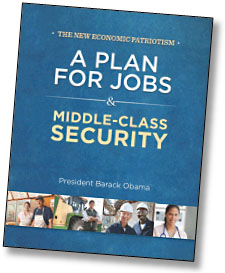
    President Obama’s new booklet, “A Plan for Jobs,” is subtitled “The New Economic Patriotism,” and the editors of National Review are not amused. I’ll admit that I could do without that subtitle myself, but it turns out that NR objects to it mainly because of its initials: “If that name seems to you redolent of early-20th-century totalitarians, that may be because it is not the first N.E.P.: Lenin’s was the Novaya Ekonomicheskaya Politika.” You’d think that National Review, of all places, would know its communist history, but no. Matt Steinglass provides the free lesson:

    Interesting reference! The Novaya Ekonomich-eskaya Politika was a free-market economic reform package introduced by the Soviet government in 1921. It entailed a retreat from an all-state economic model in favour of institutionalised recognition of a legitimate private sector in industry and agriculture, as well as a dramatic tax cut.

    ….The reforms were largely successful, leading the Russian economy back to pre-war production levels by 1927. But they also led to rising income inequality. After Stalin won the struggle for power in 1928 over alternative leaders like Trotsky, Zinoviev and Kamenev, he soon abandoned the NEP in favour of forced agricultural collectivisation and industrial centralisation under the first five-year plan. He then gradually mopped up every remaining base of political opposition within the party and had them all executed in show trials beginning in 1934.

    I’ll grant you that an association with Lenin does no politician any good, regardless of which particular policy we’re talking about. Still, if you’re going to be childish enough to object to something because of its initials, you probably ought to at least know what you’re talking about first.

  • How Twitter Is Ruining Political Journalism

    Dana Milbank writes about the way that political journalism works today:

    Walk into the “filing center” at a presidential debate and you’ll see hundreds of reporters seated at tables doing two things: Watching the action on TV (reporters covering the debates aren’t actually in the same room as the candidates) and monitoring Twitter on their laptops.

    ….From the first minutes, journalists at the site and back at home monitor each other’s tweets, testing out themes and gauging which candidate is ahead, point by point: “First section kind of a wash” . . . “Romney very soft on Libya” . . . “Obama is condescending here” . . . “Zing!” . . . “No laughs in the press file for that canned Obama line.” Somewhere around the 30-minute mark, the conventional wisdom gels — and subsequent tweets, except those from the most hardened partisans, increasingly reflect the Twitter-forged consensus. Well before the end, the journalists agree on a winner, a loser and which moments — Big Bird, binders full of women, horses and bayonets — should trend their way into the news coverage.

    ….I don’t fault the journalists who engage in instant analysis….

    Let’s stop right there. I fault the journalists who do this. Don’t get me wrong: I understand that professional reporters don’t live in a bubble. They attend the same events, they talk to each other on the campaign trail, and they read each others’ stories. This is inevitable, and it’s inevitably going to lead to a certain amount of bandwagoning.

    But even if this is inevitable, it’s something that good reporters should at least fight. The last thing they should do is actively make it worse by obsessing over their Twitter feeds. So yes: let’s fault the journalists who do this. It’s insane. They should be doing everything they can to resist groupthink, not gleefully diving ever deeper into the looking glass. This is really a staggering dereliction of duty.