• Friday Cat Blogging – 5 October 2012

    In 1912 Marcel Duchamp painted “Nude Descending a Staircase No. 2.” A century later, I have created a new classic for a new era, “Domino Heading for the Supper Dish No. 2,153.” This is a bit of poetic license, though, since she was actually heading toward Marian, who was luring her into the living room with a shopping bag for her to crawl into. But I like my title better, and anyway, there’s no telling if Duchamp’s nude was really descending a staircase either, is there?

    In other news, a team of Japanese researchers have proven that lolcats are good for the economy. The Daily Mail, your go-to site for cute animal journalism, reports that “Through three separate experiments a team of scientists found that people showed higher levels of concentration being shown pictures of puppies or kittens.” Tell that to your boss the next time he gives you a hard time about checking out Friday Catblogging in the middle of the workday.

  • Mitt Romney’s Social Security Plan

    This is nothing new, but a reader points out that Mitt Romney has explicitly endorsed raising the eligibility age for both Social Security and Medicare:

    When it comes to Social Security, we will slowly raise the retirement age….We will gradually increase the Medicare eligibility age by one month each year.

    The Social Security retirement age is already increasing by statute and will reach 67 in a few years. Apparently Romney wants it to go up to 69 or 70. The actual number he has in mind is unclear (surprise, surprise) but given that he plans to balance Social Security’s books solely by raising the retirement age and slowing the growth of benefits for “those with higher incomes,” I’d put my money on 70. Slowing benefit growth on high earners just doesn’t do enough to let you get away with anything less.

    So there you have it. If you’re in your 30s or 40s, Mitt Romney thinks you should work until you’re 70. That might be OK for bloggers and politicians, but I’m not sure how all the dockworkers and haircutters and grocery clerks are going to feel about that. Especially when you consider that life expectancy for these folks has gone up a paltry 1.3 years in the past three decades. It’s the well-off who are living longer, not the lower half of the middle class.

  • The Liberal Conspiracy Is Now Officially Everywhere


    As I was browsing my RSS earlier today I came across a short blurb about former GE chairman Jack Welch. Apparently Neutron Jack has become a truther. Not a 9/11 truther or Kenyan birth truther: he’s become, fittingly enough for a guy who got famous for his layoffs, an unemployment truther. “Unbelievable jobs numbers,” he tweeted this morning. “These Chicago guys will do anything..can’t debate so change numbers.”

    I shook my head, figuring Welch had just gone senile or something, and plowed forward. Little did I know that Welch had apparently inspired a movement. Conservatives all over the place smell a rat. Benjy Sarlin has the details here. The wingers have gone from complaining about the liberal media to complaining about liberal Hollywood to complaining about liberal pollsters and now, finally, to complaining about liberal technocrats in the Bureau of Labor Statistics. The conspiracy is everywhere.

    This is really sad. When do they finally get the intervention they so desperately need?

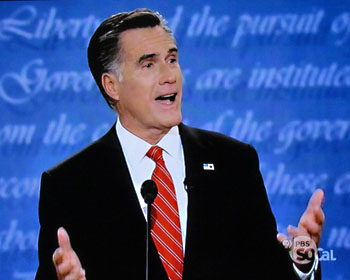
  • Mitt Romney’s Head Fake to the Center

    I want to second this remark from Ed Kilgore:

    Before it becomes a kind of Fact-Made-Fact-By-Repetition, I’d like to challenge the much-assumed idea that in the first presidential debate Mitt Romney “moved to the center” in a real, substantive way. This seems to be the conclusion of many Democrats, many in the MSM, and of those few Republicans who occasionally object to the endless rightward drift of the GOP.

    Sure, his rhetoric sounded more moderate. But when you look at the details, nothing changed.

    Ed provides chapter and verse in the rest of his post, which is worth a read. But I’d like to add a related thought: relatively speaking, Romney was never all that far to the right in the first place. Sure, he’s adopted all the standard positions of the modern tea-party-ized GOP, but during the primaries he was always pretty careful not to go any further than that. On actual policy, he never tried to move to the right of Newt Gingrich or Michele Bachmann or Rick Perry.

    What he did do was adopt a “severely conservative” rhetorical style, highlighted by his almost comically harsh attacks on Barack Obama. He was content to let the other candidates offer up redder meat than he did, but he always insisted on making sure that everyone knew his contempt for Obama was second to none. At the time, I figured this was deliberate: he didn’t want to take any insane positions that might hurt him in the general election, but he still wanted to do something to show tea party voters that he was one of them in his heart. The way he did that was by never letting five minutes go by without launching yet another over-the-top verbal volley against Obama.

    And it was a good strategy! It’s easy to ditch attacks like that after the primary is over, and for the most part he has. Ever since spring, Romney’s schtick has been an almost sorrowful acknowledgment that Obama is a good man, an honorable man, but in over his head. The harshness is mostly gone, and hardly anyone has even noticed that his attacks on Obama changed course rather abruptly as soon as he became the consensus nominee in April. And since then he’s also solidified his standing with the tea party base strongly enough that he can get away with some rhetorical concessions on policy as well. This resonates more strongly with the pundit class, but Ed is right: on substance, Romney hasn’t changed a thing. He still won’t accept a dime in revenue increases; he still plans to cut taxes substantially on the rich while claiming he’s doing no such thing; he still wants to voucherize both Medicare and education spending; he still wants to turn Medicaid over to the states and slash its funding; he still wants to increase the defense budget; he still wants to repeal both Obamacare and Dodd-Frank; and he still claims to be a deficit warrior even as he refuses to provide any details about just how he’d actually cut the deficit.

    The new, more bipartisan Romney should be taken for what it is: a campaign stratagem, not a real change. He isn’t moving to the center, he’s just trying to sound like he’s moving to the center. My guess is that it won’t work, but given the obsession of the Washington press corps with optics and conflict, it might. You never know.

  • Diplomatic Attacks Are Much Rarer Than They Used to Be

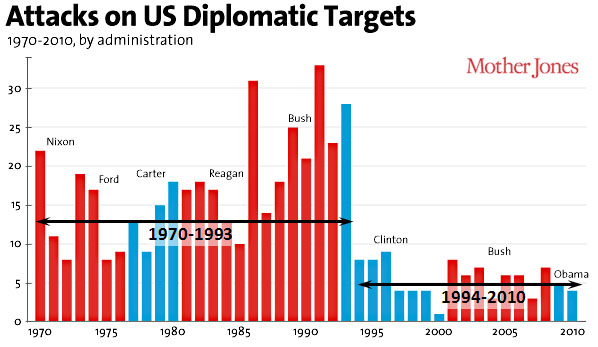
    Adam Serwer has a pretty interesting chart today that accompanies his piece about the history of attacks on U.S. diplomatic targets. Here it is:

    There’s a very sharp, very sudden dropoff in 1994. Just eyeballing it, it looks like there were an average of about 14 attacks per year from 1970-1993 but only six or so from 1994-2010. Why?

    “That follows the trend of terrorism generally,” says Erin Miller, a research assistant at START who manages the Global Terrorism Database. “In the early 1990s there’s a drop-off worldwide in terrorism against pretty much all target types.” Miller cites the collapse of the Soviet Union, and a subsequent wane in leftist terrorism as one possible explanation for the downturn beginning in the mid-1990s.

    Maybe! On a broader note, Adam points out that Mitt Romney’s tiresome trope about the Benghazi attacks being the result of President Obama’s “weakness” is just nonsense. There were lots of attacks during the Reagan administration, and many fewer during the Clinton administration. Attacks rose a bit during the Bush administration, and have been a hair lower during the Obama administration. This is almost certainly due to external factors, not to any particular strength or weakness of the presidents themselves.

    Still, it’s fair to say that the Obama administration has hardly distinguished itself with its curiously meandering response to the Benghazi attacks. I think they’ve finally given up on the suggestion that it was all because of a YouTube video, but beyond that there’s still a fair amount of confusion about who was behind the attack and what the motivation was. Weakness may not have caused the attacks, but until Obama can get his hands around it, it’s going to remain a pretty soft spot for the Romney campaign to poke at.

  • Chart of the Day #2: The Public Sector is Shrinking

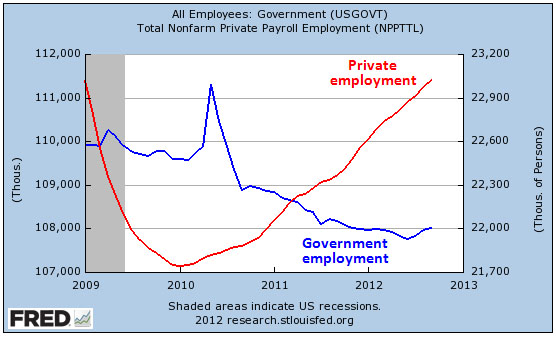
    A friend writes to remind me that, aside from a brief census blip in 2010, public sector jobs (state+local+federal) have steadily declined during the Obama administration. At the same time, private sector jobs bottomed out at the end of 2009 and have been on a steady upward rise ever since. “The government sector drag pulls the total down,” she says, “which should be appreciated by small-govt loving Republicans.” It should be! Over the past four years, government has gotten smaller and the private sector has become a bigger and bigger percentage of the workforce. Conservatives ought to be pretty happy.

  • Chart of the Day: Net New Jobs in September

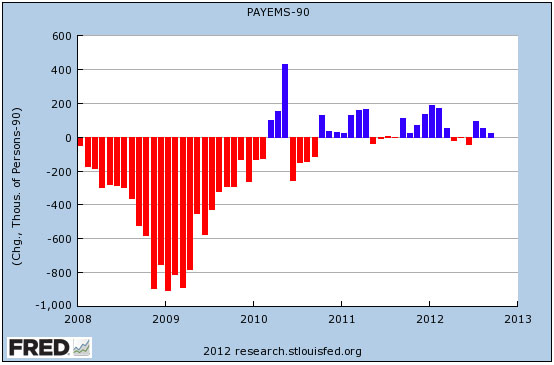
    The American economy added 114,000 new jobs last month. However, about 90,000 of those jobs were needed just to keep up with population growth, so net job growth is closer to 24,000 jobs. The chart below, which I update monthly, shows net job creation since the beginning of 2008. Those of you with sharp memories will note that the past three months look bluer than they used to. This is because the BLS revised its July and August estimates upward. It’s still nothing to write home about, but job creation over the past few months has been a bit healthier than it initially looked.

    Politically, this jobs report has something for everyone. The Romney will camp will correctly point out that the recovery remains pretty sluggish. The Obama camp will correctly note that the unemployment rate has now fallen from 9.0% to 7.8% over the past year. The Romney camp will correctly point out that the payroll survey (see chart below) doesn’t suggest job creation is really all that robust right now. The Obama camp will simply be happy that the headline unemployment number went down a bunch and the Romney team can no longer chirrup endlessly about “xx straight months of unemployment above 8%.” You should feel free to adopt your own talking points accordingly.

    UPDATE: I originally said that the unemployment rate had gone down partly because people were dropping out of the labor force and therefore no longer being counted as unemployed. That was true last month, but not this month. Sorry about that. I’ve corrected the post.


  • Should We Break Up the Two-Party Debate Monopoly?

    I’m a little tired of debate navel gazing, so let’s look around for other topics to talk about. Glenn Greenwald must have one. Let’s take a look:

    Wednesday night’s debate between Barack Obama and Mitt Romney underscored a core truth about America’s presidential election season: the vast majority of the most consequential policy questions are completely excluded from the process….In part this is because presidential elections are now conducted almost entirely like a tawdry TV reality show….But in larger part, this exclusion is due to the fact that, despite frequent complaints that America is plagued by a lack of bipartisanship, the two major party candidates are in full-scale agreement on many of the nation’s most pressing political issues. As a result these are virtually ignored, drowned out by a handful of disputes that the parties relentlessly exploit to galvanise their support base and heighten fear of the other side.
    Most of what matters in American political life is nowhere to be found in its national election debates. Penal policies vividly illustrate this point.

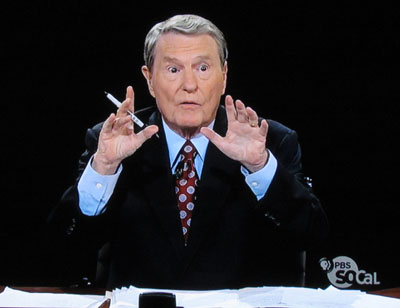
    Damn. Even Glenn is talking about the debate. He thinks that allowing third-party candidates to participate would “highlight just how similar Democrats and Republicans have become, and what little choice American voters actually have on many of the most consequential policies.” Maybe. But keep in mind that the topics of last night’s debate were chosen in advance by Jim Lehrer. Here they are:

    • The Economy – I
    • The Economy – II
    • The Economy – III
    • Health Care
    • The Role of Government
    • Governing

    Penal policy wasn’t there, so it wouldn’t really matter much if Gary Johnson had been on the stage. The problem here was the moderator, not the two-party system.

    However, there will be a stronger case for a third-party presence in the next debate, which includes foreign policy topics. Even if Candy Crowley sticks to the big-ticket topics — Iran, Afghanistan, China, etc. — a third-party candidate like Johnson would have genuinely different things to say. At the same time, I wouldn’t expect too much from this. Ron Paul participated in all of the Republican primary debates, and he didn’t noticeably move the public opinion needle on foreign policy issues. I’m not sure Gary Johnson would either.

    Still, maybe he should have a chance to try. So here’s a question for the hivemind: what’s fair here? The current threshold is that candidates have to score at least 15% in selected polls to be invited to the debates, and this year no one has qualified. Gary Johnson is around 3% nationally. But maybe that’s the wrong threshold. I’m violently opposed to a really small threshold, like 1% or so, because it has the potential to turn the debates into a circus. (Well, more of a circus.) The public really does deserve to get a good close look at the two major-party candidates, since one of them is certain to win the election, and having half a dozen true-believing obsessives on stage doesn’t help that.

    So here’s another idea: the debates should always feature three candidates. Two of them would be the major party candidates and the third would be whoever polls the best among all the minor party candidates. If there were literally no minor party candidates who even appeared on enough state ballots to be serious contenders, then maybe we’d be stuck with two debaters after all. Otherwise, though, we’d always make room for at least one more. Maybe the debate commission would commission its own polls, or maybe it would rely on existing polls. Either way, it would publish the ground rules, and a week before the first debate it would announce who the best performing third-party candidate was.

    This system has the virtue of ensuring that the non-mainstream has at least some representation, but without turning the debates into a free-for-all. Comments?

  • The Greatest Debate Performance in the History of the World!

    I don’t really begrudge conservatives their victory lap today. This campaign has been a grim one for them, with a candidate they don’t like much making gaffe after gaffe and now trailing a president they loathe in virtually every swing state. Romney’s debate win last night is a rare ray of sunshine for them, and it’s no surprise they’re making the most of it.

    But honestly, someone needs to collect some of the best reactions on the right and put them up in one place. Just for laughs. Over at NRO, Peter Kirsanow has a hilarious set of over-the-top bullet points, topped off by this one:

    Romney’s was the best performance of any presidential candidate in the television age.

    Better than the Gipper? Say it ain’t so! And why only the television age? I guess so that Kirsanow isn’t claiming that Romney was better than Lincoln. Or something. I’m not quite sure. In any case, these guys need to watch out. The way they’re crowing about Mitt’s world historical performance, he’s going to have to show up with a halo over his head to meet expectations in the next debate.

  • Numbers, Schmumbers, 9 Percent Is About Half, Isn’t It?


    Here is Mitt Romney last night, criticizing the green energy loan guarantee program that was part of the stimulus bill:

    You put $90 billion into green jobs…And these businesses, many of them have gone out of business, I think about half of them, of the ones have been invested in have gone out of business.

    Close! The DOE 1705 program has approved 33 loans worth about $16 billion. So far there have been three failures (Solyndra, Beacon, and Abound), which works out to a failure rate of…

    Nine percent.

    By dollar volume, these loans will cost a maximum of about $600 million if the government ends up on the hook for the entire loan amount. That comes to maybe 4 percent of the total. By other measures, the failure rate is less than 1 percent.

    Still, close enough for a national debate, I guess! Michael Grunwald tweets that Romney’s people later told him that “Mitt didn’t mean to say half the stimulus-funded green firms failed.” So I wonder what he did mean to say?