• CNN’s Kentucky Fried Instapoll

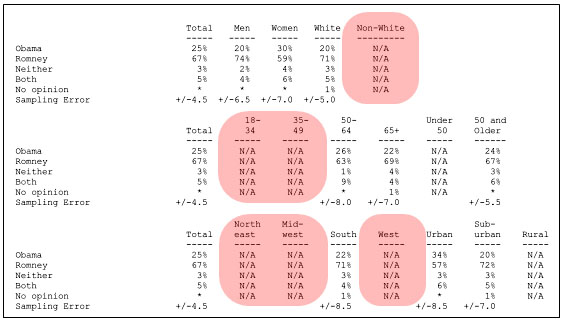
    David Atkins passes along a strange find this morning. CNN’s instapoll of the debate had Romney winning by 67-25. But if you look at the crosstabs, it appears that their sample was entirely white, entirely over 50, and entirely from the South. Maybe there’s a good explanation for this, but it seems a bit odd, no?

    UPDATE: TPM says, “CNN provided us with the internals of the poll, and the demographics of the poll respondents are very much in line with normal standards for randomized sampling.” OK. Though I’m still not sure how you account for such odd crosstabs.

  • The Strange Case of the Trap That Was Never Sprung

    Last night’s debate will end up getting parsed endlessly today, and President Obama is obviously the consensus loser already. I didn’t quite see it that way. Obama was indeed halting and unfocused, which made him appear oddly unprepared, but I thought Romney’s speaking style featured some equally unattractive qualities, ones we’ve seen in prior debates: he was nervously aggressive, spouted faux outrage over every single claim about his plans, repeatedly demanded more time to respond, and just generally oozed a sort of ADHD quality. Apparently, though, this bothers me more than most people.

    But Obama’s lack of focus bothered me too. For example, on three different occasions he claimed that Romney wanted to cut taxes by $5 trillion, and three times Romney said that was wrong:

    Governor Romney’s central economic plan calls for a $5 trillion tax cut….

    First of all, I don’t have a $5 trillion tax cut…..

    Governor Romney’s proposal that he has been promoting for 18 months calls for a $5 trillion tax cut….

    I’m not looking for a $5 trillion tax cut….

    If you believe that we can cut taxes by $5 trillion….

    Let me repeat what I said. I’m not in favor of a $5 trillion tax cut. That’s not my plan….

    This is puzzling. The obvious gimmick here is to repeatedly refer to Romney’s plan as a $5 trillion tax cut, which is sort of brazenly incorrect, as a way of baiting Romney into claiming that he’s going to close loopholes and deductions that will make his plan revenue neutral. And it worked! That’s exactly what Romney did.

    This is a pretty good trap. After getting Romney to talk about deductions and loopholes on three separate occasions, it’s the perfect time to make a withering comment about pigs in a poke and demand that he come clean. Is he going to do away with the home mortgage deduction? The charitable deduction? The healthcare deduction?  Come on, Governor Romney, level with us. No more snow jobs. Let’s hear your real plan, not a bunch of supply-side happy talk.

    It was perfect! Except that Obama never sprung the trap. Oh, he talked about “the math,” and about the “analysts” who say Romney’s plan doesn’t add up, and later on even got off a quip about Romney’s “secret plans.” But he never even tried to seriously hammer Romney on the point he was obviously setting up: What are the deductions you’re targeting? No more hiding. No more secrets. Tell us the other half of your plan.

    This, to me, was the most peculiar single aspect of the debate. It seemed obvious that this was the road Obama was trying to lead Romney down, and it worked. But then he failed to follow up with the killing blow. Why?

  • More Debate Reax

    All the talk on CNN seems to be about how Obama “looked like he didn’t want to be there.” I didn’t really see that myself. Obama certainly wasn’t crisp, which I find a little inexplicable, but that’s about the worst I saw.

    Did Romney come armed with “loads of details”? Not even close. He certainly made an endless number of points, but there weren’t really many facts and figures there. Just a flurry of words. And that old Romney weirdness made a few appearances too. For example, this bit about what he’d cut from the budget: “I’m sorry, Jim, I’m going to stop the subsidy to PBS. I’m going to stop other things. I like PBS. I love Big Bird. Actually I like you, too.”

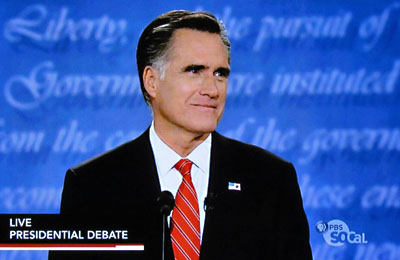
    My sister emailed during the debate to ask, “Can Romney look any more insulting when he’s listening to Obama? It’s like he’s looking at an idiot child.” Romney’s normal debate face strikes me the same way, but I don’t know if it strikes everyone that way. Judge for yourself on the right.

    Andrew Sullivan is beside himself: “This was a disaster for the president for the key people he needs to reach, and his effete, wonkish lectures may have jolted a lot of independents into giving Romney a second look. Obama looked tired, even bored; he kept looking down; he had no crisp statements of passion or argument; he wasn’t there. He was entirely defensive, which may have been the strategy. But it was the wrong strategy. At the wrong moment.” I’ll chalk that up to Sullivan’s mercurial temperament, but now that I’m listening to the talking heads, it seems like there’s a pretty fair consensus that Obama lost by a bunch. I’ll stick to my guns on this: I think Obama lost by a little, but not by much.

    Matt Yglesias tweets: “It’s interesting that conservatives who think they don’t want Mitt to pivot to the center are clearly elated when he did it and it worked.” That’s true. Romney repeatedly noted that he agreed with Obama on various issues and repeatedly took rhetorically moderate positions. For example: “Regulation is essential. You can’t have a free market work if you don’t have regulation.” You sure wouldn’t have heard him say that during one of the primary debates.

    I didn’t see this myself, but Ed Kilgore reports that the CBS instapoll has Romney winning by 46-22. Ouch. Looks like the talking heads called it better than me.

    Noodling a little more about this, I think my disagreement with the media consensus is more over Romney’s performance than Obama’s. I agree that Obama didn’t bring his A game. But I didn’t think Romney was all that good either. Yes, he attacked, but he did it in a curiously hyperactive way, constantly insisting on getting in one more rebuttal and then using it to go over every single point that Obama had just made. I thought that was both confusing and exhausting. Romney also made frequent references to things that Beltway junkies understand but ordinary viewers probably didn’t. The “accounting treatment” for oil companies, for example, or jumping into a point about Dodd-Frank without explaining what Dodd-Frank is. And for what it’s worth, I suspect that Romney won’t do well in the post-debate fact checks either. It won’t be the disaster that Paul Ryan’s convention speech was, but he seemed pretty clearly a little faster and looser with the truth than Obama was.

  • Debate Liveblogging – 3 October 2012

    WRAP-UP: This was an odd, off-kilter debate. Neither Romney nor Obama seemed entirely comfortable. Romney struck me as too hyper, insisting in every segment on going over every single claim Obama had just made. The result was a bunch of laundry lists that never cohered into recognizable points. Obama seemed oddly hesitant and halting, as if he wasn’t quite sure what points he wanted to make. Transcript here.

    Neither candidate landed any serious blows. Obama came the closest, I thought, in the last half hour when he attacked Romney for all his secret plans. After noting that Romney wouldn’t tell us which tax deductions he wants to cut, or how he wants to replace either Obamacare or Dodd-Frank, Obama delivered the best line of the night: “Is the reason that Governor Romney is keeping all these plans secret because they’re too good? Is it because somehow middle-class families are going to benefit too much from them?”
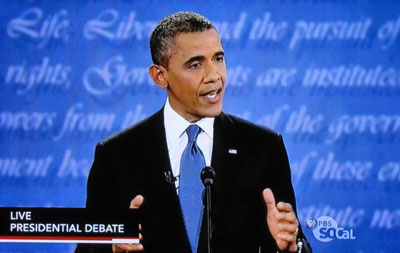
    Did that make up for the fact that Obama was strangely incompetent at attacking Romney on his tax plan in the first half hour? Hard to say. But honestly, going after Romney on the tax deduction front seems pretty obvious, and I don’t understand why Obama never really did it. Sure, he made a crack about “the math,” but he didn’t come straight out and ask Romney if he planned to get rid of the home mortgage deduction, for example. That would have hit home a lot harder than hauling out a wonkish point about the “independent analysts” who say Romney’s plan doesn’t add up.

    Romney avoided any big mistakes, and certainly projected more energy than Obama. But I didn’t think he really delivered any great lines, or got off any really crisp explanations of his policies. I don’t think tonight’s performance will hurt him, but I doubt that it really helps him either.

    Final score: I give Obama a B-, Romney a B.


    Forget all that newfangled Twitter nonsense. We’re going retro with some old school liveblogging of tonight’s debate between Barack Obama and Mitt Romney. Let’s do it.

    10:24 – Lehrer: “We’ve lost a pod.”

    10:23 – Romney is seriously rambling on education.

    10:22 – Obama keeps pulling back when he’s obviously about to attack Romney. Not sure why.

    10:21 – No zingers so far. A few obviously canned lines, but nothing delivered with any zest.

    10:16 – “I love great schools.” Uh huh. “I reject the idea that I don’t believe in great teachers.” Oh please. The faux outrage doesn’t work here.

    10:15 – Obama’s tic of constantly saying “What I’ve said is….” is annoying.

    10:13 – So Lehrer’s approach for every topic is to ask the candidates if they think there are any differences between them? This really isn’t working. It’s just an invitation to give a stump speech.

    10:12 – Romney is answering with a bunch of possible options? Weak. Now retreating to talking points.

    10:11 – Ah, finally the attack on details. Romney won’t tell us what deductions he’ll cut. He won’t tell us what he’ll replace Dodd-Frank with. He won’t tell us what he’ll replace Obamacare with. “Is the reason that Governor Romney is keeping all these plans secret because they’re too good?” Very good line.

    10:04 – Obama’s IPAB explanation wasn’t bad, but his speech is oddly halting and staccato tonight. He just doesn’t seem fully in command of what he wants to say.

    10:03 – “We didn’t cut Medicare. Of course, we don’t have Medicare.” Oops.

    10:01 – “The irony is that we’ve seen this model work really well — in Massachusetts.” Good line.

    9:59 – “Let me tell you exactly what Obamacare did.” Finally! Now let’s see if he does a good job.

    9:54 – Starting to think that the old 60-second limits were a good idea.

    9:53 – Do most viewers know what Dodd-Frank is? Do they know what leverage limits are?

    9:47 – Obama’s attack on vouchers is fairly effective. “If you’re 54 or 55, you might want to listen ‘cause this will affect you.”

    9:44 – Romney’s attack on the $716 billion that Obama cuts from Medicare was OK, but he should have stuck with it instead of flitting around to whatever other attack popped into his mind.

    9:43 – Obama is right that Social Security needs nothing more than modest tweaks.

    9:40 – Romney is all over the map trying to respond to every last thing Obama said.

    9:38 – “It’s actually an accounting treatment….” That’s really not a good phrase to come out of Romney’s mouth.

    9:36 –  So far, neither of these guys has really done a crisp job of explaining their programs.

    9:34 – Romney going all in on the dynamic scoring fairy.

    9:33 – “You’ve been president four years. You said you’d cut the deficit in half. It’s now four years later.” That’s a good line.

    9:27 – “I’m going to stop the subsidy to PBS”? Seriously? “I like PBS. I love Big Bird. Actually I like you, too.” Come on.

    9:25 – Romney’s habit of arguing about how much time he has is something he really needs to overcome. Sounds childish.

    9:20 – Nope, no pushback on loopholes.

    9:18 – Is this $5 trillion tax cut thing a trap for Romney? Now Obama can ask him to list the loophole disclosures to pay for that $5 trillion.

    9:15 – Are these guys trying to be soporific?

    9:09 – A pair of stump speeches. I’ve forgotten what they said already.

    9:01 – CNN has voter reaction in real time! Squiggly lines!

    8:58 – David Gergen says it’s all about who’s “looser.” That’s bad news already for Romney.

  • Who’s Afraid of the Fiscal Cliff?


    Sarah Binder writes today that she doesn’t expect this year’s lame duck session of Congress to conclude a deal that will avert the “fiscal cliff” our legi-lemmings are set to march over on December 31. She has three reasons, and the first two boil down to the fact that Republicans aren’t likely to suddenly stop being crazy just because we had an election, even if Obama wins.1 I can buy that. But here’s reason #3:

    Third, I’m somewhat skeptical that Democrats would have the political fortitude to go over the cliff. Democrats could have stuck to their guns in the lame duck of 2010, forcing Republicans (still in the minority) to swallow an increase in upper income tax rates as the price for extending the middle class tax cuts. That’s not the strategy Democrats chose then, and it strikes me as equally unlikely in 2012 with a GOP House majority. Going over the cliff requires Democrats to take ownership of raising taxes on the middle class at Christmas. That might be the strategically wise move for bolstering Democrats’ leverage come January. But it also strikes me as an electorally doubtful holiday gift to voters.

    I’m not so sure about that. In this case, I think I’m with the folks who like to refer to this event as a fiscal slope rather than a fiscal cliff. Their general point is that we don’t all suddenly pay thousands of dollars in taxes and cut billions of dollars in spending at the stroke of midnight on January 1st. This stuff all phases in over time.

    That’s true, and I doubt very much that there would be any serious consequences to doing a deal in February or March instead of December. In the particular case of taxes, the only thing that happens on January 1st is that withholding rates would go up slightly — and maybe not even that. The IRS has a fair amount of latitude to leave withholding rates alone for a few months if it wants to. Either way, this means that Democrats don’t really have to worry about “owning” the expiration of the Bush tax cuts for quite a while. (The payroll tax holiday also expires on December 31, but that was always unlikely to be extended anyway. It doesn’t have much to do with the fiscal cliff.)

    For a few months, then, taxpayers won’t see much impact. Maybe none at all. As a result, I think Democrats could pretty safely stick to their guns and extend negotiations into 2013 without much risk. At that point, with the Bush tax cuts gone and rates back up to their Clinton-era levels, they’ll still have to convince Republicans to introduce a bill that cuts only the middle-income rates, not the top marginal rates, and that won’t be easy. But Republicans will be under as much pressure as Democrats by that point, and they might very well be willing to do a deal.

    In short, as long as the composition of Congress doesn’t change dramatically, I don’t think the calculus is much different before and after January 1st. The cliff doesn’t really start to get scary until later in the year.

    1This entire post is predicated on the likelihood that Obama will win reelection and the House will remain fairly solidly in Republican hands. If either of those doesn’t happen, the legislative calculus changes completely.

  • Mitt Romney Casually Tosses Out Yet Another Tax Plan

    This is a bit of a placeholder post. Yesterday Mitt Romney told a Denver TV station that he had some new ideas about his plan to reduce tax deductions in order to make up for the 20% across-the-board rate cuts he’s promised:

    As an option you could say everybody’s going to get up to a $17,000 deduction; and you could use your charitable deduction, your home mortgage deduction, or others — your healthcare deduction. And you can fill that bucket, if you will, that $17,000 bucket that way. And higher income people might have a lower number.
    I haven’t commented on this yet for several reasons. First, it was casually tossed out. It’s not clear if Romney is serious about this. Second, it’s a little unclear exactly what he meant: a $17,000 max on deductions from your gross income, or a $17,000 max on how much your tax bill can be reduced? Third, it’s still missing crucial details. When Romney says “healthcare deduction,” is he talking about the exclusion of healthcare benefits from your taxable income? Is that $17,000 cap for single filers or couples? Does it include the personal exemption and dependent exemptions? Etc. Fourth, he didn’t provide a number for higher income people, just a hint that it might be lower than $17,000. Fifth, there’s no telling how the math works out on this.

    The first four of these things require more detail from Romney. The fifth requires an analysis from the Tax Policy Center or some similar outfit. In the meantime, there’s not a lot of point in commenting on something with so many missing pieces.

    So for now I’ll limit myself to saying that it’s highly unlikely that the math works out here. Josh Barro thinks that virtually everyone making under $200,000 would see either a net tax decrease or no change at all under this proposal. And we already know that even if every single deduction for those making over $200,000 were completely eliminated, they’d see a net tax decrease too. So no matter how Romney fills in the blanks, this would amount to a net tax decrease. There’s just no way that it becomes revenue neutral, as Romney has promised, without a massive sprinkling of dynamic scoring fairy dust.

  • One Last Encore for the Great “Statistical Tie” Fallacy

    If Ed Kilgore can steal an old post of mine about the whole “statistical tie” fallacy, well, I can too. I was going to do it anyway because Nicholas Beaudrot told me to, so here it is:

    The idea of a “statistical tie” is based on the theory that (a) statistical results are credible only if they are at least 95% certain to be accurate, and (b) any lead less than a poll’s margin of error is less than 95% certain.

    There are two problems with this: first, 95% is not some kind of magic cutoff point, and second, the idea that the MOE represents 95% certainty is wrong anyway. A poll’s MOE does represent a 95% confidence interval for each individual’s percentage, but it doesn’t represent a 95% confidence for the difference between the two, and that’s what we’re really interested in.

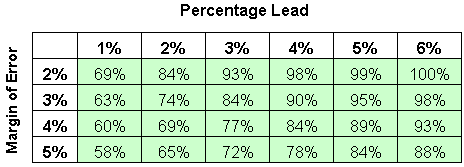
    In fact, what we’re really interested in is the probability that the difference is greater than zero — in other words, that one candidate is genuinely ahead of the other. But this probability isn’t a cutoff, it’s a continuum: the bigger the lead, the more likely that someone is ahead and that the result isn’t just a polling fluke. So instead of lazily reporting any result within the MOE as a “tie,” which is statistically wrong anyway, it would be more informative to just go ahead and tell us how probable it is that a candidate is really ahead. Here’s a table that gives you the answer to within a point or two:

    Pretty handy, no? Most national polls have an MOE of about 3%, so you can usually just use that row. NBC, for example, puts Obama ahead of Romney right now by 49-46%. So what are the odds that Obama is really ahead, and this isn’t just a statistical fluke? Answer: 84%.

    But now for the bad news: As fun as it is to haul this thing out every few years, it’s obsolete. If you want to know who’s ahead, there are now loads of sites that aggregate multiple polls in various ways to provide estimates with far less margin of error than any single poll. If Pollster or RCP says that Obama is ahead by three points, then the odds are that he really is ahead by three points. There’s still plenty of room for various kinds of error in these poll-of-polls averages, but pure sample error isn’t really one of them any more.

    For the record, as of today Pollster has Obama ahead by 4.3%; RCP has Obama ahead by 4.0%; Sam Wang’s meta-margin has Obama ahead by 5.06%; and Nate Silver has Obama ahead by 3.9%. I think it’s pretty safe to say that, at this moment in time, Obama is comfortably ahead.

  • Good News on Climate Change…and Not So Good News

    Chris Mooney has a piece for us today arguing that public opinion is turning around on climate change. What’s more, he says, recent studies suggest that climate can even be a winning political issue:

    The first of these studies emerged in 2011 from Stanford pollster Jon Krosnick and his colleagues….Both Democrats and independents strongly favored a green candidate over a neutral one, while for Republicans it was basically a wash—neither a pro or anti-climate candidate moved them much. “By taking a green position on climate, candidates of either party can gain votes,” Krosnick’s team concluded.

    ….Their findings were reinforced earlier this year by researchers at Yale and George Mason who, in a March 2012 survey, similarly found that taking a stand on climate has the potential to motivate Democratic and independent voters, without causing damage among Republicans.

    …. In a survey of 1,204 likely voters in May of 2012, [Andrew] Maxfield found that a “clean energy” candidate fared better than an “all-of-the-above” candidate who supported a variety of energy choices—coal, drilling, and also clean energy. Maxfield then went on to test a variety of climate messages—and the upshot, he says, is that “if you feel strongly about climate change, there is a way to talk about it that voters will understand and appreciate”—especially if candidates focus on recent extreme weather. “I was surprised at the strength of that, and the extent to which voters had begun to recognize the severe weather, and experience it,” Maxfield says. 

    Unfortunately, I remain skeptical. In a vacuum, supporting green policies has always been a popular position. And it’s always been true that there are good ways to talk about climate change and bad ways. I’m not sure anything big has changed here.

    The problem is that you don’t always get to talk about political issues the way you want to. Your opponents get to talk about them too. And they won’t be shy about labeling virtually any serious green policy as a price hike for consumers and a regulatory burden for business. What’s more, conservatives have an unusual advantage when they say this: it’s actually true. Things like carbon taxes and cap-and-trade policies really will increase the price of energy for consumers. That’s the whole point. Conversely, if you limit yourself to generally popular issues like CAFE standards and building more solar plants in the desert, voters will support it, but only because the price hike is small enough (and hidden enough) that it has only a modest impact on climate change in the first place.

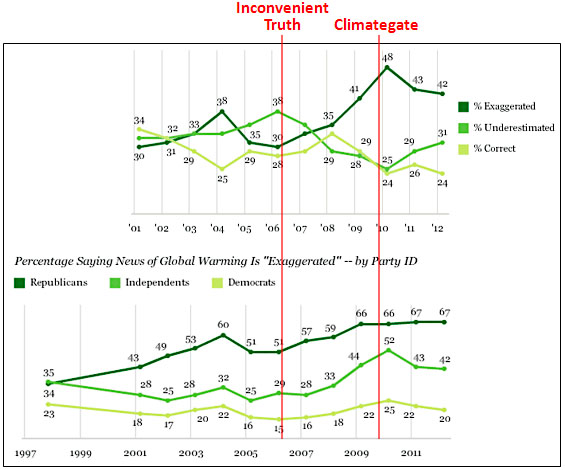
    What really matters, then, is what happens when potential voters are presented with messaging from both sides. To get an idea of how effective this is, take a look at the Gallup polls below. The first poll asks people if the threat of global warming is generally exaggerated or not, and it hits bottom in 2006, at about the time of the release of Al Gore’s An Inconvenient Truth. Then it starts to rise as conservatives fight back, reaching a peak in 2010, shortly after the release of the “Climategate” emails. It’s gone down since then, which is good news, but it’s still way higher than it was even five years ago. Likewise, the bottom chart shows that even Democrats and Independents are far more likely to think that news of global warming is exaggerated than they were back in 2006.

    So there’s a long way to go before public opinion is anywhere near where it needs to be. We need to get to a point where even if people know that it means an increase in gasoline and electricity prices — even if their noses are rubbed in it — they still support serious green policies. This is the work ahead of us.

  • Income Inequality and the Great Crash of 2008

    I’ve mentioned before my rough-and-ready theory of the 2008 financial crisis:

    1. Income inequality goes up.
    2. As a result, earnings of the middle class become sluggish….
    3. And earnings of the rich skyrocket, a trend reinforced by lower tax rates on both labor and capital income.
    4. Rich people eventually run out of sensible things to invest all this money in (because consumer demand is sluggish, see #2), so they get stupid.
    5. Stupid money finances stupid loans to middle-class borrowers who can’t afford them (because their incomes are sluggish, see #2).
    6. This all works great until it doesn’t. When it doesn’t, the economy goes kablooey.

    In the aughts, #5 took the form of increasing corruption in the mortgage loan market and increasingly baroque Wall Street financial concoctions to package up all those corrupt loans. It worked great for about five or six years, followed by a Wile E. Coyote moment where the economy was suspended in limbo for a year or so, followed by an epic crash that we still haven’t dug our way out of.

    I’m just a blogger, though, so there’s no special reason you should take me seriously. However, a reader alerted me to a recent National Journal piece by Jonathan Rauch that suggests this theory is gaining ground among serious economists:

    Once in a while, a new economic narrative gives renewed strength to an old political ideology. Two generations ago, supply-side economics transformed conservatism’s case against big government from a merely ideological claim to an economic one….Something potentially analogous is stirring among the Left. An emerging view holds that inequality has reached levels that are damaging not only to liberals’ sense of justice but to the economy’s stability and growth. If this narrative catches on, it could give the egalitarian Left new purchase in the national economic debate.

    ….As Christopher Brown, an economist at Arkansas State University, put it in a pioneering 2004 paper, “Income inequality can exert a significant drag on effective demand.” Looking back on the two decades before 1986, Brown found that if the gap between rich and poor hadn’t grown wider, consumption spending would have been almost 12 percent higher than it actually was.

    ….So inequality might suppress growth. It might also cause instability. In a democracy, politicians and the public are unlikely to accept depressed spending power if they can help it….They might, for example, create policies allowing banks to write flimsy home mortgages and encouraging consumers to seek them….That is not a bad description of what happened in the 1920s and again during these past few years. “When—as appears to have happened in the long run-up to both crises—the rich lend a large part of their added income to the poor and middle class, and when income inequality grows for several decades,” the IMF’s Michael Kumhof and Romain Rancière wrote, “debt-to-income ratios increase sufficiently to raise the risk of a major crisis.”

    But wait. Which is it? Does inequality depress demand? Or does it inflate credit bubbles that maintain demand? Unfortunately, the answer can be both. If inequality is severe enough, there could be enough of it to cause the country to inflate a dangerous credit bubble and still not offset the reduction in demand.

    And, no, we’re not finished. Inequality may also be destabilizing in another way. “Of every dollar of real income growth that was generated between 1976 and 2007,” Rajan wrote, “58 cents went to the top 1 percent of households.” In other words, for decades, more than half of the increase in the country’s GDP poured into the bank accounts of the richest Americans, who needed liquid investments in which to put their additional wealth. Their appetite for new investment vehicles fueled a surge in what Arkansas State’s Brown calls “financial engineering”—the concoction of exotic financial instruments, which acted on the financial sector like steroids.

    The whole thing is worth a read. This model of inequality and financial crises has some powerful proponents, but it’s hardly a mainstream consensus at this point. It’s worth keeping an eye on, though. There might be some serious explanatory power here.