• Is the Fed Really Buying Three-Quarters of All Treasury Debt?

    The Federal Reserve building.<a href="http://www.shutterstock.com/pic.mhtml?id=102014596">spirit of america</a>/Shutterstock

    Here’s Mitt Romney responding to a rich donor worried that the United States is heading toward bankruptcy:

    Audience member: The debates are gonna be coming, and I hope at the right moment you can turn to President Obama, look at the American people, and say, “If you vote to reelect President Obama, you’re voting to bankrupt the United States.”…

    Romney: Yeah, it’s interesting…the former head of Goldman Sachs, John Whitehead, was also the former head of the New York Federal Reserve. And I met with him, and he said as soon as the Fed stops buying all the debt that we’re issuing—which they’ve been doing, the Fed’s buying like three-quarters of the debt that America issues. He said, once that’s over, he said we’re going to have a failed Treasury auction, interest rates are going to have to go up. We’re living in this borrowed fantasy world, where the government keeps on borrowing money. You know, we borrow this extra trillion a year, we wonder who’s loaning us the trillion? The Chinese aren’t loaning us anymore. The Russians aren’t loaning it to us anymore. So who’s giving us the trillion? And the answer is we’re just making it up. The Federal Reserve is just taking it and saying, “Here, we’re giving it.” It’s just made up money, and this does not augur well for our economic future.

    Italics mine. So is this true? Is the Fed really buying three-quarters of all Treasury debt?

    The short answer is no. The longer answer is that the Fed has engaged in two rounds of quantitative easing and just recently announced a third. The first one, which started at the end of 2008, mostly involved the purchase of mortgage-backed securities. Purchase of Treasury debt was fairly small. The second round, which took place in the first half of 2011, did consist mostly of Treasury debt. It amounted to $600 billion, and led to a spate of horror stories about how the Fed was purchasing 61 percent of all Treasury issues. Since then, however, the Fed has maintained a steady level of Treasury debt, and the third round of quantitative easing, like the first, is mostly focused on the purchase of mortgage-backed securities. This year, as CNBC reports, the Fed has been a modest player in the market for Treasury debt:

    Mom-and-pop investors, and not the Federal Reserve, have been the ones most responsible for driving the mad dash to government debt, according to newly released data…The demand among average investors has swelled so much, in fact, that they bought more Treasurys in the first quarter than foreigners and the Fed combined.

    Households picked up about $170 billion in the low-yielding government debt during the quarter, while foreigners increased their holdings by $110 billion. The Fed, meanwhile, actually slightly decreased its net holdings.

    So Romney is, once again, plucking a scary number he seems to have heard from a tea party symposium somewhere and mindlessly regurgitating it to a receptive audience. But he’s wrong. There was a period of about six months during 2011 when the Fed really was hoovering up a big share of all Treasury debt. But that was a one-time deal more than a year ago, and since then the big buyers of Treasury bonds have mostly been the usual suspects: foreigners and US households.

    Read the full transcript of Romney’s remarks at the private fundraiser.
  • It Turns Out That Mitt Romney Really Does Enjoy Firing People


    Reading a bit more through the full transcript of the Romney fundraiser, we come to this passage:

    Audience member: The government in Washington right now is just permeated by cronyism, outright corruption….And I think people are fed up with that….Nancy Pelosi was supposed to give us an honest Congress and has given us just the opposite as speaker. And I think that’s a campaign issue that can work well. I’m optimistic that you’ll be elected president. And my recommendation would be clean house, immediately. The SEC, the CFTC are disaster areas.

    Romney: I wish they weren’t unionized, so we could go a lot deeper than you’re actually allowed to go. Yeah.

    Sadly, Romney didn’t elaborate on just which civil service slackers he wishes he could fire with the stroke of a pen, but this might be a fruitful area for someone to explore further. Does he specifically want to fire lots of people at the SEC and the CFTC? Or just fire lots of low-level workers in general? Inquiring minds want to know.

  • And Now, the Weirdest Excerpt From the Romney Video


    You’ve seen all the damaging parts of the secret Romney video. Now watch and be amazed at the weirdest part:

    Audience member: How are you going to win if 54 percent of the voters think China’s economy is bigger than ours? Or if it costs 4 cents to make a penny and we keep making pennies? Canada got it right a month ago. Why isn’t someone saying, “Stop making pennies, round it to the nearest nickel?” You know, that’s an easy thing, compared to Iran. I want to see you take the gloves off and talk to people that actually read the paper and read the book and care about knowing the facts and acknowledges power. As opposed to people who are swayed by, you know, what sounds good at the moment. If you turned it into like, “Eat what you kill,” it’d be a landslide. In my humble opinion.

    See? This is the kind of stuff you have to put up with at these events. I mean, what the hell is this guy even talking about? It’s a mystery. But whatever it is, I’ll bet he thinks it’s the wisdom of ages. And since Romney wants his $50,000, he has to smile and pretend it makes sense. Welcome to politics.

  • What’s Behind the EPA’s New 4-Gallon Minimum Purchase Mandate?

    Rep. Jim Sensenbrenner (R–Wisc.) is fuming:

    The latest mandate handed down from the Environmental Protection Agency (EPA) is so ridiculous, even I was shocked. The EPA has now mandated how much gasoline you must buy at certain gas stations. Say hello to the Obama Administration’s four gallon minimum.

    So what’s this all about? Well, the ethanol industry has been lobbying for a quite a while to sell E15 — a blend of 85% gasoline and 15% ethanol. Why? Because they want to sell more ethanol, and E15 contains more ethanol than the current E10 blend. But they’re not the only ones in favor of E15. The Renewable Fuel Standard, passed in 2007, requires ever greater use of ethanol, and refineries are afraid that before long they won’t be able to meet the RFS standards unless they can sell the E15 blend.

    But if the ethanol industry is in favor of E15, you can probably guess that the petroleum industry is against it. And you’d be right. After all, 5% more ethanol means 5% less petroleum. Gasoline sales have been declining for the past few years anyway, and the petroleum industry is none too happy about losing even more market share if E15 blends come onto the market.

    Both the ethanol and petroleum industries are so odious that it’s hard to pick sides here. As it turns out, though, the anti-E15 crowd has some intriguing arguments. The primary one is that E15 only works in cars manufactured after 2001. It doesn’t work in older cars, it doesn’t work in boats, and, as the Outdoor Power Equipment Institute will tell you, it doesn’t work in devices like chain saws, utility vehicles, and lawn mowers. In fact, it can destroy those things if you use it accidentally.

    But it gets worse. Most gas stations don’t want to install new tanks just for E15. Instead, they’re installing blender pumps, which mix the ethanol and gasoline together in the right proportion depending on which one you want. But there’s a problem: if you pump E15 into your car, about a third of a gallon remains in the fueling hose when you’re done. If someone comes along, switches to E10, and buys a single gallon for their lawnmower, they’ll get a third of a gallon of E15 and two-thirds of a gallon of E10. That comes to about 11.7% ethanol, and that might be enough to set your lawnmower on fire.

    So the EPA produced a new rule: if you sell E15, you have to require your customers to buy at least four gallons of gas regardless of what blend they’re buying. That’s a big enough purchase that the residual fuel in the hose is too small to matter. So let’s count up the problems here:

    • Generally speaking, corn ethanol isn’t any better for the environment than petroleum. So forcing more use of ethanol doesn’t make much sense in the first place.
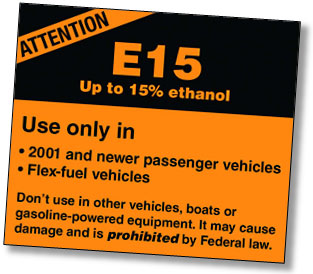
    • E15 can destroy small engines. The EPA requires gas stations to post a warning sign, but we all know how much attention people pay to warning signs in gas stations. We’re probably going to end up with a fair number of fried snowblowers and ATVs before this is all over.
    • People who buy gasoline for outdoor equipment usually only need a gallon or two. Ditto for motorcycles, many of which have gas tanks smaller than four gallons. So at gas stations that sell only E15/E10, these folks won’t be able to fill up at all because they won’t be able to meet the four-gallon minimum.

    These aren’t actually gigantic problems, and if ethanol truly had a lower carbon footprint than gasoline I might figure that it was worth going through some minor growing pains to encourage greater use of it. But it’s really not. So to my surprise, I find myself agreeing with Sensenbrenner. If we ever get to the point where we can mass-produce ethanol that’s truly better for the environment than petroleum (cellulosic ethanol, cane ethanol, etc.), then it might be worth going through all this. Until then, it’s probably not.

    And the Renewable Fuel Standard that started all this? It wasn’t such a great idea in the first place, and as long as it mandates increased use of corn ethanol it never will be. It deserves a thorough revision.

  • Why Are the Rich So Damn Angry?

    Earlier this morning I suggested that Mitt Romney’s real problem with his secret fundraising video would come from the tea party zealots on the right demanding that his reaction to all the criticism should be to double down on his disdain for the moochers. If he listens to them, he’ll be stuck defending a pretty unpopular position, as Greg Sargent points out:

    In July, Pew asked Americans what they think about the amount lower income people pay in taxes. Only 20 percent think they pay too little, versus 34 percent who say they pay a fair amount and 37 percent who say they pay too much — a total of 71 percent.

    Pew also tells me that only 23 percent of independents, and 18 percent of moderates, say low income people pay too little in taxes, while big majorities of both say they pay a fair amount or too much.

    The vast majority of the 47% who pay no federal income tax are either elderly, very poor, or families with low-incomes. Most people — including moderate, middle-class independents — simply don’t agree that it’s right to characterize them as layabouts who refuse to take “personal responsibility and care for their lives.”

    As it turns out, this reality is obvious to a lot of conservatives too. Although a few of the mouth breathers are indeed urging Romney to stick to his guns, a pretty fair sample of conservatives are telling Romney that he’s wrong and urging him to back off. This appears to be partly for political reasons (do you really want to piss off elderly people on Medicare?) and partly for ideological reasons (tax credits for the poor are a conservative idea designed to make low-paying jobs more attractive). Either way, it suggests that maybe Romney won’t have quite the tea party problem that I thought. It all depends on which wing of the conservative movement turns out to be more powerful.

    On another note, David Frum writes today about something I was chatting about on the phone with my sister last night:

    The background to so much of the politics of the past four years is the mood of apocalyptic terror that has gripped so much of the American upper class….And what makes it all both so heart-rending and so outrageous is that all this is occurring at a time when economically disadvantaged Americans have never been so demoralized and passive, never exerted less political clout.

    ….Yet even so, the rich and the old are scared witless! Watch the trailer of Dinesh D’Souza’s new movie to glimpse into their mental universe: chanting swarthy mobs, churches and banks under attack, angry black people grabbing at other people’s houses.

    It’s all a scam, but it’s a spectacularly effective scam. Mitt Romney tried to make use of the scam, and now instead has fallen victim to it himself.

    The last 30 years in the United States have been better for the rich than any other time or place in human history. High-end incomes are up spectacularly. Tax rates are down. Welfare reform has been the law of the land for 15 years. Private sector unions are all but extinct. The wages that business owners pay to their employees have been virtually flat for more than a decade. For the rich, it’s been a golden age. And yet, America’s wealthy class nonetheless seems to be in an absolute fury. The looters want their money, the government is embracing socialism, the president who rescued the banking industry hates them, and their tax dollars are all going to support a bunch of freeloaders and shirkers.

    Where does this come from? Why are the very people who have done the best so angry? It’s mystifying.

  • A Final Look at the Convention Bounce: It’s All Obama

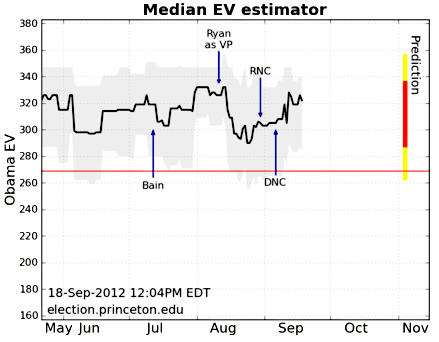
    It’s now been nearly two weeks since the end of the conventions, and before long the polls will start to show the effects of the secret Romney video. So this seems like a pretty good time to check in on Sam Wang for a final look at what kind of convention bounce we saw. And luckily for me, Sam fixed a technical glitch in his polling feeds today, providing us with a corrected look at his estimated electoral vote count. Here it is:

    Bottom line: The net effect of both the RNC and DNC appears to be a bounce from about 300 electoral votes for Obama to 322 electoral votes. That’s a pretty big bounce.

    By the way: Some of you might be wondering why I usually use Sam Wang’s forecast rather than all the others that are out there. The reason is that back in 2008 I ran a pool to predict the results of the election, and Sam was one of the co-winners. For now, then, I consider him the official election forecaster for this blog. This is, needless to say, a tenuous position, and requires him to predict really well this year too if he wants to hold on to this prestigious post. But that’s life in the free market, no? Red in tooth and claw and all that. For now, though, he’s top dog.

  • What the Secret Romney Video Tells Us About His People Skills

    Here’s an interesting side note about what Mitt Romney’s secret fundraiser video tells us: he’s not very good at handling his supporters.

    Here’s the thing: political fundraisers are full of true believers. Those are the kind of people willing to give big bucks to campaigns, after all. What’s more, these true believers often have fairly extreme political views, and they want you to have those extreme views too. No namby-pamby candidates for them! They always think you should get tougher, more aggressive, that you should really fight back against those swine on the other side. It’s like being buttonholed in a bar by a guy who’s had a few beers and insists on telling you what’s really wrong with America.

    This is the case on both left and right. And a politician with even a tenuous grasp on how to handle this kind of pressure knows what to do: you redirect. You can’t tell these folks they’re crazy, of course. They’re true believers! And they’re rich! You need their money. But you can’t really agree with them either. That’s too dangerous. Word gets around, even if nobody there is secretly recording the event. So you soothe. I get where you’re coming from. And then you back away. Maybe you blame it on polling data (“our focus groups show that voters don’t respond well to that, and you do want to win, don’t you?”) Maybe you change the subject. Maybe you introduce some interesting new fact that they’ve never heard of. Maybe you appeal to authority. Or you outsource your response to a surrogate later on so that you’re not personally connected with it. Whatever.

    But you handle them. Except that apparently Romney can’t. And that’s pretty weird, isn’t it? He has more experience handling the titanic egos of rich people than anyone in politics. If anyone should be able to stroke big-dollar donors without saying anything stupid, it ought to be Mitt Romney.

    But he can’t. Outside the business world, his people skills are apparently so poor that even when he’s faced with truly harebrained ideas, his only defense is to simply agree. He seems to have no idea how to handle strong-minded people whose support he needs. This is, needless to say, not an especially good character reference for someone who’s running for president of the United States.

  • Romney: We Should Just Kick the Can Down the Road in the Middle East

    In the latest episode of the Secret Romney Tapes™, our hero decides to tackle the Middle East. Basically, he trashes a two-state solution because he thinks the Palestinians have “no interest whatsoever in establishing peace.” This is not really surprising. These days, it’s a fairly standard GOP position. But national candidates usually aren’t quite so raw about what that implies. Romney is:

    So what you do is, you say, you move things along the best way you can. You hope for some degree of stability, but you recognize that this is going to remain an unsolved problem….and we kick the ball down the field and hope that ultimately, somehow, something will happen and resolve it.

    In its way, this is actually sort of refreshing. If, as current Republican orthodoxy holds, the Palestinians just flatly can’t be dealt with, but you aren’t quite willing to go the full monty and agree that Israel should simply annex the West Bank permanently, what’s left? Nothing. You simply ignore the whole thing and let Bibi Netanyahu do whatever he wants.

    This doesn’t sound very presidential, though. That’s why Romney’s official position sounds like this:

    As president, Mitt will reject any measure that would frustrate direct negotiations between Israel and the Palestinians. He will make clear to the Palestinians that the unilateral attempt to decide issues that are designated for final negotiations by the Oslo Accords is unacceptable. Etc.

    Actually, these two statements are exactly the same. “Direct negotiations” means that nothing happens. The Israelis and the Palestinians don’t have the slightest chance of reaching an agreement without outside help. And while the reference to the Oslo Accords sounds nicely multilateral, it’s actually a dead letter. You don’t have to read very far between the lines of the official statement to come up with the blunter version that Romney gave to the millionaire donors in Boca Raton.

    The only difference is that until now, you had to argue that doing nothing was the obvious implication of Romney’s position, and the Romney folks could reply with an explosion of word salad suggesting that their guy really did have a plan. Now they can’t do that. In private, he’s now admitted straight up that he just plans to ignore the whole thing. In fact, he’s so completely determined to ignore the whole thing that when a former secretary of state told that there might actually be a prospect for a settlement between the Palestinians and the Israelis, “I didn’t delve into it.”

    Presidential? Not really. Perfectly in sync with the modern Republican Party? You betcha!