• iPhone Now Playing Catch-Up


    So the new iPhone 5 has been announced, and the big news is that it has a larger screen than the old iPhone and will support 4G LTE.

    In other words, Apple is now chasing other smartphone vendors, who have had large screens and LTE for over a year. Surely this does not bode well for Apple’s post-Jobs future?

    UPDATE: Mostly via Twitter, many people have informed me that Apple has been playing feature catch-up for a long time with the iPhone. So this is nothing all that new. The iPhone’s success isn’t really predicated on specific features, but on the quality of its UI/ecosystem/usability as a whole.

    Point taken. I still think today’s announcement might be a bit of a warning sign for the long-term growth of the iPhone brand, but maybe not.

  • Thanks to Obamacare, the Ranks of the Uninsured Fell This Year


    Jon Cohn explains today that although most of Obamacare doesn’t take effect until 2014, parts of it are already working:

    For the first time in three years, the proportion of Americans with health insurance rose, from 83.7 percent in 2010 to 84.3 percent in 2011.

    And what explains the shift? The breakdown by age offers some clues. Relative to last year, the percentage of young adults with health insurance rose by 2.2 percent. That was the largest increase of any group. And it was the second year in a row that coverage among young adults increased….As you probably know, the Affordable Care Act allows young adults to enroll on their parents’ health insurance plans if they have no access to coverage on their own. That provision surely doesn’t account for all of the young adults getting coverage. But it almost certainly explains a lot of it.

    Good job, Obamacare! I’ll note in passing that this particular provision of Obamacare is quite popular with the public, so naturally it’s one of the provisions that Mitt Romney says he’d keep. He just won’t explain how. But I’ll give him a hint: the free market declined to allow young adults to enroll on their parents’ policies for 80 years before the passage of Obamacare. If Romney really likes this idea, it’s going to take something more than the free market to keep it around.

  • Why Do People Hate Teachers Unions?

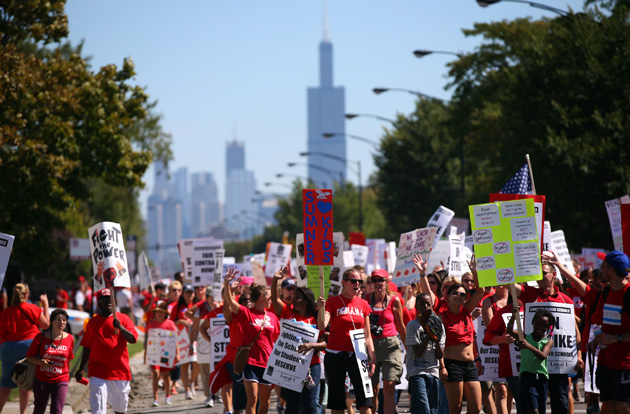
    Chicago Teacher Union members rally near Marshall High School in Chicago on Wednesday. Read our explainer on what's happening with the Chicago teacher strike.E. Jason Wambsgans/Chicago Tribune/ZUMA


    Doug Henwood on the Chicago teacher strike:

    A lot of otherwise liberal people really hate teachers’ unions. I’ve been wondering why they’re so singled out for contempt. It struck me last night that perhaps the thinking is that it’s ok for autoworkers or janitors to unionize because they’re pretty much interchangeable from an educated upper-middle-class perspective. Teachers, though, are supposed to be “professionals,” and any kind of solidarity among them offends an individualistic, meritocratic sensibility that believes in (often “objective”) measures of evaluation.

    I really, really doubt this. It’s true that teachers themselves were sometimes reluctant to unionize in the early days for exactly this reason: they didn’t think of themselves as the kind of blue-collar workers who manned a picket line and chanted slogans at their bosses. But I don’t think anyone else gives this a moment’s thought. Matt Yglesias responds to Henwood:

    The most salient difference, completely absent from his armchair psychologizing, is surely that public school teachers work for the government. If AT&T workers get a better deal for themselves, that may well mean a worse deal for people who bought AT&T stock in past years but I’m not going to cry on their behalf. By contrast, if Chicago public school teachers get a better deal for themselves that may well mean a worse deal for Chicago taxpayers.

    Indeed, what baffles me about these discussions is the tendency of labor’s alleged friends to simply refuse to look this reality in the face and instead insist that any hostility to specific union asks must secretly reflect the skeptic’s hostility to the existence of the union or its members.

    As it happens, plenty of Chicagoans, liberal and otherwise, do support the teacher strike. But a lot of others don’t, and I suspect that general antipathy toward teachers unions isn’t hard to explain. First, teachers are viewed as pretty well paid. In the past, teachers were trying to catch up to what similar private sector workers earned, but they’ve mostly accomplished that. Total comp for urban teachers these days is pretty good.

    Second, they work 180 days a year. Third, they get pretty good benefits. Fourth, teacher unions are viewed as dead-end opponents of any kind of accountability or reform.

    Now, you can argue about all these things. Teachers still aren’t paid as much as a typical college grad. They’re paid less than they are in most other countries. Their benefits aren’t any better than those for most white-collar workers (it’s police and fire fighters who generally get the primo benefit packages). And “reform” can be just a thinly disguised attack on teachers themselves.

    Nonetheless, this perception, I suspect, is pretty widespread. Add to that the fact that teacher salaries do indeed come out of taxpayers’ wallets—taxpayers whose incomes haven’t risen in a decade—and that teacher strikes hurt people’s children, and is it any wonder that teachers unions aren’t always especially beloved? I agree with Matt: you don’t really need a lot of armchair psychologizing to figure this out.

  • There’s Nothing Left That the Romney Campaign Respects

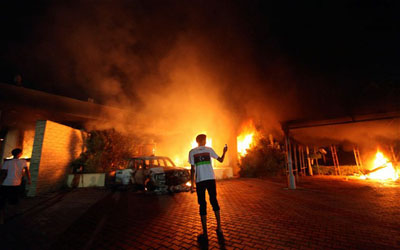
    First Read responds to the Romney campaign’s contemptible rush to gain political advantage from the attacks on U.S. embassy personnel in Egypt and Libya last night:
    Yesterday we noted that Mitt Romney, down in the polls after the convention, was throwing the kitchen sink at President Obama. Little did we know the kitchen sink would include — on the anniversary of 9/11 — one of the most over-the-top and (it turns out) incorrect attacks of the general-election campaign….This morning, we learned that the U.S. ambassador to Libya, Chris Stevens, and others died in one of the attacks.

    Bottom line: This was news-cycle campaigning by the Romney campaign gone awry. Why didn’t the Romney campaign wait until it had all the facts? On his overseas trip in the summer, Romney was so careful not to criticize Obama while on foreign soil. But how much time do you give an administration to work through a diplomatic and international crisis before trying to score immediate political points? You’d expect the Sarah Palins of the world to quickly pounce on something like this, and she predictably did. But a presidential nominee running for the highest office in the land? After the facts have come out, last night’s Romney statement only feeds the narrative that his campaign is desperate.

    The Romney campaign was so eager to issue its statement of outrage that they initially scheduled it for release at 12:01 am. Why? So that no one could claim they were trying to score political points on 9/11. But eventually their giddiness got the better of them and they let it go late Tuesday night.

    These guys just don’t know when to quit. I don’t think there’s anything left that they won’t say or do if they think it might give them a 1% pop in the polls. They really don’t respect anything at all anymore.

  • Romney Campaign Attacks Obama Over Mythical Apology to Embassy Attackers


    From Mitt Romney tonight:

    I’m outraged by the attacks on American diplomatic missions in Libya and Egypt and by the death of an American consulate worker in Benghazi. It’s disgraceful that the Obama Administration’s first response was not to condemn attacks on our diplomatic missions, but to sympathize with those who waged the attacks.

    What actually happened:

    Before the protesters attacked the compound, the U.S. mission in Cairo [] said in a statement: “The Embassy of the United States in Cairo condemns the continuing efforts by misguided individuals to hurt the religious feelings of Muslims — as we condemn efforts to offend believers of all religions.”

    The embassy statement was not a response to the attacks because it was issued several hours before the attacks even occurred. The Washington Post helpfully passes along the actual first response to the attacks from the Obama administration:

    “I condemn in the strongest terms the attack on our mission in Benghazi today,” Secretary of State Hillary Rodham Clinton said in a statement. “As we work to secure our personnel and facilities, we have confirmed that one of our State Department officers was killed. We are heartbroken by this terrible loss. Our thoughts and prayers are with his family and those who have suffered in this attack.”

    ….She added that although the United States “deplores” any intentional effort to denigrate the religious beliefs of others, “there is never any justification for violent acts of this kind.”

    As always, classy behavior from Romney HQ.

  • Why Obama is Avoiding a Meeting With Benjamin Netanyahu


    Here’s the latest from Reuters:

    The White House has rejected a request by Prime Minister Benjamin Netanyahu to meet President Barack Obama in the United States this month, an Israeli official said on Tuesday, after a row erupted between the allies over Iran’s nuclear programme.

    An Israeli official told Reuters on condition of anonymity that Netanyahu’s aides had asked for a meeting when he visits the United Nations this month, and “the White House has got back to us and said it appears a meeting is not possible. It said that the president’s schedule will not permit that”.

    Andrew Sprung takes this as evidence that “Obama has learned when not to negotiate, and how to back adversaries into a corner when he has public (or world) opinion on his side.” Maybe so. Certainly I don’t believe for a second that Obama couldn’t have rearranged his schedule to meet with Netanyahu if he’d wanted to.

    But I think the main reason for Obama’s reticence is hidden in plain sight: the source for this story is an “Israeli official.” In other words, it comes from Netanyahu himself (via an aide), trying once again to create an incident at Obama’s expense. Basically, Obama understands quite keenly that a meeting with Netanyahu is a no-win situation. Netanyahu almost certainly won’t get everything he wants, and Obama can’t trust him not to immediately begin leaking the most damaging possible version of the meeting to his pals in Congress. For all practical purposes, he knows perfectly well that he has to treat Netanyahu as an arm of the Republican Party whose main goal is to prevent his reelection.

    Given that, it’s much better to simply pretend that scheduling conflicts make a meeting impossible. Netanyahu can complain, but unless he’s willing to flatly call the president a liar, he can’t make anything stick. It’s just a scheduling conflict. Bill Kristol will write an aggrieved op-ed about it in the Weekly Standard, but that’s about as far as it will go.

  • Dick Cheney Sets New World Record for Being an Asshole

    Really, you almost have to admire the sheer balls this takes:
    Former Vice President Dick Cheney took a shot at President Barack Obama late Monday night after it was reported that the president has attended fewer than half of his daily intelligence briefings.

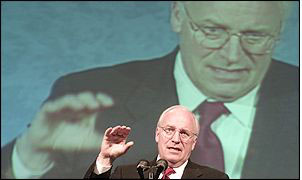
    “If President Obama were participating in his intelligence briefings on a regular basis then perhaps he would understand why people are so offended at his efforts to take sole credit for the killing of Osama bin Laden,” Cheney told The Daily Caller in an email through a spokeswoman.

    This came on the same day that Kurt Eichenwald told us what he’d learned after seeing a series of daily briefings from the months prior to 9/11. Presumably Dick Cheney saw them all too:

    By May 1, the Central Intelligence Agency told the White House of a report that “a group presently in the United States” was planning a terrorist operation. Weeks later, on June 22, the daily brief reported that Qaeda strikes could be “imminent,” although intelligence suggested the time frame was flexible.

    But some in the administration [i.e., Cheney’s clique of neocon nitwits -ed.] considered the warning to be just bluster….In response, the C.I.A. prepared an analysis that all but pleaded with the White House to accept that the danger from Bin Laden was real.

    “The U.S. is not the target of a disinformation campaign by Usama Bin Laden,” the daily brief of June 29 read, using the government’s transliteration of Bin Laden’s first name….On July 1, the brief stated that the operation had been delayed, but “will occur soon.”….On July 9, at a meeting of the counterterrorism group, one official suggested that the staff put in for a transfer so that somebody else would be responsible when the attack took place, two people who were there told me in interviews.

    ….On July 24, Mr. Bush was notified that the attack was still being readied, but that it had been postponed, perhaps by a few months. But the president did not feel the briefings on potential attacks were sufficient, one intelligence official told me, and instead asked for a broader analysis on Al Qaeda, its aspirations and its history. In response, the C.I.A. set to work on the Aug. 6 brief.

    August 6, of course, was the infamous daily brief titled “Bin Laden Determined to Strike in U.S.” — the one that prompted George Bush to tell his briefer, “All right. You’ve covered your ass.”

    Honest to God, Dick Cheney really is the world’s biggest asshole, isn’t he? And for the record, it turns out that sometimes Obama reads the daily brief and sometimes he attends briefing sessions. Either way, though, he certainly seems to pay more attention to them than either George Bush or Dick Cheney ever did.

    Via Wonkette.

  • If Obama Wins, You Can Thank the Economy, Not Blame It

    Election guru Charlie Cook says that if President Obama wins in November, “it will be despite the economy.” That’s the conventional wisdom, all right, but the conventional wisdom is wrong. Ezra Klein explains:

    Some months ago, I worked with political scientists Seth Hill, John Sides and Lynn Vavreck to build a model that used data from every presidential election since 1948 to forecast the outcome of this presidential election. But when the model was done, I thought it was broken: It was forecasting an Obama win even under scenarios of very weak economic growth.

    ….After a lot of frantic e-mails, my political scientist friends finally convinced me that that’s the point of a model: It forces you to check your expectations at the door. And my expectation that incumbents lose when the economy is weak was not backed up by the data, which suggest that incumbents win unless major economic indicators are headed in the wrong direction.
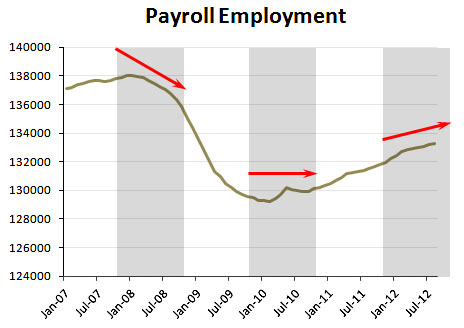
    Matt Yglesias picks up the baton with a series of charts showing that, in fact, the economy isn’t in especially dire shape. I’ve compressed this all into one chart, and as Matt says, the difference is like night and day. In the year before the 2008 election, employment was dropping like a stone. Sure enough, the incumbent party lost. In the year before the 2010 election, employment was at rock bottom and going nowhere. Sure enough, the incumbent party lost. But in the year before the 2012 election, employment numbers have been on a steady upward trajectory. That suggests a modest win for the incumbent party.

    Obviously, Obama’s chances are hurt by the fact that unemployment remains high, wages are stagnant, and we still haven’t made up all the job losses from the recession. But politically speaking, the economy isn’t in terrible shape. It’s in OK-but-not-great shape. And that means the incumbent probably has a small advantage. If Obama wins by a couple of percentage points in November, he will have performed almost exactly as well as you’d expect given the state of the economy.

  • A Quick Peek at How Chicago Students are Performing

    Joe Nocera comments today on the teacher strike in Chicago:

    There really isn’t much evidence that introducing choice and competition — an important rationale for charter schools — has forced the big-city public schools to improve. Until somebody figures out how to create reforms that work for all, and not just the lucky few, American public education will continue to suffer….Students in other countries now regularly outperform American students. We are truly in the midst of an education crisis — one that won’t be solved until we completely rethink the way we offer public education.

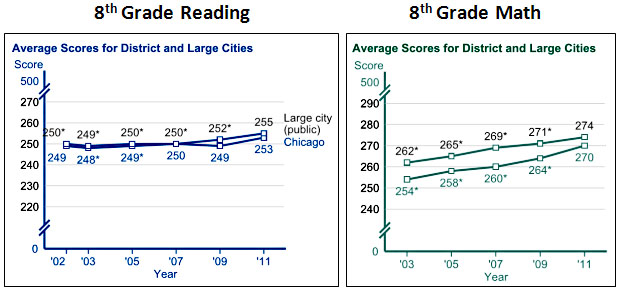
    Is it true that big-city schools have failed to improve? There’s plenty of evidence that American students in general are doing better today than they did 30 years ago — you can see my brief overview of the raw NAEP data here — but as it happens, there’s also evidence specific to big-city schools. It’s called the Trial Urban District Assessment and it hasn’t been running as long as the main NAEP. However, it’s been running for about a decade and has now collected enough data to show us some trends. Here’s the data for Chicago in reading and math:

    As you can see, test scores both in Chicago and in urban schools generally have risen over the past ten years. Scores for fourth graders have increased even more dramatically. More here.

    As for whether we’re falling behind the rest of the world, I don’t know. The data is frustratingly mixed on this subject, and long-term data barely exists. My best take, however, is that nothing much has changed. The United States has always performed above average (compared to other industrialized countries) but only by a little bit, and that still seems to be true. I don’t think there’s been much upward or downward movement over the past few decades.

    As usual, I don’t have any special comment to make about this. Maybe this improvement is a statistical mirage. Maybe it’s real but we should be doing even better. But whatever you think, it should be based on the best data we have. And this is it.

    For more on the Chicago teacher strike itself, check out Dana Liebelson’s explainer here. It will answer most of your basic questions.