• Mitt Romney Still Unprepared for Questions About Paul Ryan’s Medicare Plan


    Here’s the latest from Romneyland:

    Since the announcement of Ryan as Romney’s vice-presidential pick, the Republican challenger has faced persistent questioning over where he stands. The Romney team has been left vulnerable, in part because it has been sending out mixed messages.

    Romney, in a rare press conference on Monday night in Florida, repeatedly refused to say whether he backed Ryan’s Medicare reform plan. Some of advisers have gone on television to say publicly that he wholly and enthusiastically endorsed Ryan’s budget proposals and would, if president, have signed it. Others have sought to distance him from it, saying Romney was running on his own plan.

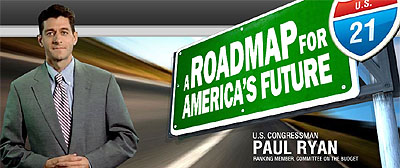
    Seriously? Romney picked Paul Ryan as his VP on August 1st, and two weeks later his team still wasn’t prepared for a barrage of questions about whether their guy supports Ryan’s budget roadmap and his Medicare plan? Even though that’s the single most important policy initiative he’s associated with?

    Who the hell is running this operation? This is a clown show of epic proportions.

  • The Media’s Love Affair With Paul Ryan Might be Fading

    It’s been about six hours since my last Paul Ryan post, so I guess I’m allowed to do another one now without turning my blog into Paul Ryan Central. I’ve been emailing with a friend about something that might be surprising if it’s true: the unexpectedly blunt tone of the press coverage of the Ryan announcement. In the past, the press has been pretty friendly toward Ryan, thanks to the Beltway’s obsession with “adult” conversations about budget deficits. And yet, it’s not clear that this is how the media has been covering Ryan for the past few days:

    Note that the reporting is not framing Ryan’s budget as debt reduction, but entitlement cuts, which seems new. And this coverage zeitgeist, in turn, seems to at least be leading some writers to match the Ryan mythologies that the press has bought (e.g., bipartisan, work-across-the-aisle-guy, etc.) to his voting record and actual accomplishments. See, most surprisingly to me, Dickerson going in-depth on this.

    Maybe it’s just a flash of negativity before the love-fest of the convention, but it struck me as notable given that I did not expect this since the press really hasn’t taken this approach with Ryan before in any meaningful way.

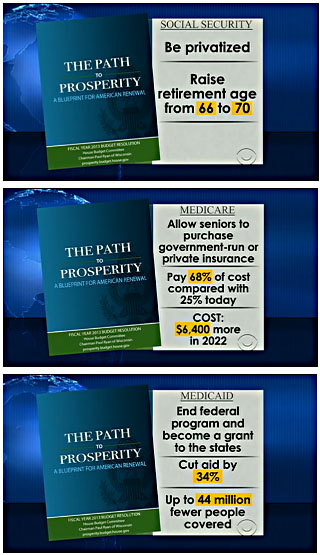
    That is interesting! Assuming it’s true, of course, something I’m not entirely sure of. It sounds plausible, but I haven’t been following the press coverage diligently enough to agree with total confidence. As one data point, however, take a look at the three screen shots on the right from the CBS Evening News on Saturday, courtesy of Uggabugga. Those are pretty straightforward.

    I imagine that part of this has been driven by Democratic attacks on Ryan, and part has been driven by the media’s preference for covering conflict, especially during presidential campaigns. And right now, the conflict is more over entitlement cuts than it is over deficit reduction. Still, it’s an interesting observation. It’s possible that the longtime media crush on Ryan has faded a bit over the past year as Ryan has become such an explicitly partisan warrior. We’ll see.

    UPDATE: Another reader, one who ingests a fair bit of cable news, agrees with reader #1:

    I can totally confirm your correspondent’s impression of this, and I’ve been pleasantly surprised by it. Covering conflict, yes, but also the realization that this is no longer just some whacko proposal that’s never going to go anywhere but is the de facto budget outline for the major party challenger to the president who might actually win if things go badly for Obama.

    Interesting, no?

  • Just How Awful is Nano-Plagiarism?


    I’m with Atrios on this. Plagiarism “scandals” have a tendency to get out of hand awfully quickly. Here’s the latest charge against Fareed Zakaria:

    Zakaria’s 2008 book, “The Post-American World,” contains a quote from former Intel Corp. chief executive Andy Grove about the nation’s economic power….Grove’s comment was published three years earlier in “Three Billion New Capitalists: The Great Shift of Power to the East,” by former Commerce Department official Clyde V. Prestowitz.

    ….Zakaria, in an interview Monday, defended the practice of not attributing quotes in a popular book….”I should not be judged by a standard that’s not applied to everyone else,” he added. “People are piling on with every grudge or vendetta. The charge is totally bogus.”

    Prestowitz was unmoved. “I think there should be an apology,” he said Monday. “I don’t want to unfairly level accusations [because] those of us who are writers know a lot of things can happen. But I feel I have a justifiable complaint. It kind of has been bugging me for a while.”

    Give me a break. Prestowitz doesn’t have a copyright on the quote just because it came from an interview of his. Once it’s out there, it’s out there. Nobody credits every quote they ever use. Nobody.

    There’s a more general point to make too, one that I’ve been hesitant to make because it will inevitably sound like I’m defending plagiarism. But here goes anyway. Plagiarism, to me, is the wholesale borrowing of another person’s words. Today’s plagiarism scandals, by contrast, usually revolve around a handful of paragraphs from another source that have been lightly rewritten instead of completely rewritten. That may not be defensible, but frankly, it strikes me as more like a parking infraction than assault and battery. Ditto for “self plagiarism.”

    I’ll repeat that I’m not defending plagiarism here. But on the list of dreadful things that popular writers do, I’m honestly not sure that nano-scale plagiarism makes it into the top 100. Maybe it’s time to get a grip here.

    NOTE: I’m talking only about popular writers here. Different standards justifiably apply within academic circles.

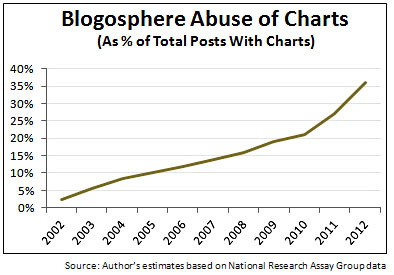
  • Chart of the Day: The Blogosphere Has Too Many Damn Charts

    Reihan Salam on how to persuade people:

    If you want to change people’s minds, graphs and charts might be more effective than words alone. I sense that the word is out about this phenomenon, and that it is being used and abused. But that is another matter entirely.

    I don’t know if Reihan is using “abused” in the sense of used too much, or in the sense of people lying with statistics. If it’s the latter, I can’t say that I’ve noticed charts being used any more deceptively than before. But if it’s the former, I’m sadly in agreement. I love presenting information in a graphical format, but this is now so omnipresent in the wonkosphere that even I tend to switch off when I see a headline that says something like “Everything you need to know about [xxx] in two charts.” Charts can illuminate, but they rarely explain everything, and posts with headlines like that seldom deliver the goods.

    It’s possible, of course, that my real beef is with the headlines, not the charts. If the same post simply said something like “Drought now covering 23 states,” and there was a nice map showing which states were suffering from drought, I’d probably think nothing of it. The map is a good tool for making the information more easily accessible. Still, it doesn’t explain everything. In fact, it’s not even the reason for the post. It’s just a visual aid for something else. We should all remember that more often.

  • Congress Really, Truly Doesn’t Care About the Middle Class

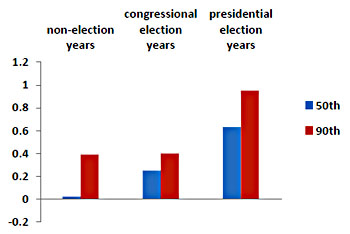
    Martin Gilens has done some very interesting work on the way that politicians respond to public opinion, and his key result is that Congress doesn’t really care much about the poor (no surprise) and cares only modestly about the middle class (a bit of a surprise). What they care about are the upper middle class and the rich.

    Today he puts up a chart that gives this result a bit more nuance. The blue bars represent middle-income voters, and during election years they have a moderate amount of influence. Not as much as the well-off, but when an election is imminent politicians pay at least some attention to the preferences of the middle class (and, to a smaller extent, the poor).

    So when do the rich get their payoff? Answer: during non-election years, when no one is paying attention. In those years, members of Congress respond solely to the preferences of the well-off. What’s more, laws passed during non-election years are more durable:

    The hopeful side of this observation is that democratic institutions do work, to an extent, to discipline policymakers and bring policy outcomes more in line with the public’s desires. But these periods of heightened responsiveness are the exception, not the rule, and it appears that policies “forced” on decision makers by political circumstances fare less well over time than those adopted under less “coercive” conditions. Although policies adopted during presidential election years are more consistent with public preferences, they are also more likely to lose funding over time than are policies adopted in other years of the quadrennial election cycle.

    To summarize: In election years we throw a few sops to the 90%. During non-election years, we cut back the funding for those sops and pass the legislation that the top 10% want passed. Welcome to America.

  • Quote of the Day: Driverless Cars


    From Alex Tabarrok, about the misgivings some people have about letting computers drive our cars:

    At first when there is an accident people will ask, “did he have the driverless option on?” But soon they will start to say “if only he had the driverless option on.”

    Yep. I agree with everything else he says too. In fact, just as many 20-somethings no longer know how to drive a stick shift, I’ll bet that in twenty years a lot of 20-somethings won’t know how to manually drive a car at all.

  • Pro-Lifers Should Stop Being So Skittish About Their Own Beliefs

    <a href="http://www.shutterstock.com/cat.mhtml?lang=en&search_source=search_form&version=llv1&anyorall=all&safesearch=1&searchterm=in+vitro+fertilization&search_group=&orient=&search_cat=&searchtermx=&photographer_name=&people_gender=&people_age=&people_ethnicity=&people_number=&commercial_ok=&color=&show_color_wheel=1#id=6217096&src=2419db0fc656e93db9170dd717eaef78-1-11">iDesign</a>/Shutterstock


    Paul Ryan is a cosponsor of HR 212, the Sanctity of Human Life Act. After a bit of throat clearing, the text of the act is admirably brief and direct:

    (B) the life of each human being begins with fertilization, cloning, or its functional equivalent, irrespective of sex, health, function or disability, defect, stage of biological development, or condition of dependency, at which time every human being shall have all the legal and constitutional attributes and privileges of personhood; and

    (2) the Congress affirms that the Congress, each State, the District of Columbia, and all United States territories have the authority to protect the lives of all human beings residing in its respective jurisdictions.

    A BuzzFeed reporter wrote a piece suggesting that HR 212 would ban all abortions, but as the text of the law makes it clear, it doesn’t quite do that. It gives states the authority to ban all abortions. Ramesh Ponnuru thinks it’s therefore unfair to claim that Paul Ryan wants to ban all abortions, even those that are the result of rape or incest:

    Ryan may, for all I know, believe that abortion should be illegal with exceptions only to save a mother’s life. But has he really co-sponsored a bill to effect this policy? No.

    Why are extreme pro-lifers so skittish about their own beliefs? This is a bill that would give a fertilized egg “all the legal and constitutional attributes and privileges of personhood.” There are (a) no exceptions for eggs fertilized by rapists or by your own father, and (b) Ryan is a cosponsor. Logic chopping aside, this means that Ryan has cosponsored a bill that has the plain intent of “effecting” a policy that allows states to ban abortion with no exceptions for rape or incest.

    In fact, if this bill were passed and the Supreme Court upheld it, I’ll bet that a rapist could go to court and sue to prevent his victim from getting an abortion. He’d argue that the fetus was legally a human being, and the court has no power to discriminate between one human being and another. He’d probably win, too.

    In other abortion news, Stephanie Mencimer reports that the same bill would likely have the effect of making in-vitro fertilization illegal. My Twitter feed is full of outrage that Stephanie would say this, but what else can you conclude about the law? In IVF, multiple embryos are created, and only a few are used. The others are either destroyed or frozen, and everyone knows that the frozen embryos are never going to be revived. HR 212 would almost certainly make IVF illegal, and since Mitt Romney’s kids have used IVF it would, as the headline says, make them criminals. Or childless. Is that a brutal way of putting it? Sure. But it’s a pretty brutal law. What’s wrong with letting people know in stark terms just exactly what it would mean?

    If human life begins at fertilization, it means abortion would be illegal even in cases of rape and incest, and it means IVF would be illegal. Those are the consequences. If you hold an extreme pro-life position, you need to own those consequences, even if they’re politically unpopular.

    UPDATE: Ponnuru responds here. I won’t pretend to understand his position, which simply doesn’t make any sense to me. The effect of HR 212 seems clear to me, but Ponnuru views it as merely giving states “policymaking authority” over abortion and IVF. That’s not at all how I read it. In fact, I think I gave it too soft a reading above.

    But for the record, I am not a lawyer.

    UPDATE 2: Of course, this all shies away from the original question: why don’t we know for sure what Paul Ryan’s position on abortion in the case of rape and incest is? Why won’t he just tell us?

  • Smart Republicans Not Happy About Going Down With the Paul Ryan Ship

    Both conservatives and liberals are thrilled by Mitt Romney’s choice of Paul Ryan as his running mate. Conservatives are thrilled because it suddenly makes the election into a real referendum on hard-nosed right-wing values, including tax cuts for the wealthy and entitlement cuts for the not-so-wealthy. Liberals are thrilled because….it suddenly makes the election into a real referendum on hard-nosed right-wing values, including tax cuts for the wealthy and entitlement cuts for the not-so-wealthy.
    Publicly, both sides claim they can win this referendum. In private, one side is apparently not so sure:

    Away from the cameras, and with all the usual assurances that people aren’t being quoted by name, there is an unmistakable consensus among Republican operatives in Washington: Romney has taken a risk with Ryan that has only a modest chance of going right — and a huge chance of going horribly wrong.

    ….It is not that the public professions of excitement about the Ryan selection are totally insincere. It is that many of the most optimistic Republican operatives will privately acknowledge that their views are being shaped more by fingers-crossed hope than by a hard-headed appraisal of what’s most likely to happen.

    And the more pessimistic strategists don’t even feign good cheer: They think the Ryan pick is a disaster for the GOP….“Very not helpful down ballot — very,” said one top Republican consultant….Another strategist emailed midway through Romney and Ryan’s first joint event Saturday: “The good news is that this ticket now has a vision. The bad news is that vision is basically just a chart of numbers used to justify policies that are extremely unpopular.” 

    I haven’t seen a similar story about private liberal reaction, but I’ll bet that’s because there’s no story to tell. Democrats are dancing in the corridors both privately and publicly. As well they should be: conservatives might like to talk a big game about cutting entitlements, but actions speak louder than words. In 2010, when they had a chance to win an election by running a scorched-earth campaign against President Obama’s cuts to Medicare, they tossed their conservative principles firmly under the bus because they knew perfectly well that entitlement cuts are a big political loser.

    The fever swamp wing of the Republican Party might have worked itself into a frenzy this year, convinced that the American public is totally ready to wipe out its own retirement security, but cooler heads know better. I continue to think that the VP choice doesn’t matter a lot, but this election is going to be close and even a point or two matters. And in the bright light of morning, anyone who hasn’t drunk the tea party Kool-Aid knows that Paul Ryan will probably cost Republicans a point or two in November.

  • Paul Ryan Still Says He Wants to Take Away Some Mysteriously Fuzzy “Tax Shelters” From the Rich

    Here’s an excerpt from yesterday’s 60 Minutes interview with Mitt Romney and Paul Ryan:

    Bob Schieffer: You say of course the wealthiest people pay the larger share, but don’t they also pay at a lower rate? When you figure in capital gains and all of that?

    Mitt Romney: Well, it depends on the individual, what their source of income is. But if you look at the top one percent or five percent or quartile, whatever, they pay the largest share of taxes. And that’s not something which I would propose making smaller.

    Paul Ryan: What we’re saying is take away the tax shelters that are uniquely enjoyed by people in the top tax brackets so they can’t shelter as much money from taxation, should lower tax rates for everybody to make America more competitive.

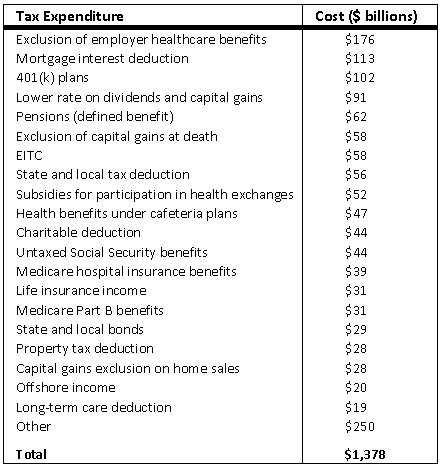
    Needless to say, Bob Schieffer didn’t bother following up with the obvious question: “And what tax shelters do you have in mind, congressman Ryan?” You see, the biggest “tax shelters,” by far, are the exclusion of health benefits from taxation, the mortgage interest deduction, deferred taxes on retirement plans, and special treatment of capital gains.

    In fact, if you take a look at the list of tax expenditures on the right, it’s not clear to me that there are more than two or three of them that Ryan and Romney really want to touch in any kind of serious way. But maybe I’m wrong. Maybe they really are willing to hack away at these things, and to hack away only above a certain income level.

    If they are, though, they ought to say so, especially since they’re so eager to talk in detail about the lower tax rates they endorse for people in the top tax brackets. They never will, of course, because this is all a feint for the rubes. They almost certainly have no intention of touching this stuff. Still, it would have been nice for Schieffer to at least have the basic reporting skills to ask.