• Mitt Romney Says He’s Paid Plenty of Taxes Over the Past Ten Years

    What with all the Paul Ryan news lately, Harry Reid’s claim that Mitt Romney didn’t pay any taxes over the past decade fell down the memory hole and all but disappeared. At least, it would have disappeared except that Romney decided to bring it up again today. He finds America’s fascination with his taxes to be “very small-minded,” but:

    I did go back and look at my taxes, and over the past ten years I never paid less than 13%. I think the most recent year is 13.6, or something like that.

    So there you have it. Since Romney paid essentially nothing in payroll taxes, the only reasonable read of this statement is that he never paid less than 13% in federal income taxes in any of the past ten years — though it would probably be wise for someone to ask for clarification on that. That’s the latest.

    Via Dan Amira.

  • A (Very Brief) Comparison of Romney and Obama on Medicare

    Speaking of Medicare, one of the problems with covering the current debate is that it hasn’t been easy to figure out what the candidates’ positions actually are. Paul Ryan has a plan, but Mitt Romney initially said that his campaign’s plan was different. Today he said it’s pretty much the same, aside from the Obamacare cuts that Ryan adopted in his plan but Romney promises to repeal. Barack Obama, as best I can tell, doesn’t have a plan at all. He’s got Obamacare, which has already made changes to Medicare, but he doesn’t really have anything new going forward.

    If this is now the playing field — and I think it is, though I’m not 100% sure — then the two plans on offer are:

    • Obamacare’s existing changes to Medicare
    • Paul Ryan’s plan minus the Obamacare cuts

    Roughly speaking, here’s Obamacare:

    • Reduces payments to private Medicare Advantage programs that have been costing the government about 20% more than standard Medicare. More here and here.
    • Cuts reimbursement rates to doctors and hospitals. More here, but keep in mind that the effect will be small if private insurers follow Medicare’s lead and also reduce reimbursement rates.
    • Institutes the IPAB advisory board to recommend cost-saving measures. More here.
    • Encourages a switch from fee-for-service (doctors get paid a flat rate for every procedure they perform) to a more quality-oriented reimbursement system.
    • Caps overall Medicare cost growth at GDP + 0.5%.

    And here’s Ryan’s plan:

    • Caps overall Medicare cost growth at GDP + 0.5%.
    • Requires providers to bid competitively for Medicare business based on a minimum guaranteed service level. Standard fee-for-service Medicare would be one of the bidders. A primer on competitive bidding is here.
    • Medicare recipients get a voucher equal to the second lowest bid. They can use this to buy insurance, or they can pay more if they want to buy a more comprehensive plan. More here.
    • This applies only to people under 55. There would be no changes to Medicare for anyone older than that.

    So which do you like better? A plan that reduces reimbursement levels and relies on top-down control/encouragement to produce more cost-effective medical care? Or a plan that relies on competitive bidding to keep costs under control? The choice, for both liberals and conservatives, is not as simple as you might think. Conservatives need to acknowledge that, like it or not, cost controls have a proven track record and that Obamacare’s top-down programs really might help improve the efficiency of healthcare delivery. Liberals need to acknowledge that those top-down controls aren’t a sure thing and that competitive bidding might make a real difference.

    There are lots of details I’ve left out, including spending on other healthcare programs, such as Medicaid and CHIP. But at a 10,000-foot level, this is the basic state of play.

    UPDATE: Via email, Austin Frakt points out that in a sensible world you could actually combine both of these plans: keep the Obamacare changes to standard Medicare, but let other providers bid against it. More here. Needless to say, we don’t live in such a sensible world.

  • The Fleeting Substance of Campaign 2012

    Ezra Klein argues that we’re actually having a pretty substantive presidential campaign:

    It’s also had its share of ridiculous gaffes and absurd attacks. But Romney is running on a platform that, though it lacks important details and relies on overly ambitious targets, is definitely a clear vision of the general direction he’d take the country. Obama’s platform is less radical, and much more detailed.

    In my experience, you’re actually getting a more serious conversation over the issues if you listen directly to the two campaigns….Now, these speeches and ads aren’t always polite. They’re not even always accurate. But this is what a serious campaign looks like. And it’s up to the media to cover it that way. So no more meta-serious conversing! If you want a serious conversation about the two campaigns’ Medicare plans and you have the good fortune to be speaking on a national television program, just say some serious things about the plans!

    That works OK for chat shows, but not so well for news shows. Hell, I write a blog aimed at fairly wonky readers (wonkier than most voters, anyway), but even I have a hard time covering substantive campaign issues all the time. I mean, how many different times can you write about Paul Ryan’s Medicare plan? After you’ve done it three or four times, there’s just nothing left unless the candidates themselves say something new about it. Even wonky readers don’t want to read the same post over and over and over. (And I don’t want to write it over and over and over.)

    This is the problem with substance: it doesn’t change. Once you’ve outlined both campaigns’ positions on something, there’s not a lot new you can say about it. So you either repeat yourself (boring!) or report on campaign nonsense (non-substantive!). If there were dozens of issues to report about, that would solve the problem, but the plain fact is that most campaigns are won and lost based on three or four major positions. And if those are the things the campaigns are focused on, then those are the things you need to report on. Right now, for example, there are loads of important foreign policy issues we should be talking about: Afghanistan, Syria, the euro, Israel’s apparent desire to bomb Iran, and much more. But like it or not, those just aren’t center stage. You can write a long summary piece about all this stuff, but that’s about it. When you’re done, you’re done. If the campaigns choose not to address these things, there’s nothing new to report about.

    It’s easy to say that the media is letting itself be bulldozed by the tyranny of the new. And they are. But the truth is that most of us will turn the channel if we see a star reporter delivering yet another half-hour special on the future of Medicare. And the blogosphere, which is obsessed with Outrage of the Day posting, isn’t much better. So the fault, dear readers, may lie partly in our stars, but mostly in ourselves. If we really, truly voted with our remotes for substance, we’d get it.

  • The Endless Mystery of Business Class Pricing

    Michael O’Hare asks a question that’s been puzzling me approximately forever: why do airlines charge so much for business class seats?

    On most wide-body aircraft, seven international business class seats take up about the same cabin floor space as 18 coach seats. So the airline should be indifferent between selling coach seats for $C and business seats for 18/7 x C, a little more than twice as much. Instead, they charge five to six times as much for business. For the $1150 SFO-FRA RT itinerary I just looked at on United, this should be about $3000, but the business fare is $5600 or $6200. What’s the extra two-and-a-half large for?

    There’s more, but the basic math doesn’t change much. Logic suggests that a business class seat should sell for about twice what a coach class seat sells for, but in reality it’s more like 4-5x higher and they routinely fail to sell all their seats. (Many of them are given away as free upgrades to their “elite status” Gold/Platinum customers.) Why?

    When this kind of question comes up, I always assume that airline executives aren’t idiots. Not all of them, anyway.1 This isn’t exactly rocket science, after all, and the arithmetic is pretty obvious. So why don’t they do it? Is it because the elasticity of business class seats turns out to be really weird? Because they actually make more money holding some seats back for upgrades? Because the business class price is about 2x the full coach fare, and it makes more business sense to discount coach fares than business class fares? Is there some arcane regulatory issue at play?

    I dunno, and it’s the kind of thing airline executives (apparently) won’t talk about truthfully, which makes the whole thing even stranger. Like Michael, I’ve often booked a flight knowing that I’d be willing to pay 2x to get a business class seat, but I’m not willing to pay 5x. So the airline loses a bunch of money on me. I’m not sure why they’re all willing to do this. But it really is all of them, so there must be something going on.

    1Yes, yes, I know all the jokes. But honest: they’re not all total morons.

    UPDATE: If you want my guess about this, here it is. It’s basically weird elasticity. Suppose that coach fare on a particular flight is $1000, and there are ten business class seats. At 5x pricing, the airline sells half the seats to people who are flying on corporate accounts and are willing to pay no matter what the price. The other half of the seats are given away to Gold/Platinum upgraders. Total revenue: $25,000 plus some happy regular customers who got the upgrade. At 2x pricing, they sell all ten seats. Total revenue: $20,000.

    If this is the way things work, it’s possible that there’s simply no price lower than 5x that produces higher total revenue. Weird but possible. (Though if this is the case, I do wonder why airlines can’t figure out a way to engage in some of their famous price discrimination to increase revenue beyond what they can get by charging either 5x or zero.)

  • Mitt Romney’s Great Tax Loophole Scam

    I just saw a short segment on CNN about Mitt Romney and all the tax loopholes he’s supposedly going to close to make up for his tax cuts. It was admirably forthright, with nobody really cutting him any slack for his weasel words. Fortune’s Andy Serwer was one of the guests, and the conversation revolved around his interview with Romney that was posted today. Here’s the relevant question:

    Specifically what tax loopholes would you close and what exemptions would you eliminate to make the revenue-neutral equation work?

    Simpson-Bowles laid out a formula that shows that you can do just as I described. That you can bring down the rates, limit deductions and exemptions for people at the high end, and with additional growth that comes by virtue of the stimulative action you can reach a balanced budget. I will follow a model similar to Simpson-Bowles and work with Congress to identify which of the alternative methods we should apply to reduce deductions, benefits, and exemptions.

    Just to be crystal clear here: Everyone knows this is never going to happen, right? If Republicans win in November, they’ll extend the Bush tax cuts and then pass additional cuts of their own. After all, the economy is suffering! We need to put more money in the pockets of the job creators so they can create some jobs.

    As for all those loopholes, well, that’s going to need some study, folks. Can’t be going off all half cocked on that kind of thing. And we never said our tax plan would be revenue neutral right away. It’s really revenue neutrality over a ten-year window. That was always the plan. But don’t worry. We’ll get there.

    But they never will. Republicans have been in control of the presidency and Congress plenty of times over the past two decades, and they’ve never shown the slightest interest in closing tax loopholes on the rich. They don’t have any interest in doing it this time either. Even their own supporters know this. It’s just smoke and mirrors to distract the press.

    Everyone gets that, don’t they?

  • The Strange Case of the Quote Theft That Wasn’t

    Very few of you are probably interested in whether or not Fareed Zakaria properly credited Clyde Prestowitz for a quote he used in his 2008 book, The Post-American World. But since I wrote about this yesterday, I owe everyone an update.

    Nickel summary: Zakaria used a quote from Andy Grove that first appeared in a book Prestowitz wrote. Prestowitz says Zakaria never credited him, and believes Zakaria owes him an apology. “It kind of has been bugging me for a while,” he told the Washington Post.

    So David Frum trekked out to the library to look at the paperback edition of Zakaria’s book, and used Amazon’s “Look Inside” feature to check out the original hardcover version. It turns out that both of them fully credited Prestowitz in footnote 11 on page 262. Today the Post retracted its article:

    Endnotes crediting Prestowitz were contained in hardcover and paperback editions of Zakaria’s book. The Post should have examined copies of the books and should not have published the article. We regret the error and apologize to Fareed Zakaria.

    This is just damn strange. The Post reporter obviously didn’t do his homework, so shame on him. But what’s the deal with Prestowitz? Did he not notice the footnote because it came at the end of a long passage? Did a friend tell him he hadn’t been credited and he just accepted it without checking? Is there a first edition hardcover that doesn’t have the footnote? What’s going on here?

    On a related note, I got an email from a reporter today taking me to task for my contention that in popular writing there’s no need to credit every single quote. At his newspaper, he says, the standard is to attribute everything:

    You can’t just go around stealing quotes. It takes a lot of work, as you know, to get good quote. Really this is journalism 101, to credit info that you didn’t get yourself. It isn’t just inside baseball. It’s so the readers can judge where the info comes from. All of this applies, in my view, to books written by journalists.

    This actually seems reasonable for a newspaper, which mostly deals with breaking news and fairly recent quotes. Less so for non-academic books, which I just don’t think adhere to this standard. In a follow-up email, I asked why his newspaper had this rule:

    Our main reason is that we feel it helps readers if they know where each bit of information comes from. Another reason, probably equally important, is that, frankly, it covers your butt if it turns out there’s some problem with the quote. It often prevents us from printing bogus stuff….You’re right it’s probably not always necessary. But we have a lot of rules like this because they have helped stop us from printing false stuff repeatedly. It’s kind of like those error-prevention routines they follow in hospitals.

    I like this answer. The rule is there to help readers and ensure accuracy, and at a newspaper, under deadline pressure, it’s probably best to insist on attribution in the text as a way of ensuring that fact checking has been done properly. However, in long-form writing, I’d argue that fact checking can be done separately, and you don’t necessarily need the crutch of having everything in the text itself.

    In fact, the only thing I really object to here is the idea of someone “stealing” a quote. Maybe this is just me, but when I see a quote I don’t assume it came from an interview conducted by the author. So I don’t think there’s any kind of misrepresentation when a quote isn’t credited. Nor do I feel that an interviewer “deserves” credit every single time a quote from an interview is ever used by someone else. If it’s something recent, especially something exclusive, then sure: they probably do deserve credit. But after a month? Or a year? I just don’t see it.

  • Will Democrats Keep Control of the Senate Because of Paul Ryan?

    Sam Wang of the Princeton Election Consortium, who had a pretty good forecasting record in 2008, writes to suggest that we might all be missing the boat on Paul Ryan. Although Ryan might not have a big influence on the presidential race, he could very well have a big influence on whether Democrats maintain the control of the Senate:

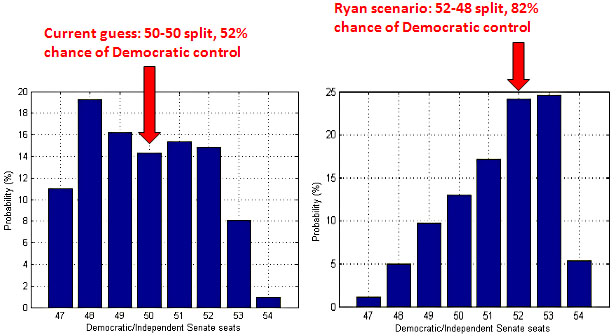
    What if the Romney-Ryan ticket causes candidates to campaign explicitly on GOP budget priorities? Imagine that slightly more voters switch their votes in one direction or the other based on what they hear. If 1% of voters flip toward Democrats, the resulting 2% swing leads to [an 82% chance of Democratic control]….Anyway, that’s what a knife-edge looks like. Pundits, please talk about this instead?

    Obviously we don’t know what effect Ryan will have on down-ticket voters, but a 1% swing against Republicans certainly seems plausible. Either way, though, it does seem as though Ryan’s real influence could be much greater in congressional races than in the presidential contest. Wang’s charts are below.

  • How an Outsider Got a Shot in Connecticut’s 5th District

    This is a little outside of my usual wheelhouse, but a friend of mine who worked for Elizabeth Esty’s dark horse congressional campaign in Connecticut’s 5th district emailed last night with some personal observations about the race. I thought it made for interesting reading, so here it is. Enjoy.


    The Democratic primary became a three-person race that resembled a Carl Hiaasen novel transplanted from Miami to New England. The Democratic Party-endorsed candidate and frontrunner, CT House speaker Chris Donovan, started to lose staff members to arrest by the FBI. The FBI alleged illegal campaign contributions from “roll-your-own” cigarette vendors. Really. The dark-horse candidate Dan Roberti advertised himself as a 31-year-old fresh-faced newcomer to politics, despite being the son of a prosperous Beltway lobbyist, and flooded local TV with ads funded by a super-PAC. Elizabeth Esty was accused of receiving campaign contributions from the utility companies her husband regulates. Her campaign countered that she had no contributions from the companies themselves, but might have gotten small-donor support from their employees. Esty did get a cash infusion from Emily’s List — which was characterized as a Super-PAC by her opponents. For me, the telling financial detail was that the Estys took out a $500K loan on their house for backup campaign funds. Even for a two-professional household, that is a lot of skin to put into the game.
    I only spent a few afternoons as a campaign foot soldier, but it was instructive. Out in the neighborhoods, most people are not home, so you leave a flyer. Even if the voter is home, he or she often doesn’t want to talk with you — an attitude that I totally understand. The people who want to talk, however, express a sort of desperation with the mess that U.S. political governance has become. Many of these people have lost their jobs, or have close friends who lost their jobs, and they can’t see a way out of the stagnation. It’s pretty clear that the Romney/Ryan economic plan won’t persuade these people, but the Obama campaign needs to express a countervailing vision to give these folks a reason to vote in November.

    I spoke with Daniel Esty at his wife’s election-night party and he echoed many of my observations about the 5th-District neighborhoods. Connecticut probably has more hedge-fund managers per-capita than any other US state, but it also has a significant manufacturing sector. Because manufacturing is ailing, there is a white working-class-male demographic that feels abandoned by the political system, abundant in the central-CT cities of Waterbury, New Britain, and others.

    Esty remarked that these cities are distressed and economically poor, but my impression was not as pessimistic, based on the streets that I walked. I walked far fewer streets than the candidate’s husband, of course, but there is a tendency among suburban professionals to judge as economic failure anything less than a substantial raised-ranch manse on a wide leafy street, with the grocery store a three-mile-drive away. What I remember from New Britain were old neighborhoods with small post-WWII houses which the residents had worked hard to make nice. No signs of crime or unrest.

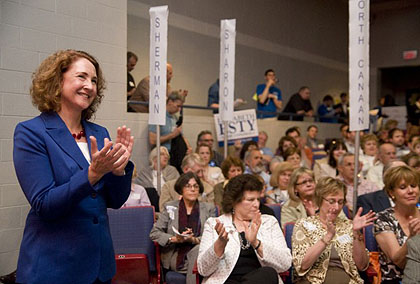
    Elizabeth Esty won the nomination last night. For a person of my vintage, the 1970s movie The Candidate is the touchstone for moments like Elizabeth Esty’s election-night party. By 10 pm both competing candidates had conceded and the new congressional nominee came into the room in an electric-blue ensemble to give her speech. At such times one understands why political candidates amplify their plumage — she needs to stand out in a crowd of supporters. She paused, as though pondering putting her family through another three months of cold-pizza campaigning. But Romney/Ryan has given all Democratic candidates some automatic applause lines as footholds for their electoral climb. Esty finished her victory speech with decisive declarations that she would protect a women’s right to choose (she’s not supported by Emily’s List for nothing), protect Medicare, and protect Social Security.

    UPDATE: A reader who lives in New Britain writes in to say that the city actually contains only a few neighborhoods like the one described above:

    Much of the rest of the city is appallingly unsafe, with frequent violent crime. The truly lovely park, right beside the college, is also home to prostitution rings and vial-based drug dealing. (The weed dealer is one of our neighbors, in one of those those old neighborhoods.) The school district is crumbling, both from the weight of poverty and from middle-class flight. Our son is in the public schools, but most of the kids who would be his peers are in magnet schools in other towns or are in private schools or are home-schooled. The kids we see in the sports leagues often come from situations that would turn Paul Ryan into a socialist.

    We don’t like it when people from the snooty towns in CT look down at us without having lived here, because there are some nice areas in New Britain — but it is a city with terrible, terrible problems, with a massive number of distressed citizens. When Stanley and other manufacturers shut down the factories, the city started to collapse, and not much has helped it. No campaign visits the vast majority of the city, because the residents don’t vote, and it’s not safe to send people out.

    Obviously I didn’t intend to spark a discussion of the relative merits of New Britain, and I promise not to drag this out. But I figured I should at least air this dissenting view.


  • Chart of the Day: Still No Inflation!

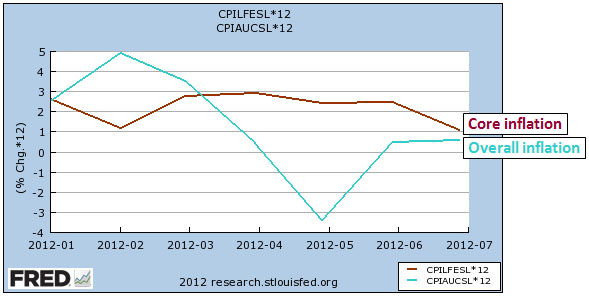
    Dylan Matthews points out today that despite the predictions of the doomsayers, inflation continues to be nearly nonexistent. According to the BLS, the headline CPI figure stood at zero in July, and core inflation (which excludes food and energy) was at 0.1%.

    As it turns out, that zero number is a statistical artifact. The real number is 0.045%, which rounds down to zero. But if you multiply by 12 to get the annualized figure, it’s still a very, very modest 0.5%. The chart below shows monthly inflation for 2012, annualized for both headline CPI and core inflation.

    So why is the Fed still so concerned about inflation, when it’s so well controlled and unemployment is still so high? It is a mystery.