• People Just Don’t Like Mitt Romney, Part 34

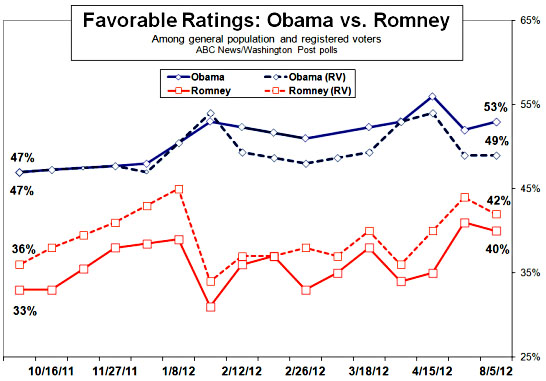
    According to a new Washington Post/ABC News poll, Mitt Romney still isn’t doing well in the “connecting with other humans” department:

    Mitt Romney is laboring under the lowest personal popularity ratings for a presumptive presidential nominee in midsummer election-year polls back to 1984….Forty percent of Americans overall view Romney favorably, 49 percent unfavorably….A new high of 30 percent now see him “strongly” unfavorably, nearly double his strongly favorable score

    Romney got a nice bounce upward after the primary battles ended in April, but he’s started to slide back down over the past few weeks. The only good news for the Romney camp is that although Obama is far better liked than Romney among the general population, the gap is only seven percentage points among registered voters. So there’s that to cling to.

  • Mitt Romney and His Mysterious $102 Million IRA


    This morning I blasted Harry Reid for inventing a story about a mysterious informant who told him that Mitt Romney hadn’t paid any income taxes for the past ten years. One reason for thinking that Reid invented this is the sheer implausibility of Romney avoiding taxes for an entire decade. One year, maybe. Two years, still a possibility. But not ten.

    I’m sticking to my guns on this, but there’s now a sliver of doubt. Today, for the first time that I know of, someone has produced a reasonable-sounding scenario that explains how Romney might have paid either zero or close to zero in income taxes for eight years. It’s related to Romney’s $102 million IRA, something that’s been tantalizing us ever since it showed up in his 2010 tax return. You can read it here.

  • The Problem With Idioms

    From the annals of misunderstood idioms, Business Insider brings us an email from a guy applying to be a Wall Street trader. He was asked to add a bit of color to his application, so he sent back a reply with various sections highlighted in different colors.

    This reminds me of a new guy who was hired to work for me back when I ran a Radio Shack store in the early 80s (hiring was done by a central office in each district, so I hadn’t met him before). He dropped in to introduce himself, and I told him I wanted him to come in from 10 to 6 the next day. When I showed up at 9:30, he was already waiting. “You didn’t need to come early,” I said. “I’m just going to do a bit of paperwork before I open the store.”

    “Early?” he asked. “You told me to come in at 10 to 6.” Turns out he had been waiting in the parking lot for me since 5:50 am. This wasn’t my fault or anything, but I’ve always felt a little bad about it ever since.

  • Cats Continue Their Ongoing War Against Birds


    Yet another study has been done investigating the shocking allegation that cats kill lots of birds:

    “I think it will be impossible to deny the ongoing slaughter of wildlife by outdoor cats given the videotape documentation and the scientific credibility that this study brings,” said Michael Hutchins, Executive Director/CEO of The Wildlife Society.

    Yes indeed, the slaughter of wildlife. But there’s not much new here. The investigators attached cameras to a bunch of cats and then counted how many critters they killed. The lead author calls the results “surprising,” and the press release from the American Bird Conservancy says the study shows that house cats kill “far more than the previous estimate of a billion birds and other animals each year.”

    That might be true on the “other animals” front, but not on the bird front. A year ago the American Bird Conservancy estimated that cats killed 500 million birds per year. The new study says that cats kill….500 million birds per year. Last year I looked into this and concluded that this probably represents about 3% of all birds in the United States. There’s more to it than just that (cats might have a bigger impact on specific species in specific places, for example), and you can decide for yourself whether 3% is a lot or a little. Either way, though, this study doesn’t seem to change things much.

    ALSO: Judicial notice is hereby taken that birds make up only 13% of total feline kills. But nobody seems to care much about the other 87%. Why is that? Apparently lizards, voles, chipmunks, birds, frogs, and small snakes don’t have a very strong lobbying presence.

  • Mitt Romney Doubles Down on Opposition to Obama’s Support of Welfare Queens

    A few decades ago (in blog time — that’s a couple of weeks ago in ordinary time) Republicans were making hay with a charge that President Obama was “gutting” the work requirement of welfare reform by agreeing to consider waiver requests from various states. Never mind that some of the requests came from Republican governors, and never mind that the goal of the waivers was to increase the number of welfare recipients who transition into jobs (“Governors must commit that their proposals will move at least 20% more people from welfare to work compared to the state’s past performance,” HHS secretary Kathleen Sebelius confirmed in a letter). None of that mattered. Obama was gutting work requirements in obvious solidarity with welfare queens and strapping young bucks everywhere.

    Anyway, I thought it was a three-day kind of eruption that had since died away. But no! Ed Kilgore tells me that this has become the latest centerpiece of Mitt Romney’s campaign. He provides us with some history:

    This is kind of personal with me. I worked on welfare policy back in the 90s at the Progressive Policy Institute, which was the absolute hotbed of “work first” approaches to welfare reform. [This was back when Ed was an evil neoliberal. –ed.] Indeed, we were about the only people in the non-technical chattering classes who seemed to understand the distinction between the Clinton administration’s philosophy of welfare reform (aimed at getting welfare recipients into private-sector jobs, not just through work requirements but with robust “making work pay” supports like an expanded EITC, which was enacted at Clinton’s insistence well before welfare reform) and that of congressional Republicans (House Republicans were mainly concerned about punishing illegitimacy and denying assistance to legal immigrants, while Senate Republicans enacted a bill that was just a straight block grant that let states do whatever they wanted so long as they saved the feds money).

    I mention this ancient history to point out the rich irony of conservatives now attacking Obama for an alleged hostility to the private-sector job placement emphasis they never gave a damn about, and for giving states more flexibility in administering the federal cash assistance program, which GOPers at every level of government (including Mitt Romney) were clamoring for loudly before, during and after the 1996 debate.

    There’s a technical question underlying all this that relates to HHS’s legal basis for considering these waivers, and I don’t really have an informed opinion about that. But Romney’s latest ad states flatly that Obama plans to gut welfare reform by “dropping work requirements.” What’s more, “Under Obama’s plan, you wouldn’t have to work and wouldn’t have to train for a job. They just send you your welfare check.”

    This takes a shameless distortion and turns it into an outright falsehood. There’s no Obama plan in the first place; there’s certainly no plan to “drop” work requirements; and Sebelius has been crystal clear that the only waivers that will even be considered are ones that measurably increase the transition from welfare to work. Perhaps PolitiFact would care to weigh in on this?

  • Why Aurora Got More Media Attention Than Oak Creek

    I don’t spend a lot of time on this blog commenting on things like mass shootings. But a lot of people do, at least when it happens in a movie theater in Aurora and the victims are folks like you and me. But when it happens in Oak Creek and the victims aren’t so much like you and me? Robert Wright points out today that the media (and social media) coverage of the Sikh temple shootings has been way less intense than the coverage of the Aurora shootings:

    On twitter and blogs and many web sites, the difference in intensity of coverage between Aurora and Oak Creek seems to me close to an order of magnitude. (On some traditional news sites—e.g. the New York Times—the difference seems significant but not so vast.)

    Some of this can be accounted for by the number of deaths—twelve vs. six—and maybe some of it by the theatricality of the Batman murders. But I think some of it has to do with the fact that the people who shape discourse in this country by and large aren’t Sikhs and don’t know many if any Sikhs. They can imagine their friends and relatives—and themselves—being at a theater watching a Batman movie; they can’t imagine being in a Sikh temple.

    This isn’t meant as a scathing indictment; it’s only natural to get freaked out by threats in proportion to how threatening they seem to you personally. At the same time, one responsibility of journalists and pundits is to see things in terms of their larger social significance. And it seems to me that the Sikh temple shooting, viewed in that context, is at least as frightening as the Aurora massacre. This was violence across ethnic lines, and that kind of violence has a long history of eroding and even destroying social fabric.

    The whole thing is worth a read. Also, a question for commenters: Is Wright’s observation equally true for television? Has the coverage of the Sikh temple massacre on Fox and CNN and MSNBC been lighter than it was for the Aurora massacre? I don’t watch enough TV to have a good idea.

  • Louisiana Schools All Set to Become Subsidiaries of Christian Church


    Over at Blue Marble (I’m not sure what it’s doing there, but whatever), Deanna Pan regales us with 14 wacky facts that Louisiana kids will soon be taught on the public dime now that Gov. Bobby Jindal’s new voucher program is poised to go into effect. There’s lots of good stuff there, but since I’m a product of the New Math, I got the biggest kick out of this one:

    11. Abstract algebra is too dang complicated: “Unlike the “modern math” theorists, who believe that mathematics is a creation of man and thus arbitrary and relative, A Beka Book teaches that the laws of mathematics are a creation of God and thus absolute….A Beka Book provides attractive, legible, and workable traditional mathematics texts that are not burdened with modern theories such as set theory.” – ABeka.com

    Teaching set theory to fourth graders in the 1960s probably wasn’t the greatest idea in the world, but not because set theory is either “modern” or “arbitrary and relative.” It just turned out not to have much to do with teaching kids how to add and subtract. Still, it’s true that the foundations of modern math are fundamentally based on axioms that can change depending on which ones seem the most useful. And a good thing too, unless you think Einstein’s theory of relativity is some God-denying conspiracy against Euclid’s fifth postulate. Which these guys might. Who knows?

    In any case — and to change the subject entirely — this is why Bobby Jindal is my semi-dark horse pick to be Mitt Romney’s running mate. I know he’s got a few things in his background that might be troublesome, but nothing too bad. And he’s got a lot going for him: tea party cred, good speaking skills, not a boring white guy, gives conservatives a chance to show they’re OK with dark-skinned politicians, and — well, stuff like his voucher program, which he hasn’t backed down on despite plenty of withering criticism of all the money that will end up in the pockets of fly-by-night Christian schools. True conservatives take that as a badge of honor, not a criticism, and so does Jindal.

    In any case, he’s my current guess. Put your guess in comments, but do it quickly if you want full Nostradamus credit.

    UPDATE: My guess that this was all related to conservative animus toward the New Math along with philosophical opposition to Hilbert’s program is, apparently, wrong. Maggie Koerth-Baker has a much more parsimonious and knowledgable explanation here. It’s also far more entertaining! Apparently poor old Georg Cantor is the villain in this story.

    I admit that my original theory (New Math + Hilbert) was sort of unlikely. But in this case, it turns out that its big problem is that it wasn’t unlikely enough. Go figure.

  • The Supreme Court Did Not Say That States Can Pull Out of Existing Medicaid Rules

    In the Obamacare case, the Supreme Court ruled that the federal government couldn’t threaten to take away existing Medicaid funding from a state that refused to go along with Obamacare’s expansion of Medicaid. The level of coercion was too great, the court said. In practice, it left states with no choice in the matter.

    In the LA Times today, Tom Campbell suggests that this opens up a whole new era in Medicaid governance:

    Before the Supreme Court’s ruling….only the federal government had the authority to say what kind of coverage was sufficient. If a state, for example, wanted to cover more people by cutting out more expensive kinds of treatment, a federal waiver was required — and seldom given.

    But under a reasonable interpretation of the court’s recent decision, that might no longer be true….The Supreme Court’s rationale [] holds significance for a much broader question: What might there be in the existing Medicaid rules that could also be held to constitute coercion? The governor of Maine contends that if his state wants to limit eligibility for Medicaid, to save state dollars, it has the right to do so without having to get a waiver from the federal government or losing any federal funds it now gets in proportion to the level of coverage. Maine will pay its share, and the federal government should pay its too, for the smaller amount of coverage. Anything else, according to his argument, constitutes coercion, and the logic of the Supreme Court ruling should strike it down.

    Campbell is a smart guy and a non-wingnut conservative. But I sure don’t see where this comes from. Medicaid expansion is a brand new program, and the Supreme Court said that states couldn’t be forced to accept a new program. There had to be some legitimate scope for real negotiation. But current rules are different: the states accepted those long ago. The federal government isn’t forcing anything new on them when it says they have to get a waiver if they want to deviate from these rules.

    So what am I missing? This seems completely unrelated to anything the Supreme Court said in the Obamacare case. It would mean that states can unilaterally opt out of rules they’ve already agreed to without any penalty, which in turn would essentially mean that the federal government would have no authority to set rules at all. Even the court’s conservatives would surely balk at that, wouldn’t they?

    Or would they?

  • Why Obamacare Probably Won’t Lead to Doctor Shortages

    The New York Times reports today about evidence that the HCA hospital chain has performed lots of unnecessary heart surgery over the past few years:

    “The allegations related to unnecessary procedures being performed in the cath lab are substantiated,” according to a confidential memo written by a company ethics officer, Stephen Johnson, and reviewed by The New York Times. Mr. Tomlinson’s contract was not renewed, a move that Mr. Johnson said in the memo was in retaliation for his complaints.

    ….At Lawnwood, where an invasive diagnostic test known as a cardiac catheterization is performed, about half the procedures, or 1,200, were determined to have been done on patients without significant heart disease, according to a confidential 2010 review. HCA countered recently with a different analysis, saying the percentage of patients without disease was much lower and in keeping with national averages.

    ….HCA denies its decisions at these hospitals were motivated by financial considerations, but rather “demonstrate the strong focus we have on quality patient care.” The company also says that more than 80 percent of its hospitals are in the top 10 percent of government rankings for quality.

    I’m going to use this as an excuse to make a fairly tangential point: Stories like this are why I’m not all that worried about a doctor shortage after Obamacare fully kicks in in 2014. It’s not that the fear is totally groundless. If you put a lot more patients into the medical system, that’s likely to make hospitals and doctors’ offices more crowded. But there’s also a lot of evidence for a substantial supply-side effect on medical care: the more doctors a city has, the more treatment people get, whether they need it or not. Likewise, if a hospital buys an expensive piece of equipment, they’re highly motivated to keep it in constant use whether it’s really necessary or not.

    So yes: more patients might cause more crowding. It’s a reasonable concern. But there’s a pretty good chance that it’s mostly going to crowd out a fair amount of unnecessary care, like the stuff HCA is accused of providing. That will eat into bottom lines, but it won’t necessarily make it any harder to see a doctor when your kid has an ear infection. We’ll just have to wait and see.