• It’s Time to Stop Celebrating Harry Reid


    Here is Harry Reid on Mitt Romney’s taxes: “I was told by an extremely credible source that Romney has not paid taxes for 10 years.” PolitiFact rates this a Pants on Fire lie.

    An awful lot of liberals disagree. Typical reasons include sophistry (“PolitiFact doesn’t know that Romney paid any taxes”); revenge (“Romney’s been telling lots of lies, so why shouldn’t we?”); disingenuousness (“All Romney has to do is release his tax returns to clear this up”); or lying as a virtue (“Politics ain’t beanbag”).

    Come on, folks. Reid didn’t say I’ll bet Romney didn’t pay any taxes. He didn’t say he talked to someone familiar with high earners who told him Maybe Romney won’t release his returns because he didn’t pay any taxes. He made a flat statement of fact. He said he has an “extremely credible source,” which in this context means someone with direct knowledge of Romney’s taxes who decided to pick up the phone and dish about it to Harry Reid. Does anyone really believe this? Really? Then, as if that weren’t enough, Reid made his little bluff even less plausible by deciding that Romney didn’t just avoid all taxes for one year, he avoided them for ten years. Yeah, baby, that’s the ticket! Put these two things together with the fact that Reid hasn’t even tried to make his fairy tale sound believable (it’s just some guy he talked to) and this is not a story that a five-year-old would credit. It’s just Reid making stuff up in order to put pressure on Romney, and I think we all know it.

    Can I prove this? Of course not. Given the epistemological limits of proof, I can’t prove Barack Obama was born in the United States either. Nevertheless, I feel safe saying that anyone who claims to have an “extremely credible source” that Obama was born elsewhere is either crazy or lying. The same is true for Reid, and Reid isn’t crazy. It’s simply vanishingly unlikely that he’s telling the truth, and no one — not liberal or conservative — would spend even ten seconds on a story so patently far-fetched if it were anybody but Reid and the background were anything but the frenzy of a presidential campaign.

    Politically, of course, Reid’s ploy has worked like a charm. Romney’s taxes are back in the news and Romney’s ham-handed handling of the whole affair has kept it there. And that gives everyone a fifth reason to cheer on Reid: the end justifies the means.

    Take a deep breath, folks. This is contemptible stuff and it’s not just business as usual. We’ve spent too many years berating the tea partiers for getting on bandwagons like this to get sucked into it ourselves the first time it’s convenient. It’s time to quit cheering on Reid and get off this particular bus.

  • 14 Wacky “Facts” Kids Will Learn in Louisiana’s Voucher Schools

    Separation of church and what?Currier & Ives/Library of Congress

    Thanks to a new law privatizing public education in Louisiana, Bible-based curriculum can now indoctrinate young, pliant minds with the good news of the Lord—all on the state taxpayers’ dime.

    Under Gov. Bobby Jindal’s voucher program, considered the most sweeping in the country, Louisiana is poised to spend tens of millions of dollars to help poor and middle-class students from the state’s notoriously terrible public schools receive a private education. While the governor’s plan sounds great in the glittery parlance of the state’s PR machine, the program is rife with accountability problems that actually haven’t been solved by the new standards the Louisiana Department of Education adopted two weeks ago.

    For one, of the 119 (mostly Christian) participating schools, Zack Kopplin, a gutsy college sophomore who’s taken to Change.org to stonewall the program, has identified at least 19 that teach or champion creationist nonscience and will rake in nearly $4 million in public funding from the initial round of voucher designations.

    Many of these schools, Kopplin notes, rely on Pensacola-based A Beka Book curriculum or Bob Jones University Press textbooks to teach their pupils Bible-based “facts,” such as the existence of Nessie the Loch Ness Monster and all sorts of pseudoscience that researcher Rachel Tabachnick and writer Thomas Vinciguerra have thankfully pored over so the rest of world doesn’t have to.

    Here are some of my favorite lessons:

    1. Dinosaurs and humans probably hung out: “Bible-believing Christians cannot accept any evolutionary interpretation. Dinosaurs and humans were definitely on the earth at the same time and may have even lived side by side within the past few thousand years.”Life Science, 3rd ed., Bob Jones University Press, 2007
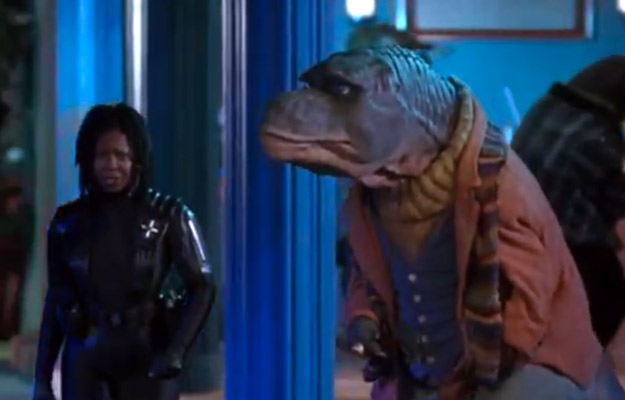
    Much like Whoopi and Teddy in the cinematic classic Theodore Rex. Screenshot: YouTubeMuch like tough cop Katie Coltrane and Teddy the T-rex in the direct-to-video hit Theodore Rex Screenshot: YouTube

    2. Dragons were totally real: “[Is] it possible that a fire-breathing animal really existed? Today some scientists are saying yes. They have found large chambers in certain dinosaur skulls…The large skull chambers could have contained special chemical-producing glands. When the animal forced the chemicals out of its mouth or nose, these substances may have combined and produced fire and smoke.”Life Science, 3rd ed., Bob Jones University Press, 2007

    3. “God used the Trail of Tears to bring many Indians to Christ.”—America: Land That I Love, Teacher ed., A Beka Book, 1994

    4. Africa needs religion: “Africa is a continent with many needs. It is still in need of the gospel…Only about ten percent of Africans can read and write. In some areas the mission schools have been shut down by Communists who have taken over the government.”—Old World History and Geography in Christian Perspective, 3rd ed., A Beka Book, 2004
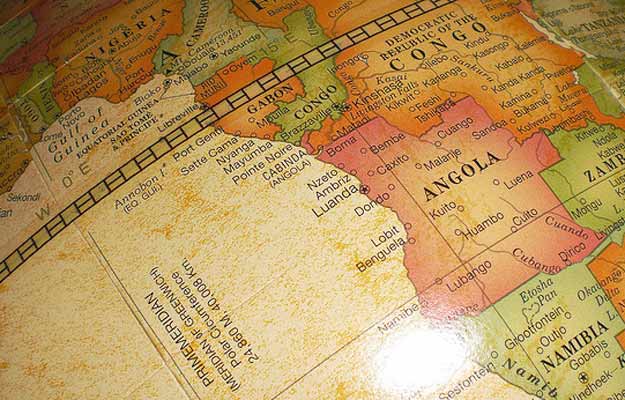
    The literacy rate in Africa is "only about 10 percent"--give or take a few dozen percentage points. residentevil_stars2001/FlickrThe literacy rate in Africa is “only about 10 percent”…give or take a few dozen percentage points. residentevil_stars2001/Flickr

    5. Slave masters were nice guys: “A few slave holders were undeniably cruel. Examples of slaves beaten to death were not common, neither were they unknown. The majority of slave holders treated their slaves well.”United States History for Christian Schools, 2nd ed., Bob Jones University Press, 1991
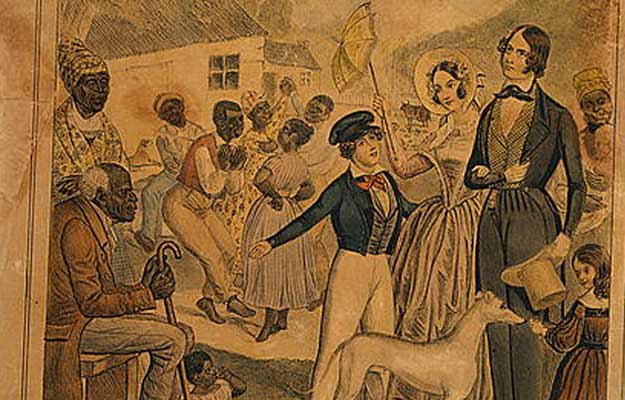
    Slaves and their masters: BFF 4lyfe!  Edward Williams Clay/Library of CongressDoesn’t everyone look happy?! Edward Williams Clay/Library of Congress

    6. The KKK was A-OK: “[The Ku Klux] Klan in some areas of the country tried to be a means of reform, fighting the decline in morality and using the symbol of the cross. Klan targets were bootleggers, wife-beaters, and immoral movies. In some communities it achieved a certain respectability as it worked with politicians.”United States History for Christian Schools, 3rd ed., Bob Jones University Press, 2001
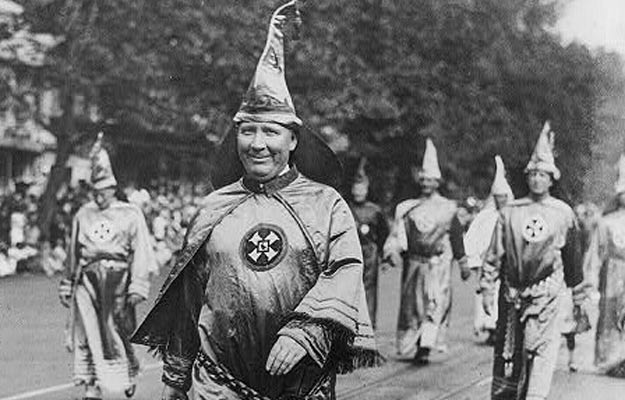
    Just your friendly neighborhood Imperial Wizard! Unknown/Library of CongressJust your friendly neighborhood Imperial Wizard Unknown/Library of Congress

    7. The Great Depression wasn’t as bad as the liberals made it sound: “Perhaps the best known work of propaganda to come from the Depression was John Steinbeck’s The Grapes of Wrath…Other forms of propaganda included rumors of mortgage foreclosures, mass evictions, and hunger riots and exaggerated statistics representing the number of unemployed and homeless people in America.”United States History: Heritage of Freedom, 2nd ed., A Beka Book, 1996
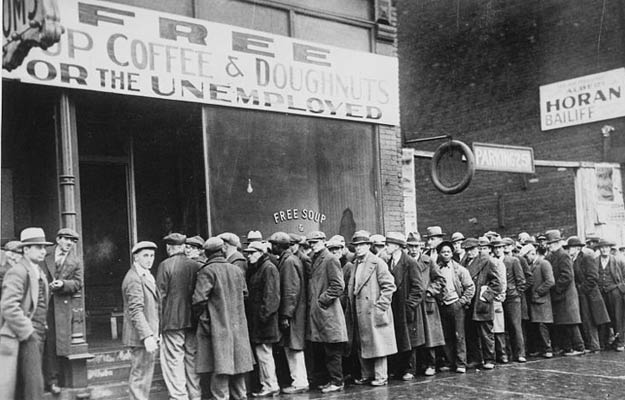
    Definitely Photoshopped.  U.S. National Archives and Records Administration/WikipediaDefinitely Photoshopped. U.S. National Archives and Records Administration/Wikipedia

    8. SCOTUS enslaved fetuses: “Ignoring 3,500 years of Judeo-Christian civilization, religion, morality, and law, the Burger Court held that an unborn child was not a living person but rather the “property” of the mother (much like slaves were considered property in the 1857 case of Dred Scott v. Sandford).”American Government in Christian Perspective, 2nd ed., A Beka Book, 1997

    9. The Red Scare isn’t over yet: “It is no wonder that Satan hates the family and has hurled his venom against it in the form of Communism.”— American Government in Christian Perspective, 2nd ed., A Beka Book, 1997
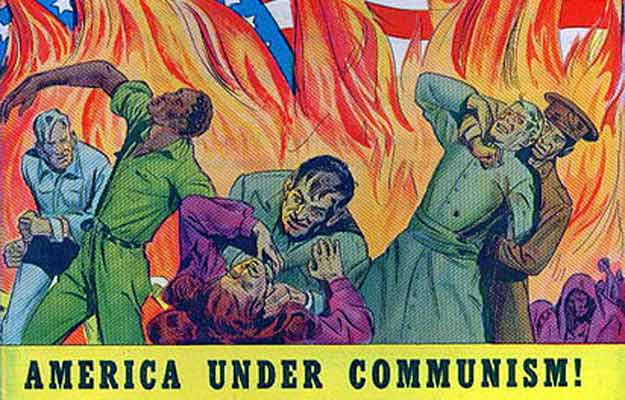
    Meanwhile, God sneezes glitter snot in the form of Capitalism. Catechetical Guild/Wikipedia Catechetical Guild/Wikipedia

    10. Mark Twain and Emily Dickinson were a couple of hacks: “[Mark] Twain’s outlook was both self-centered and ultimately hopeless…Twain’s skepticism was clearly not the honest questioning of a seeker of truth but the deliberate defiance of a confessed rebel.”Elements of Literature for Christian Schools, Bob Jones University, 2001

    “Several of [Emily Dickinson’s] poems show a presumptuous attitude concerning her eternal destiny and a veiled disrespect for authority in general. Throughout her life she viewed salvation as a gamble, not a certainty. Although she did view the Bible as a source of poetic inspiration, she never accepted it as an inerrant guide to life.”Elements of Literature for Christian Schools, Bob Jones University, 2001

    And her grammar was just despicable! Ugh! Todd-Bingham picture collection, 1837-1966 (inclusive)/ Manuscripts & Archives, Yale UniversityTo say nothing of her poetry’s Syntax and Punctuation—how odious it is.Todd-Bingham picture collection, 1837-1966 (inclusive)/ Manuscripts & Archives, Yale University

    11. Abstract algebra is too dang complicated: “Unlike the ‘modern math’ theorists, who believe that mathematics is a creation of man and thus arbitrary and relative, A Beka Book teaches that the laws of mathematics are a creation of God and thus absolute…A Beka Book provides attractive, legible, and workable traditional mathematics texts that are not burdened with modern theories such as set theory.”—ABeka.com
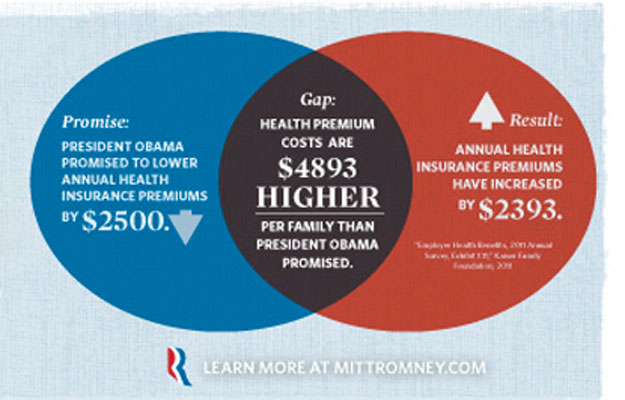
    Maths is hard! Screenshot: MittRomney.comMATHS: Y U SO HARD? Screenshot: MittRomney.com

    12. Gay people “have no more claims to special rights than child molesters or rapists.”Teacher’s Resource Guide to Current Events for Christian Schools, 1998-1999, Bob Jones University Press, 1998

    13. “Global environmentalists have said and written enough to leave no doubt that their goal is to destroy the prosperous economies of the world’s richest nations.”Economics: Work and Prosperity in Christian Perspective, 2nd ed., A Beka Book, 1999
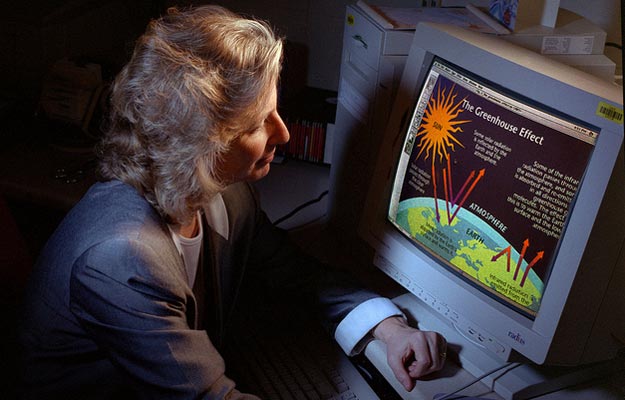
    Plotting world destruction, BRB.  Lynn Freeny, Department of Energy/FlickrPlotting economic apocalypse, BRB Lynn Freeny, Department of Energy/Flickr

    14. Globalization is a precursor to rapture: “But instead of this world unification ushering in an age of prosperity and peace, as most globalists believe it will, it will be a time of unimaginable human suffering as recorded in God’s Word. The Anti-christ will tightly regulate who may buy and sell.”Economics: Work and Prosperity in Christian Perspective, 2nd ed., A Beka Book, 1999
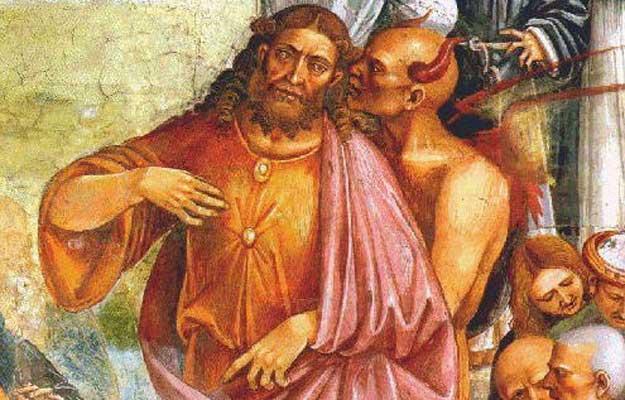
    He'll probably be in cahoots with the global environmentalists. Luca Signorelli/WikipediaSwapping insider-trading secrets is the devil’s favorite pastime. Luca Signorelli/WikipediaWhew! Seems extreme. But perhaps we shouldn’t be too surprised. Gov. Jindal, you remember, once tried to perform an exorcism on a college gal pal.

  • No, Barack Obama Isn’t Trying to Undermine Military Voters

    Today’s Outrage of the Day™ is Mitt Romney’s contention that Barack Obama hates our men and women in uniform and wants to prevent them from voting. Here is Katie Biber, legal counsel for the Romney campaign:

    We disagree with the basic premise that it is “arbitrary” and unconstitutional to give three extra days of in-person early voting to military voters and their families, and believe it is a dangerous and offensive argument for President Obama and the DNC to make.

    That does sound offensive, doesn’t it? The nickel version of the truth is that Ohio recently restricted early voting for everyone except members of the military, and the Obama campaign wants the law overturned. They want everyone to be able to vote early. In other words, if Obama gets his way, nobody in the military will lose their early voting rights. Romney was just flat-out lying when he implied last week that Obama was trying to “undermine” the voting rights of members of the military.

    On the other hand, it’s also true that if Obama’s suit succeeds, members of the military will no longer get special consideration, as the Ohio legislature wanted to give them. There’s little doubt that the motivation for this was largely partisan (the military tends to vote Republican), but you know what? There’s also a perfectly defensible case to be made that military voters do indeed deserve preferential treatment. Obama’s suit argues otherwise, and Republicans are making hay with it.

    Anyone suggesting that Obama is trying to restrict military voting rights is pretty plainly lying. On the other hand, if you stick to the argument that the military deserves special treatment and Obama opposes giving it to them — as Biber did — you’re in the clear. It’s nasty stuff, but still pretty garden variety attack politics.

  • Chart of the Day: Algobot Wars Now Rule Wall Street

    Felix Salmon passes along this animation that shows the remarkably chaotic growth of high-frequency trading on all of America’s various stock exchanges over the past five years (this includes the three exchanges you’ve heard of plus the dozen others you probably haven’t). The basic idea behind HFT is that humans are taken out of the trading equation entirely. Instead, computer algorithms trade stocks directly, executing millions of trades per second and occasionally going crazy, as they did during the Flash Crash of 2010 and then again a few days ago, when an HFT bug cost Knight Capital $440 million in 30 minutes. Felix wants it to stop:

    Back in 2007, I wasn’t a fan of a financial-transactions tax; today, I am. And this chart shows better than anything why my opinion has changed. The stock market is clearly more dangerous than it was in 2007, with much greater tail risk; meanwhile, in return for facing that danger, society as a whole has received precious little utility. Are spreads a tiny bit tighter than they might be otherwise? Perhaps. But that has no effect on stock-market returns for long-term or even medium-term investors.

    The stock market today is a war zone, where algobots fight each other over pennies, millions of times a second. Sometimes, the casualties are merely companies like Knight, and few people have much sympathy for them. But inevitably, at some point in the future, significant losses will end up being borne by investors with no direct connection to the HFT world, which is so complex that its potential systemic repercussions are literally unknowable. The potential cost is huge; the short-term benefits are minuscule. Let’s give HFT the funeral it deserves.

    I agree. The problem with HFT isn’t that we know it’s dangerous, it’s that we don’t know anything at all. It’s become flatly too complex for even its creators to understand what their creations are doing. Here’s an example. The heart of HFT is speed: even the speed-of-light delay can make a difference, so most HFT shops locate their computers as close to the stock exchanges as possible. Even a few milliseconds can make a difference. At least, that’s what a company called UNX thought until it moved from Burbank to New York:

    This is where the story gets, as [Scott] Harrison put it, weird. He explains: “When we got everything set up in New York, the trades were faster, just as we expected. We saved thirty-five milliseconds by moving everything east. All of that went exactly as we planned.”

    “But all of a sudden, our trading costs were higher. We were paying more to buy shares, and we were receiving less when we sold. The trading speeds were faster, but the execution was inferior. It was one of the strangest things I’d ever seen. We spent a huge amount of time confirming the results, testing and testing, but they held across the board. No matter what we tried, faster was worse.”

    “Finally, we gave up and decided to slow down our computers a little bit, just to see what would happen. We delayed their operation. And when we went back up to sixty-five milliseconds of trade time, we went back to the top of the charts. It was really bizarre. I mean, there we were in the most efficient market in the world, with trillions of dollars changing hands every second, and we’d clearly gotten faster moving to New York. And yet we’d also gotten worse. And then we improved by slowing down. It was the oddest thing. In a world that values speed so much, you could be slower, yet still be better.”

    The problem here isn’t that UNX’s move failed, it’s that Harrison still doesn’t know why it failed. Until we do, allowing HFT bots to control our equity markets is just begging for a catastrophe.

    And that’s where the transaction tax comes in. HFT works by making tiny amounts of money on a huge number of trades. Even a tiny tax, maybe a quarter of a percent per trade, would make HFT unprofitable and would put our markets back in the hands of human beings. Those human beings will still screw up, but at least there’s a limit to how fast and how badly they can do it.

  • Maybe, Just Maybe, the Economy Is Starting to Recover

    Is the economy finally getting better? A friend writes in with some anecdotal evidence: his father, who declared bankruptcy two years ago, got cold called by Bank of America offering him a refi deal. What’s more, his brother finally got evicted from his foreclosed house in Riverside. “I’ve told people that the recession won’t end until his creditors evict him,” he writes. “His presence in the house was a sign that the house can’t be sold. Well, my brother is getting evicted next week.”

    Karl Smith has some anecdotal evidence too, but he also has some statistical evidence to offer. According to the BLS payroll series on employment, job growth has been pretty flat for the past year (that’s the red line). But the household survey tells a different story. From a near stall in June, employment growth has been accelerating steadily for the past year and is now up to nearly 250,000 new jobs per month. So maybe the economy is doing better than we think.

    It’s worth noting that none of this matters much for the election. If the economy really is poised for takeoff, it will come too late to do Barack Obama any good. For now, this is just something to scratch our chins about.

  • Mitt Romney Not Such a Great Real Estate Investor


    The LA Times reports that although Mitt Romney may be pretty good at making money in the private equity biz, he’s apparently not so good at the real estate investment biz. His La Jolla mansion, the one with the car elevators, hasn’t worked out so well for him:

    After paying cash for the Mediterranean-style house with 61 feet of beach frontage, [the Romneys] asked San Diego County for dramatic property tax relief….Initially, the Romneys asked that their 2009 assessment, $12.24 million, be reduced to $6.8 million, maintaining that their home had lost about 45% of its value in the first seven months they owned it.

    Impressive! A lot of homes here in Southern California lost value during the housing bust, but Romney must be the only guy to lose 45% in the space of seven months. Or to claim he did, anyway. The San Diego County assessor rejected Romney’s rather dramatic sob story, and eventually everyone settled on a 29% reduction over the course of three years — though Romney’s lawyer still thinks that’s a lot higher than the home’s current fair market value. I guess mansions on the beach in La Jolla aren’t what they used to be.

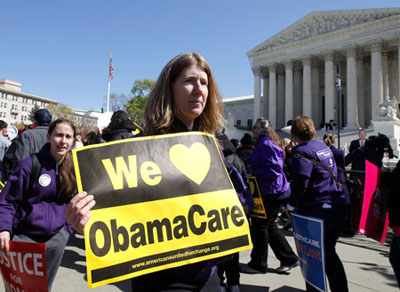
  • Hooray for Obamacare!

    The New York Times reports that even liberals are now referring to the Affordable Care Act as “Obamacare”:

    Whether Democrats can change a pejorative into a positive is unclear, but after three years on the defensive, they have resigned themselves to the fact that “Obamacare” has become the popular name for the sweeping social program, and they are trying to spin it in their direction. Particularly since the Supreme Court upheld the law’s constitutionality, Mr. Obama and his allies have tried to take ownership of the term.

    “The right created it and spits it out as an epithet; it has that tone, a sneering quality like they’re hanging it around his neck,” said Jeff Shesol, a former White House speechwriter under President Bill Clinton. “But it has so taken hold, it reached that level of saturation that it’s very difficult for Obama or the Democrats to escape it. So why not then try to appropriate it?”

    I’ve always been fine with Obamacare as a nickname, much the same way that Reaganomics is a nickname for supply-side economics. And whether embracing it converts the term Obamacare from a pejorative into a positive depends entirely on Obamacare itself, I think. “Neoconservative” started out as a pejorative term and did just fine when neocons made it into a popular doctrine. Conversely, “welfare” used to be so plainly positive that conservatives urged other conservatives not to use the term. But that changed when conservatives made welfare itself suspect.

    Likewise, if ACA eventually becomes popular, then Obamacare will be a positive term. If it fails, then it will fade away. It’s that simple.

  • Nobody Likes Mitt Romney


    This is from Obama’s Last Stand, a new e-book from Glenn Thrush:

    Obama [] began campaign preparations feeling neutral about Romney, but like the former governor’s GOP opponents in 2008 and 2012, he quickly developed a genuine disdain for the man. That scorn stoked Obama’s competitive fire, got his head in the game, which came as a relief to some Obama aides who had seen his interest flag when he didn’t feel motivated to crush the opposition. Obama, a person close to him told me, didn’t even feel this strongly about conservative, combative House Majority Leader Eric Cantor, the Hill Republican he disliked the most. At least Cantor stood for something, he’d say.

    When he talked about Romney, aides picked up a level of anger he never had for Clinton or McCain, even after Sarah Palin was picked as his running mate. ‘There was a baseline of respect for John McCain. The president always thought he was an honorable man and a war hero,’ said a longtime Obama adviser. ‘That doesn’t hold true for Romney. He was no goddamned war hero.’”

    Romney really does seem to inspire contempt in almost everyone he comes into contact with these days, doesn’t he? I don’t have the sense that this has always been true — he seems to have produced the usual range of reactions when he was governor of Massachusetts or managing Bain Capital or running the Olympics — but something about the presidency seems to have brought out the worst in him. His ambition is so naked, his beliefs so malleable, his pandering so relentless, and his scruples so obviously expendable, that everyone who spars with him comes away feeling like they need to take a shower.

    I always wonder how Romney himself feels about this. Surely he knows what he’s doing? It’s not like he’s the worst guy in the world or anything, but somewhere, deep down, he understands that in a pedestrian but still real way he’s compromised his soul for a shot at the Oval Office, doesn’t he? Or has he shut it all out and somehow convinced himself that he’s still the hard-nosed but principled guy he’s always imagined himself to be? I wonder what he thinks of all this in the small hours of the night.