• Mitt Romney is Desperate to Show That He’s a True Believer

    A couple of days ago Mitt Romney suggested that Palestinians were poor because of their culture. Then he walked it back. Then he doubled down. Then the pointy-headed elites weighed in. Romney was misrepresenting the books he based his argument on, they said. One of the authors, Jared Diamond of Guns, Germs, and Steel fame, even took to the New York Times to say so himself. Romney’s riff on his book was so far off, Diamond said, “that I have to doubt whether Mr. Romney read it.” But Dan Drezner, who almost (almost!) betrays a bit of vicarious sympathy for the beatdown Romney is getting, says it doesn’t matter:

    Will this make a whit of difference in the campaign? That depends entirely on whether you believe that voters still respond to cues from elites… so for me the answer is “probably not.”

    Ah, but this was never a play for elite opinion, except maybe in the sense of assuring voters that Romney isn’t part of the fuzzy-headed, PhD-wielding, social science wimpocracy. Romney was basically suggesting that Palestinians are lazy and violent, and that’s why the milk and honey doesn’t run through their land. It was a crass shoutout to the Christian right, the Jewish right, and the neocon rump, all of whom already basically believe this. Romney is just sending a not-so-subtle signal that he’s one of them.

  • The Real Reason the Olympics Suck


    Mariel Zagunis, the U.S. flag bearer in the Olympic opening ceremonies, lost her semifinal sabre match yesterday. She was a two-time medal winner facing enormous pressure. She was way ahead of her opponent during most of the match and then collapsed utterly in the last couple of minutes. Afterwards she was in a daze. All she could talk about was how badly she had done, how disappointed she was. In the midst of all that, she failed to fulsomely congratulate the play of her opponent.

    This is what most of us call “being human.” A devastating disappointment affects people like that, at least for a few minutes. But Washington Post columnist Mike Wise doesn’t care:

    Say buh-bye, America. Mariel Zagunis’s Q-rating just left the building.

    ….I met Mariel Zagunis in Athens in 2004. Zagunis then was this likable teen with a blond ponytail who did spot-on impersonations of a three-toed sloth because she watched so much Animal Planet….Contrast that with Wednesday’s unsmiling, hyper-focused, I’m-not-talking-to-anyone-but-my-coach-between-matches ball of stress, who remained in an autopilot daze even after she lost.

    Etc.

    Yep, that’s what’s important. Zagunis, in the aftermath of a crushing letdown, wasn’t quite the bubbly teen that Wise remembers from eight years ago. She’s not as media savvy as, say, Kobe Bryant, and after her bout she continued to say that she could have won if she hadn’t lost her concentration, instead of vacuously thanking God for the mere opportunity of attending the games, the way you’re supposed to. And for that she deserves to be publicly slagged by some idiot columnist searching out something new to write about.

    I think this is what I dislike most about the Olympics. Not that it’s tape delayed. Not that the commentators are annoying. Not the commercialism or the nationalistic hype. It’s people like Mike Wise. Go back into your cave, will you? Leave the rest of us alone.

  • Mitt Romney’s Plan to Screw the Middle Class

    There are two parts to Mitt Romney’s tax plan. Here they are:

    Part 1: Romney wants to lower tax rates. This part of his plan is extremely detailed. Tax rates would be cut by a fifth across the board. Taxation of investment income would be eliminated for families with incomes under $200,000. The estate tax would be eliminated. The Alternative Minimum Tax would be eliminated. Obamacare’s payroll tax increase on the wealthy would be repealed. The corporate tax rate would be cut to 25%.

    Part 2: Romney wants to eliminate or reduce various tax credits and deductions in order to increase revenue. This would make up for the lost revenue from Part 1. However, he has provided zero detail about this part of his plan.

    Isn’t that odd? Romney has extremely specific thoughts about lowering tax rates and is willing to share chapter and verse. But when it comes to the part where you raise some taxes to make up for it, he suddenly thinks he ought to defer to Congress on the details instead of doing their job for them. Why is that?

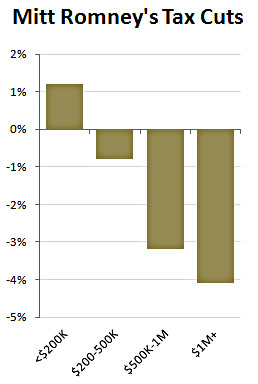
    The analysts at the Tax Policy Center provide a pretty good clue today. Romney himself won’t say anything about the credits and deductions he’d target, so they made the most progressive assumptions they possibly could about them by “starting at the top.” That is, they made a list of all the possible credits and deductions and then completely eliminated them for the highest income group. This would produce the largest possible tax increase for the wealthy. Then they worked their way down, and by the time they got to the bottom group they reduced the credits and deductions only enough to make the whole plan revenue neutral. This produced the smallest possible tax increase for the non-wealthy.

    So: the biggest possible increase for the wealthy, the smallest possible increase for the less wealthy. For technical reasons, they could only model this down to $200,000, but that’s enough to show what Romney’s plan would do. You can see it in the chart on the right. When you combine the decrease in rates and the increase from credits and deductions, millionaires would get a tax cut of 4.1%. Everyone under $200,000 would get a tax increase of 1.2%.

    At this point, President Obama’s problem is trying to get people to believe that Romney actually supports a plan that’s so outlandishly friendly to the rich. When the Priorities USA Super PAC tried to inform voters about Paul Ryan’s similar plan, Robert Draper reports that “the respondents simply refused to believe any politician would do such a thing.” And Romney, of course, will hide behind the fact that he himself hasn’t endorsed any particular basket of tax increases to make up for his rate cuts, so the Brookings analysis is just guesswork.

    Still, it’s the most sympathetic analysis possible. Any other basket of credits and deductions would make things even better for the wealthy and even worse for the non-wealthy. It might be, in Jon Chait’s words, cartoonishly evil to think that any politician would actually propose such a plan, but Romney has done exactly that. The only question is whether anyone can make the voters believe it.

  • Fed Continues to Twiddle Its Thumbs


    Here is the latest statement from the Fed:

    The Committee expects economic growth to remain moderate over coming quarters and then to pick up very gradually. Consequently, the Committee anticipates that the unemployment rate will decline only slowly toward levels that it judges to be consistent with its dual mandate. Furthermore, strains in global financial markets continue to pose significant downside risks to the economic outlook. The Committee anticipates that inflation over the medium term will run at or below the rate that it judges most consistent with its dual mandate.

    So there you have it. Unemployment remains higher than the Fed’s target and inflation remains at or below its target. The obvious response is to target unemployment more strongly since inflation is likely to remain subdued. Instead, the Fed announced it would do nothing new.

    That sound you hear is millions of people who actually care about unemployment banging their heads against the wall in frustration. Easier monetary policy might or might not be effective, but it seems like even the Fed thinks it would be a pretty low risk thing to try. So why not try it?

  • Why Does Ed DeMarco Hate Principal Forgiveness?

    The Treasury Department recently offered a deal to the Federal Housing Finance Agency: a tripled incentive to participate in a program of loan forgiveness to underwater homeowners. Yesterday, FHFA released an analysis that suggested this might be a good deal for Fannie Mae and Freddie Mac but probably not for taxpayers. So they declined to participate. This has produced many, many calls for President Obama to fire Ed DeMarco, the acting head of FHFA. The basic argument is that FHFA’s job is to worry about what’s good for FHFA, not what’s good for the taxpayers. That’s Treasury’s job.

    Point taken. But if you dig into both FHFA’s report and the technical appendices (here and here), something more interesting is at work here. Two things in particular struck me. First, FHFA’s various models do indeed suggest that FHFA would come out ahead if they took up the Treasury offer. But:

    The vast majority of the benefits are derived from those loans where the homeowner has not made a mortgage payment in more than a year and whose current LTV is greater than 140 percent, as shown in Table 4 of the appendix. Given that early intervention is the key factor to the success of modifications, relying on successful modifications from borrowers who have not made a mortgage payment in more than a year as supporting the Enterprises’ use of principal forgiveness does not seem warranted, despite the modeled results. Second, the HAMP NPV model by assuming principal is fully reduced at the outset as compared to over the course of three years, likely overstates the benefits of principal reduction on reducing default probabilities.

    This is….peculiar. The authors of the report seem to be saying that they don’t believe their own agency’s models. But how can this be? If FHFA thinks that FHFA’s models don’t take all the relevant factors into account, then FHFA should create better models. If these issues are genuine, why didn’t the modelers consider them?

    Second, the report argues that because FHFA would be required to offer principal forgiveness according to strict rules (unlike private banks, which are allowed to use more discretion), homeowners who are current on their payments would find it easy to game the system and claim hardship, hoping to get a principal reduction. If too many homeowners did this, it would wipe out FHFA’s benefit:

    As few as 14,000 strategic modifications (only one percent of all potential HAMP PRA eligible current borrowers) to as many as 126,000 (nine percent of those borrowers) would eliminate the Enterprise benefit of HAMP PRA.

    Again, I’m puzzled about why this isn’t incorporated into a bigger model. Why create a bunch of model scenarios (the study includes more than a dozen), and then discuss reasons the models might be off? Why not model both the early intervention problem and the strategic default problem and then produce a final set of scenarios?

    In a sense, I think the criticisms of DeMarco are off. If his only issue was that he didn’t like Treasury’s program because it would cost the taxpayers money, that would be pretty inexcusable. It’s up to Treasury to decide how to spend taxpayer money. But that doesn’t really seem to be his biggest problem. His real problems are these:

    • He doesn’t believe his own models. He thinks success rates will be low because the program targets homeowners who are too far gone, and that strategic defaults might wipe out any gain from the incentive subsidies.
    • He believes that reducing monthly payments is the key part of any loan modification program, and that the existing principal forbearance program does that just as well as principal forgiveness, and with less risk to taxpayers.
    • Principal forgiveness is a brand new program and would cost a considerable amount of money to implement.

    I’m not sure what to think of all this, but I do think these are the most concrete issues at hand, not the sideshow of taxpayer costs. The question is whether they’re legitimate, and that’s difficult to answer. I can’t help but think there’s some kind of wonk war going on within FHFA, with the modeling team refusing to take everything into account that the management team thinks they should. Or something like that. Whatever it is, though, it makes it pretty hard to fairly evaluate FHFA’s case for turning down Treasury.

  • Bomb Scares and Fighter Escorts


    As we all know, flight attendants found a camera on a United flight to Geneva yesterday, and after diverting the flight to Boston and offloading all the passengers, it turned out that the camera was….a camera. All of which suggests to me that if al-Qaeda were smart, they’d recruit lots of sympathizers who weren’t really ready for the whole suicide bomber thing and just have them leave cameras on board airplanes. It would tie up international air travel nicely.

    But I have one question about this incident that I haven’t been able to find an answer to. It’s this:

    Procopio said the North American Aerospace Defense Command deployed fighter jets to escort the United plane, but the aircraft landed before the jets reached it.

    What exactly are these kinds of fighter escorts for? There was no question about the pilot crash landing the plane, was there? Nor could a fighter escort do anything if the camera had turned out to be a bomb. They had radio contact with the cockpit the entire time, so what’s the point of this?

  • Is NBC’s Olympics Broadcast a Little Too Live?

    I mentioned the other day that I was tired of all the whining about NBC not broadcasting the Olympics live. After writing that, I discovered that, in fact, NBC is broadcasting the Olympics live, which made my puzzlement over the whining even greater. Every single event, it turns out, is being livestreamed at nbcolympics.com/liveextra/.

    As it happens, my continuing YouTube problems have prevented this from working on my computer. But apparently I am a lonely exception. Over in the great city of Los Angeles, their IT department is worried about City Hall’s servers melting down due to the high volume of Olympics-related malingering:

    “We are experiencing a high volume of traffic due to people watching the Olympics online. I respectfully request that you discontinue this as it is impacting city operations,” city tech guru Randi Levin wrote in an email sent to thousands of workers Tuesday morning.

    ….Some council members expressed alarm at the prospect that city employees were watching the Olympics instead of doing their jobs. “City employees aren’t paid to watch the Olympics on their computers or TV. That is not what the taxpayers are paying them to do,” said Councilman Dennis Zine, who saw the email. “The question is where are the supervisors when this is going on?”

    Councilwoman Jan Perry said she’s outraged and wants the city to block Olympic streaming from City Hall computers.

    So I’m prompted to ask once again: apparently there is absolutely no problem watching the Olympics in real time if you want to. It’s true that you have to be a cable subscriber. You don’t just get it for free. But you don’t get Game of Thrones for free either. So what’s the problem?

    In related news, check out Adam Weinstein’s epic whine about the Olympics here. I’m sorely tempted to write an epic counter-whine, but it would just take too long. But I do have to ask what Adam has against table tennis. Seems like an OK sport to me.

  • Badminton Federation Screws Up, Players Pay the Price


    Several women’s badminton teams have been tossed out of the Olympics for deliberately trying to lose. Why? Because of a new tournament structure. They had already been guaranteed a spot in the quarterfinals, so their only goal was to get themselves into the bottom half of the draw, where they wouldn’t have to meet the top-ranked team until the finals:

    Even before the disqualifications, the matches Tuesday night triggered hand-wringing throughout the sport. This is the first Olympics to include preliminary rounds where four teams played one another once to determine who advanced to the knockout stage. All four pairs who played Tuesday night had won spots in the quarterfinals, so jockeying for an opponent —not winning or losing —was the imperative.

    Because the Chinese so dominate the sport and are so numerous in the tournament, they have incentive not to play one another when possible. And because they are so good, teams from other countries do their best to avoid the Chinese until there is no choice.

    Count me among those who blame the badminton federation at least as much as the players themselves. It’s idiocy to set up a knockout system in which it pays off to lose, especially when it’s pretty obvious that your system rewards strategic play. It’s like complaining about cricket teams deliberately slowing down to produce an inconclusive result, or basketball players trying to run out the clock. It’s all part of the game. If you don’t like it, don’t set up the rules to encourage it.