 David Corn has been beating the drum for a while about Mitt Romney’s claim that he left Bain Capital in 1999 and therefore can’t be held responsible for any of the stuff they did after that. Today the Boston Globe moves this story along:
Government documents filed by Mitt Romney and Bain Capital say Romney remained chief executive and chairman of the firm three years beyond the date he said he ceded control, even creating five new investment partnerships during that time.
Romney has said he left Bain in 1999 to lead the winter Olympics in Salt Lake City, ending his role in the company. But public Securities and Exchange Commission documents filed later by Bain Capital state he remained the firm’s “sole stockholder, chairman of the board, chief executive officer, and president.”
Also, a Massachusetts financial disclosure form Romney filed in 2003 states that he still owned 100 percent of Bain Capital in 2002. And Romney’s state financial disclosure forms indicate he earned at least $100,000 as a Bain “executive” in 2001 and 2002, separate from investment earnings.
If I had to guess, I’d say that when Romney took the Winter Olympics job he hadn’t made up his mind to leave Bain permanently. So he took a leave, keeping his ownership and his titles so that he could return later. As for his intentions during his Olympics tenure, who knows? Maybe he planned to keep his finger in the Bain pie but ended up not having the time. Maybe he planned to stay semi-involved. Maybe he did stay semi-involved. It’s impossible to say.
But look: it doesn’t matter. SEC documents show that he was CEO and owner of the firm between 1999 and 2002. In a political context, there’s just no way to weasel your way around that, and Romney is going to look increasingly weaselly if he tries. Your average Joe sees a multi-gazillionaire trying to claim that he was only technically CEO and isn’t responsible for what happened during his technical CEO-ship. That’s like a Mafia don taking the Fifth. It’s not going to fly, especially from a guy who’s constantly yammering away about personal responsibility and accountability.
So Romney has a problem, and he’d better figure out a better way of dealing with it than releasing increasingly tortured explanations of the definition of “CEO.” Voters want a president who takes responsibility, not one who tries to blame other people when something goes wrong.
And while we’re on the subject, check out David’s latest piece on Bain’s investment in a Chinese manufacturing company that “depended on US outsourcing for its profits—and that explicitly stated that such outsourcing was crucial to its success.” This happened in 1998, when Romney was unequivocally in charge. This stuff is piling up, and it doesn’t look very salt-of-the-earth to those independent blue-collar voters Romney is so anxious to court. He’d better figure out an answer.
 centers will ever come back. Retrofitting existing ones as health care facilities, by contrast, should be a booming business.
 all of the excess return occurs in a series of 24-hour periods eight times a year. Take away those 24-hour periods, and stock market returns are about what you’d expect them to be.
 problem everyone associates with Swiss bank accounts is much simpler: they’re for rich people trying to hide dodgy money from the tax man in dodgy ways.
 You should probably be sitting down before you read this.
 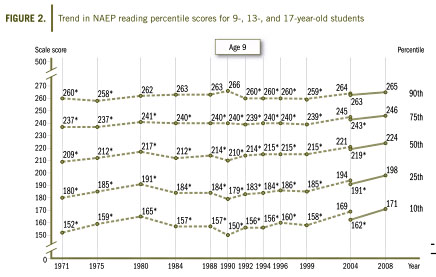 single parenthood is a problem, but still, if that were really the cause of the gap then I’d expect to see kids in poorer families doing worse on an absolute scale. But I don’t know of any evidence on that score, and Brooks doesn’t provide any. In fact, the one piece of evidence he mentions is school test scores, and he very cagily writes of poorer kids only that “Their test scores are lagging.” Technically, that’s true: poorer kids have always done worse than affluent kids, and they continue to do worse today. But that doesn’t mean their test scores have gone down. On the contrary: whether you measure by income level (kids who qualify for free lunches) or by performance level (the bottom decile of test scores), poor kids have improved their scores over the past four decades. That’s true for white kids, black kids, and Hispanic kids. It’s true for boys and girls. It’s true for public school kids and private school kids.