• Quote of the Day: How to Tell if Your City is Poorly Run


    From Doug Rawson, chief executive of a printing company a few miles south of LA in the city of Vernon:

    John Pérez has to be laughing. In retrospect, I think he was right. I think the city is poorly run…. I think we made a big mistake.

    This is totally inside baseball for folks who live in Southern California, and I apologize to all the rest of you. But reading this just cracked me up. For years Vernon has been a cozy little oligopoly with a population of about a hundred residents who ran the city like a fiefdom for the benefit of its corporate chieftains. And those corporate chieftains thought this was great! Then the cozy little oligopoly started dabbling in stupid financial derivatives, stupid business deals, and insanely corrupt payoffs to local officials. But even after all this had long since been exposed, and Assembly leader John Pérez tried to disincorporate Vernon, its corporate chieftains still thought everything was peachy and fought Pérez’s proposal like crazed weasels.

    Why? Because their taxes were still low and apparently all the local corporations thought they’d somehow stay low even though the city owed tons and tons of money. They still didn’t realize the city was poorly run! Imagine that. But eventually all those stupid deals and corrupt payoffs had to be accounted for, and that meant a tax increase. And guess what? Suddenly they realized that Pérez was right: Vernon was poorly run after all!

    Moral of the story: actual good management doesn’t matter. If taxes are low, a city is well run. If taxes go up, it’s not well run. Any questions?

  • Everyone Hates Healthcare

    The Washington Post reports that there’s just no pleasing the American public:

    Fifty-six percent of Americans rate the nation’s current health care system unfavorably in a new Washington Post-ABC News poll, while 52 percent regard the “federal law making changes in the health care system” in a negative light….Perhaps most interestingly, Americans who are not happy with their current health care also give Obama’s health care law negative ratings, by a 2-to-1 margin.

    This is a group that health reform was theoretically supposed to help. Back in August 2009, a Kaiser Family Foundation poll found that people who were less satisfied with their current health care were more likely to believe it would improve under health care reform. That clearly hasn’t happened.

    In short, people like neither the status quo nor the new version.

    This is less surprising than it seems. For starters, people are just in a sour mood these days thanks to a dismal economy and the endless, partisan bickering in Washington DC. What’s more, they’ve been assaulted by hundreds of million of dollars of brutally negative advertising about Obamacare and by a relentless campaign of vilification from the Rush/Fox/Drudge axis.

    And it sure hasn’t helped that after Obamacare passed, Democrats could hardly scurry into their hidey holes fast enough. Instead of defending the law as a historic guarantee of health insurance even if you’re sick or poor or out of work or self-employed, they clammed up. If Democratic leaders don’t believe in the bill, and don’t take the time to extol its virtues, why should we expect anyone else to?

    Beyond that, though, let’s be honest. What we all want is unlimited access to medical care; unlimited access to any procedure we want no matter how pricey; unlimited choice of physicians; instant availability of doctors every time we get an ear ache; and we’d like all this for free. That’s what we want. And we’re annoyed when we don’t get it.

    This means that we’re always going to be annoyed no matter what kind of healthcare system we have. And guess what? That’s true. Surveys from around the world prove it. In pretty much every country, people complain about their healthcare systems. Americans generally complain more than most, which makes sense since our healthcare system is so bad, but it’s only a matter of degree. The truth is that healthcare is just a tough nut to crack and sick people are cranky. No one is ever going to be satisfied, not with the status quo or with any conceivable replacement.

    Still, that’s no excuse for the excruciating lack of support for Obamacare on the left, which ranges from simple cowardice to outright derision because it doesn’t solve every healthcare problem in the world immediately. When I’m in a particularly black mood, I think that it would simply serve us right if the Supreme Court overturned the entire bill. If we refuse to support — really, loudly, insistently support — the biggest advance in social legislation since the 1960s, why should we expect anyone else to?

  • Buying Insurance vs. Paying a Fine: What’s the Tradeoff?

    Since the healthcare mandate is on everybody’s mind today, Ezra Klein asks a good question: does the mandate even matter?

    [If you choose not to buy insurance] you have to pay a penalty of $695 a year (that’s the 2016 number; after 2016, it rises with inflation) or 2.5 percent of your annual income, whichever is greater….[But suppose] you simply refuse to pay the mandate. What can the government do to make you pay?

    Well, unlike if you refuse to pay your taxes, it can’t throw you in jail or put a lien on your home or other property (page 336 of the legislation). It can potentially reduce your tax refund, but that’s really it. If you’re not getting a tax refund, you’re free and clear. Given these specifics, it’s worth asking why anyone thinks the mandate will work at all. And it’s worth saying that some don’t.

    So the fine is small and the government can’t do much to collect it anyway. But in practice, there’s an even more important question: how many people would fail to buy insurance and be forced to pay the fine in the first place? On the left, a fair number of people think that ACA’s subsidies are stingy enough that poor families simply won’t be able to afford insurance even if they want it, which would mean paying the fine instead. But is that true?

    What follows is back-of-the-envelope stuff, but I think it’s in the right ballpark. Let’s take a family of four where the policyholder is age 35 and has an income of $40,000. How much would insurance cost them? According to this handy calculator from Kaiser, here’s what that family would have to pay (converted into a monthly premium):

    • Premium cost: $925
    • Federal tax credit: $760
    • Net cost of policy: $165

    However, this overstates things because it’s based on the cost of a “silver” policy. But you don’t have to buy a silver policy. You can pay more and get a gold or platinum policy, and more importantly, you can pay less and get a bronze policy. Bronze policies don’t provide great coverage, but they do provide the basics and they also cover health emergencies. It’s a reasonable option for someone who just can’t afford more. By my rough calculation, a bronze policy would cost about $125 less than a silver policy. This means that the net monthly premium for our family of four would be about $40. That’s not much — and it’s half the cost of the fine.

    But how about a family of four with an income of $50,000? After subsidies, their cost for a bronze policy would probably come to about $166 per month. That’s more than the fine ($166 vs. $100) but not a lot more. How many families earning $50,000 would forego health insurance for a net cost of $66 per month? Not too many, I’d guess, even if the insurance policy is mediocre.

    As for families making more than $50,000, hardly any of them are uninsured in the first place. This paper estimates only about 1.6 million uninsured adults with incomes consistently above $50,000. It’s just not a big number.

    You can play with these numbers endlessly, and if you choose the worst possible set of circumstances you can always come up with an example or two of people who would be forced to pay a fair amount of money for health insurance they’d rather not have. But here are the basics for a family of four:

    • Under $30,000, families qualify for Medicaid and pay nothing for insurance.
    • Under $37,000 or so, most families can buy a bronze policy for free.
    • Between $37,000 and $45,000, the cost of a bronze policy is quite small, and certainly less than paying the fine.
    • Above $45,000, the cost of a bronze policy is a bit more than the fine.
    • Above $50,000, the cost of a bronze policy is significantly more than the fine, but there aren’t very many uninsured families in this category.

    The numbers work out differently for single people, but singles under 30 also have the option of buying only catastrophic coverage. We don’t know yet how much policies like this are going to cost, but certainly substantially less than a bronze policy. For most under-30s, this means they have the option of free or nearly free coverage all the way up to a fairly high income level.

    There are a lot of numbers in this post. Sorry about that. And I don’t mean to imply that the mandate is meaningless: in fact, it probably has both an objective and a subjective effect. Objective because it makes the financial case for buying insurance stronger, and subjective because most people prefer to obey the law. Still, it’s not overwhelmingly important. My personal preference would be for true national healthcare, and failing that, for higher subsidy levels under Obamacare. Nonetheless, the truth is that Obamacare makes insurance available to all poor families and most working class families either free or at very small cost. It’s a pretty good deal. The mandate is a backstop, and it’s one I support both on a substantive policy level and as a matter of constitutional law. But the subsidies and the insurance regs are the heart of Obamacare, and they always have been.

  • US Housing Market Starting to Rebound


    This post is dedicated to Karl Smith:

    Sales of newly built single-family homes rose to their highest level in more than two years last month, adding to evidence that the U.S. housing market is on the mend and no longer dragging down the broader national recovery.

    …”This is the first time I have heard any kind of pulse in the home building business in the last five years, and I think it is legitimate,” said Stuart Hoffman, chief economist for PNC Financial Services Group. “The housing market will be a source of strength to the economy for the first time in years.”

    Karl has been trying to figure out for a while why his prediction of a resurgent housing market turned out to be incorrect, but perhaps he was only off on the timing a bit. I’m still on the fence about his theory that pent-up demand for housing will drive economic recovery, but this is a data point in its favor.

  • In Iowa, Paying Your Debt to Society Isn’t Quite Enough

    <a href="http://www.flickr.com/photos/ldcross/2246225674/" target="_Denise Cross">eschipul</a>/Flickr


    Via Ed Kilgore, we learn today that voter suppression is alive and well in Iowa. On his first day in office after winning the 2010 election, Gov. Terry Branstad reinstituted a long and laborious process that prevents most released felons from voting:

    Henry Straight, who wants to serve on the town council in the tiny western Iowa community of Arthur, is among those whose paperwork wasn’t complete. Straight can’t vote or hold office because as a teenager in Wisconsin in the 1980s, he was convicted of stealing a pop machine and fleeing while on bond.

    Straight spent a year on the effort and hired a lawyer for $500 to help. Yet he was notified by the governor’s office last month that he hadn’t submitted a full credit report, only a summary, or documentation showing he had paid off decades-old court costs. They make the process just about impossible,” said Straight, 40, a truck driver. “I hired a lawyer to navigate it for me and I still got rejected. Isn’t that amazing?”

    Iowa’s process also includes a 31-question application that asks for information such as the address of the judge who handled the conviction. Felons also must supply a criminal history report, which takes weeks and costs $15. Then the review can take up to six months.

    Felons, of course, tend to be poorer, blacker, and younger than the general population, which means they’re more likely to vote for Democrats than the general population. So who cares if they’ve paid their debt to society? A tendency to vote for Democrats is mighty suspicious behavior all on its own, no? Surely anyone foolish enough to belong to one or more of these demographic groups should expect to have a hard time voting whenever a Republican machine is in charge.

    Ed adds this: “A credit report to regain the right to vote? That’s about the most revealing reflection of latter-day Republican values I’ve seen in a while….There’s not a question in my mind that these people would reinstitute poll taxes if the courts and Grover Norquist would let them.”

  • Norway Gets Ready to Relive the Past

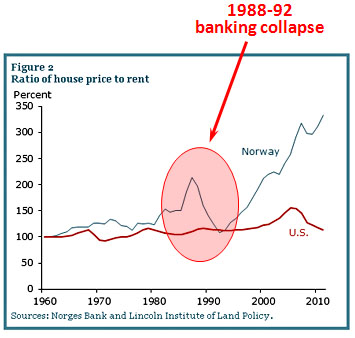
    Matt Yglesias points out today that Norway is in the middle of a gigantic housing bubble, and as I recall, Denmark is too. (I’m not sure about Sweden.) You can say all the usual things about this, but what’s most interesting from the “this time is different” perspective is that Norway has already had a gigantic housing bubble. Not the one a century ago in 1890, but the one a mere 20 years ago that led to a banking crisis starting in 1988. It’s the red oval in the chart on the right, and even though it looks like a blip compared to the current bubble, it was anything but. It led to the collapse of Norway’s banking sector, an all but total collapse of the housing market in Oslo, a taxpayer-led bailout, and Norway’s exit from the ECU (the precursor to the euro).

    But despite this near-death experience, within a mere two decades Norway is in the midst of a housing bubble that makes the last one look like a pipsqueak. The good news is that they’re no longer in a fixed-rate exchange area, which gives them more flexibility, but it’s still a bubble, and even with a krone that floats it’s a pretty dangerous place to be. We really never learn, do we?

    Interested in more? The definitive report on the 1988-92 crisis is here, and it’s recommended reading for anyone who wants to understand banking collapses and how they can be dealt with. Also, read this John Hempton post from 2008, which explains what happened and suggests that Spain might be next. The new report from which the chart above is taken is from the San Francisco Fed.

  • The War Against the Young

    David Frum writes that the Great Recession has hit the young the hardest but that older Americans don’t care. They just want to protect their own lifestyles, and they’ll get their way by ruthlessly voting their self interest:

    The economics blogger Steve Randy Waldman memorably and bitterly articulated the meaning of these grim facts. The long slump has revealed the preferences of the aging polities of the Western world. “Their overwhelming priority is to protect the purchasing power of incumbent creditors. That’s it. That’s everything. All other considerations are secondary” — including economic recovery.

    We could jump-start the economy with a massive jolt of monetary and fiscal stimulus, but such a policy would risk inflation and pose a threat to retirement savings. So we don’t do it. We could borrow money to finance infrastructure programs that would set people to work now and enrich society over the long haul — but that borrowing would have to be serviced by taxes to which older Americans fiercely object. So we don’t do that either.
    ….The old have always grumbled about the young. No doubt Cro-Magnons complained that their kids didn’t appreciate their effort to put a nice, dry cave above their heads. Yet we seem today to hear a new bitterness in the attitudes of the old, a special glee in reproaching and denouncing the young. In 2012 job seekers outnumber jobs offered by a margin of 3–1, down from a post-Depression record of 5.5–1 in early 2009, with the ratio worst among the youngest workers. As young job applicants collect rejection slips, the leading conservative policy intellectual, Charles Murray, has publicly urged his fellow older Americans to regard unemployed young men as “lazy, irresponsible, and unmanly” and to publicly revile them as “bums.”

    Here’s a similar sentiment from another observer, trying to predict what politics will look like a decade from now:

    At the same time that the generational fight over values starts to cool off, the generational fight over resources will heat up. Partly this will be because of the increase in the elderly population. Partly it will be because of slower growth and the increasing stagnation of the working class. And partly it will be because the [Republican and Democratic] parties will be increasingly split by age group.

    Oh wait — that was me. I think Frum is a little more apocalyptic about this than I am, but generally speaking we’re on the same page. Both the boomers and the generation before them were enormously lucky to have started their careers in the postwar world, roughly from 1950 through 1980. Good jobs were plentiful; retirement benefits — both public and private — increased steadily; and a variety of factors kept middle-class growth high. But the beneficiaries of this good fortune, like all beneficiaries of good fortune, became convinced that they had done well solely through hard work and native talent. If today’s kids aren’t doing as well, it must be because they’re dumber and lazier.

    But they’re not. They just aren’t as lucky. And the competition between the generations is likely to heat up as time goes by. Welcome to our future.

  • Romney to Base: I Hate Obama As Much As You Do

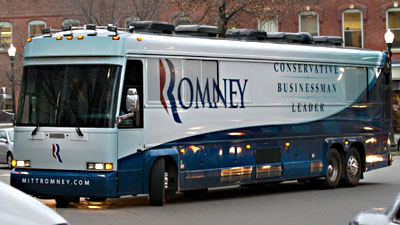
    For the second time, Mitt Romney’s campaign has dispatched one of its buses to make obnoxious noises at an Obama fundraiser:

    Romney’s campaign bus circled Obama’s fundraiser at Boston Symphony Hall Monday night several times, according to Romney deputy press secretary Ryan Williams and verified by several onlookers who said it was honking its horn as it passed. Williams told BuzzFeed that the bus made “a few” laps before local police closed the roads around the venue before Obama’s arrival. They plan on bringing the bus back after Obama leaves to attend another fundraiser.

    The fundraiser was inside the hall, the bus didn’t interrupt anyone trying to speak, it didn’t block any entrances, and it didn’t harass anyone trying to get in. As near as I can tell, the only real purpose of this was to demonstrate to Romney’s base that he holds Obama in the same contempt they do, and he’s delighted to resort to sniggering junior high school displays to prove it. Welcome to Romney 2012.

    Still four months to go. Why is God punishing us like this?

  • Why I Hate Social Media, Part 387


    The latest from Facebook:

    Facebook has introduced its latest social media innovation — changing the email addresses posted by users on their profiles, en masse and without warning.

    In the change, which took effect on Monday, Facebook abruptly replaced the details users had elected to associate with their account with addresses using a “@facebook.com” convention.

    I’m sure this will shortly be followed by yet another faux-tearful apology and a promise to do better. “We just wanted to make our user experience better. We had no idea that when people chose an email address, they actually wanted that to be their address forever.”

    Jesus. Isn’t Mark Zuckerberg rich enough that he doesn’t need to keep pulling sleazy stunts like this?