Get your news from a source that’s not owned and controlled by oligarchs. Sign up for the free Mother Jones Daily.


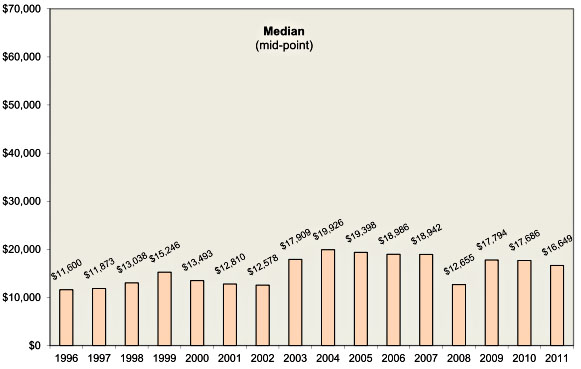
The Great Recession took a big toll on 401(k) retirement plans. The chart below, from the Employee Benefit Research Institute, shows the general volatility of 401(k) accounts: they go up smartly during booms (1996-99, 2002-07) and plummet during busts (2000-02, 2007-08). The average account took a 30 percent hit when the housing bubble burst in 2008.

In general, average 401(k) account balances have grown fairly steadily over the past two decades. But 401(k)s have two big problems. The first is volatility. If you were 55 when the Great Recession hit, you’ve made up most of the losses from 2008 and your account balance is probably close to where it was in the mid-aughts. But if you turned 65 in 2008 and were planning to retire that year, you were screwed.

Second, account balances just aren’t very big. The chart below understates retirement readiness since it shows averages for all workers. The actual median account balance for workers in their sixties is in the neighborhood of $50,000 or so. But even that isn’t much: it provides an annual annuity of only a few thousand dollars. That’s nice to have, but it’s hardly a windfall.

Of course, one other thing to keep in mind is that less than half the population has a pension of any kind, and that’s always been true. Over the past three decades, defined-contribution plans like 401(k)s have grown while defined-benefit plans have mostly disappeared. But over that entire period, less than half of all private sector workers have had either kind of pension. For the rest, the big debate over pensions is strictly academic. They rely almost exclusively on Social Security and always have.

This is just one part of the retirement puzzle, of course. More on the bigger picture tomorrow.
THIS IS URGENT! DON’T MISS THE DEADLINE.

Until MIDNIGHT only, every dollar you give goes twice as far to support kickass reporting. This is the moment to make your support count double.

In a climate where journalists face mounting pressure to back down, stay silent, or soften their reporting, Mother Jones refuses to flinch. We’re pushing back against intimidation and delivering fierce, independent journalism that holds power accountable—no matter who’s trying to silence us.

But here’s the reality: We’re a nonprofit newsroom with zero corporate backing and no financial cushion. We depend entirely on readers like you to fund the investigations that matter most. The 2X match deadline is just hours away. We need you on the team right now. Please chip in and double your impact.

THIS IS URGENT! DON’T MISS THE DEADLINE.

Until MIDNIGHT only, every dollar you give goes twice as far to support kickass reporting. This is the moment to make your support count double.

In a climate where journalists face mounting pressure to back down, stay silent, or soften their reporting, Mother Jones refuses to flinch. We’re pushing back against intimidation and delivering fierce, independent journalism that holds power accountable—no matter who’s trying to silence us.

But here’s the reality: We’re a nonprofit newsroom with zero corporate backing and no financial cushion. We depend entirely on readers like you to fund the investigations that matter most. The 2X match deadline is just hours away. We need you on the team right now. Please chip in and double your impact.

We Recommend

Latest

Sign up for our free newsletter

Subscribe to the Mother Jones Daily to have our top stories delivered directly to your inbox.

Get our award-winning magazine

Save big on a full year of investigations, ideas, and insights.

Subscribe

Support our journalism

Help Mother Jones' reporters dig deep with a tax-deductible donation.

Donate