• Democrats Better Start Selling Obamacare Soon


    Jackie Calmes reports something today that I think everyone already knows: Republicans will be relentlessly exploiting Obamacare’s rollout problems during next year’s midterm elections.

    For the third time, Republicans are trying to make the law perhaps the biggest issue of the elections, and are preparing to exploit every problem that arises. After many unsuccessful efforts to repeal the law, the Republican-led House plans another vote soon. And Republican governors or legislatures in many states are balking at participating, leaving Washington responsible for the marketplaces.

    “There are very few issues that are as personal and as tangible as health care, and the implementation of the law over the next year is going to reveal a lot of kinks, a lot of red tape, a lot of taxes, a lot of price increases and a lot of people forced into health care that they didn’t anticipate,” said Brad Dayspring, spokesman for the National Republican Senatorial Committee. “It’s going to be an issue that’s front and center for voters even in a more tangible way than it was in 2010.”

    I know that it’s way too easy for a blogger with nothing at stake to say this, but I sure don’t see any possible response to the Republican attacks except for Democrats to get out of their crouch and start selling Obamacare like their lives depend on it. Which they do. A moderate response just won’t do any good here. Dems need to be promoting Obamacare with the same fervor Republicans bring to the attack, pointing out its benefits and upsides at every opportunity. So far I haven’t seen this—or even anything even close to this—and I suppose that might only be due to the fact that 2014 is still a ways off. But it better start happening soon.

  • Examining the Hack Gap: Economics Edition


    Every time a health insurance company announces a rate hike, a phalanx of conservatives are ready to step in and declare that it’s the fault of Obamacare. But flashy rate hikes aside, overall health inflation has actually been slowing down lately. Jonathan Bernstein wants to know why liberal hackdom has been largely silent about this:

    What we don’t have, and haven’t anywhere that I’ve seen it, are liberal economists claiming that the entire slowdown in costs has been ACA-related, or even the bulk of it (the bulk is in fact, economists tell us, recession-related, and of the rest it’s not altogether clear where it came from).

    Just as we didn’t see any liberal economists last year arguing that the economy was in fact way more healthy than people thought. If anything, in the lead-up to an election with a Democrat in the White House, most prominent liberal economists stressed the weaknesses of the economy.

    There are plenty of liberal hack pundits; there’s nothing about being a liberal that prevents people from embracing convenient arguments, even if they’re barely plausible. And there are conservative hack economists, so there’s nothing about being an economist that prevents lame spin. But for whatever reason, there aren’t any liberal economists who function as party apologists. That doesn’t mean that liberal economists are always right about everything; it also doesn’t mean that there’s no biases involved in their work (more, perhaps, in choice of projects, for example). It just means that, as far as I can see, they tend strongly to call them as they see them, rather than adapting their analysis and talking points to whatever the Democratic Party happens to need at the time.

    And I’m not saying that there should be liberal hack economists. I don’t think liberals are worse off because of this gap, at all. I just think it’s odd that either there’s no demand for it, or there’s no one willing to fill the demand.

    Beats me. Maybe liberals are just more easily embarrassed. The thing that gets me about conservative hackdom isn’t that it exists, but that it’s often so flagrantly ridiculous. There’s a solid core of right-wing economists who seem literally willing to say anything, even if it’s so obviously wrong that a few seconds of googling can prove it. They just flatly don’t care. And they can get away with it because their more temperate colleagues are largely willing to let this stuff slide without comment, instead of actively criticizing it.

    The usual liberal explanation for this state of affairs is that we’re simply more dedicated to the truth than conservatives. Maybe so. I wouldn’t bet the farm on it, though. Here are some other possibilities:

    • Liberal hack economists are just a little more subtle than conservatives. They don’t make quite the patently outrageous claims that some conservatives make.
    • It’s market driven. For some reason, liberals prefer their propaganda with a thicker sheen of pseudoscience than conservatives, so that’s what liberal economists deliver.
    • Rightly or wrongly, liberals are truly convinced that they’re right. They’re more willing to let the research take them wherever it goes, because, deep down, they have faith that eventually it will demonstrate what they want to see. Conservatives lack that confidence, so they have to bluster more.
    • There are plenty of liberal hack economists out there who say ridiculous stuff, and Bernstein and I are just too wrapped in our own little liberal bubbles to realize it.

    I dunno. Generally speaking, I’d say that liberals and conservatives both choose to place their trust in truth-producing systems that help promote their goals. Adherence to textual fidelity (religious fundamentalism, legal originalism, etc.) is popular with conservatives because it’s inherently conservative. Science is popular with liberals because it opens the door to change, something that’s inherently congenial to the liberal project. This stuff interacts in sometimes complicated ways, but it might also be at the core of the differences between liberal and conservative economists who choose to take roles as public intellectuals.

  • Can the Internet Sales Tax Bill Pass in the House?


    You may recall that I wrote a few weeks ago about a bill pending in the Senate that would allow states to collect sales tax on internet sales. Well, it passed. But here’s the interesting bit:

    But opposition from some conservatives who view it as a tax increase will make it a tougher sell in the House….Republican Speaker John Boehner has not commented publicly about the bill, giving supporters hope that he could be won over.

    Rep. Bob Goodlatte, R-Va., chairman of the House Judiciary Committee, which would have jurisdiction over the bill, has cited problems with the legislation but has not rejected it outright. “While it attempts to make tax collection simpler, it still has a long way to go,” Goodlatte said in a statement. Without more uniformity in the bill, he said, “businesses would still be forced to wade through potentially hundreds of tax rates and a host of different tax codes and definitions.”

    This is a bill that got the support of 21 out of 45 Republicans in the Senate. It’s genuinely bipartisan. And yet, it’s still a question mark in the House. If a bill with support from Amazon, support from most of the business community, support from most of the states, and support from half the Senate GOP caucus ends up not passing in the House, we’re in even worse shape than we thought. This is a canary in the coal mine.

  • It’s Time for the EPA to Bypass Congress and Regulate Carbon Emissions on Its Own


    David Roberts wrote a while back to praise a new proposal from the National Resources Defense Council for reducing carbon emissions from electric plants. The key part of NRDC’s plan is that instead of setting targets for individual plants, something that creates nearly insurmountable problems, EPA would set targets for entire states:

    Here’s how it would work: the EPA would first tally up the share of electricity generated by coal and gas-fired plants in each state during the baseline years (2008-2010 was used for this analysis). Then the agency would set a target emission rate for each state for 2020, based on the state’s baseline share of coal and gas generation.

    ….Each covered plant with an emission rate above the state standard could meet the standard by using one or more compliance options: First, a plant could reduce its own CO2 emission rate by retrofitting a more efficient boiler or installing CO2 capture systems….Second, the owners of multiple power plants could average the emissions rates of their plants, meeting the required emission rate on average by running coal plants less often, and ramping up generation from natural gas plants or renewable sources instead….The plan also allows trading of credits between companies within a state, and across state lines among states that choose to allow it, further lowering the overall costs of compliance.

    This is OK, I guess. But I’m confused. If (a) EPA has the authority to set state standards, and (b) maximizing flexibility is a good thing, then why not simply have EPA mandate a national cap-and-trade system? I assume this is a purely political calculation, but I’m not sure I understand it. It’s not as if the usual suspects won’t fight the NRDC’s state-based plan like crazed weasels, and I guarantee that no matter what formula you use, every state in the union will insist that its target is woefully unfair for some reason or another. If your goal is to avoid the political morass of cap-and-trade, I don’t really see how this plan does it.

    Besides, if electricity generators have a choice of the NRDC plan vs. national cap-and-trade, I assume they’d pick cap-and-trade. It gives everybody a little more maneuvering room and delivers the same results more efficiently.

    In any case, if EPA really does have any serious plans for regulating carbon emissions at existing power plants, they’d better get moving. This kind of thing takes at least four years to get through the regulatory process, and there’s no telling who will be president four years from now. There’s not much time to waste if they want to get something done while Barack Obama is still in the White House.

  • Heritage Foundation Ignites Conservative Civil War Over Dynamic Scoring


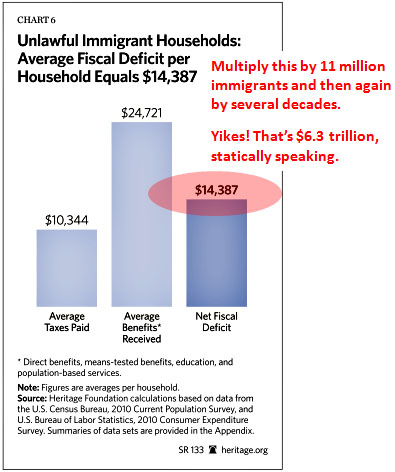
    Pass the popcorn! Today the Heritage Foundation, under the leadership of conservative dreamboat (and former senator) Jim DeMint, released a study showing that immigration reform would cost taxpayers a gazillion dollars over the next 50 years. The actual number doesn’t matter much, just the fact that it has a nice, shocking number of zeroes in it. The methodology of the report doesn’t matter much either. You’ll be unsurprised to learn that it’s shoddy, but this isn’t a PhD dissertation. It’s not meant to be accurate, it’s meant to provide cover for any member of Congress who wants to give a speech and have a few handy numbers to quote. (You can read all the gory details of the study’s shoddiness here if you’re feeling especially masochistic today.)

    So far, so boring. But here’s what’s really great about this: Heritage is getting raked over the coals today by fellow conservatives for issuing this shoddy study. Why? Not because they happen to disagree about immigration reform, but because Heritage was able to produce its gigantic number only by abandoning the sacred conservative cause of dynamic scoring.

    Dynamic scoring is critical to the conservative movement because it’s the way they can claim that tax cuts produce higher tax revenue. The basic idea is that you can’t just look at, say, a 10 percent tax cut and assume that it will reduce tax revenue by 10 percent. That’s fusty old static scoring. Instead you have to take account of the fact that the tax cut will supercharge the economy, which in turn will produce higher incomes and higher tax receipts even though tax rates are lower. The Heritage immigration report, however, doesn’t take into account the fact that undocumented immigrants are all dynamically creating extra wealth and increasing the size of the economy. Jennifer Rubin reports:

    Josh Culling of ATR said that while Heritage was a “treasured ally,” its work was a rehash of a flawed 2007 study….Cato’s Alex Nowrasteh was even more outspoken saying “how disappointed” he was that Heritage abandoned conservative dynamic scoring….The prize for candor, though, went to American Action Forum’s Douglas Holtz-Eakin, who stated flatly, “It really misleads.”

    ….These are longtime allies of Heritage and promoters of free market capitalism who are witnessing the intellectual bastardization of a once great institution….Fiscal, pro-growth conservatives are concerned (as they should be) that the movement may turn reactionary, rejecting not just dynamic scoring but faith in a dynamic economy and society.

    ….However the debate turns out, one hopes that real scholars at Heritage and its supporters reject the slovenly work in the Heritage report and reaffirm the conservative message that more workers create more wealth, higher incomes and upward mobility. For if they do not, then virtually all their criticism of the Obama administration has been wrong and free markets (for labor and goods) are a cruel farce.

    Will the “real scholars” at Heritage speak up? Will Heritage manage to reverse its growing intellectual bastardization? Or will the rest of the conservative movement eventually have to acknowledge that Heritage has always been willing to use whatever methodology happens to produce the results it wants? Stay tuned.1

    1Just kidding. Here are the answers: (a) No. (b) No. (c) No. And as long as I have a footnote handy, it’s worth saying that nearly everyone agrees that dynamic scoring is reasonable in small doses. Heritage, however, has always been a champion of truly gargantuan claims for the potency of dynamic scoring. This is what makes their U-turn today so notable.

  • I Need Some Help With Yelp


    Andrew Sullivan points me today to an essay by Tom Vanderbilt about the rise of online reviewing. Here he is describing his problems with Yelp reviews of restaurants:

    As I navigate a Yelp entry to simply determine whether a place is worth my money, I find myself battered between polar extremes of experience: One meal was “to die for,” another “pretty lame.” Drifting into narrow currents of individual proclivity (writing about a curry joint where I had recently lunched, one reviewer noted that “the place had really good energy, very Spiritual [sic], which is very important to me”), I eventually capsize in a sea of confusion. I either quit the place altogether or, by the time I arrive, am weighed down by a certain exhaustion of expectation, as if I had already consumed the experience and was now simply going through the motions.

    ….What further complicates this picture of the masses liberating the objects of criticism from the tyranny of critics is that so many reviewers seem to turn toward petty despotism. Reading Yelp reviews, particularly of the one-star variety, one quickly senses the particular ax being ground—the hostess who shot the “wrong” look at the “girls’ night” group; a greeting that is too effusive, or insufficiently so; the waiter deemed “too uneasy with being a waiter”; or any number of episodes (each example has been taken from Yelp) that have little to do with food.

    I’ve pretty much given up reading Yelp reviews. Part of the problem, as Vanderbilt notes, is that they’re so polarized it’s hard to make sense of them. Too often, it barely seems possible that the reviewers are even describing the same place.

    But it’s not just polarization. My sense is that people are much more likely to spend time writing a Yelp review when they’re pissed off. And when they’re pissed off they bring their full rhetorical skills to bear. So, as I browse through the reviews of even a pretty good place, I’m nearly always bombarded with enough horrible comments that I start to back off. Do I really want to go there? Seems pretty chancy.

    Basically, Yelp makes me less likely to eat out, not more, because every place ends up sounding like a possible plunge into the heart of darkness. Is that because I’m more risk-averse than average? Or do others find the same thing? Let me know in comments. What’s your advice for using Yelp most effectively?

  • Advertising Didn’t Have Much Effect on the 2012 Election


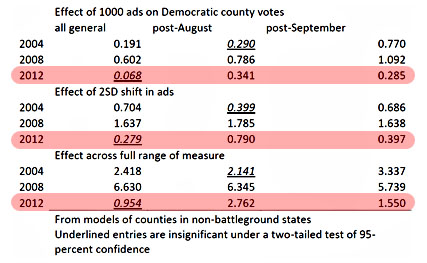
    Over at the Monkey Cage, Michael Franz has an interesting postmortem on the effect of TV advertising during the 2012 presidential election. He uses a clever design that takes advantage of the fact that ads in battleground states sometimes bleed over the border into non-battleground states, producing a random set of non-battleground voters who are exposed to large numbers of ads.

    Franz’s bottom line is simple: advertising didn’t have much effect in 2012. The maximum effect—that is, the effect of swapping the market with the biggest Democratic ad advantage to the one with the biggest Republican ad advantage—is about 1 percentage point of the vote share. The effect is bigger if you look solely at ads in the final two months, but not a lot bigger. And this is the biggest possible effect. In more likely scenarios, where one side or the other out-advertised the other by a fairly normal amount, the effect is a few tenths of a percentage point.

    This doesn’t mean ads don’t matter. What it means is that (a) they largely cancel each other out, and (b) there’s probably a saturation point above which they have diminishing returns. It’s also likely that ads have less impact in an election featuring a well-known incumbent (ads were apparently more effective in 2008 than in either 2004 or 2012). Nonetheless, this fits with other data suggesting that 2012 was a very fundamentals-driven election. Obama’s superior organization might have made a difference at the margins, but only a small difference. This cake was pretty much fully baked before the Republican Party even agreed on a nominee.

    POSTSCRIPT: As clever as this study design is, I do wonder if it’s possible that battleground-state voters respond differently to ads than non-battleground-state voters. Perhaps there’s an interaction between ads and all the other stuff going on in battleground states that makes them more effective than in other places?

  • Budget Follies Are Coming Soon to a Congress Near You


    One of the big pieces of political theater that political junkies are looking forward to this summer is the reconciliation of the House and Senate budgets. Ginger Gibson of Politico describes the basic differences, which are pretty well known to everyone:

    The differences between the House GOP and the Senate Democratic plans are clear, with the House GOP plan balancing the budget after 10 years but extracting deep cuts in spending and ultimately converting Medicare to a voucher program. The Senate Democratic plan doesn’t balance the budget at all but does contemplate nearly $1 trillion in tax hikes along with equal parts spending cuts.

    Republicans, after wailing for years about Democratic unwillingness to pass a budget via regular order (as opposed to makeshift continuing resolutions), suddenly find themselves unenthusiastic about naming a conference committee because it would give minority Democrats in the House an opportunity to force embarrassing votes on a variety of politically sensitive topics. For their part, Democrats, who have been OK with makeshift continuing resolutions for the past few years, have finally decided that the time is right for a High Noon showdown and think a conference committee would be peachy.

    I don’t actually have anything to say about this. Conference committees have been something of a dead letter for a while, and it’s not as if I have any deep and principled love for them. Mainly, I think it’s interesting that, as near as I can tell, Democrats feel more confident about their position these days than Republicans do. After about $3 trillion in spending cuts over the past two years, they seem confident that the public is firmly on their side when they demand that any further cuts should be matched with revenue increases from the wealthy.

    We’ll see about that. Basically, though, this is just a placeholder post to make sure everyone knows where we are at the moment. The budget wars haven’t started to seriously heat up yet, but they probably will fairly soon.

  • Wanted: Adult Supervision for the Gun Nuts


    Guns have never been a hot button for me. On a pragmatic level, I don’t think they have a big effect on crime. On a constitutional level, I’ve long accepted that the Second Amendment does indeed confer a personal right to bear arms. (A limited right, sure, but that’s true of every right in the Constitution.) And on a political level, it’s obvious that America has a long and deep cultural attachment to guns that simply isn’t going away.

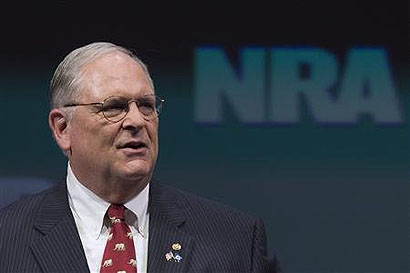
    But last week the NRA proudly announced a new president: James Porter, a man who, among other things, refers to Barack Obama as a  “fake President”; apparently thinks the Civil War was a great example of an armed citizenry resisting Northern tyranny; and advocates training all civilians in the use of standard military firearms so “they’re ready to fight tyranny” yet again. Fellow Southerner Ed Kilgore is distinctly unamused:

    Am I perhaps being unfair to these people in suggesting that they are behaving like America-haters and are flirting with treason? I don’t think so. Porter and those like him could dispel this sort of suspicion instantly, any time they wanted, by just saying: “Let’s be clear: the kind of ‘tyranny’ we are arming ourselves to forestall is something entirely different from anything Americans have experienced since we won our independence—a regime engaged in the active suppression of any sort of dissent, and the closure of any peaceful means for the redress of grievances. We’re not talking about the current administration, or either major political party, as presently representing a threat of tyranny.”

    I’m not holding my breath for any statements like that to emerge from the NRA, or indeed, from the contemporary conservative movement. It’s ironic that people who almost certainly think of themselves as patriots—perhaps as super-patriots—are deliberately courting the impression that loyalty to their country is strictly contingent on the maintenance of laws and policies they favor, to be achieved if not by ballots then by bullets. Republican politicians should be repudiating such people instead of celebrating them, accepting their money and support, and even adopting their seditious rhetoric.

    Normally, I’d brush off Porter’s comments as nothing more than a guy blowing off steam in front of a friendly audience. And to a large extent, I do. Still, Ed is right. If an imam in Brooklyn toured the country saying stuff like this, no one would just laugh it off. Ditto for a Black Panther or the head of the American communist party. Fox News would go ballistic.

    This kind of stuff has gone well beyond the stage of being a joke or merely a way to rally the troops, and it’s long past time for some of the alleged adults in the conservative movement to rein it in. Enough’s enough. Guns have never been a hot button for me in the past, but the NRA is sure working hard to make them into one.

  • What We Know—And What We Don’t—About the Oregon Medicaid Study


    I’ve been spending a bit of time this weekend trying to understand better what the real issues are with the Oregon Medicaid study that was released on Thursday and shortly afterward exploded across the blogosphere. Unfortunately, I’ve come to the conclusion that it’s next to impossible to explain it in a way that would be understandable to most people. My readers, however, are not “most people,” so I figure I’ll take a crack at it anyway. The damage may have already been done from the many misinterpretations of the Oregon study that have been published over the past few days, but who knows? Maybe this will help anyway.

    First, to refresh your memory: In 2008, Oregon expanded Medicaid coverage but didn’t have enough money to cover everyone. So they ran a lottery. If you lost, you got nothing. If you won, you were offered the chance to sign up for Medicaid. This provided a unique opportunity to study the effect of Medicaid coverage, because Oregon provided two groups of people who were essentially identical except for the fact that one group (the control group) didn’t have access to Medicaid, while the other group (the treatment group) did.

    There are several things to say about the Oregon study, but I think the most important one is this: not that the study didn’t find statistically significant improvements in various measures of health, but that the study couldn’t have found statistically significant improvements. It was impossible from the beginning.

    Here’s why. The first thing the researchers should have done, before the study was even conducted, was estimate what a clinically significant result would be. For example, based on past experience, they might have decided that if access to Medicaid produced a 20 percent reduction in the share of the population with elevated levels of glycated hemoglobin (a common marker for diabetes), that would be a pretty successful intervention.

    Then the researchers would move on to step two: suppose they found the clinically significant reduction they were hoping for? Is their study designed in such a way that a clinically significant result would also be statistically significant? Obviously it should be.

    Let’s do the math. In the Oregon study, 5.1 percent of the people in the control group had elevated GH levels. Now let’s take a look at the treatment group. It started out with about 6,000 people who were offered Medicaid. Of that, 1,500 actually signed up. If you figure that 5.1 percent of them started out with elevated GH levels, that’s about 80 people. A 20 percent reduction would be 16 people.

    So here’s the question: if the researchers ended up finding the result they hoped for (i.e., a reduction of 16 people with elevated GH levels), is there any chance that this result would be statistically significant? I can’t say for sure without access to more data, but the answer is almost certainly no. It’s just too small a number. Ditto for the other markers they looked at. In other words, even if they got the results they were hoping for, they were almost foreordained not to be statistically significant. And if they’re not statistically significant, that means the headline result is “no effect.”
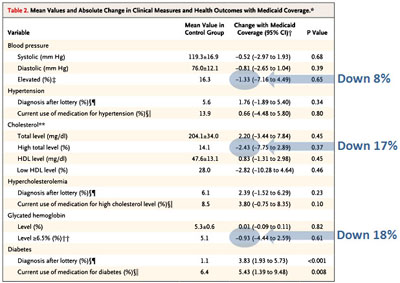
    The problem is that, for all practical purposes, the game was rigged ahead of time to produce this result. That’s not the fault of the researchers. They were working with the Oregon Medicaid lottery, and they couldn’t change the size of the sample group. What they had was 1,500 people, of whom about 5.1 percent started with elevated GH levels. There was no way to change that.

    Given that, they probably shouldn’t even have reported results. They should have simply reported that their test design was too underpowered to demonstrate statistically significant results under any plausible conditions. But they didn’t do that. Instead, they reported their point estimates with some really big confidence intervals and left it at that, opening up a Pandora’s Box of bad interpretations in the press.

    Knowing all this, what’s a fair thing to say about the results of this study?

    • One fair thing would be to simply say that it’s inconclusive, full stop. It tells us nothing about the effect of Medicaid access on diabetes, cholesterol levels, or blood pressure maintenance. I’m fine with that interpretation.
    • Another fair thing would be to say that the results were positive, but the study was simply too small to tell us if the results are real.
    • Or there’s a third fair thing you could say: From a Bayesian perspective, the Oregon results should slightly increase our belief that access to Medicaid produces positive results for diabetes, cholesterol levels, and blood pressure maintenance. It shouldn’t increase our belief much, but if you toss the positive point estimates into the stew of everything we already know, they add slightly to our prior belief that Medicaid is effective.
    • But you can’t say that the results are disappointing, at least not without a lot of caveats. At a minimum, the bare fact that the results aren’t statistically significant certainly can’t be described as a disappointment. That was baked into the cake from the beginning. This study was never likely to find significant results in the first place.

    So that’s that. You can’t honestly say that the study shows that Medicaid “seemed to have little or no impact on common medical conditions like hypertension and diabetes.” That just isn’t what it showed.

    POSTSCRIPT: That said, there are a few other things worth saying about this study too. For example, the researchers apparently didn’t have estimates of clinical significance in mind before they conducted the study. That’s odd, and it would be nice if they confirmed whether or not this is true. Also: the subjects of the study were an unusually healthy group, with pretty low levels of the chronic problems that were being measured. That makes substantial improvements even less likely than usual. And finally: on the metrics that had bigger sample sizes and could provide more reliable results (depression, financial security, self-reported health, etc.), the results of the study were uniformly positive and statistically significant.