
• Our Broken University Financial Aid System


    Felix Salmon draws our attention today to a new study by Stephen Burd of the New America Foundation about Pell Grants and low-income college students. The news is grim. More and more universities, he says, have joined the “high tuition, high aid” brigade:

    In theory, the structure should work well. Rather than charge every student the same amount, have a high rack rate, paid by the richest students, and then use the proceeds to put in place a generous scholarship system which will help support the poorest students.

    In practice, however, that doesn’t happen. The scholarships go towards “merit aid”, which is often, dismayingly enough, a polite way of saying that the college is helping to pay for wealthy kids to attend, even if they’re not particularly smart. Some 20% of students with GPAs below 2.0, for instance, receive merit aid. And at the same time, the “need aid” is carefully calibrated so that poor kids won’t take the colleges up on their offers

    Apparently this called “gapping,” or “admit-deny,” which is the practice of offering “a financial-aid package that is so rotten that you hope they get the message, ‘Don’t come,’” Mark Heffron, a senior vice-president at the enrollment management firm Noel-Levitz, told The Atlantic Monthly back in 2005. ‘They don’t always get the message.’”

    More and more, the whole structure of Pell Grants, and financial aid in general, looks broken. Increased financial aid doesn’t make college more affordable for poor students, it just allows universities to charge ever higher tuition rates. So what’s the solution? Burd recommends a carrot-and-stick approach:

    The carrot is to help schools that simply don’t have the resources to keep down the net prices of the low-income students they serve. The plan would offer Pell bonuses to financially strapped public and private four-year colleges that serve a substantial share of Pell Grant recipients (more than 25 percent) and graduate at least half their students school-wide.

    ….The stick is for wealthier colleges that have chosen to divert their aid to try to buy the best students….These schools, which generally enroll a relatively small share of low-income students but charge them high net prices, would be required to match at least a share of the Pell dollars they receive.

    I’m not sure this is enough, but it’s a start. One way or another, this is a broken system that needs to be fixed. It’s great for universities, and it’s pretty good for upper middle-class and wealthy families. For everyone else, it just doesn’t work.

  • Yet Another Benghazi Nothingburger Today


    Well, the big Benghazi hearings have finished up for the day, and as near I can tell we learned…..nothing. We heard testimony about the following:

    • The Pentagon didn’t dispatch fighter jets to patrol Benghazi following the initial attack.
    • A 4-man special ops team was stationed in Tripoli, but wasn’t dispatched to Benghazi the morning after the attacks to help with rescue and evacuation.
    • In interviews on the Sunday after the attacks, Susan Rice said things that contradicted Libyan President Mohamed Yusuf al-Magariaf.

    None of this is even remotely new. The Pentagon has said before that they believed it was best for the Tripoli team to stay in Tripoli.1 General Carter Ham has testified that he didn’t think deploying F-16s over Benghazi would be helpful, and he still doesn’t. And Rice’s interviews were litigated to death long ago. If you actually review the evidence, it turns out that her language was careful; it was based on CIA talking points; there was (and maybe still is) evidence that the “Innocence of Muslims” video played a role in the attacks; and al-Magariaf was almost certainly wrong about whether the attacks were a long-planned operation. Details here.

    All of this stuff is arguable. Maybe the Pentagon was wrong about both the Tripoli team and the fighter jets. Maybe Rice should have said something slightly different on the Sunday shows. Maybe the State Department should have beefed up security in Libya months before the attacks. Maybe the infamous talking points got sanded down a bit too much by the interagency review process. That’s all possible.

    Was Benghazi mishandled? Maybe. Are there lessons to be learned? Probably. Is there a scandal or a coverup? There’s never been any evidence of it, and there still isn’t. This is a show that goes on and on without end, but it never delivers a payoff. Issa and his colleagues need to start paying more attention to stuff that actually matters, and give up on the Fox-friendly conspiracy theories that never pan out. Enough’s enough.

    1Hold on. I might be thinking of something else here. It’s not clear if the Pentagon has addressed the deployment of this particular team before. Regardless, this is solely about a tactical decision made after the attacks. A different team from Tripoli was dispatched earlier and arrived in Benghazi shortly before the final mortar attack.

  • How Thinking About Thinking Reduced Crime in Chicago


    Harold Pollack draws my attention today to the results of a large-scale study he conducted recently with several other researchers in low-income Chicago schools. The study design was fairly simple: first, they chose several thousand teenage boys with horrible risk profiles. Their group was 70 percent black and 30 percent Hispanic; had an average GPA of 1.7; and had missed 40 out of 170 days of school the previous year. Over a third of them had been arrested at least once prior to the study.

    They randomly assigned these boys to a control group or a treatment group. The randomization was done beforehand to avoid choosing a treatment group that differed in some unknown way from the control group. The treatment group was offered a chance to participate in a program called “Becoming a Man,” which focused strongly on improving poor judgment and decision making. Here’s an example:

    At 3pm on Saturday, June 2, 2012, in the South Shore neighborhood just a few miles from the University of Chicago, two groups of teens were arguing in the street about a stolen bicycle. As the groups began to separate, someone pulled out a handgun and fired….Two weeks later, prosecutors filed first-degree murder charges against the alleged shooter, Kalvin Carter — 17 years old.

    …. In Chicago, the site of our study, police believe that roughly 70 percent of homicides stem from “altercations,” compared to only about 10 percent from drug-related gang conflicts….At 3pm on June 2 on the south side of Chicago, is Kalvin Carter thinking about 3:01 — or even consciously thinking at all, for that matter? Automatic, intuitive decision-making is also susceptible to systematic biases, partly because the brain’s automatic “system” tends to emphasize explanations that are coherent rather than necessarily correct. Examples of such errors include hostile attribution bias….confirmation bias….or catastrophizing.

    The intervention in the study was not really all that intense: the kids all skipped one regular class and attended 27 one-hour weekly sessions during the school year. In addition, some of the kids also attended after-school sessions. The primary purpose of the sessions was to teach cognitive behavioral therapy—”thinking about thinking”—in an effort to get the participants to change the way they interact with the rest of the world. The results were pretty stunning:

    We find that participation reduced violent crime arrests by 8.1 arrests per 100 youth….Arrests in our “other” (non-violent, non-property, non-drug) category decreased by 11.5 arrests per 100 youth….Participation also led to lasting gains in an index of schooling outcomes equal to 0.14 standard deviations (sd) in the program year and 0.19sd in the follow-up year….We estimate our schooling impacts could imply gains in graduation rates of 3-10 percentage points (7-22 percent). With a cost of $1,100 per participant, depending on how we monetize the social costs of violent crime, the benefit-cost ratio is up to 30:1 just from effects on crime alone.

    All my usual caveats apply here. This is just one study. We don’t know how well it would scale. We don’t know if the effects will last. But the design of the program is encouraging: it’s not expensive, and it doesn’t require highly trained coaches. Nor is it designed to help everyone. This quote tells most of the story:

    As one juvenile detention staff member told us: “20 percent of our residents are criminals, they just need to be locked up. But the other 80 percent, I always tell them — if I could give them back just ten minutes of their lives, most of them wouldn’t be here.”

    This program is designed for those 80 percent whose lives spiral out of control because of one or two dumb mistakes. And it seems to work. More studies like this, please.

  • Ladies and Gentlemen, Pick Your Team


    I think Paul Krugman has the right take on the fact that South Carolina voters chose a disgraced Republican to represent them in Congress vs. an honest, centrist Democrat:

    Look, we have an intensely polarized political system, and in Congress, at least, party affiliation is basically all that matters. When Massachusetts voters chose Scott Brown because he seemed like a nice guy, they were being idiots.

    ….Maybe, just maybe, you can make a case for choosing the right person for governor, regardless of party. But when you’re sending someone to Congress, all that matters is the R or D after that person’s name. It seems that conservative voters understand that; liberals and moderates should, too.

    This wasn’t always the case. Today it is. For all practical purposes, we live in a pseudo-parliamentary system of governance, and the only thing that matters in Congress is what party you belong to. If you’re a Republican, you’re obsessed with Benghazi, Solyndra, Fast & Furious, and debt ceiling hostage taking. If you’re a Democrat, you’re obsessed with more prosaic topics: passing a budget, keeping social welfare programs from being ripped apart, implementing Obamacare successfully, and asking the rich to help out a wee bit with our long-term budget balancing. Pick your team.

  • A Couple of Graphical Lessons From the Government’s Huge Hospital Chargemaster Data Dump


    Today the government released data showing how much different hospitals charge for the same procedure. I’ve been struggling since last night to figure out what to say about this, since in one way there’s no news here. The fact that there are huge disparities has been well known for quite a while. This new data simply lays it out in more mind-numbing detail than usual. For now, then, I’m just going to offer up a couple of good graphical presentations that I’ve seen. The first is your basic map, courtesy of the New York Times. I zoomed in on Los Angeles here:

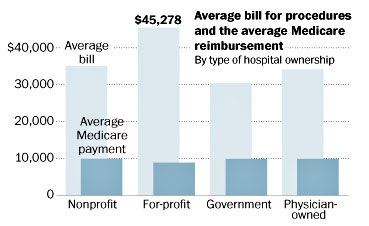
    Take a look in the hospitals in the middle. There’s a disparity of 2-4x in pricing between hospitals that are only a couple of miles apart. Why? Some is probably due to the nature of the cases they take, and the amount of unpaid work they do. But 2-4x? What accounts for this? Part of the answer comes from the chart below, courtesy of the Washington Post:

    This doesn’t explain everything, but it explains a fair amount. The private sector, we’re told, is always more efficient than the public sector. Competition, you understand. But that doesn’t seem to be the case in the healthcare industry. I will allow you to draw your own conclusions.

  • Republicans Refuse to Negotiate Unless They Can Take a Hostage


    Today’s Washington Post story about the tepid pace of budget negotiations may seem like a snoozer at first glance, but it’s really pretty mind-boggling. Here’s a snippet:

    That might seem like good news, but it is unraveling Republican plans to force a budget deal before Congress takes its August break….In the meantime, Republicans face a listless summer, with little appetite for compromise but no leverage to shape an agreement….“The debt limit is the backstop,” Ryan said before taking the stage at a debt summit organized by the Peter G. Peterson Foundation in Washington. “I’d like to go through regular order and get something done sooner rather than later. But we need to get a down payment on the debt. We need entitlement reform.”

    ….Democrats are urging Republicans to initiate talks well before the next deadline and at last resolve the long-standing dispute over whether to tame the debt solely by cutting spending, as Republicans demand, or also by raising taxes on the wealthy, as Obama insists….But senior Senate Republicans, including several who recently dined with Obama and huddled with administration officials, conceded that it may be tough to bring their colleagues to the table too far ahead of the debt-ceiling deadline….“We need to realize this debt ceiling is out there. It’s inevitable. It’s coming. And [the later deadline] should not relieve pressure,” said Sen. Jeff Sessions (Ala.), the senior Republican on the Senate Budget Committee. But “sometimes we don’t want to act until a gun is at our heads.”

    So that’s that. Republicans are flatly refusing to even start budget negotiations until they can threaten default on the national debt if they don’t get their way. Apparently this is literally the only way they’re now willing to do business.

    I should have something snappy to say about this, I suppose. But it’s still too early in the morning here in California. I’ve always said that Sacramento made Washington DC look like pikers in the government dysfunction department, but I think I’m getting ready to change my mind about that. As always, California is a bellwether for the nation.

  • How the “Inception” Soundtrack Conquered the World


    This weekend, I saw Iron Man 3 plus about a dozen trailers. OK, not really. It was only half a dozen. It just seemed like more. But the soundtracks for at least two of them included the deep, throbbing duhhhhn that I associate with the movie Inception. This made me wonder: Does every action movie trailer in the world now sport an Inception-style ripoff soundtrack? Today, I discovered that Ian Crouch answered my question last week. Apparently, the answer is yes:

    For the unfamiliar, a quick tour of recent trailers promoting big-budget fare gives a fuller sense of this abominable sonic trend: spots for “Transformers: Dark of the Moon,” “The Dark Knight Rises,” “Prometheus,” “Iron Man 3,” “Olympus Has Fallen,” “World War Z,” “Oblivion”—the list goes thudding on and on. Sometimes the hum is delivered by deep horns, other times by strings—often these are expertly timed to the sound of drums and/or something exploding onscreen—and recently it has taken on a digitized, layered character.

    If you’re curious, Crouch has more details at the link, along with a little history of this particular bass note. Plus a mini-history of the evolution of the trailer. Unlike him, however, I don’t think his recut trailer for Ghostbusters sounds incongruous. Kinda cool, actually.

  • Can States Decline to Enforce Federal Laws?


    As long as we’re on the subject of shiny new gun laws, Steve Benen points out yet another offering from the great state of Texas:

    Perhaps the most controversial of the gun-related items, HB 1076 would ban state agencies from enforcing any new federal gun laws, including background checks. The bill passed the Republican-led House on a largely party line vote Monday, but legal experts say the attempt to “nullify” possible future federal laws likely wouldn’t pass the scrutiny of the U.S. Supreme Court.

    “That’s absurd beyond the word absurd. I like the author personally but that’s just pure political grandstanding,” said state Rep. Lon Burnam (D-Fort Worth).

    This is actually a little more interesting. This legislation doesn’t claim that any new gun law would be unconstitutional, it merely says that no state officers will enforce it. If the feds want it enforced, that’s up to them.

    I’m not really sure what the legal status of such a law would be, but I don’t think it’s self evidently absurd. The intersection of federal law and state enforcement is fairly complex, and states have considerable discretion about where and how they apply their resources.

    In any case, I wonder what we’d all think about the constitutionality of this bill if it dealt with, say, federal marijuana laws instead of federal gun laws?

    UPDATE: Jonathan Adler confirms via both email and blog post that this Texas law would probably be constitutional. “States can’t obstruct, but they don’t have to help,” he says. More here.

  • Kansas Gun Law Looks Like a Trojan Horse for a Commerce Clause Challenge


    Once again, I haven’t been paying attention. I knew that Kansas had passed a law saying that any law which “violates the second amendment to the constitution of the United States is null, void and unenforceable in the state of Kansas.” It was a silly piece of legislation since it begs the question of just who decides whether a law violates the Constitution, but in any case, it all seemed vague enough that I didn’t pay it much mind.

    But it turns out that the Kansas statute isn’t as vague as I thought. It also says that the federal government is forbidden from enforcing any law regarding “a firearm, a firearm accessory, or ammunition that is manufactured commercially or privately and owned in the state of Kansas and that remains within the borders of Kansas.” This is (a) quite specific, and (b) pretty obviously not something Kansas can do on its own, as Attorney General Eric Holder has tartly pointed out. So what’s going on?

    Most of the commentary I’ve read assumes that this is basically a gun issue, a Second Amendment issue, and a nullification issue. But I don’t think so. It sounds, rather, like a test case for the Commerce Clause, the same thing that was at issue in last year’s Supreme Court Obamacare ruling. Basically, Kansas is saying that the federal government can’t regulate something that’s made, sold, and used entirely within the confines of Kansas, because that’s not interstate commerce. However, the Supreme Court ruled otherwise long ago in the case of Wickard vs. Filburn, which you probably all got sick of reading about last year. In that case, the court ruled that Congress could regulate even the purely local production of wheat “if it exerts a substantial economic effect on interstate commerce and this irrespective of whether such effect is what might at some earlier time have been defined as ‘direct’ or ‘indirect.'”

    So it sounds to me like Kansas Gov. Sam Brownback and Secretary of State Kris Kobach are hoping to make this a test case that will rein in the scope of Congress’s power to regulate interstate commerce. Here’s an AP dispatch from a few weeks ago with a bit more detail:

    No major gun manufacturers have production lines in Kansas, so the measure would be aimed at firearms or ammunition made at small machine shops. The measure makes it a felony for a federal agent to attempt to enforce laws, regulations or treaties restricting access to such firearms, ammunition or accessories.

    This makes it clear that the new law doesn’t have much real-life impact on guns, since virtually all guns in Kansas are manufactured elsewhere. Its main purpose is simply to test the Commerce Clause. Brownback and his friends seem to be betting that even though the Supreme Court didn’t overturn Obamacare last year, the opinions in the case show that a conservative majority is itching to take another crack at the Commerce Clause. The only question is whether they can find a good test case, and then goad the feds into prosecuting their guinea pig so that they can go to court. We’ll see.

    UPDATE: Oh hell, I’m way behind. It turns out this whole thing started several years ago in Montana with a guy named Gary Marbut, who came up with a scheme to evade federal gun restrictions by building a gun that never crosses state lines. Our own Tim Murphy reports that the idea then went viral in the conservative community:

    Lawmakers in 34 states have introduced copycat versions of Marbut’s Firearms Freedom Act, six of them in the five weeks since the massacre at Sandy Hook Elementary School in Newtown, Connecticut. All told, nine state attorneys general have signed onto an amicus brief supporting him; eight governors have signed it into law. The National Rifle Association supports Marbut’s law; so does the Cato Institute.

    Read the whole thing for all the deets.

  • Followup: Could the EPA Mandate a National Cap-and-Trade Program?


    Quick update: last night I wrote a post about an NRDC proposal on carbon reduction from existing power plants. Basically, they suggest that the EPA should set standards for each state, then allow the states to meet those standards however they want. If they wanted to, states could even trade credits back and forth in order to meet their caps.

    My question: If EPA has the authority to do this, why not just mandate a national cap-and-trade plan instead? That would be more efficient, and probably no more politically difficult than the NRDC plan.

    Leaving the political issues aside, I’ve gotten some answers—sort of—about EPA’s legal authority, which is based on a combination of (a) a court ruling that CO2 is a pollutant and (b) EPA’s responsibilities under the Clean Air Act. I haven’t dived into this deeply or anything, but apparently NRDC believes its plan is legal because it follows the fundamental structure of the CAA, which generally requires EPA to set out state standards for pollutants. However, some interest groups think that EPA also has the authority to mandate a national cap-and-trade plan.

    Long story short, a cap-and-trade mandate might be legal, but also might be risky, especially given the conservative makeup of both the DC Circuit Court and the Supreme Court. So far, there’s no sign that EPA thinks it has the legal authority to create such a mandate. Conversely, the NRDC plan is probably less risky thanks to its state-based structure, though it’s still not a slam dunk either.

    If I learn more, I’ll write a followup. I just wanted to pass this along since I mentioned it last night.

