• George Washington Himself Could Not Get a Revenue Increase Out of the Modern Republican Party


    Michael Corleone in The Godfather Part 3:

    Just when I thought I was out… they pull me back in.

    You know, I don’t really enjoy writing endlessly about Barack Obama’s essential powerlessness when it comes to dealing with an increasingly fanatic Republican Party. It’s just so damn gloomy and special pleadingish. But I keep getting pulled back in. Today, a friend of mine emails with a short summary of Ron Fournier’s appearance on Morning Joe today:

    John Heilemann asked Fournier the same question that everyone asks Fournier, which he dodges: well, what would you have the President do? Fournier then said, “let me turn that question back on you” and went off a tangent, but not without dropping in at the end of the segment that Obama can get revenue increases if he just engages with the Republicans. I yelled at the television and scared my 4 year-old. Did he really say that? Yes, he did.

    I just don’t get it. What does it take to convince the Dowds and Milbanks and Fourniers of the world? How can any of them still believe that Republicans will ever agree to real revenue increases? George Washington himself could rise from the grave and the House Republican caucus wouldn’t agree to pass a revenue increase for him. What then? Would Dowd and Milbank and Fournier sigh theatrically and mourn the fact that Washington just isn’t the leader he used to be?

    Republicans aren’t going to let Obama raise revenues. They aren’t going to let Obama pass a gun bill—even a watered-down one. They aren’t going to let Obama close Guantánamo. They aren’t going to let Obama fill the vacancies on the DC Circuit Court. They aren’t going to help Obama implement Obamacare. They aren’t going to let Obama address climate change. Period.

    They’ve made this crystal clear to anyone who asks. They are true believers and there’s nothing Obama, or Fournier, or anyone else can offer them that would break through their glinty-eyed zealotry. There are no deals to be made, no leverage that can be used, and no schmoozing that will change their minds. This isn’t an Obama problem, it’s a Republican Party problem. Why is such a simple and unambiguous fact so hard to acknowledge?

    But just to keep things on an even keel around here, go read Jon Chait’s “What Obama Can Actually Do About Congress.” I endorse all of it. So you see, I agree that there are things Obama could do better, just as there are issues (like Guantánamo detainees) where Obama himself bears some of the blame for our current gridlock.

    Now, none of Chait’s suggestions would actually make more than a hair’s breadth of difference. But Obama should do them anyway. After all, you never know, do you?
  • Want to Get Married? Buy a Cable Modem.


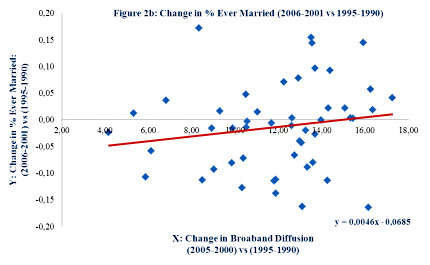
    Via Brenda Cronin, here’s a fascinating study suggesting that faster adoption of broadband internet leads to higher marriage rates. The author, Andriana Bellou of the University of Montreal, presents the basic regression chart on the right, and then runs through a variety of tests to find out whether this is really a causal relationship. After all, maybe tech-friendly places have always produced higher marriage rates. Or maybe sociable people like the internet and also like getting married. Or it could be that causality runs in the other direction: maybe people who are more likely to get married are also more likely to move to tech-friendly places. Etc.

    Bellou takes a variety of strategies to test causality. For example, it turns out that broadband penetration in 2000-05 doesn’t predict marriage rates in the pre-internet era (1990-95). This suggests that her results aren’t due to something special about the geographic areas that eventually adopted broadband at high rates.

    Long story short, her conclusion is that this association is probably causal. Other things equal, better access to the internet really does produce a greater number of marriages. eHarmony really does work.

    In a way, this isn’t too surprising, but there’s obviously a lot of noise in the data. I’ll be interested to see if her result holds up once the rest of the world starts banging away on it.

  • “How Not To Die”


    From Dr. Angelo Volandes, on the way physicians routinely treat patients near the end of life:

    Physicians are good people. They want to do the right things. And yet all of us, behind closed doors, in the cafeteria, say, “Do you believe what we did to that patient? Do you believe what we put that patient through?” Every single physician has stories. Not one. Lots of stories.

    Volandes is making a series of stark videos that he hopes might change that:

    The first film he made featured a patient with advanced dementia. It showed her inability to converse, move about, or feed herself. When Volandes finished the film, he ran a randomized clinical trial with a group of nine other doctors. All of their patients listened to a verbal description of advanced dementia, and some of them also watched the video. All were then asked whether they preferred life-prolonging care (which does everything possible to keep patients alive), limited care (an intermediate option), or comfort care (which aims to maximize comfort and relieve pain).

    The results were striking: patients who had seen the video were significantly more likely to choose comfort care than those who hadn’t seen it (86 percent versus 64 percent).

    Volandes published that study in 2009, following it a year later with an even more striking trial, this one showing a video to patients dying of cancer. Of those who saw it, more than 90 percent chose comfort care—versus 22 percent of those who received only verbal descriptions. The implications, to Volandes, were clear: “Videos communicate better than just a stand-alone conversation. And when people get good communication and understand what’s involved, many, if not most, tend not to want a lot of the aggressive stuff that they’re getting.”

    Jonathan Rauch has the rest of the story here. It’s worth a read.

  • Republicans Not Even Pretending Anymore That They Aren’t the Party of the Rich


    Obviously I haven’t been keeping up with Republican shenanigans at the state level. I knew about all the abortion restrictions, and I knew about all the voting restrictions. But somehow I missed this:

    Friction over tax policy within the GOP has flared in states such as Louisiana, Nebraska, Kansas and Ohio, as Republican lawmakers raise concerns over projected revenue losses from income-tax cuts. Three of those states shelved big income-tax cuts that would be paid for by broadening the sales tax, and in Kansas, legislators will return next week to a continuing debate over the size and speed of proposed cuts.

    Last week, the Indiana legislature passed a plan giving Gov. Mike Pence an income-tax cut that was smaller and phased in over a longer period than his original proposal. Oklahoma Gov. Mary Fallin agreed to an income-tax-cut deal with Republican lawmakers, but they postponed it until 2015 over revenue concerns. North Carolina lawmakers have been discussing a tax overhaul for months but haven’t come up with a plan.

    Really? I knew about Bobby Jindal in Louisiana, and his plan to scrap the (progressive) state income tax and make up the revenue by raising the (regressive) state sales tax. But Nebraska, Kansas, Ohio, Indiana, Oklahoma, and North Carolina have all been contemplating the same thing?

    WTF? Is this now a conservative thing? Did ALEC or the Heritage Foundation release a white paper about this last year? What possible excuse can they be offering for such a direct tradeoff between lower taxes on the well-off and higher taxes on the middle class? Why risk their reputations on such a transparent sop to the rich? Have they now officially given up even pretending?

  • Fannie and Freddie Ought To Be Wound Down


    Will 30-year fixed-rate mortgages disappear if the federal government doesn’t guarantee them via Fannie Mae and Freddie Mac? Dean Baker cries foul:

    This can easily be shown not to be true by the market in jumbo mortgages. These are mortgages that are too large in value to be insured by the GSAs. A large share of these mortgages are 30-year fixed rate mortgages. Also, while it is less common today, prior to the housing bubble banks did hold a substantial share of their mortgages, typically around 10-20 percent. Since the government was not guaranteeing these mortgages, the banks must have felt the guarantee was unnecessary to get them to issue 30-year fixed rate mortgages.

    I’d add that most other countries don’t have agencies like Fannie and Freddie, but manage to have robust mortgage markets anyway. (Sometimes a bit too robust.) It’s true, I think, that the traditional 30-year fixed is a bit of a historical artifact in the U.S. that isn’t common elsewhere, but so what? There’s no reason to stay hooked on the 30-year fixed just because it’s been around for a long time. We should be concerned with proper regulation of the mortgage market—down payment requirements, income requirements, interest rate limitations, etc.—not with saving a particular kind of mortgage. Variable-rate mortgages work fine throughout the world with proper regulation but without GSAs like Fannie and Freddie, and they can work fine here.

    Fannie and Freddie need to be wound down gradually. There’s no need for a big bang. But they’re relics of an earlier age and we should be willing to get rid of them.

  • ECB Finally Lowers Interest Rates Slightly


    Today’s economic news from Europe:

    As was widely expected, the ECB’s governing council voted to cut the main refinancing rate by a quarter of a percentage point to 0.50%. The rate, which determines the cost of more than €850 billion in ECB loans outstanding, had stood at 0.75% since last July.

    Unemployment in the euro area is 12.1 percent, and the ECB has finally seen fit to reduce policy rates to 0.5 percent. What’s it going to take for them to go lower? 13 percent unemployment? 14 percent? 20 percent?

    It is all just mind boggling.

  • Followup: Medicaid Probably Does Improve Health Outcomes After All


    I’ve now read the new study of the Oregon Medicaid experiment, as well as some additional commentary on it, and I think some of the results are important enough that they deserve a new post, not just updates to the previous post.

    In a nutshell, Oregon held a lottery a few years ago in which some people received Medicaid coverage and others didn’t. Today’s study is a two-year followup, and the headline result is that “Medicaid coverage generated no significant improvements in measured physical health outcomes.” But it turns out that “significant” is doing a lot of heavy lifting here, and the headline is extremely misleading.

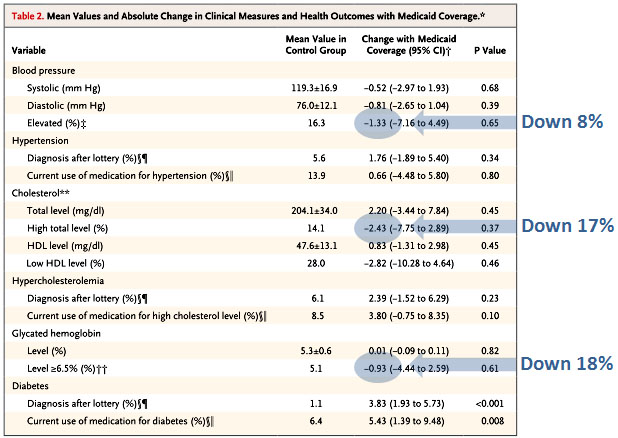
    In fact, the study showed fairly substantial improvements in the percentage of patients with depression, high blood pressure, high cholesterol, and high glycated hemoglobin levels (a marker of diabetes). The problem is that the sample size of the study was fairly small, so the results weren’t statistically significant at the 95 percent level.

    However, that is far, far different from saying that Medicaid coverage had no effect. It’s true that we can’t say with high confidence that it had an effect, but the most likely result is that it did indeed have an effect. The table below shows the point estimates. Note also that in all cases, the use of prescribed medication went up, in some cases by a lot.

    Bottom line: It’s more likely that access to Medicaid did improve health outcomes than that it had zero or negative effects. It’s just that the study was too small to say that with certainty. For laymen, as opposed to stat geeks, the headline result of the Oregon study was “Possibly positive but inconclusive,” not “Had no effect.”

    UPDATE: Even if they’re real, are these results worth the money spent? That’s a different question, and there’s just no way to answer it with this study. That would require a much larger, longer-term research project.

  • So Is Healthcare Worthwhile or Not?


    Avik Roy tweets:

    Oregon study, that Obamacare partisans constantly cited as “proof” that Medicaid improves health outcomes, doesn’t.

    Here’s the abstract of the study:

    Conclusions

    This randomized, controlled study showed that Medicaid coverage generated no significant improvements in measured physical health outcomes in the first 2 years, but it did increase use of health care services, raise rates of diabetes detection and management, lower rates of depression, and reduce financial strain.

    This is a disappointing result that raises obvious questions about Medicaid expansion, but I’d make several comments here. First, the study found that Medicaid patients had lower rates of depression. That’s a good health outcome! Second, Medicaid “nearly eliminated catastrophic out-of-pocket medical expenditures.” This suggests that poor people without Medicaid do get treated for catastrophic problems, but mostly in emergency rooms. Medicaid is certainly an improvement here even if the health outcome is the same.

    Third, Medicaid coverage “significantly increased…the use of diabetes medication, but we observed no significant effect on average glycated hemoglobin levels.” This is odd, and I wish I had access to the full report to understand this better. Is it because diabetes medication is ineffective? Or what? [See update below for more on this.]

    Fourth, Medicaid “increased the use of many preventive services.” This is almost certainly a positive development even if it had no measurable effect within the two-year window of the study.

    Fifth, the study suffers from the usual problem of measuring “outcomes,” and suffers especially because it measured only a very limited set of outcomes (primarily chronic conditions like blood pressure, cholesterol, and diabetes). This has long been one of my pet peeves. The problem is that there are lots of things that improve your quality of life but don’t show up as an improvement in either mortality rates or glycated hemoglobin levels. If I have an infection, for example, a course of antibiotics is a godsend. More than likely, though, the infection would have gone away eventually on its own. Does that mean the medication was useless? Of course not. Ditto for arthritis meds, a better pair of glasses, a new hip, a root canal, or fixing a broken ankle.

    The truth is that if you take a narrow view of “outcomes,” it’s hard to find a significant effect from most of our healthcare efforts. Nonetheless, improved access to Medicaid produces plenty of improvement in acute problems; better use of preventive care; and far better financial outcomes. This is all worthwhile stuff even if controlling chronic conditions remains a challenge.

    Overall, I’m a little unclear about what the conservatives who are crowing over this study really think. They obviously believe that access to healthcare is a good thing for themselves. (At least, I haven’t heard any of them swearing off doctor visits.) But you can’t have it both ways. If it’s a good thing for us middle-class types, it’s a good thing for poor people too. Conversely, if it’s useless for poor people, then it’s useless for the rest of us too. So which is it?

    POSTSCRIPT: One thing I’d be interested in learning is what most of the Medicaid money was spent on during this two-year study. If half of it went toward cholesterol and diabetes treatment with little to show, that’s a terrible result. If 5 percent went to those things, with the bulk being spent on more prosaic acute problems, then the result isn’t so bad after all. I imagine this data is available somewhere.

    UPDATE: Austin Frakt and Aaron Carroll have read the full study and have some more detailed thoughts here. Notably, it turns out there were improvements in blood pressure, glycated hemoglobin, and cholesterol, but the size of the study was fairly small, so the results weren’t statistically significant. Specifically, as Sam Richardson tweets, “#Oregon point estimates: Reductions of 30% in depression, 18% in high HbA1c, 17% in high chol, 8% in high BP. Big effects, little power.” As Austin and Aaron note, this is very, very different from saying there was no effect.

  • Quote of the Day: Fed Says That Austerity is Stupid


    From the Federal Reserve, explaining why the economic recovery remains sluggish:

    Household spending and business fixed investment advanced, and the housing sector has strengthened further, but fiscal policy is restraining economic growth.

    This is an unusually straightforward statement from the Fed. They’re basically saying that the fiscal cliff deal and the sequester spending cuts are acts of idiocy. We should be spending more and taxing less right now, not the other way around. Belt tightening needs to wait another couple of years.

    But tighten we do. Economic growth is not in the political interests of the Republican Party at the moment, so they’re not going to allow it. End of story.